Monday, April 30, 2018

Ash Indomitable

What did I do to get dropped into this sad alternate universe in which people apparently prefer interminable shambling zombie soap operas to the exploits of a chainsaw-armed, boomstick-toting deplorable from Michigan who battles Deadites all the way from the medieval past to the post-apocalyptic future?

In other words, I just finished Season 3 of Ash vs Evil Dead, which concludes with – I tell you, you wouldn't even believe it! only to find that the show has been cancelled, and that Bruce Campbell has decided to hang up his boomstick…forever.

So here I sit, all alone, while the rest of the world eagerly debates post-credits scenes and wonders what Robert Downey Jr. and Friends will do with their next billion dollars in the search for Infinity Whatsits, and possibly the most glorious slingshot ending in the history of humanity remains a tantalizing, unanswered what-if.

I mean, geez, the show was scary, gory, disgusting, offensive, hilarious – everything a decent show should be – but, on top of all of that, it was kind of inspiring in a weird way, and even – dare I say it? – touching. In that face-meltingly awesome final episode, Ash, the lovable idiot feared by hordes of evil demons, actually…grows a little bit. I don't know. Maybe, in the divine scheme of things, that meant it really was the End. And that's to say nothing of the fact that he actually gave up his own life, descended to hell, released souls from bondage, and ascended on high to sit on his own throne as the "prophesized" savior of humanity. Where do you go from epic closure in the mythos of summer? Narratively speaking, I mean.

Oh, who am I kidding? There are plenty of places to go from there, and the world is a lesser place because we don't get to see them.

Well, at least we can say this. We got fifteen hours of unadulterated awesomeness that the world simply did not deserve. Plus, the show was made by people who care about their fans, and they made sure to bring the story to an emotionally satisfying if sadly truncated conclusion. Maybe in the long run it will be better this way. Maybe I'll find my way into that alternate timeline where Evil Dead Beyond Thunderdome: Ash vs the Army of Dark Ones is a thing. For now, though, I'm just a little sad to see El Jefe ride off into the sunset, and to bid Pablo and Kelly a fond farewell. (Although, to do them justice, "Pablo" and "Kelly" are having none of it.)

I'll always remember you, Ash. Not for what you were, but for what you've become. You've completed your journey from zero to hero. You've become a king by your own hand. And you know what? If, at this point in my life, I do get back up, and continue to fight for what's right no matter what crazy s**t may happen to me, and go on living as though I have a destiny to fulfill even though 100% of the world around me thinks I'm an idiot, it will, in some part, be thanks to Ash vs Evil Dead. Crazy, isn't it?

Hail to the King, Baby.

Yes, that's a tank. We live in a world in which a show about
Ash battling giant demons with a tank wasn't renewed.

Thursday, April 19, 2018

The Neverending Story

You know, one fantasy novel I never hear much talked about these days is The Neverending Story. Published originally in German as Die Unendliche Geschichtein in 1979, it became popular here in the United States in the eighties thanks to that terrible, terrible kids' movie of the same (except for a capitalized E) name. Of course I loved that movie (which is terrible) at the time, and especially that sweet theme song. But just read the book (which I did when I was a teenager) and you'll see what a hatchet job the movie is. The author, Michael Ende, would seem to have agreed with that assessment. Let's not even discuss the sequel.

I recently read the book to my kids. I'd forgotten what a mind-bending piece of meta it is. We read it as originally published, with the page-size capital letters at the beginnings of the chapters (from A for Chapter 1 to Z for Chapter 26) and the dual colors of ink (red and green) to help you navigate between metafictional modes. I'm not exactly sure what Ende was getting at with all those layers of self-reference, so here's where you get to see me puzzle that out.

If you haven't read The Neverending Story, watch out, because I'm about to spoil it all, though I don't think it's really the kind of book that gets spoiled by your knowing the plot ahead of time.

Bastian, a doughy, wimpy schoolboy with a deceased mother and an emotionally frigid father, steals a strange book from an enigmatic dealer, and holes up with it in the schoolhouse attic. In it reads the adventures of Atreyu the Greenskin, the chosen savior of Fantastica, which is being devoured by the Nothing while the Childlike Empress languishes from a mysterious illness. (Unlike in the movie, the Nothing literally looks like nothing, as though you'd gone blind.) (The clouds in the movie look pretty cool, though.) The Empress, it seems, must be given a new name by a human, but humans have stopped coming to Fantastica. We gradually learn that the purpose of Atreyu's quest and all his sufferings are solely to get Bastian, the human reader, interested in the book. At the Magic Mirror Gate, it's revealed that Bastian and Atreyu are, in some sense, the same person.

Bastian, in his reluctance to say the (slightly goofy) name he's thought up, forces the Childlike Empress to go to the Old Man of Wandering Mountain and have the story told again from the beginning, within the story itself. Here (and elsewhere) I catch just a hint of both Nietzsche (the eternal return) and – just maybe! – The Worm Ouroboros. AURYN, the talisman borne by Atreyu and the symbol of the book as a whole, consists of two snakes biting one another's tails…

Once Bastian says the name (I'll let you read the book to find out what it is), he finds himself in Fantastica. In 100% green ink now, he cuts an impetuous and increasingly disturbing swath across a succession of bizarre landscapes in an adventure that reminds me a bit of A Voyage to Arcturus. The one command laid upon him is DO WHAT YOU WISH, which seems great at first. But it turns out that each wish costs him a memory. He starts to become insufferable as he forgets what he once was.

What everyone tells him, though, is that he has to go right through Fantastica, making whatever wishes come to him and following wherever they lead. Whenever he stops wishing, he starts going in circles. He tries to make himself emperor (no one can see the Childlike Empress twice), which doesn't go too well, and almost results in his becoming the demented resident of a city of mad would-be emperors superintended by a creepy monkey. Eventually the wishes divest him of everything – his very last memories – and leave him an empty shell.

The strange thing about The Neverending Story is that, despite its having more layers than a premium nacho plate, it's enjoyable as a story in its own right. The world of Fantastica is convincingly portrayed, and Ende's powers of invention are seemingly inexhaustible. One of the main pleasures in reading the book is experiencing all the surprising and beautiful things he comes up with. The story ends with…well, with something heartwarming and sentimental. I won't knock it, but if that were the point of the novel then it wouldn't have the power it has.

To me a lot of it seems to be a parable about storytelling. Bastian is the one person in Fantastica who can tell stories. The stories he tells come true as the tells them, but there are always unintended consequences: dragons that cause suffering, clown-butterflies who vandalize. What's more, Bastian's path of wishes and growing lack of self-knowledge make him less and less capable of telling stories at all.

The Childlike Empress is portrayed as indifferent to good and evil, but her mandate, to go on wishing, while not exactly "good," is fitting, appropriate, right. It's what Bastian's got to do. Similarly, telling a story is a spiritually draining process, but the teller must go where it leads. If it's worth telling it's got a certain logic that has to be obeyed. In her indifference, I think the Empress is merely Story personified. Morality for the characters in a story is one thing; the "morality" of the storyteller (which is neither more nor less than the virtue of good craftsmanship) is another. Someone I follow online recently said something to the effect of, what kind of person takes pleasure in the misery inflected upon a character by a cruel author? I suppose it's possible to get a sadistic thrill in reading a novel, but for me it's really more the pleasure of seeing a pattern fall into place.

As I said, telling a story is a spiritually draining process. Literally, perhaps: it sucks something out of you. It's also fraught with peril. In setting yourself up as the emperor of your (invented) world, you  may find yourself doing violence to your own conceits and being relegated at last to the city of demented might-have-beens.

But maybe I'm just saying all that because I've been going in circles myself lately…

Wednesday, February 28, 2018

Reviews, Local Fame, Cosmogony, Crime, Etc.

Charles Payseur of Quick Sips Reviews fame has reviewed Heroic Fantasy Quarterly Issue 35, and appears to have enjoyed "White Rainbow and Brown Devil." There's no better feeling than knowing that you wrote something that gave someone pleasure, so, thanks, Charles!

On the other hand, there's no worse feeling than knowing that you wrote something that brought someone nothing but annoyance and impatience, so I won't link the other review I've gotten so far.

I haven't been posting here much lately, have I? That's partly because I got a monthly column (about STEM matters) in the local paper, and the samples for my pitch and the first installment have sucked up most of my light nonfiction-writing energy. But now I'm so famous that people tell me all over town that they enjoy my writing, so it's definitely worth it. This month I wrote about honeybees and melon-stacking. The next installment will be about the tesseract, because a movie based on a certain book is coming out in March and will undoubtedly be showing in the local theater. I have small hopes for the movie, alas.

I have revised the Eladogran Cosmogony a bit, bringing my translation more in line with the original texts. You can now find it under the Library of Enoch tab at the top of the page.

I've been reading quite a bit of crime fiction from the forties and fifties lately, mostly thanks to a Library of America collection I checked out at the library. I'm also still working through the correspondence of Flannery O'Connor and The History of the Conquest of Mexico and a few books about four-dimensional geometry. I recently read and greatly enjoyed several volumes of Hellboy comics graphic novels. I got into these through the excellent Guillermo del Toro movies. A big red devil with sawed-off horns battling Nazis, Rasputin, and evil gods out of H. P. Lovecraft: what's not to love? The art is wonderfully expressive and minimalistic; I find that I'm not a big fan of the hyper-realistic, cinematic presentation of superhero comics these days.

All matters that might get turned into full-fledged posts at some point, if I feel like it...

ADDED: And here's an appreciative review of "White Rainbow and Brown Devil" by Fletcher Vredenburgh. Thanks, Fletcher!

Monday, February 5, 2018

"White Rainbow and Brown Devil" at HFQ

The vagabond conquistador Francisco Carvajal y Lopez continues his grim, rapacious, and not-terribly-successful trek across southwest Texas in the latest installment of his exploits, "White Rainbow and Brown Devil," a tale of high adventure and weird horror appearing in Issue 35 of Heroic Fantasy Quarterly. Published out of chronological order because of the awesome Triple Crossover Event that, as the perspicacious reader may have noticed, took place at HFQ last year, it falls between "Heart of Tashyas" and "I Am Become Death, Destroyer of Worlds," being a sequel to the former but preceding the latter by an as-yet-undetermined-by-historians amount of time.

"White Rainbow and Brown Devil" takes place in a geographically telescoped version of what's now Val Verde County, following the Rio Grande and the route of U.S. 90, from Sycamore Creek in the east, past San Felipe Springs, across the Devil's River, and through Seminole Canyon, to the Pecos River in the west. As my bio states, I'm a circuit-riding professor; this is one of the circuits I ride. (In a pick-up truck, not a horse.) Past Del Rio, the country is desolate, torturously prickly, beautiful, and slightly sinister, with ruined stone buildings here and there, and abandoned bridges from the old highway paralleling the modern one. The bed of the Devil's River is under the Amistad Reservoir now; one wonders what other dark secrets those placid waters hide.

Fate Bell Shelter, Seminole Canyon
Seminole Canyon, which is named after Black Seminole Scouts posted there by the U.S. Army in the nineteenth century, was first inhabited something like 10,000 years ago, with paintings in Panther Cave and the Fate Bell Shelter dating back some 8,000 years, among the oldest in North America.

Other items of note appearing in HFQ Issue 35 include stories "That Sleep of Death" by Mary-Jean Harris and "Things of Shreds and Patches" by Norman Doeg, and poems "Washer at the Ford" by James Byers and "Dragon Mountain" by Mary Soon Lee. The issue also contains HFQ's first foray into audio, with the poem "Fire Lover" written and narrated by Karen Bovenmeyer, who also narrates for the horror podcast Pseudopod. Please go check it out!

The picture that accompanies my own story is an original watercolor. You can read about it here.

Monday, January 29, 2018

The Four-Dimensional Lord of Dance

I wrote two posts last year dealing with the fourth dimension:
The focus was mathematical, but along the way I looked at how the fourth (spacial) dimension appears in the works of authors like H. P. Lovecraft, Robert Heinlein, H. G. Wells, Jorge Luis Borges, and, most memorably, Madeleine L'Engle, whose A Wrinkle in Time is about to appear as an uninspired-looking Disney movie in March (sigh). I also talked about mathematical visionaries and mystics like Paul S. Donchian and Charles Howard Hinton, both of whom made real contributions to the field, if only in the sense that they developed and humanized what the academics were saying in their inaccessible research articles, and both of whom might be labeled as cranks or crackpots.

Since then I've done a little research on Hinton, Donchian, et al., and have found a number of other links between the idea of a fourth spacial dimension and various forms of spirituality or mysticism. For instance, the German astronomer Friedrich Zöllner (1834 – 1882) apparently tried to use the fourth dimension explain Spiritualist phenomena. In his eagerness, he was imposed upon by the medium Henry Slade in experiments that have since been debunked. Fantasy and horror authors in their turn used the claims of Spiritualism in their stories; some, like Arthur Machen and Algernon Blackwood, actually subscribed to its views. Hinton, who wrote a number of "scientific romances" himself, was a post-Christian altruist who speculated that spiritual agencies might work by means of the fourth dimension and believed in something like eternal return.

Some Christians of the late Victorian era, disconcerted by the advance of materialism, attempted to colonize the fourth dimension themselves. For other Christians, such as the liberal theologian Edwin Abbott Abbott (author of Flatland: A Romance of Many Dimensions, a book much admired by Hinton), higher spacial dimensions were merely a metaphor for gradual way in which the human mind must approach divine truths. 

[source]
Salvador Dalí appears to have used the fourth dimension in a similar way, in his famous 1954 painting Crucifixion (Corpus Hypercubus), which portrays Christ crucified on the net of a tesseract / hypercube / 8-cell (Schläfli symbol {4,3,3}) hovering over a square grid (Schläfli symbol {4,4}), illustrating the incomprehensibility of God to man.

I have in my hands a Dover edition of Speculations on the Fourth Dimension: Selected Writings of Charles H. Hinton, which includes several of Hinton's scientific romances. It's edited and has an excellent introduction by Rudolph v.B. Rucker, also known as Rudy Rucker, author of the Ware Tetralogy and a modern tribute to Flatland and all-around sci-fi author of note. So no doubt I'll soon be posting about all of this yet again.

*

My post on four-dimensional arts and crafts includes an account of my building the sections and net of a 120-cell. More recently, I've printed and built the sections and net of a 24-cell, which is a regular four-dimensional polytope built from twenty-four octahedra.


The sections proceed as follows, with colors given as the craft paints I bought at Wal-Mart: (I) the octahedral cell at the "south pole" (Parchment); (II) the truncated octahedral section cut by a hyperplane through the midpoints of the edges "above" the south pole (Parchment and Real Brown); (III) the cuboctahedral equatorial section cut by a hyperplane through the set of vertices to which these edges connect (Look At Me Blue and Real Brown); (IV) the truncated octahedral section analogous to Section II but in the "northern hemisphere" (Look At Me Blue and Real Brown); and (V) the octahedral cell at the "north pole" (Coffee Latte).


The net has the "south pole" at the center and the "north pole" at the base. For reasons fully known only to my subconscious, but partly inspired by Dalí's painting above, I decided to model it after traditional depictions of the Hindu god Shiva as Nataraja or Lord of Dance, with three-fold rotational symmetry.


Shiva is the destroyer, and his dance is the cosmic dance of creation / destruction. That puts me in mind of the line from the Bhagavad Gita, uttered by Krishna, quoted by Robert Oppenheimer, and used by me in the title of a short story: "Now I am become Death, destroyer of worlds."

Thursday, January 25, 2018

Francisco Carvajal y Lopez: A (Self) Portrait

My story "White Rainbow and Brown Devil" is set to appear in Heroic Fantasy Quarterly Issue #35 in February. It's a direct sequel to my first Carvajal story, "Heart of Tashyas," coming between it and "I Am Become Death, Destroyer of Worlds," and takes place in the Southwest Texas border region, which is where I live, beginning at Sycamore Creek and traveling up the Rio Grande across Devil's River and Seminole Canyon to the Pecos crossing. (The geography is somewhat telescoped.)

The story will be accompanied by an original watercolor painting of its protagonist, the vagabond conquistador Francisco Carvajal y Lopez:


That is, essentially, a self portrait, except that I don't have long hair, I don't wear earrings, I don't encourage birds of the American subtropics to perch on my shoulder, and I don't go about armed to the teeth. Ultimately it's just a picture of the guy in my story, but to me it also asks the question To what extent do I identify with my protagonist? without really answering it. I looked to Frida Kahlo for inspiration.

Here's the slightly modified version that will accompany the story:


That's a green jay on his/my shoulder, incidentally. In the United States, green jays are found only in South Texas. The sewage treatment plant outside the town I live in is pretty much the northern limit of their range. I sometimes go there to bird-watch, and the jays are my favorite thing to see. A magnificent, lime green bird with a dark blue head. Much of the adjoining nature reserve occupies an old landfill covered with thickets of prickly pear; Carvajal's first adventure in "Heart of Tashyas" began at the foot of the small extinct volcano just across the highway, on a site now occupied by trailer homes and the ruins of a fort.

Here's the initial sketch:


The background is a prickly pear cactus wallpaper design of my own devising:


There are exactly seventeen types of wallpaper symmetry. My design is described by the group known as pg in the IUC (International Union of Crystallography) notation. I created it by drawing a single prickly pear image and copying it via translations and glide reflections.

I cast this wallpaper upon the Internet for noncommercial use, but I urge the reader to employ it in papering a room only with extreme caution.

Thursday, January 11, 2018

Nightmare Alley

Question: What does William Lindsay Gresham, the American author of Nightmare Alley, a bitingly vitriolic, pessimistic, cynical novel about the rise and fall of a carnie conman, have in common with C. S. Lewis, the popular apologist and beloved writer of children's fantasy books?

Answer: They were both married to Joy Davidman.

I first learned of Nightmare Alley, which came out in 1946, when I watched the film noir of the same name starring Tyrone Power. After being rather difficult to find for a long time, it was available for streaming through Amazon for a brief period last fall, but has now mysteriously vanished again. It's an excellent film, a true gem among noirs. I must be getting worldly-wise, because I could tell exactly where the film was glossing over seedy details or pulling its punches. Most importantly, I could tell exactly how the story was supposed to end. I don't want to spoil it, but it's hard to think of a darker ending.

If the film is excellent, the novel is only that much better, a detached, merciless dissection of a man destroyed by his own small-mindedness and lack of self-understanding. Stanton Carlisle, the protagonist, uses what he learns at the carnival to start a big-time mentalist act, then reinvents himself as a spiritualist minister in a bid for money, lots of money. I don't think I'm giving anything away when I say that it all blows up in his face. He shows no mercy to marks and gets none when it's his turn to be the prey. The last line of the novel is so cold it burns.

And yet it's impossible not to pity Stan. There are several flashbacks to his childhood: you can't really look at a well-portrayed kid and say, yeah, he gets what's coming to him. As the pieces of his backstory fall into place, you see the picture of a child warped by selfish parents whose dysfunctional marriage pushes him into the adult world of fear, lies, compromise, manipulation, frustration, and abuse. The novel leans heavily (though not explicitly) on certain well-known Freudian theories, but its examination of Stan's psychology is no less incisive for all that.

Nightmare Alley is a grotesque but beautiful kaleidoscope of twisted humanity, in which the only freaks, inside the carnival or out, are those who aren't freaks. It's aptly named, because you can see the monstrous ending from far off in the very first pages, then proceed to step slowly toward it with the inevitability of a nightmare. Nightmare Alley is a masterpiece of noir.

A brief but detailed account of Gresham's life can be found here. He got to know the ins and outs of the carny world through a fellow volunteer in the Spanish Civil War. Shortly after the war his first marriage ended in divorce. He began drinking heavily and attempted suicide, after which he turned to writing and editing, marrying Davidman, his second wife, in 1942. They had two sons. His abiding interest in sideshows, spiritualism, magic acts, and debunking molded his literary career as a writer of both fiction and nonfiction.

In an account I can't seem to locate right now, I read that he and his wife both became interested in Christianity and the works of C. S. Lewis; he ultimately moved on to other things (like Spiritualism and Scientology, strangely enough), but Davidman, who was a Jewish atheist, became a Christian and traveled to England to meet Lewis. Gresham had an affair with Davidman's cousin, Renee Rodriguez, while she was away. He had also become abusive toward her and their children, and their marriage ended in divorce, after which he married Rodriguez. Davidman's subsequent marriage to Lewis was made famous by his writings, most notably by A Grief Observed, written after her death in 1960. Gresham's sons remained with Lewis.

Gresham committed suicide at a Manhattan hotel in 1962 after being diagnosed with cancer of the tongue. In his pockets they found business cards that read: No Address. No Phone. No Business. No Money. Retired.

Monday, January 8, 2018

Metapost 2017

The year 2017 has come and gone. Time for a year-end retrospective metapost!

First, and most importantly to me, the list of books I read in 2017, in reverse chronological order:
  • The Aztecs: People of the Sun by Alfonso Caso
  • Flow My Tears, the Policeman Said by Philip K. Dick
  • Story of a Soul by Therese of Lisieux *
  • The Haunted Mesa by Louis L'Amour
  • The Texas Stories of Nelson Algren by Nelson Algren
  • The Haunting of Hill House by Shirley Jackson *
  • Now Wait For Last Year by Philip K. Dick
  • Alice's Adventures in Wonderland by Lewis Carroll *
  • Kiss Me, Deadly by Mickey Spillane
  • Mona Lisa Overdrive by William Gibson
  • The Return of the King by J. R. R. Tolkien *
  • The Big Kill by Mickey Spillane
  • The Godwhale by T. J. Bass
  • One Lonely Night by Mickey Spillane
  • Half Past Human by T. J. Bass
  • The Stars My Destination by Alfred Bester
  • Count Zero by William Gibson
  • King of Infinite Space: Donald Coxeter, the Man Who Saved Geometry by Siobhan Roberts
  • The Gulag Archipelago: Volume 3 by Aleksandr Solzhenitsyn
  • The Two Towers by J. R. R. Tolkien *
  • The Ministry of Fear by Graham Greene
  • David Copperfield by Charles Dickens
  • Necronomicon by H. P. Lovecraft
  • Vulcan's Glory by D. C. Fontana
  • The House on the Borderland by William Hope Hodgson
  • Cugel's Saga by Jack Vance
  • The Preparation of the Child for Science by Mary EverestBoole
  • The Russia House by John le Carré
  • The Fellowship of the Ring by J. R. R. Tolkien *
  • Missions and Pueblos of the Old Southwest by Earle R. Forrest
  • The Summer Stargazer by Robert Claiborne
  • Life of William Blake by Alexander Gilchrist
  • The Gulag Archipelago: Volume 2 by Aleksandr Solzhenitsyn
  • Regular Polytopes by H. S. M. Coxeter
  • A Storm of Wings by M. John Harrison
  • The Pastel City by M. John Harrison
  • The Pueblo Revolt by David Roberts
  • Pueblo Gods and Myths by Hamilton A. Tyler
  • The Conquering Sword of Conan by Robert E. Howard
  • Life in the Pueblos by Ruth Underhill
  • Hell House by Richard Matheson
  • A Wizard of Earthsea by Ursula K. LeGuin *
  • Vengeance is Mine! by Mickey Spillane
Isn't it sad how I only read old stuff? What's the matter with me? I do actually have a few newer things on my list of to-reads; my immanent venture into the world of e-books will hopefully help with that. (I'm not a complete luddite, just ten years behind the times. I do have a cell phone now. That is, my wife does.)

Asterixes denote works read aloud to my children. I read aloud to them for half an hour to an hour every night. Because they begged me to, I read them The Lord of the Rings this year. I'd been reluctant, thinking them a bit young (seven and nine) and reflecting that, after all, you can only read a book for the first time once. But they were starting to read it without me, so I figured I'd better take the opportunity while I still had it.

It was a long project: we went in something like real time, from Frodo's departure from Bag End to his awakening on the Field of Cormallen, and decided that we'd have to start it on September 22 next time around. This is my third time to read LOTR aloud, but...I still cry at certain parts. I'm not ashamed, dammit.

My literary high point for the year is probably my completion of The Gulag Archipelago. My low point would be those four Mickey Spillane novels, none of which I can clearly remember now, although I do seem to recall one whose resolution involved a baby blowing a woman's brains out with a handgun. I began Kiss Me, Deadly while standing in line at Wal-Mart, waiting to score a Super NES Classic when it became available at midnight of its release date, if that gives you any idea of the luridness of my daily life.

But here's an amusing Mickey Spillane story I heard at Thanksgiving. My godfather, who, like Spillane, lived in South Carolina, used to know a bar or some such place also frequented by Spillane. He went out one night with someone from out of town, and they saw Spillane. "Hey, want to meet Mickey Spillane?" my godfather asked. They went over and, like an old buddy, my godfather said, "Mickey, I'd like you to meet so-and-so." Spillane gave them both a hearty handshake and hello. It isn't known whether he realized he'd never met either of the two.

My 2017 reading completion rate is a bit of a falling-off from previous years, but in my defense I should list the works I'm in the middle of:
  • History of the Conquest of Mexico by William H. Prescott
  • The Habit of Being by Flannery O'Connor
  • Summa Theologica by Thomas Aquinas
Not exactly light reading! There are also bits and pieces by writers like Plato, Aristotle, Pascal, Descartes, Nietzsche, and others. I've also read a bunch of comic books graphic novels and manga, including four superman comics, the first omnibus edition of Wonder Woman comics by George Perez, Nausicaä of the Valley of the Wind, and Akira. I meant to write a post about Wonder Woman comics, but seeing the movie (which everyone seemed to like so much but which I found depressingly stupid) sort of took the wind out of my sails. Sometime soon, perhaps.

As for stuff I produced this year, I had two Carvajal novelettes appear in the august e-pages of Heroic Fantasy Quarterly.

Heart of Tashyas, HFQ #31
I've got a couple more sitting in the trunk, to be produced in the future if there seems to be interest in more. One day I'd like to see a collection of Carvajal stories published in some way, shape, or form.

I Am Become Death, Destroyer of Worlds, HFQ #33
The third installment of my Carvajal narrative will appear in HFQ next month. Here's the sketch for the accompanying illustration:


That's based on a self-portrait, incidentally, though I don't have a pirate earring, and I don't let my hair grow that long these days. (I do like to go around with a sword in each hand, however.) The prickly pear wallpaper pattern, which is of type pg, is my own invention. I'll include the pattern itself in a future post.

All of which reminds me: one high point of 2017 was my attendance at the World Fantasy Convention in San Antonio, where I got to meet assorted heroes, villains, and rogues of the fantasy publication world in person, and had the heady experience of encountering some of my very own writing and illustration in the dealers' room.

I also showed my art in a one-man exhibition on the Sul Ross State University campus in Alpine, Texas. I sold a few pieces, gave a talk about art, math, and writing, ate some tasty snacks, and in general had a good time.


Unfortunately I didn't have the presence of mind to get any pictures during the closing reception. Some of the pictures will be familiar to readers of my books.


Speaking of Alpine, Nelson Algren, an author I discovered this year, has an interesting connection to Sul Ross. A college-educated would-be journalist from Chicago, he wound up in Alpine as a drifter / hobo during the Great Depression, where he began working on a novel on a typewriter at Sul Ross, which was then just a normal college. Upon leaving town by train, he decided to take the typewriter with him. The authorities caught up with him further down the line. He was arrested and thrown into the Brewster County jail, where he languished for months until a judge was in the area to hear his case. His lawyer compared him with Jean Valjean during the trial; although convicted, he was released and given twenty-four hours to leave the state. His imprisonment was a harrowing experience that colored his fiction for the rest of his life. He was a proletarian writer whose work petered out in the forties or fifties, though one of his best stories appeared in Playboy in the seventies. I encountered him in Flannery O'Connor's correspondence; O'Connor didn't have a high opinion of his work.

But back to me. I also showed some painting, drawings, and mathematical sculptures at a gallery in the town where I live. The 120-cell sections and net in the foreground are mine; the painting in the background is not.


My sections and net of the 24-cell were also on display, though not shown in this picture. I'll dedicate a post to them in the near future.

Lately I've mostly been working on Ark of the Hexaemeron, the third installment in my Enoch series. One of my 2018 resolutions is to get it finished and published this year. For various reasons my work speed has slowed down somewhat of late, which is why my blogging continues to be light. But I do plan to continue with reviewing noir films; the next one on my list is, I believe, The Killers.

The Coming of the White Worm
This year I'm also going to continue tinkering with techniques for digital illustration, as I'd really like to tell a story in pictures some day. I think of my various HFQ illustrations as playful exercises. I've played with doing colors solely on the computer, mainly because it's so difficult to ensure accurate color transitions from watercolor to digital files. In the end I suspect I'll try to compromise somehow.

Well, that about wraps it up. Let's send 2017 off on a high note!

Monday, December 4, 2017

Haunted Mesa by Louis L'Amour

Though the cover features a katchina
dancer, they never really come up in the
book. I've read that the katchina cult,
which seems strongest among the modern
Hopi, is something of an innovation. At
any rate, it has its own complicated and
little-known history.
I just did something I thought I'd never do: I read a Louis L'Amour novel.

Louis L'Amour, if you don't know, is arguably the all-time most popular writer of westerns. He wrote 89 novels in all, a number of which were turned into films and television shows. His presence, though increasingly tattered and faded, was inescapable for someone growing up in Texas in the eighties and nineties, which I did. But I've had an aversion to westerns as long as I can remember, and I was never tempted to crack open one of the zillions of L'Amour paperbacks underfoot back then.

(Perhaps my aversion dates from the time we got free 3D movie glasses from the county courthouse to watch a 3D John Wayne movie on the local UHF station. I think it was Hondo, which is based on a L'Amour story. Our county seat happened to be called Hondo as well...! Anyway, I remember looking over at my family, all gaping at the TV screen with big grins on their faces, and silently removing my own glasses, content to watch the movie in overlapping red-and-blue, which gave me a headache. But did I really need John Wayne's horse's nose popping out of the screen at me?)

Anyway, recent events have conspired to soften my old contempt, the primary one being my ill-considered decision to begin writing "Weird Westerns" myself. So I'd already been toying with the idea of picking up a L'Amour novel or two when I learned that L'Amour himself had written a science fiction novel set in the Four Corners area!

Haunted Mesa, which came out in 1987 and appears to have been the author's last novel, combines the parallel universe conceit with elements of modern Puebloan and ancient Mayan mythology to explicate the mysterious disappearance of the Anasazi1 from cultural centers like Mesa Verde and Chaco Canyon. Since I've taken my own stab at that sort of thing, and have driven and camped around the Four Corners region too many times to count2, I headed over to our beloved county library and checked it out.

The novel tells the story of Mike Raglan, a middle-aged professional debunker-of-mysterious-claims, who's called to a remote mesa in Navajo country by the frantic summons of his friend Erik Hokart, an eccentric but wealthy inventor. Hokart has been living on the mesa with the intent of building a house there, but the discovery of mysterious ruins, including a well-preserved kiva with a strange window, has precipitated events resulting in his disappearance. It gradually unfolds that he's held prisoner in a parallel universe, the Third World from which the ancient Anasazi emerged into our world, the Fourth World, and to which they subsequently returned. Raglan spends the first two thirds of the novel investigating the disappearance on this side of the veil, and the last third in his rescue attempt on the Other Side.

All in all, Haunted Mesa was an enjoyable novel that kept me turning the pages. Unfortunately, it has more plot holes than interdimensional portals, and more loose ends than desert jeep trails. I won't bore you with the details, but if you're someone who notices things like that, they'll jump out at you on every page. Just one example: the story begins with Raglan reading Hokart's journal, which takes him right up to the very instant Hokart was abducted from a cafe. If we pause to reflect on this, we're forced to picture Hokart leaning over the cashier's counter, writing, while shadowy forces are seizing him and firebombing the building.

Incidentally, the novel's opening chapters remind me strongly of William Hope Hodgson's The House on the Borderland. Come to think of it, the discovered journal in Borderland also ends with an absurd account of the writer's last minutes. Here's to dedicated diarists! In Haunted, though, the atmosphere of mystery and doom is quickly dissipated by a night at a resort condo.

L'Amour was a veteran writer, and I assume that issues like the ones I describe above don't represent his best work. Did he have a hard time transitioning from westerns to something set in the modern world? That can't be it. After all, he also wrote plenty of well-regarded crime stories. He died of lung cancer the very next year, so perhaps he was simply suffering from ill health. It's possible that the bulk of the book was drafted much earlier, and that he simply put together what he had to get it out there while he still could. That's just speculation, of course.

There's a lot of historical exposition, mostly consisting of the kinds of things you might have heard from a Mesa Verde park ranger circa 1987. (I camped at Mesa Verde in 1991, 2001, and 2017, and the ranger talks were different every time. Not so much in facts as in assertions and interpretations.3) These digressions are fairly repetitive and sometimes last through multiple pages. They often begin, for no discernible reason, right in the middle of the action. It struck me that a little critical editing could have made the narrative considerably tighter.

One thing I appreciate about Haunted Mesa is how conscious it is of place. Settings are described with vivid, concrete details. The plot unfolds, not against some vague southwestern backdrop, but at specific geographical locations. Actually, most of it reads like L'Amour took a trip to the area, stayed at a certain resort near Cortez, Colorado, drove (or had himself driven) up and down certain roads, and plotted his story around what he saw, which...I'm pretty sure is exactly what he did. Still, it's not a bad effect.

I took the contour map inside the back cover and (because I'm old-school like that) compared it to my folding AAA Indian Country Map, locating all the roads and landmarks mentioned in the text. Then, because I'm not an absolute luddite, I found it all on Google Earth. In case you're curious, the novel begins on a disused dirt road paralleling No Man's Mesa and passing through 37° 10' 1" N, 110° 29' 27" W; the coordinates of the haunted mesa itself are 37° 14' 30" N, 110° 31' 58" W, though I think L'Amour conflates it with the neighboring Nokai Dome when it suits him. Are all his novels that specific, I wonder? Maybe I'll find out. Or maybe not.

Without a doubt, the best part of the novel is the last third, when Raglan finally ventures into the Third World. I don't mind a bit that L'Amour took so long to get him there, because I think these things are best when nicely built up. There he teams up with a female Anasazi leader, a grizzled but genteel old cowboy trapped in the Third World for decades, and various other characters, encountering unknown technologies, a "modern" Chacoan city, a mysterious, giant-lizard-infested ruined city more ancient than Egypt or Babylon, a vast labyrinth / government palace / temple complex / library filled with traps and armed enemies, and an impending "spacequake." Pretty awesome.

So, yeah, despite the issues which a bit of good editing could have taken care of, I'm going to give Haunted Mesa a two-thumbs-up.

*

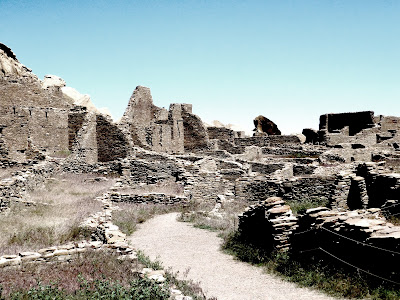
But hey, since we're on the topic of the Four Corners region, how about some pictures from my latest vacation??? We made a big counterclockwise loop, beginning with Chaco Culture National Historic Park, which lies at the end of thirty miles of rough washboard road.

Fajada Butte in Chaco Canyon. It's famous for the its "sun dagger"
petroglyph,
which appears to have been used by ancestral Puebloans to
mark the equinoxes and solstices. The site has shifted due to hordes of
people tramping
up there to see it, and is now closed to visitors. Another
casualty of the Cultural Uncertainty Principle.

A great kiva in the Casa Rinconada complex in Chaco Canyon. Nowadays it's
theorized that the canyon served as a kind of center for ceremony and trade.

A famous view in the Pueblo Bonito complex, the largest and most intricate
of the Great Houses in Chaco Canyon. It was inhabited for about 300 years
before being abandoned in the twelfth century.

I've read that Pueblo Bonito was carefully oriented according to the solar
cycle. You can get a better idea of the grandeur of the structure from this
aerial view.

Chaco Canyon at sunset, looking toward Pueblo Bonito from Pueblo del
Arroyo.

A reconstructed great kiva at the incorrectly named Aztec Ruins National
Historic Site, which lies between Chaco Canyon and Mesa Verde. This is
something like what the ruined kiva above might have resembled.

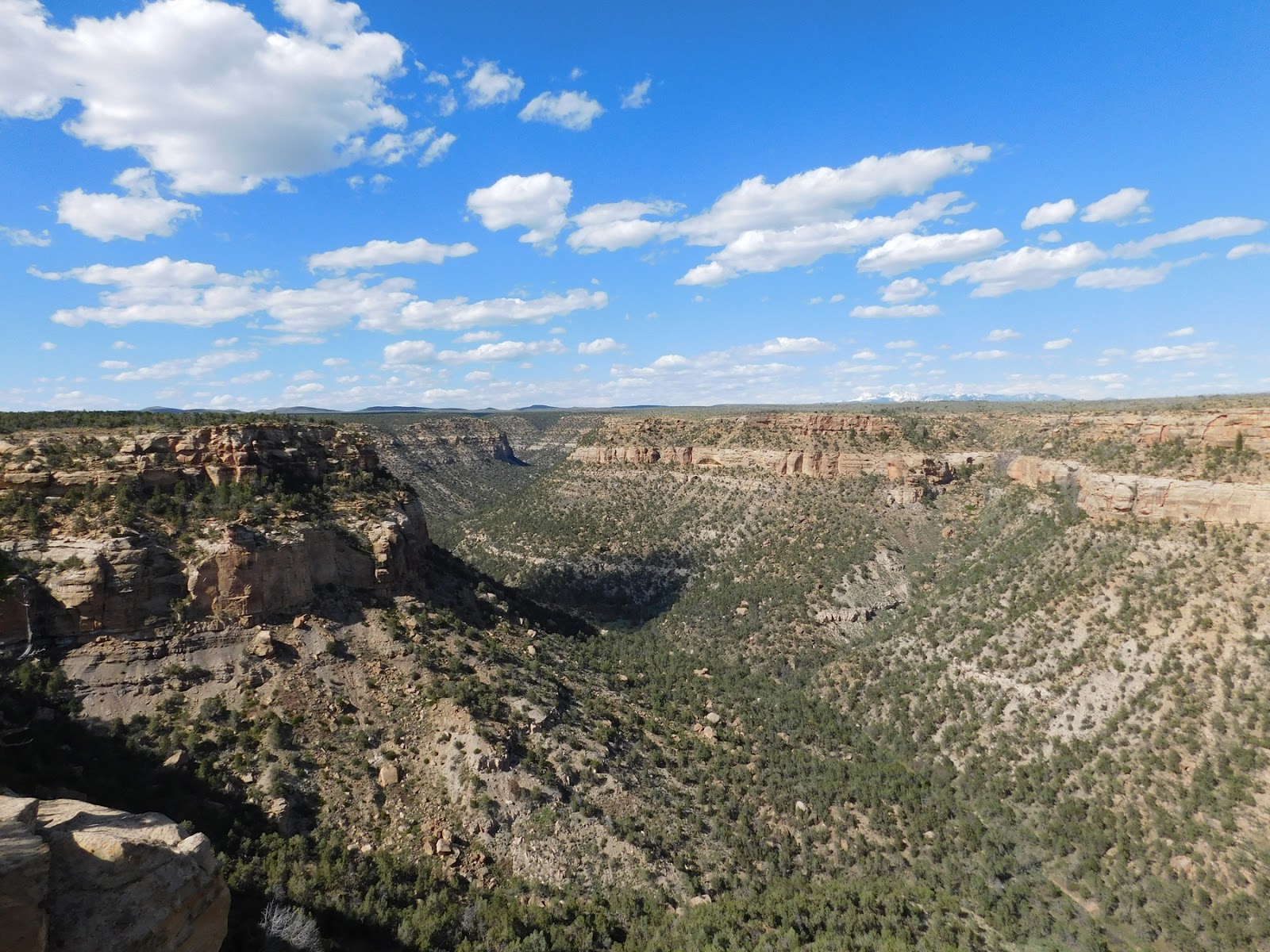
Mesa Verde from Balcony House. Though mostly famous for its cliff dwellings,
Mesa Verde is just as remarkable for its geology. It's a giant table of rock,
tilted toward the south, with immense cliffs along its western edge, where it
towers over the desert. From its highest point you can see Shiprock in New
Mexico.

Cliff Palace, the most famous of the cliff dwellings at Mesa Verde, abandoned
sometime before 1300.

Mesa Verde, looking south along Navajo Canyon.

Canyon de Chelly, which is in the Navajo Nation, in Arizona. The Navajo
still farm and herd at the bottom of the canyon, which is mostly closed
to visitors. The cliffs are sheer and tower 600 to 700 feet.

Spider Rock in Canyon de Chelly. The canyon was home to ancestral
Puebloans before the coming of the Navajo.

El Morro, a site frequented by travelers in northwestern New Mexico since
prehistoric times. Visitors came for the water, but left records of their passage
in the form of inscriptions on the walls. The ruins of a pueblo occupy the top,
and the Ancestral Puebloans left the earliest petroglyphs.

The waters of El Morro.

The oldest Spanish inscription, left by Juan de Oñate, conquistador and first
governor of New Mexico, in 1605. He's famous mostly for his massacre of
Acoma Pueblo, in which 800 Acoma were killed, and after which all male
prisoners over the age of twenty-five were sentenced to have their right foot
cut off.
Oñate was later banished from New Mexico and exiled from Mexico
City for his use of excessive force.

Modern pueblos I've visited include Taos, Santa Clara, San Ildefonso, Santo Domingo, Jemez, Zuñi, and Shongopavi (on the Hopi Reservation). The first and last mentioned are among the oldest continuously inhabited dwellings in the United States. Someone I talked to on the Hopi Reservation told me that, according to their traditions, their villages existed contemporaneously with the cliff dwellings at Mesa Verde, and that they absorbed some of the subsequent diaspora. Their kivas are square-shaped.

1 Nowadays the term ancestral Puebloan seems preferable to Anasazi, which is a Navajo term. The "disappearance" L'Amour talks so much about, and which was mentioned quite often when I toured the area in 1991, is now typically ascribed to migration. The modern pueblos are held to be at least partially descended from the "Anasazi" cultures, an explanation that seemingly wasn't taken seriously back then, but is now.

2 Actually, it's not too many times to count. I think it's eight.

3 Listen, everyone! Tour guides are not experts! I repeat, tour guides are not experts! They are friendly people who've memorized a number of facts and know how to answer silly questions while keeping tourists from climbing over things. That applies to most park rangers!

Friday, November 10, 2017

World Fantasy Convention 2017

I attended the World Fantasy Convention last week. It was held in San Antonio, my hometown, which I still live not too far from. I didn't stay at the hotel, being too cheap/poor, but fortunately a good old friend of mine had a spare bedroom to offer in the next town over. He was out of town most of the time, but me and his house rabbit (he has a house rabbit) kept each other company.

The convention got off to a bad start for me when, like the moron I am, I saw the picture of the Lila Cockrell Theater on the web page and just assumed, without further inquiry, that the convention was thereabouts, that is, somewhere on the grounds of the Henry B. Gonzalez Convention Center. (Henry B. Gonzalez himself once visited my Cub Scout meeting once when I was a kid. When he was leaving, I shouted, "See you later, navigator!", having just seen Flight of the Navigator. Not that you wanted to know that.) Despite not having much common sense, I know downtown S.A. pretty well, and drove straight there and parked and wandered around the empty, enormous, terrifyingly silent corridors of the convention center like Keftu in the Tower of Bel before I figured out my mistake. Why do I always do stupid things like that? I hated to waste my parking fee, so I walked all the way across downtown to where the convention actually was, passing along the way the spot outside the Gunter Hotel where my grandpa had his picture taken when he ran away from home as a teenager. It was Dia de los Muertos, too. By that time I was all steamed up, because November in Texas.

I went to the convention with pretty low expectations, not because I thought the programming would be lacking (and it wasn't), but because I know people go to these things to network, and I'm not exactly good at that. However, although I expected (dreaded) something like the various conferences I've attended in academia, I was pleasantly surprised. The format was similar, sure, but the atmosphere was completely different. Constructive and collaborative rather than competitive. There were lots of writers of various stripes, both obscure people like me and Big Names, people I've rubbed elbows with on the Internet, artists and illustrators, scholars, librarians, and knowledgeable readers. Not a bad mix.

Because I'm vain, the first high point was running into Adrian Simmons in the dealers' room, and seeing the new Heroic Fantasy Quarterly anthology for sale, with two awesome illustrations by Yours Truly, including the following depiction of a naked warrior astride a giant lamprey, which I could imagine gracing the Sistine Chapel ceiling, if Michelangelo had painted naked warriors sitting astride giant lampreys.

From "The Worship of the Lord of the Estuary" by James Frederick William Rowe.
Actually, I was going for a "fannish" look when I drew this, having enjoyed pictures from some of the old fanzines I've seen floating around the Web. I also picked up a copy of Skelos #3, which has a cool story by my friend Scott Cupp, who stopped by my art show in September and encouraged me to go to the convention; he also has a story in Issue 1, a fact I'd somehow overlooked before now. Small world. The Robert E. Howard Foundation had a table, too, with copies of the good new REH biography Blood and Thunder by Mark Finn, who was also at the convention.

Panel discussions I especially enjoyed included ones about keeping Texas weird (and it is a very, very weird place, and not in the ways you might think if you only know it from afar), westerns and fantasy (which touched on many of the themes that have come up in my Tashyas stories), pulp-era influences (before now, how many times in my life have I heard someone who wasn't myself refer to A. E. van Vogt? answer: none), the writings of Lord Dunsany (with three excellent readings by professional narrators), and, best of all, the secret history of the Hyborian Age (secret from L. Sprague de Camp, that is).

Looking back on the convention, I kind of see two sort-of distinct populations. One includes people who game a little, read things like Black Gate, Skelos, and HFQ, and think Robert E. Howard is a masterful writer and aren't afraid to say it. The other, well, I won't go into detail because I don't want to seem like I'm throwing rocks. I went to panels across the spectrum, though, and I found that in some I was like, what are you people even talking about? Actually, it was kind of surprising that there were so many sessions on things I dig. Is that always the case at these?

There were also some really good art talks, the best of which was Gregory Manchess's account of his own long career in illustrating. He went into detail on technique, which I really appreciated. He's recently written and illustrated his own book, Above the Timberline. Another panel featured Manchess and a few other writer-illustrators who are experimenting with telling their own stories instead of illustrating others'. That put a few ideas in my head...

In the dealers' room I picked up an old copy of Philip K. Dick's Now Wait For Last Year. I read it a long time ago and somehow lost my copy. It's not Dick's most well-known novel but it's always stuck with me. It's got a kind of slow sad haplessness that I like, and a stomach-churningly awful marital relationship, and a flatulent dimension-spanning world dictator fighting a grudge-match against stuck-up humans from another solar system. A good book for bad times. I spent a lot of my free time reading it.

All in all I'm definitely glad I went. Let's end on a high note, with my other HFQ illustration (apologies to Gustave Dore).

From "Crown of Sorrows" by Sean Patrick Kelley