Showing posts with label rtvf. Show all posts

Monday, April 30, 2018

Ash Indomitable

What did I do to get dropped into this sad alternate universe in which people apparently prefer interminable shambling zombie soap operas to the exploits of a chainsaw-armed, boomstick-toting deplorable from Michigan who battles Deadites all the way from the medieval past to the post-apocalyptic future?

In other words, I just finished Season 3 of Ash vs Evil Dead, which concludes with – I tell you, you wouldn't even believe it! only to find that the show has been cancelled, and that Bruce Campbell has decided to hang up his boomstick…forever.

So here I sit, all alone, while the rest of the world eagerly debates post-credits scenes and wonders what Robert Downey Jr. and Friends will do with their next billion dollars in the search for Infinity Whatsits, and possibly the most glorious slingshot ending in the history of humanity remains a tantalizing, unanswered what-if.

I mean, geez, the show was scary, gory, disgusting, offensive, hilarious – everything a decent show should be – but, on top of all of that, it was kind of inspiring in a weird way, and even – dare I say it? – touching. In that face-meltingly awesome final episode, Ash, the lovable idiot feared by hordes of evil demons, actually…grows a little bit. I don't know. Maybe, in the divine scheme of things, that meant it really was the End. And that's to say nothing of the fact that he actually gave up his own life, descended to hell, released souls from bondage, and ascended on high to sit on his own throne as the "prophesized" savior of humanity. Where do you go from epic closure in the mythos of summer? Narratively speaking, I mean.

Oh, who am I kidding? There are plenty of places to go from there, and the world is a lesser place because we don't get to see them.

Well, at least we can say this. We got fifteen hours of unadulterated awesomeness that the world simply did not deserve. Plus, the show was made by people who care about their fans, and they made sure to bring the story to an emotionally satisfying if sadly truncated conclusion. Maybe in the long run it will be better this way. Maybe I'll find my way into that alternate timeline where Evil Dead Beyond Thunderdome: Ash vs the Army of Dark Ones is a thing. For now, though, I'm just a little sad to see El Jefe ride off into the sunset, and to bid Pablo and Kelly a fond farewell. (Although, to do them justice, "Pablo" and "Kelly" are having none of it.)

I'll always remember you, Ash. Not for what you were, but for what you've become. You've completed your journey from zero to hero. You've become a king by your own hand. And you know what? If, at this point in my life, I do get back up, and continue to fight for what's right no matter what crazy s**t may happen to me, and go on living as though I have a destiny to fulfill even though 100% of the world around me thinks I'm an idiot, it will, in some part, be thanks to Ash vs Evil Dead. Crazy, isn't it?

Hail to the King, Baby.

Yes, that's a tank. We live in a world in which a show about
Ash battling giant demons with a tank wasn't renewed.

Friday, May 5, 2017

Ashes to Ashes

Today I'd like to talk about a man. We all know who he is. Some think of him as a great man; none more so than himself. He is, in many ways, the man for our times. True, he's not the most intelligent person. He's not the most emotionally mature. Most of his injuries are self-inflicted. He's apt to say whatever comes into his head, and his decisions reflect an extreme lack of forethought. His words and actions are frequently reprehensible, sometimes even disgusting. He's a bit of a racist, a bit of a xenophobe, a bit of a sexist. He thinks very highly of his attractiveness to women of all ages, and feels welcome to take what he wants when he sees it. Still, time and again, he's proven his detractors wrong. He's proven that he does have it in him to be a winner.

This is Donald Trump, the President of the United States.
He is not the subject of this post.

Saturday, October 22, 2016

The Incredible Shrinking Man

I recently watched (for the second time, I think) The Incredible Shrinking Man (1957). The screenplay is by Richard Matheson, the writer to whom we owe the novel upon which it is based, as well as I Am Legend (1954), Hell House (1971), and What Dreams May Come (1978). Amazingly, he also wrote the screenplays for that best of Poe adaptations, The Pit and the Pendulum (1961), as well as two other Roger Corman productions, namely, the memorable but somewhat inferior House of Usher (1960), and the ridiculous but entertaining The Raven (1963); he wrote the famous Twilight Zone episode "Nightmare at 20,000 Feet"; the Star Trek episode "The Enemy Within"; The Legend of Hell House (1973), which I talked about earlier this year; the made-for-TV movie Trilogy of Terror (1975), whose little doll continues to pursue me through my worst nightmares; and numerous other things.

Anyway, The Incredible Shrinking Man. It's one profound movie. An ordinary man starts shrinking, more or less inexplicably, becoming a tiny bit smaller each day. He undergoes humiliation, alienation, and, finally, cosmic isolation. His resentment becomes tyrannical petulance, then terror, then utter loneliness. His white-collar insecurities gradually crumble before Pascal's fear of the eternal silence of the infinite spaces. In the last act, the basement-hell to which he finds himself consigned stretches before him like an alien landscape in which he must fight like an insect to survive. More so even than the protagonist of I Am Legend, he finds himself marooned in an inimical new universe. He triumphs over the spider, only to go on shrinking smaller, and smaller still.

But despair turns to acceptance and finally hope. The film ends in epiphany, as the protagonist wanders out through the grating, looking up at the stars, soliloquizing, as the viewer receives flashes of distant galaxies:
I was continuing to shrink, to become... what? The infinitesimal? What was I? Still a human being? Or was I the man of the future? If there were other bursts of radiation, other clouds drifting across seas and continents, would other beings follow me into this vast new world? So close – the infinitesimal and the infinite. But suddenly, I knew they were really the two ends of the same concept. The unbelievably small and the unbelievably vast eventually meet – like the closing of a gigantic circle. I looked up, as if somehow I would grasp the heavens. The universe, worlds beyond number, God's silver tapestry spread across the night. And in that moment, I knew the answer to the riddle of the infinite. I had thought in terms of man's own limited dimension. I had presumed upon nature. That existence begins and ends in man's conception, not nature's. And I felt my body dwindling, melting, becoming nothing. My fears melted away. And in their place came acceptance. All this vast majesty of creation, it had to mean something. And then I meant something, too. Yes, smaller than the smallest, I meant something, too. To God, there is no zero. I still exist!
Profound words, but merely quoting them fails to convey the feeling they give me when I watch the movie. It really brings tears to my eyes, because it captures so well what has tormented me all my life. That is, the terror of the senseless cosmos.

What people miss when they talk about how insignificant man is in the universe is the fact that man is also gigantic. The truth is, man hangs suspended between two extremes, the infinite and the infinitesimal, a fact that the mathematician-philosopher Blaise Pascal, mentioned above, wrote about at some length:
Let man [...] contemplate the whole of nature in her full and grand majesty, and turn his vision from the low objects which surround him. Let him gaze on that brilliant light, set like an eternal lamp to illumine the universe; let the earth appear to him a point in comparison with the vast circle described by the sun; and let him wonder at the fact that this vast circle is itself but a very fine point in comparison with that described by the stars in their revolution round the firmament. But if our view be arrested there, let our imagination pass beyond; it will sooner exhaust the power of conception than nature that of supplying material for conception. The whole visible world is only an imperceptible atom in the ample bosom of nature. No idea approaches it. We may enlarge our conceptions beyond all imaginable space; we only produce atoms in comparison with the reality of things... 
Returning to himself, let man consider what he is in comparison with all existence; let him regard himself as lost in this remote corner of nature... What is a man in the Infinite? 
But to show him another prodigy equally astonishing, let him examine the most delicate things he knows. Let a mite be given him, with its minute body and parts incomparably more minute, limbs with their joints, veins in the limbs, blood in the veins, humours in the blood, drops in the humours, vapours in the drops. Dividing these last things again, let him exhaust his powers of conception, and let the last object at which he can arrive be now that of our discourse. Perhaps he will think that here is the smallest point in nature. I will let him see therein a new abyss. I will paint for him not only the visible universe, but all that he can conceive of nature's immensity in the womb of this abridged atom. [...] Let him lose himself in wonders as amazing in their littleness as the others in their vastness. For who will not be astounded at the fact that our body, which a little while ago was imperceptible in the universe, itself imperceptible in the bosom of the whole, is now a colossus, a world, or rather a whole, in respect of the nothingness which we cannot reach? He who regards himself in this light will be afraid of himself, and observing himself sustained in the body given him by nature between those two abysses of the Infinite and Nothing, will tremble at the sight of these marvels; and I think that, as his curiosity changes into admiration, he will be more disposed to contemplate them in silence than to examine them with presumption. 
For in fact what is man in nature? A Nothing in comparison with the Infinite, an All in comparison with the Nothing, a mean between nothing and everything. Since he is infinitely removed from comprehending the extremes, the end of things and their beginning are hopelessly hidden from him in an impenetrable secret, he is equally incapable of seeing the Nothing from which he was made, and the Infinite in which he is swallowed up. [Pensées 72]
So you see, the universe is considerably more terrifying than your rather unimaginative New Atheist types generally realize. The Incredible Shrinking Man is a profound exploration of that terror, and a moving attempt to answer it. But it's also a gripping film apart from its philosophical implications, with wonderful sets and meticulous attention to detail in its depiction of the protagonist's rapidly growing world. And the battle with the giant spider toward the end is very cool.

Truly one of the great science fiction films of all time.

Saturday, October 15, 2016

Yet More Hauntings

Our leisurely ramble through the haunted houses of yesterday and today continues! Previous posts on the subject include:

The Haunting of Hill House


First, I've finally gotten around to reading Shirley Jackson's The Haunting of Hill House. I was deeply impressed with the Robert Wise film, which I discussed here earlier this year, and had been meaning to read the book ever since. The film is, for me, the definitive haunted house movie; but now that I've read the book, I can offer the movie no greater compliment than to say that it faithfully and sensitively represents the spirit of the book, which is easily one of the best things I've ever read.

It's not so much a ghost story as a bad place story, which I'm beginning to think is really what a good haunted house story is all about.
"You will recall," the doctor began, "the houses described in Leviticus as 'leprous,' tsaraas, or Homer's phrase for the underworld, aidao domos, the house of Hades; I need not remind you, I think, that the concept of certain houses as unclean or forbidden – perhaps sacred – is as old as the mind of man. Certainly there are spots which inevitably attach to themselves an atmosphere of holiness and goodness; it might not then be too fanciful to say that some houses are born bad. Hill House, for whatever the cause, has been unfit for human habitation for upwards of twenty years. What it was like before then; whether its personality was molded by the people who lived here, or the things they did, or whether it was evil from its start are all questions I cannot answer. Naturally I hope that we will all know a good deal more about Hill House before we leave. No one knows, even, why some houses are called haunted."
There are various supernatural occurrences, though their ultimate cause is left unsettlingly ambiguous. The house's geometry is disturbing, misanthropic, hateful. It was designed by a sick, demented man. But what's truly terrifying is that the house is itself a monstrous and voracious organism. It's never made clear what order of "intelligence" (which is too anthropocentric a term) the house represents, however.
No live organism can continue for long to exist sanely under conditions of absolute reality; even larks and katydids are supposed, by some, to dream. Hill House, not sane, stood by itself against its hills, holding darkness within; it had stood so for eighty years and might stand for eighty more. Within, walls continued upright, bricks met neatly, floors were firm, and doors were sensibly shut; silence lay steadily against the wood and stone of Hill House, and whatever walked there, walked alone.
Jackson's supreme mastery of style is exhibited most surely in her ability to convince you that, whatever is going on, it's much more worse than you imagine. A classic haunted house story, paranormal investigator and all; a delicate, sensitive exploration of a repressed soul; a humorous satire of heavy-handed spiritualism; a bone-freezing read for the small hours of the morning: The Haunting of Hill House is all these and more.

The Shining


If a good haunted house story is one that uses subtle brushes of style to build up an ineffable atmosphere of dread, an atmosphere that clumsy delineations and explanations would tear to shreds, then Stephen King can safely be said never to have written a good haunted house story. Still, The Shining is clearly a good story; the laws of inference therefore indicate that The Shining is not principally a haunted house story.

For me, it's really the story of a father and husband destroyed by his own small-mindedness and inner demons. There are a few creepy moments, but King simply doesn't know how not to explain every supernatural occurrence in precise detail by the end. That's okay, I think. The truly disturbing events are those that occur entirely within Jack's sane mind, when he soliloquizes on his own life and doggedly lies to himself about who he is and what he has done. The ghosts' making him into a monster is merely a reflection of what he had done to himself and his vision of reality, freely and willingly, before ever setting foot in the Overlook Hotel. As a father and husband with his own inner compromises, I found that it all hit a little close to home. It got under my skin, which, I suppose, is what a good novel does.

It had been a long, long time since I'd read any Stephen King. Like Fletcher Vredenburgh, I got into him when I was in junior high; I read The Stand first, I think, and then moved on to various other things, such as Carrie, Misery, The Eye of the Dragon, The Dark Half, and The Dead Zone. I recall being unimpressed with King's portrayal of good and evil, his plot resolutions (in his longer novels), and his frequent conflation of seaminess with wickedness. He has a way of reducing people to ugly, brutal caricatures, and at the time I found it so dehumanizing that I eventually decided – as a fourteen-year-old! – to leave it aside for a future date. Well, I suppose that date has now come.

I find myself kind of wanting to read Dr. Sleep now. If it shows up at the county library, I just might! I've also been wanting to read his Dark Tower books for some time. A buddy of mine has them, so that's probably next on my list.

The Shining


Of course, I haven't been looking for haunted houses in books alone. For years I've been meaning to watch Kubrick's version of King's novel, and for years I've refrained from it, as I wanted to read the book first. Somehow I managed to hold out all this time, despite being a great admirer of Kubrick's other films, and despite somehow becoming aware of the entire plot, down to numerous scenes, by subconsciously absorbing it from the universal cultural Id.

I can see why King doesn't like Kubrick's vision. It is, nevertheless, sublime. The members of the Torrance family are reduced to opaque archetypes enacting some kind of horribly eternal play in a snowbound universe that they alone inhabit, out of space, out of time. It reminds me of 2001: A Space Odyssey more than any of Kubrick's other films. It also makes me think of Ingmar Bergman's surreal horror film, Hour of the Wolf, and Tarkovsky's Solaris.

Perhaps the less I say about The Shining, the better. If you're looking for a psychological thriller, a scary ghost story, or a point-by-point adaptation of a King novel, you'll probably be disappointed. If you're looking for a quiet, unsettling island universe existing unto itself and violating conventions of time and space like a cosmic M. C. Escher design, you've come to the right place, my friend.

The Conjuring 2


I suppose I should mention this one, too. Yes, I watched it, and, yes, I thought it was okay, though not quite so good as the first one, which I also thought was okay but not great. This one committed the exact same errors as the first installment, but more so, and with fewer memorable scenes (like that clap scene, brrr). It's genuinely scary, with good production values, an intelligent script, a realistic texture, and an ending that's actually kind of positive and inspiring. Oh, and toys. Creepy, creepy toys. (What is it with creepy toys these days? The real Annabelle was a Raggedy Ann doll.) Anyway, it's a good Halloween movie, but nothing to compare with The Haunting or The Shining.

This is neither here nor there, but the aftermath scenes in both Conjuring movies make me think of the little picnics and gatherings they always ended stories with on Rescue 911.

Local Hauntings


A couple weeks ago I discussed The Haunting of Hill House with a friend of mine, a psychology professor. He told me of a house in town that he'd been told is haunted. Bad things happen to people who live there, he said, and no one stays there long. This is all hearsay. But it's up the street from where we both live, so I went to check it out on the way home from work. It's a small, rather run-down one-story house with an oddly convoluted floor plan. Is it haunted? Hard to tell from my pick-up truck.

My own house, which was built around 1901 and actually bears some resemblance to the house in the first Conjuring movie, has a filled-in well in the back corner of the lot. The spot is visible merely as a pit of soft earth. I've always found it a bit unsettling.

There's a small pioneer cemetery at the end of the block, within sight of our upstairs windows, inhabited mainly by nineteenth-century casualties of arrow wounds and bullet holes. I've been told, however, that there are graves sprinkled here and there around the entire block...

Speaking of arrow holes, my best friend from the town where I grew up, a few towns over from where I now live, has an ancestral family member who was killed by arrows...and his family still has the shirt. It's a white shirt with little bloody arrow holes. His grandmother, who was born in the nineteenth century and lived to be well over one hundred, resided practically next door to us, and one day I was taken into a small, slightly stuffy back room of her house to see the family artifacts. Old photographs stared down on us from the walls. That was an unsettling place.

Last But Not Least


In conclusion, while we're on the subject of paranormal investigators and creepy things, I'd like to mention that John Linwood Grant of greydogtales fame, together with Sam Gafford and Travis Neisler, are starting up a quarterly print (print? yes, print!) magazine called Occult Detective Quarterly, a revival of the kinds of stories that feature William Hope Hodgson's Carnacki and his various relatives and descendants. You can check out their Kickstarter campaign here.

Thursday, October 6, 2016

Release the Kraken! Eighties Fantasy Schlock

A while back I wrote about the dearth of true fantasy in film. At the time, I was searching for a Tolkienistic sense of Recovery, for mythopoeic wholeness translated into cinema, which might or might not involve what are typically thought of as fantastic elements. At least, that's what I think I was looking for. I'm still not quite sure.

What my search necessarily left by the wayside, of course, was the golden age of fantasy schlock: the 1980s. But not because I'm not fond of it! And certainly not because I'm not familiar with it. After all, it's what I grew up watching. When I went to the tiny video rental place up the street, with its tinted windows and brown shag carpet and rows of little cardboard circles hanging on hooks, I almost always walked away with a fantasy movie, usually one I'd already rented multiple times. And I never failed to watch them when they came on the local UHF station, either.

But, fond though I am of it, eighties fantasy isn't what you'd call fine cinema. Most entries fall into the category of cult favorites, which, as far as I can tell, means that they're too hokey or peculiar to be universally popular, but remain likeable in some weird way nonetheless. To watch them now, you have to be willing to take them as they are, stiff acting, laughable dialogue, synthesizer score, and all. For a while I found them unwatchable, but, now that the patina of age is settling in, they seem more like primitive insects preserved in amber. They've acquired the distinctive beauty that only the passage of years can give. In fact, it's only in hindsight that I've come to regard eighties fantasy as a thing in and of itself. I would go so far as to claim that it forms its own time-bound genre, like the film noir of the forties and fifties, that can be harked back to but never truly replicated.

I suppose the birth of the genre (if we can call it that) was sparked by the success of Star Wars, as well as the rise of fantasy as a commercial literary genre. It's hard to draw a hard line between kids' fare and films aimed at adults; it also bleeds at its periphery into science fiction and horror. The major entries (in my book, at least) include:
  • Star Wars (1977)
  • The Empire Strikes Back (1980)
  • Flash Gordon (1980)
  • Excalibur (1981)
  • Dragonslayer (1981)
  • Clash of the Titans (1981)
  • Time Bandits (1981)
  • Conan the Barbarian (1982)
  • The Beastmaster (1982)
  • The Dark Crystal (1982)
  • The Return of the Jedi (1983)
  • Krull (1983)
  • Conan the Destroyer (1984)
  • Sword of the Valiant (1984)
  • The Neverending Story (1984)
  • Red Sonja (1985)
  • Legend (1985)
  • Ladyhawke (1985)
  • Brazil (1985)
  • Labyrinth (1986)
  • The Princess Bride (1987)
  • Willow (1988)
and, too late to be in the eighties but still clearly belonging with the rest,
  • Bram Stoker's Dracula (1992)
Stop-motion animation and practical effects like puppetry, models, and matte paintings reached heights of realism never before attained. It seemed like the sky would soon be the limit. And then, just like that, digital effects swept away everything else, and, with a couple exceptions, fantasy disappeared from the big screen until the rise of the turgid big-budget multi-volume epics of the naughts. It has always deeply frustrated me that George Lucas felt the need to digitize the original Star Wars trilogy. He turned the pinnacle of the eighties fantasy period into a patched-together Frankenstein monster, in which we're forced to watch a sideburned Harrison Ford chatting with a digital Jabba the Hutt, a shaggy Mark Hamill piloting a slick computerized X-wing. Like an aging actor who's gone in for extreme plastic surgery, Star Wars has merely lost what made it truly itself, visually at least.

Fortunately, the other entries on my list don't face that kind of temptation. They still smell of the dim, stuffy video rental place. A few have aged very well. Most might be described as flawed gems. And a few are indisputably terrible, but irreplaceable nonetheless. Clash of the Titans (which I've seen too many times to count) is, despite being Ray Harryhausen's swan song, quite awful in the special effects department, and further marred by horrendous acting, a ludicrous plot, and unintentionally hilarious dialogue. But can it be denied that it has a canonical place in pop culture? Does anyone need to be told what "Release the Kraken!" comes from?

For me, many of these movies derive considerable charm from their trashy / awesome pop soundtracks. The most memorable is undoubtedly Flash Gordon, with music composed and performed by Queen ("Flash! Ahh-ahhhh!"), but the Neverending Story song is up there, too as are the Tangerine Dream soundtrack for Legend, and the delightful (and slightly unsettling) performance David Bowie gives as the singing, dancing goblin king in Labyrinth.

I wrote all this after watching Krull the other night with my kids. I find it emblematic of the era. It has many good points. It's stunningly beautiful. It features a rousing score by James Horner, a beautiful princess (whatever happened to beautiful movie princesses?), battles with lasers and swords, a cyclops, truly awesome stop-motion creatures, and big, weird, surrealistic sets. The plot is...okay. It's not bad. But the script. And the acting. Even Liam Neeson (in an early role) is bad. I blame it on the director.

But, so, there you go. Cult material. It's a movie you can be fond of. It's a movie you could watch a bunch of times, unlike a lot of supposedly "great" movies. It's just not a movie you can really defend as good. That's eighties fantasy all over. It may not be cinematic mythopoeia, but I like it.

Now what does this remind me of?

Sunday, September 4, 2016

Animated Princesses

My family is not what you'd call up-to-date. We don't watch television. We do watch movies together, but it tends to be older stuff. We're not entirely out of pop culture, but at best we're usually a couple of years behind.

A big giant movie like Frozen comes and goes, and it's not even a blip on our radar. I see news stories about "viral videos" of people dressed like these two big-eyed girls singing some song called "Let it Go," and kind of scratch my head, and move on to another Mental Floss video, or maybe watch Mothra vs. Godzilla with my daughter.

But well-meaning adults tend to assume that Disney movies are some kind of universal touchstone that you can use to gain instant rapport with any child. Alas, that doesn't work with mine. They'll change the subject to the giant black leeches on The African Queen.

A friend recently gave my daughter, who's six, a shirt with the two princesses from Frozen. She wore it somewhat tentatively, but stated every time she did so that she felt awkward wearing a shirt for a movie she hadn't seen. Eventually she requested to watch it, telling us that she wanted to decide whether she liked it. So my wife rented it for the kids on a rainy day when I was away at something.

For several days afterward my daughter refused to say what she thought of it. She evaded the question when asked. It was plain that she was deep in assessment. At last, however, she dispassionately declared that she didn't like it, that she wouldn't be wearing the shirt in the future, and that in fact she wanted to place the shirt in our next yard sale. But she still wouldn't explain why she disliked it. After several weeks, however, I asked her again while we were alone, and she told me, somewhat exasperatedly: "Of course I didn't like it because it has too much love."

Now, I can't say whether my daughter's assessment is fair or accurate, because I haven't seen the movie. But my kids tend not to like any Disney/Pixar fare, and I can't say I blame them. They're all so bland, so repetitive, so perfectly smooth and rounded. My attention just slips right off them.

In the past several weeks, however, two animated movies have come to the rescue to prove to my kids that not all cartoons are meh: The Last Unicorn and Nausicaä of the Valley of the Wind. They're both so well known in certain circles that anyone reading this has probably seen them, but I'm going to talk about them anyway.

Visually, both are products of Japanese animation. The Last Unicorn (1982) was produced by Rankin/Bass, of whose stop-motion Rudolph fantasies I'm rather fond. The screenplay is by Peter S. Beagle, the author of the novel, and it has excellent voice acting. I would describe it enchanting, sad, and whimsical in equal parts. My children were struck with its beauty from the first few frames. They told my wife afterward that it was "a cartoon but not really a cartoon because most of it is painted." I'm not sure exactly what they meant by this, but I think they were just struck by the freshness of its hand-drawn, hand-painted animation as opposed to the slick computer-generated stuff they've seen in more recent movies.

Flaming demon bulls and vicious harpy attacks don't faze my kids, incidentally, but there's one scene I don't quite understand, and wish hadn't been handled as it was in the film: the one involving the, er, tree. If you've seen the movie, you know what I mean. What were they thinking?

On the other hand, Nausicaä (1984), directed by the great Hayao Miyazaki and based on the manga by the same, is just about the most terrific animated film I've ever seen. I've watched it twice now in a single week, and I think I'm in love with it. How could I not have seen it sooner? High-speed battles between giant airships. Ruined cities. Monstrous biomechanical warriors. Ancient disasters. Jungles of poisonous fungi. Ceramic blades. Gigantic, intelligent insects. Swords and tanks together.

Most of all, a brave, kind, intelligent, resourceful, independent female protagonist. I mean, she's a princess who actually acts like one, as opposed to, say, an entitled tween with indulgent parents. She single-handedly brightened my daughter's dim view of the breed. The main themes – peace, harmony with nature, self-sacrifice – are straightforward enough for a child to grasp, but movingly and profoundly presented.

And it's all done in the loveliest animation I may have ever seen, accompanied by a delightful score that's sometimes enchanting, sometimes almost religious, and sometimes pop, Plus, the English-dubbed version features the voice talents of actors like Patrick Stewart, Edward James Olmos, and Uma Thurman.

Oh, yeah, and my kids liked it, too. Tonight, after watching it for the first time, my eight-year-old son said, "That's the best cartoon movie I've ever seen."

 I'm definitely going to be reading the manga sometime soon.

Thursday, August 25, 2016

Two More Hauntings, and a Madhouse

My search for haunted house movies continues. I saw a very good one recently: Burnt Offerings (1976), starring Karen Black and Oliver Reed. As it began I resigned myself to poorly lit, foggy-lensed, muffled-sounding, ill-carpeted seventies schlock, but I very quickly got into it. It's underrated and, I think, quite good.

I'll not reveal much about the plot, except to emphasize that it's not a ghost story. The house itself is a character, as it is in the best movies of this kind, from The Haunting to Crimson Peak. It's not enough (and may be a great deal too much) to have creepy carved newels. The Haunting does amazing things with the illusory faces you seem to see in patterns on the wall at night. Burnt Offerings seems to rely mainly on an attic window that stays lit a lurid red at night. It was shot at the Dunsmuir House, where a number of movies have been filmed. There's a pool, unfortunately, but it's used to good effect.

I'm familiar with Karen Black mainly from Trilogy of Terror. That little doll has lived in my nightmares since I saw it as a fourteen-year-old. I thought Black was quite effective in Burnt Offerings, especially in the final moments, which I saw coming from a mile away, but was still genuinely scared by. That's what a good haunting story does well. It lets you in on the secret pretty much right from the get-go, but toys with you, taunting you until just the right pitch of suspense has been reached. Timing is everything.

And there's this chauffeur. With shades. Sometimes he smiles. It's terrifying. And a mysterious locked room that no one can ever go into. That right there is the stuff of bad dreams. In fact, put a sealed room in pretty much any kind of movie, and you've got a ho

All in all, the movie has a weird kind of logic that reminds me of the nightmares I had when I was a little kid. Like the one about the picture in the yellow living room that silently wanted me to go get a candy from the candy dish. Ugh. Everything is out to get you, the movie seems to say. It's watching you. What is watching you? Who knows? But it watches. The world is sunny. It smiles. It smiles at you.

Though marred by one or two cheesy scenes, this is a good movie that I won't soon forget.

*

And then there's The House that Dripped Blood (1971), one of those horror anthologies released by Amicus Productions. As a haunted house movie it's terrible. The stories, though taking place in the same house, are all quite different, and have nothing at all to do with the setting, except for one or two ominous references shoehorned into the script. Contrary to the advertising, the house doesn't drip blood, and as a matter of fact I don't think there's one drop of blood in the whole production. And it's got vampires, even. What a waste of a good set! A rather nice and creepy little house, murky and slightly run down and with just the right amount of ornament.

Still, it seems a bit churlish to grouse about a movie starring both Peter Cushing and Christopher Lee. Two of the shorts are fairly creepy, one involving waxworks and the other a little witch-girl, and a third is mildly amusing. All were written by Robert Bloch. As a whole the film would have been better if it hadn't been so painfully awkward about linking the stories to the house.

So, as a schlocky horror movie, thumbs moderately up, but as a haunted house movie, thumbs down.

*

I also happened to watch Asylum (1972), another Amicus anthology written by Robert Bloch, and it's much better. Humorously campy at some points, genuinely scary at others, and delightfully bizarre (or gross! – like that little robot's guts!) at still others. In addition to Peter Cushing, it stars Herbert Lom, an actor I'm fond of. Not a haunted house movie, though.

Monday, July 25, 2016

On Reptoids from Alpha Draconis

In keeping with my time-honored tradition of writing a blog post whenever I encounter a network of ideas connected in any way, shape, or form with speculative fiction, but also in keeping with my equally time-honored tradition of not commenting on current affairs, I hereby commence a post about

THE REPTOIDS AMONG US


without explaining what, precisely, has motivated me to pursue this particular avenue of discovery.

I will tell you what set me upon the path, however.

One day at the office, whilst devouring the salami sandwich, granola bar, and green apple that constitute my lunch, I happened to watch a Mental Floss YouTube video about weird conspiracy theories. Among the factoids presented therein is the assertion that 12 million Americans believe that shape-shifting lizard people secretly hold the reins of world government. This is according to Public Policy Polling.

Now, if a survey company called me to ask whether I believe shape-shifting lizard people are in control of the government, I would respond with an enthusiastic YES, YES, I DO STRONGLY BELIEVE THAT. And surely I'm not alone in my love of trolling the strangers who call my house to ask stupid questions. So, perhaps the number is a little misleading. Still, there must be some truly devout lizard-people believers, right? A little googling (not for the faint of heart in this case) would seem to confirm that, yes, there are some believers out there.

The leading proponent is one David Icke, British ex-footballer and conspiracy theorist. He asserts that reptilians (or reptoids, as I prefer to call them) from Alpha Draconis have been selectively breeding the human race since its inception, creating the Babylonian Brotherhood, a hybrid race of Illuminati who now control the world. He suggests that the aliens first came to earth in search of monatomic gold, which enhances the capacity of their nervous systems ten thousandfold.

Hm. A race of superintelligent extraterrestrials who inhabited earth long before man's coming and now treat the human race as a pet project and secretly orchestrate events from behind the scenes? Remind you of anything? Here we have the connection with my blog's purported focus. It has been suggested that the Reptoid Hypothesis owes a large debt to the writings of H. P. Lovecraft, Robert E. Howard, and Clark Ashton Smith; they, in their turn, took much of their material from nineteenth-century theosophical writings on Atlantis and Lemuria.

The idea that disguised aliens secretly control everything of course puts me in mind of John Carpenter's They Live (1988). I love eighties sci-fi actioners, and They Live is one of the most enjoyable. The screenplay was written by Carpenter under the pseudonym Frank Armitage, an allusion to Dr. Henry Armitage of "The Dunwich Horror." Like most Carpenter assays, They Live has a B-movie feel, but it's also hilarious, sharply satirical, and eerily contemporary. It takes place in a not-so-distant future when the middle class is being squeezed out of existence, the underemployed live in shantytowns on vacant lots, racial discord and police brutality are on the rise, and a media-induced malaise seems to have overcome the human race. One day, a down-and-outer (played by pro wrestler Rowdy Roddy Piper) discovers a pair of cheap-looking sunglasses that let him see a whole new reality. Turns out the rich and powerful are all aliens or people who have sold out to the aliens. This leads to one of the greatest and cheesiest one-liners in action sci-fi history: "I have come here to chew bubblegum and kick ass...and I'm all out of bubblegum."

Now, it's one of my little pleasures in life to post extremely weird links and opaque commentary on Facebook to see if my aunts, cousins, in-laws, coworkers, and high school friends will think I've gone off my rocker. (I used to go in for politics, but eventually you learn what everybody is going to say, so why bother?) So I recently posted the above picture of George W. Bush, Tony Blair, and Queen Elizabeth II as reptoids. Imagine my surprise when, immediately afterward, the "people also posted" thing popped up with three stories about...Donald Trump.

Let me pause here to assure whomever might be reading this that I, for one, welcome our new reptilian overlords.

Now, what's interesting to me about They Live (which is awesome and you should watch soon if you haven't yet) is that it appeared shortly before David Icke began his career as New Age prophet. Was it an influence on his ideas? Icke is also supposed to have been influenced by 1940s non-fiction writer Mark Doreal, who took some of his ideas from Robert E. Howard. So apparently there's been a strange cross-fertilization between weird horror and cranky fringe conspiracy theories. Each influences the other; both grow together.

For all that, though, there's a distinct psychological line between the weird horror fan and the wild-eyed conspiracy theorist. For the former, there's a big element of play, of fun. The latter is in deadly earnest. I would even assert that the fan is the unlikeliest person to go down that rabbit hole. They're inoculated by their sense of humor.

But what does make someone start thinking that the celebrities and politicians they see on TV and in the news are all reptoids in disguise? That, I'm afraid, is a question above my pay grade, so I'll just conclude with a word from our sponsor:


ADDENDUM: D'oh! While writing this, I forgot to mention another ridiculous eighties movie making use of the same idea: the inimitable The Adventures of Buckaroo Banzai Across the 8th Dimension (1984), which pits humans and Black Lectroids against the evil Red Lectroids of Planet 10. Less pointed, much weirder, with an awesome cast. I'll have to start reviewing fantasy and sci-fi schlock from the eighties sometime soon.

Tuesday, July 12, 2016

D.O.A.

I can breathe and I can move, but I'm not alive because I took that poison, and nothing can save me.
I watch a lot of film noir. To some people, the term means trenchcoated detectives, laconic voiceovers, femmes fatales, and cigarette smoke. I think of it more as a directorial style, a style that uses harshly geometric, minimalistic (= dark) photography and unpityingly logical plots taking place beyond the boundaries of "normal" society to create an atmosphere of emotional detachment and alienation. Yes, chain-smoking dicks and dames figure largely in such films, but that's because the world they inhabit lends itself so readily to the style. Some of my favorite films noir don't involve detectives at all.

That includes D.O.A., a film that wasn't appreciated at the time of its release (1950) and isn't very well known today. It's in the public domain, and you can watch it at the Internet Archive, which no doubt has to do with its obscurity. Edmund O'Brien plays Frank Bigelow, an accountant and notary public who, months prior to the opening, notarized a seemingly innocuous transaction, a chance happening that sends him down a black rabbit-hole of madness and murder. Most films noir have a certain sense of predestination, but this one takes it a step further: it's narrated by a dead man.

Grim humor and dark irony punctuate Bigelow's nightmare urban odyssey. In confronting his nonsensical, undignified position (the human position), he seizes control of his destiny, loses all fear, and achieves a kind of justice, only to keel over in the film's final minutes. One of the last lines is the homicide captain's dispassionate "Call the morgue!"

D.O.A. has some corny elements toward the beginning, as many films noir do, but rapidly descends into darkness, madness, sweat, and grit. I appreciate it a little more every time I watch it. It also has an almost science-fictional feel, with a search for stolen iridium and a "luminous toxin" that glows in the dark. And it must have one of the best openings of any movie ever:
Bigelow: I want to report a murder.
Captain: Sit down. Where was this murder committed?
Bigelow: San Francisco, last night.
Captain: Who was murdered?
Bigelow: I was. 
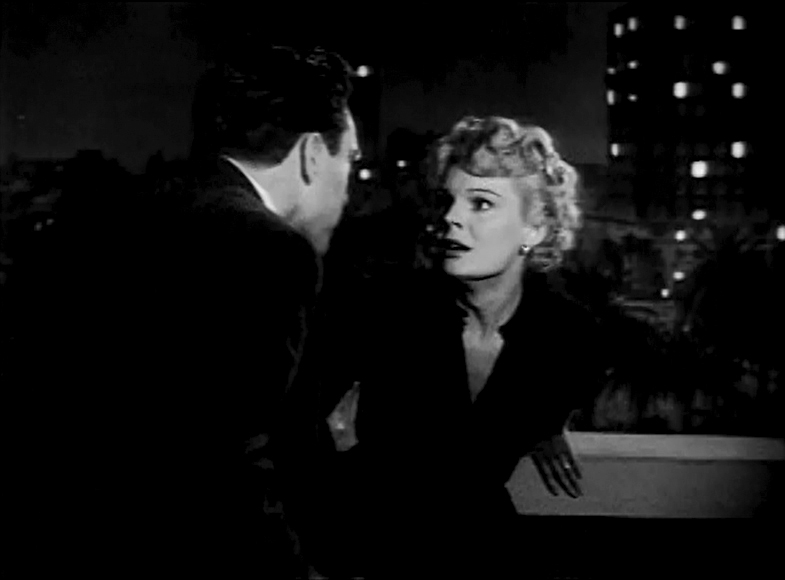
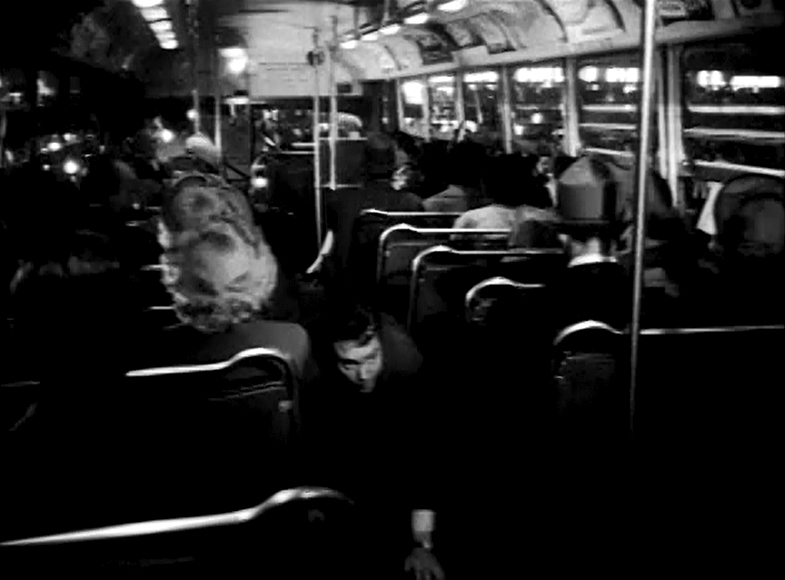
Anyway, because this is my blog, and I can do whatever I like, here's some of my favorite stills:
 
The opening sequence. Bigelow marches through a dark police station.

"I want to report a murder."

Pamela Britten plays Paula, Bigelow's sweet but slightly clingy
secretary-girlfriend back home.

The madness begins: a San Francisco jive club.

"He's flipped. The music's drivin' him crazy." Meanwhile, the faceless
killer prepares the luminous toxin.

"You've got it, all right." A doctor confirms his diagnosis with a glowing
test tube. Bigelow has one day to live.

"I don't think you fully understand, Bigelow. You've been murdered."
Bigelow races down a crowded street. A neat sequence filmed without
permit, and without the bystanders' knowing what was happening.

Irony.

Now on the trail of his own killer, he journeys to Los Angeles, where he
encounters tart, unprofessional secretaries...

...and gun-toting models.

Soon he's getting shot at...

...and chasing phantom gunmen through abandoned warehouses.

Someone doesn't like him sticking his nose in.

But he's utterly fearless now. "He's not afraid," says Majak. "You can tell
from a man's eyes when he is afraid. Look at his eyes."

Chester, one of the creepiest henchmen I've seen. "That's the way I wanna
see you go, Bigelow...niiice and slooow."

But it's Chester who goes, in a drugstore shoot-out.

Beautiful on-site night photography.

The final interview with a not-so-grieving widow.

Surrounded by people but utterly alone.

Crawling on hands and knees to gain a few hours of life.

A few hours to go to the final confrontation at...

...the Bradbury Building, Los Angeles. Is this actually the exterior of the
Bradbury, though? I don't think so.

This, however, is clearly the interior. Recognize it? It's where the climax
of Blade Runner takes place. A lot of movies have been filmed there.

The faceless killer.

The final shot. "Better make it 'Dead on arrival.'"

Wednesday, March 30, 2016

Bone Tomahawk

Did you know that there were two westerns starring Kurt Russell last fall? There was Quentin Tarantino's The Hateful Eight, and then there was S. Craig Zahler's Bone Tomahawk. The latter was an indie film by a first-time director. It did well at festivals but had only a limited release, meaning that there was zero chance for me to see it in the theater. But I finally watched it on the small screen the other night, and, dang, that was a good movie.

First off, I have to say that I'm not a huge fan of westerns. This is not due to lack of exposure. Quite the contrary, perhaps. I live half an hour from the Alamo Village movie set, where they filmed both the John Wayne film and Lonesome Dove. Growing up, I watched John Wayne movies until I had them memorized. When the local UHF station featured one in 3D (I forget which), we actually went out to the county courthouse – in a different town, mind you – to pick up the glasses to watch it as a family. There's some good old-fashioned red-blooded American fun for you. (It was like John Wayne's horse's nose was popping right out at us!) But, sadly, I simply can't stand westerns now. At least ones that don't involve some combination of Sergio Leone or Clint Eastwood.

However, Bone Tomahawk is better described as a horror-western, certainly an unusual combination of genres. It's like The Searchers stitched by a degenerate backwoods psychopath onto The Texas Chain Saw Massacre. So here let me also say that I'm not the target audience for brutal slasher horror films. So, why would I like Bone Tomahawk so much?

Well, I first became interested in it when I encountered this interview with the director. In it he trashes both The Hateful Eight and The Revenant, and explains that what inspired the story "comes a little bit more from the disciplines of lost race fiction, like H. Rider Haggard kind of stuff, really, than from westerns."

H. Rider Haggard kind of stuff? Sign me up!

So, the basic plot is this: A young foreman's wife (who happens to be a doctor) gets kidnapped by a tribe of degenerate cannibal troglodytes. The sheriff (Kurt Russell, who is and will always be awesome) forms a mismatched little posse to rescue her. They cross the wilderness, experiencing various Old West setbacks, and then step right into the mouth of Hell.

Really, most of film consists of these four men riding across the landscape with each other. The characters are well drawn and quite enjoyable to watch. The mood is quiet and brooding, with a rising sense of menace as they get deeper and deeper into this back corner of the wilderness. The horror is only hinted at until the last thirty minutes or so of the film. And then...hold onto your chair. Seriously, don't watch this movie if you're sensitive to graphic violence. I've never seen anything like it. What makes it hard to watch is that the characters never lose their basic humanity in the viewer's eyes. There's no emotional detachment, as you might have in a straight-up slasher. But the horror is also offset by a kind of grim but compassionate humor. And Kurt Russell is the man.

The main feature, of course, is the cannibal troglodytes. There's a lot to love here, but I don't want to say too much. They're very scary and very cool. And I love this idea of riding deeper and deeper into the American wilderness, encountering stranger and stranger things as you go, until you come to the final horror of all. In the interview mentioned above, Zahler says this:
If I could have picked anywhere to shoot this movie, probably my first choice would have been New Mexico, and certainly the thing I am least happy with in the entire movie are the exterior locations [...] I had a very specific geographical progression throughout this movie from hills and green, to flatter and green, to green and dirt, to dirt and red, to white, to rocky, to an almost primordial setting that someone compared to Journey to the Center of the Earth. It was very specific in the script how the landscape was supposed to progress, and I spent an enormous amount of time going around with different people in Los Angeles trying to find the best substitutions I could.
Too bad. I can just imagine what he could have done with a free choice of locations in New Mexico, where I've traveled, camped, and backpacked more times than I can count. But he does a very fine job with what he has at his disposal, and it's just a beautiful, beautiful movie.

So, if you want something a little different, but well worth your while if you like H. Rider Haggard kind of stuff, give Bone Tomahawk a chance. (It's currently available for free streaming if you have Amazon Prime.)

Thursday, February 11, 2016

Into the Vortex

As promised in my curmudgeonly Star-Wars-flogging post, here are reviews of two more from the seventies.

Zardoz (1974)


If you ever have a hankering for a film whose opening scene depicts a generously mustachioed Sean Connery wearing an orange diaper and cowering before a giant floating stone head that booms "THE GUN IS GOOD! THE PENIS IS BAD!" while spewing heaps of firearms through its stone teeth into the arms of worshiping orange-diaper-clad warriors, then, my friend, this is the movie for you.

My brother apparently thought it was the movie for me, because, after he caught it as a midnight cable flick last spring, he immediately ordered me a copy in anticipation of Christmas. (I got him The Thing and They Live.) Admittedly, we do share a warped taste in movies, which makes sense, seeing as we rented videos together during our formative years.

But I digress. Amazingly, Zardoz was directed by John Boorman, fresh from his success with Deliverance (1972). I've never seen Deliverance, though my understanding is that it involves, er, hillbillies. I have seen another Boorman effort, Excalibur (1981), so many times that I'm embarrassed to attempt a count. It's as clunky and awkward as its knights, who insist on wearing their big, shiny suits of armor while relaxing and eating dinner around the Round Table, but, oh, how I love it. The Grail sequence and closing scenes are simply sublime, and redeem much that has gone before.

But I digress again. After Deliverance, Boorman was given free rein to make the movie of his heart's desire. Zardoz was the outcome. Because it jumps around a lot and doesn't explain itself, it can be a little hard to follow. It's one of those movies that you suspect are best enjoyed in small doses while high on some controlled substance. With only my staid and sober brain to guide me along, however, I seem to grasp the following:

It is the year 2293. The world, unsurprisingly, is a whacked-out place. Mankind is divided into two groups: the Brutals and the Eternals. The Brutals are grimy peasants who live in a sad wasteland. The protagonist, Zed (Sean Connery), is an Exterminator, a Brutal whose job is to ride around shooting extraneous peasants. But there's a bit more to him than that, as we later discover: secretly, he's a super-intelligent mutant not over-fond of the works of L. Frank Baum.

The Eternals are immortal, though sometimes they're aged a few years as a penalty for rule-breaking. They're very pretty, both men and women, with the men wearing little crocheted sweaters with low-cut necklines. They're also quite impotent. They spend all their time eating fruit and getting mellow in small-group sessions. Their society is run by the Tabernacle, an A.I. resembling a talking Wikipedia, which they can access through their mood rings. They seem very smart and have mind-control powers, but there's something of the Eloi about them.

The Eternals live in the Vortex, a beautiful green valley enclosed by a force field, where they manage an old (Irish?) farmstead. It has one building painted blue to make it look futuristic, some plants growing in plastic bubbles, a mirror door leading to a complex filled with famous statues and paintings, and a bunch of groovy interiors whose spacial relation to the farmstead buildings is never elucidated, including an orange one that looks like the set of an old TV game show and another with sloping crystal walls behind which nude women float through space.

Not all is well in the Vortex. The Eternals have stagnated. Some, overcome with ennui, have become Apathetics who just stand around looking at one another all day. Others, recalcitrant troublemakers, have become Renegades, who are made old and senile but can never die. They're housed apart, whiling away their days in mawkish fancy-dress parties.

Zed rides the floating head into the Vortex. He becomes a domesticated animal and symbol of male potency. In time he's revealed as a messiah-figure come to bring the gift of death to the Eternals, which arrives in a crazy tragicomic bloodbath, the victims gleefully crying "Kill me! Kill me!" to their murderers. It ends with Zed siring a child with Consuella (Charlotte Rampling), an Eternal who had wanted to destroy him but now loves him, in the giant floating head, which is no longer floating. Their son leaves and they grow old and turn into skeletons, all to the tune of Beethoven's Seventh.

Visually, this movie is actually quite beautiful. Certain images and scenes definitely stick with you. On the other hand, it is horribly awkward in parts, beginning with the prologue, in which the cut-out, barely-mustachioed head of one Arthur Frayn (the voice of the stone head) floats around on a black screen, saying things like, "In this tale, I am a fake god by occupation, and a magician by inclination." Then there's the part where they show Zed some weird porno films to see if he'll get an erection, and the part where…well, you get the picture.

All in all, it's one of those trippy and highly symbolic but opaque movies they made in the late sixties and seventies, that leave you with a feeling of wondering what you just watched. The nuttiness of its plot as I try to summarize it reminds me of the fictional movie described by Philip K. Dick in VALIS, which for some reason remains one of my favorite science fiction novels. Dick himself was inspired by The Man Who Fell To Earth, starring the late David Bowie, which is another of those movies.

So, is Zardoz worth watching? Well, I enjoyed it, so I'm going to come down on the side of...yes.

A Boy and His Dog (1975)


A Hugo-winner based on a story cycle by Harlan Ellison, this one is genuinely worth watching, if you have the stomach for it. It's crass and brutal, and there's arguably a misogynistic slant to the whole thing, especially the ending, so be warned.

Taking place in the post-nuclear wasteland of Arizona (as opposed to the pre-nuclear wasteland of Arizona), it centers around the titular teenage boy, Vic (Don Johnson), who roves the landscape in search of canned food to eat and women to rape, and his titular dog, Blood (voice of Tim McIntire, who also sings the main theme), with whom he communicates telepathically. Vic is vicious, shallow, and not particularly intelligent; Blood is the real leader of their team. (There's an unsubstantiated rumor that the dog is Tiger from The Brady Bunch, which I dearly wish were true, but strongly suspect is not.)

The only civilization shown on the surface is a camp where wanderers can trade food for the opportunity to watch surreal pornographic films. There Blood sniffs out a female human, whom Vic follows with ungentlemanly intentions. But after he saves her from scavengers (shown) and mutants (not shown), she seemingly falls for him, and they proceed to do things that bore and disgust Blood. In reality, the girl, Quilla June (Susanne Benton), has been sent by her father (Jason Robards) from their underground city ("Topeka," a bizarre totalitarian parody of Midwestern culture) in order to entice Vic down so that he can be captured and impregnate all their females. This is not as happy a fate as Vic at first imagines...

The movie remains genuinely interesting and darkly humorous throughout. While horrifying in a way, there's a certain hilarious justice to the end, although Mr. Ellison objected to the last line, which he characterized as moronic and chauvinistic. The whole thing has a low-budget feel, but does well with what it has, and evokes classic science fiction literature in a way that most movies do not.

*

To read more of my rambling yet uniquely entertaining and insightful reviews of seventies science fiction movies, start here: