Showing posts with label carter. Show all posts

Thursday, July 30, 2015

Two Hundred Million A.D.

As I've mentioned several times, A. E. van Vogt, the famous "pygmy with a giant typewriter," is my favorite golden-age science fiction author. His best novels bear multiple readings, partly because they're so rich in ideas and settings, partly because they're damnably confusing. They're bold yet weirdly naïve, headlong plunges through time and space, peopled with dunderheaded supermen and strong-minded beauties and towering arch-villains, littered with unbearable solecisms and unmotivated actions, touched with sweeping grandeur.

I just finished a repeat visit to Two Hundred Million A.D. (a.k.a., The Book of Ptath), serialized in 1943, published as a novel in 1947. My copy, shown to the right, was printed in 1963.

One thing that strikes me upon this re-reading is that, from a stylistic point of view, the book is very badly written. To wit:
…for a moment he had an enormous, an almost owlish conviction that he had picked a fatal flaw in the whole story.
An owlish conviction? What does that mean, exactly? We seem to be talking about a conviction that is enormous, yes, but, what's more, it's so very enormous that it's almost owlish. As in…like unto an owl?

And then there's this:
These rebels were right, basically. No group had ever been braver, defying an unkillable woman and a religio-slave set-up of temple potentates more powerful than anything that had ever existed anywhere.
An unkillable woman and a religio-slave set-up. That made it into a published novel? It sounds like something I'd use as a placeholder in a rough draft for a rough draft, hoping I wouldn't die before I could revise it.

The plot, on the other hand, is fairly incomprehensible. Restrictions on action shift from paragraph to paragraph. Characters make bold, arbitrary resolutions, then abandon them on the next page. Time crawls by, and then, between two neighboring lines of dialogue, a month elapses. Plot holes yawn like black abysses, unsuspected by their author. Plot points emerge like ships from a dark, foggy night, and vanish vaguely to aft. The whole thing hangs together with a kind of murky dream-logic, not making sense if you look at it as a whole, but seeming to make sense from page to page. Kind of.

And yet, I like it. Honestly, I'd rather read it than a lot of things that make more sense. In Imaginary Worlds, Lin Carter gushes about it on pp. 85 – 86, winding up by calling it van Vogt's "single best novel." He gets a number of details wrong, in typical Lin Carter fashion, but gives a good overall summary. I can't say I agree with his assessment – certainly I'd rank the Null-A books, the Weapons Shops books, Slan, and The Voyage of the Space Beagle as far superior – but it's definitely worth a read.

There's the setting, for one thing. The action spans two continents and the isthmus joining them, moving through jungles, rivers of boiling mud, smoking volcanoes, and stupendous cities, two hundred million years in the future. The earth, it's suggested, is exhausted of ores. Battles are fought with crude weapons of varnished wood and carved stone, but high technology is also present. The human population is in the tens or hundreds of billions. Once-human goddesses pit armies of loyalists and rebels against one another in a strange game where mastery is the prize. In a curious reversion to geological antiquity, the southern supercontinent, where most of the story takes place, is known as Gonwonlane (Gondwanaland), and the sea adjoining it, Teths (Tethys). The armies employ prehistoric-seeming beasts like elephantine grimbs and leather-winged screers.

As a matter of fact, I'm struck by how many material elements of The Book of Ptath remind me of Gene Wolfe's Book of the New Sun. I wonder if it served as a partial inspiration?

The protagonist is the god Ptath, returned to the present from a sojourn among the humans of the past, his most recent incarnation being Peter Holroyd, a soldier and casualty of World War II. At the opening he is blank-minded and physically inexorable; later on the Holroyd psyche takes over for some reason that I don't quite understand.

Ptath's age-long merging with the human race has something Christ-like about it, in a Gnostic sort of way, an attempt to grow in compassion and root out the sort of divine cruelty that has conquered the goddess Ineznia. But religion, though the source of Ptath's power, is treated in a coldly scientific, utilitarian way. "Religion is fear," he says on the penultimate page.

Power accrues to the three divinities through the use of prayer-sticks, but only women can pray to the god (Ptath), while men pray to the goddesses (Ineznia and L'onee). This god-power consists of the ability to possess other people (though only of the same sex) and, eventually, depending on the piety of the populace, the ability to transport oneself bodily through space. No, it doesn't make sense to me, either. And van Vogt is, as ever, on the side of the superman.

But still, look at the sheer number of ideas we have thrown together here. Any one of them could have been the basis for an entire novel. As usual, I find myself slightly frustrated that van Vogt didn't develop his speculations more fully or make a better attempt at narrative coherence. But it's hard to think of another science fiction author so useful to steal from, or (for me at least), so enjoyable to read.

Friday, April 25, 2014

Tricks of the Trade

And now at long last let us complete our dialogue with the last three chapters of Lin Carter's Imaginary Worlds. Previous posts are here and here. The eleventh and final chapter is entitled "Tricks of the Trade: Some Advanced Techniques of World-Making." Let's begin!

The chapter is divided into four sections, the first being about magic. Lin here gives the oft-repeated advice that magic without limitations gets a bit dull. I've written about this before. Different people find different things dull, I suppose, but what I find dull is stories with magic "systems." To me the issue is one of style, and is best attended to by careful word choice and presentation rather than the invention of ingenious "rules."

He cites several examples. The most illustrative is Jack Vance's Dying Earth, in which a magician can seemingly hold only so many spells in his skull at one time. To me, the stories in The Dying Earth are enjoyable chiefly for their mordant humor, and the magic system contributes to this by putting the protagonists in potentially embarrassing situations.

Another example is Tolkien.
Similarly, in The Lord of the Rings, Professor Tolkien* faced the problem of Sauron, a black magician of such immense power that he long ago transcended mortality to become virtually indestructible: he is described as almost a god of evil. Now, any hero, no matter how gallant, is obviously going to be helpless against an antagonist of such strength. Tolkien anticipates the objection by having the greater part of Sauron's power center about his possession of an enormously potent talisman, the "One Ring"; his entire plot revolves around the dual problem of keeping Sauron from obtaining the ring and, if possible, destroying it before he does gain possession of it.
Sigh. Where to begin? Didn't Lin write Tolkien: A Look Behind The Lord of the Rings? Did he not even read the book? Yes, he boasts on page 115 that he read it three times. Three times! And that's enough to write a book about it? No, apparently not. At any rate, his description might apply to a Ringwraith, but certainly not to Sauron, who, it is quite clear from the book, never was a mortal. He is, in fact, quite literally a "god of evil," if we are to take the Valar and Maiar as gods, as man in his darkened wisdom often does. If anything, Sauron has fallen by becoming dependent on physical forms; the legends from the end of the Second Age show him to be discomfited by the destruction of his corporeal "vehicle." You don't have to have read The Silmarilion to know all this; you don't even have to have read the Appendix, which Lin certainly could have done. It's alluded to a number of times in the text.

The point about the limitations imposed on Sauron by the One Ring is well-taken, but this is more like the checks and balances one finds in fairy tales than the hocus-pocus rules of Jack Vance. I notice that no limitations are made explicit concerning Gandalf's magic tricks, which seem to consist of lighting things on fire, making his staff glow, and (occasionally) casting bolts of lightning. No, Gandalf is more like Geoffrey of Monmouth's Merlin, who's nine parts prophet and one part thaumaturge, and simply goes places to make things happen. But Tolkien wisely makes his stories about hobbits rather than wizards.

The second part Lin calls "The Problem of Realism." He dwells on realism of presentation as opposed to realism of content. Sharply rendered, crisp little details draw the reader into a fantastic story. C. S. Lewis'** Experiment in Criticism is cited to good effect, and one of Lewis' examples is the dragon that sniffs along the stone in Beowulf. Lin adds several of his own, but his, alas!, are all of the sugar-icing variety he so delighted in, like the mounted unicorn head in the study of Malygris the Magician, or the gate made from a single piece of ivory in "Idle Days on the Yann." They're quite the opposite of what Lewis means. He lists commonplace details used to make the fantastic "real," while Lin lists fantastic details used to make the commonplace fantastic.

The third part, "The Problem of 'Business,'" continues this theme, by dwelling on the little fripperies that abound in Eddison and The Dream-Quest of Unknown Kadath and the like. Best if used sparingly, and with reason!

The fourth section is about flora and fauna, and treats of the critters one finds in fantasies. For one thing, should stories set in other worlds or olden tymes feature horses as mounts, or some other creature? What I say is, if the mood of the story calls for horses, horses let them be; otherwise, give me emus or biarmosuchians or thoats. Just be consistent, and don't make things up as mere stand-ins for commonplace creatures. Burroughs is cited, and certainly the thoats, banths, and zitidars of Barsoom are quite effective. For the record, the horses in Eddison's Mercury have never offended me.

I'm sure other people have complained about this, but the horses in a lot of fantasies are rather lacking. Writers seem to take them for a species of hooved moped. Now, I know a bit about horses and their handling, having ridden them in my youth – this is Texas, after all – and I hate them with a passion. Yes, I hate horses, and I look a little suspiciously on horse people, who when I meet them on the trail seem to regard themselves as a higher grade of being, looking down on me from their restive, smelly mounts, ordering me to scuttle this way or that, wearing their little white helmets like crowns.

A horse nearly bringeth Sir Percival to destruction.
Note the knowing eye, the demented grin.
I once went on a week-long cavalcade (I'm on a tangent, I know) through the Davis Mountains of west Texas, led by two lazy, supercilious, self-regarding "cowboys" from Pecos. (Needless to say, no cows were in evidence.) My horse was named Crazy Alice, and she more than earned her modifier. She hated mules – not donkeys, not horses, just mules – and would lay her ears back and charge if one came near her. I had to show myself her master there, but if a mule was in front of us in line she had a way of secretly nipping its buttocks with her teeth. She would also never take a step when a flying leap would do, and once fell over on my leg, the stiff stirrup fortunately protecting my bones as she tried to scramble to her feet again. (I kept my seat like a pro, though, and everyone else told me I looked like a rodeo rider, something I was not a little proud of.)

So, you see? I read horsey fantasies, with horses that move as though on little wheels, and never take craps or kick their riders in the knee or need their girths tightened or try to roll around while they're crossing a dry riverbed, and my eyes just kind of glaze over. Then again, horses are probably more exotic to a lot of people these days than thoats. I guess that's why we've got urban fantasy now.

Well, this concludes my discussion of Lin Carter. If I seem a little hard on him, don't think it's because I'm not fond of him; I am. As I've said many times, I certainly owe him a great deal, for having given me something to sink my teeth into when I discovered that Terry Brooks and Katharine Kerr weren't going to satisfy the craving awakened by Tolkien and Lewis. He loved what I loved, as few people do. Requiescat in pace.

* I've resolved that, once I'm a famous novelist, I'm going to be known as Professor Ordoñez, because I am, after all, a math professor. This may be difficult, though, because I wear embroidered guayberas rather than ornamental waistcoats, and I don't smoke at all.

** Not Professor Lewis! No waistcoat or pipe!

Wednesday, March 5, 2014

Lin Carter on Naming

On to Chapter 10 of Lin Carter's Imaginary Worlds: "A Local Habitation and a Name: Some Remarks on Neocognomina."* This is a continuation of a previous post.

Lin** heads the chapter with the Tsargol Records Genesis 2:19, in which God brings the animals before Adam so that he can name them. God gave the earth to man for his dominion, and to man belongs the office of naming. The two are indissolubly tied – but that is a subject for another post. Lin goes on to quote Auden: "A Proper Name must not only refer, it must refer aptly, and this aptness must be publicly recognizable."

Let me make an aside here. The authority of a parent to name their child is a great authority indeed. I sometimes feel, in an almost mystical sense, that the act of naming exercises an influence over a child's destiny until the day they die and, perhaps, beyond. My parents have revealed that I was almost named Richard; well, I cannot imagine life as Richard any more than I can imagine being a different person. They clearly chose the correct name. It horrifies me when parents are flippant or cute about naming their children.

My wife and I went to a diner late one night a few years ago, and the waiter came over and introduced himself as…well, as having a name most people would find quite humorous. Naturally, being the well-bred people we are, we merely smiled and opened our mouths to order our coffee. Surprised, he asked why we weren't laughing. Apparently his mother had given him his name, and he'd never introduced himself to a patron without being laughed at. Imagine going through life like that! How could someone be so frivolous, to name their child as though they were a cute doll that would never grow up and have to make their way in the world?

My own children's names I thought long and carefully about. I named my son after my father and grandfather, but his middle name is a rather ornate Greek name that isn't commonly encountered in its masculine form, and has to do with the season in which he was born. Both my children have martyrs' names from the Roman Canon. We considered others, of course, but there's a strange retrospective sense of predestination. Beforehand, we could have chosen anything, but after the fact it was always going to be what we picked, forever, from the foundation of the world.

There's a touch of that in writing. I find that I have to be careful about affixing placeholder names to characters until I can think of something better, because they tend to become canonical and irreplaceable despite my intentions. Consider the example of E. R. Eddison, the consummate stylist who wrote an epic fantasy novel in Jacobean prose while retaining the ridiculous names of his childhood make-believe games, like Goldry Bluzsco and Fax Fay Faz. I'm willing to bet that he simply couldn't have written the story otherwise.

All of which is to say, the subject of naming must be approached diffidently, because we have less freedom in the matter than it may sometimes seem.

Lin begins by discussing Robert E. Howard's much-criticized penchant for using actual historical names. I can understand the criticism, but to be honest it's never really bothered me. REH was looking for connotations, and was generally pretty good about picking the right ones. Leigh Brackett's Sword of Rhiannon I have a harder time forgiving. What could she have been thinking, to have used Welsh place-names for an ancient Martian civilization? Babylonian I could see. Assyrian, too, or Egyptian. One of those desert empires that made really big stone buildings. But "Caer" on Mars? And "Ywain" as a lady-name?? And "Rhiannon" as a male entity???

Of course, a decent historical name is arguably better than a really stupid made-up one. Lin commends Moorcock's Imrryr (though why the double r?) but singles out R'lin K'ren A'a for contempt. How exactly did those mysterious preadamite races pronounce words with apostrophies?

As to aptness in common-nouning, Lin cites the opening to Edgar Rice Burroughs' Thuvia, A Maid of Mars as a prime example. Happy choice! I will repeat it here, though I've done so on this blog before:
Upon a massive bench of polished ersite beneath the gorgeous blooms of a giant pimalia a woman sat. Her shapely, sandalled foot tapped impatiently upon the jewel-strewn walk that wound beneath the stately sorapus trees across the scarlet sward of the royal gardens of Thuvan Dihn, Jeddak of Ptarth, as a dark-haired, red- skinned warrior bent low toward her, whispering heated words close to her ear.
Even without having read this passage, it's plain to anyone that ersite is a hard, granite-like stone susceptible to cutting and polishing, suited to upholding the shapely posteriors of scantily clad Martian princesses, while the pimalia is clearly a small, exotic tree out of place anywhere but the ornamental gardens of Martian jeddaks. The sorapus, of course, is a bit like a horse chestnut, a bit like a loquat, and a bit like an elephant, with big leaves and knobby, many-branching trunks.

I've written on the subject of common noun invention in previous posts, so won't dwell on it here. The point is to introduce apposite new terms for common things so as not to break the spell of the story.

For this reason Lin excoriates the style of one Jane Gaskell***, whose works I have not read, but who uses words like "epaulettes," "the big brass," and "H.Q." in a novel-series set during the time of Atlantis. She corresponded with C. S. Lewis, who advised her that names in fantasies should be "beautiful and suggestive as well as strange; not merely odd." He adds: "In a fantasy, every precaution must be taken never to break the spell, to do nothing which will wake the reader and bring him with a bump to the common earth. All magic dies at the touch of the commonplace."

Lin spends several pages discussing letter choice. He warns against an overuse of Q, X, and Z in attempting to create exotic-sounding place-names. This is excellent advice, though he might just as well have mentioned the abuse of double (and triple!) letters, a practice to which he was unfortunately addicted. Tolkien is presented as an antidote. He uses English-derived names for place-names in the common tongue, which eases the (English) reader into the story. Verisimilitude and mystery are heightened by occasionally referring to the more ancient, Elvish names, of which the common names are sometimes corruptions. For instance, the Brandywine is known to the Elves as Baranduin.

This reminds one of the many towns and rivers in England whose names come down from pre-Roman times, such as York, which derives from the latinized Eburacum. The landscape mirrors this layeredness. In a single day I once toured Salisbury Cathedral, went by bus to Stonehenge and Avebury, walked past Silbury Hill (a prehistoric mound used by Roman road surveyors) to an open Bronze-Age barrow, saw from a distance a white horse-figure cut into the green downs, and returned to town to dine on venison at a medieval inn. At the time it struck me that Eriador could be an immense Salisbury Plain.

There is, Lin claims, an "almost irresistible tendency to make up names which begin with 'T.'" I must confess to never having experienced this myself. S is also singled out as an offender. It is quite true from a practical point of view that one should avoid having too many names that begin with the same letter. Then again, one can get a little too worried about it, so that it becomes obvious and annoying.

Come to think of it, though, the character names in LOTR are pretty well distributed. If anything Tolkien would seem to incline toward F and G, with his Frodo, Fredegar, Folco, Faramir, Gandalf, Glamdring, Galadriel, Gondor, and Gimli. Lin criticizes his overuse of the ending -or for countries, e.g., Arnor, Eriador, Gondor, Mordor. Which, I suppose, is valid enough, though it's never bothered me.

With that, on to Chapter 11: "Tricks of the Trade: Some Advanced Techniques of World-Making."

* Is "neocognomina" a real word? Or was Lin indulging in a bit of unwarranted neology?

** He writes so chattily, I find I must call him by his praenomen. It's similar to the way people can't help but refer to Elizabeth Gaskell as Mrs. Gaskell, and to J. R. R. Tolkien as Professor Tolkien (though no one ever calls C. S. Lewis Professor Lewis – I suspect pipes have to do with it).

*** The great grandniece of Elizabeth Gaskell, mentioned in the previous footnote. Apparently she went on to become a journalist and an astrologer.

Friday, February 28, 2014

Imaginary Worlds

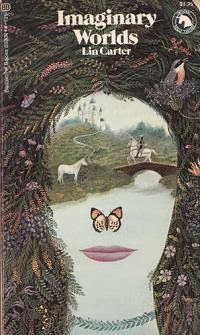
Being a Ballantine Adult Fantasy aficionado, I'm fond of Lin Carter's Imaginary Worlds, despite its (ahem) rather outré cover. (I'm sensitive about book covers.) It's a priceless document: published in 1973, it stands at the watershed moment, when fantasy was at last being widely recognized as a distinctive vein of literature, but before the appearance of The Sword of Shannara and all its consequences for Western civilization.

The first eight of IW's chapters present a history of fantasy literature from the Victorians down through Ursula K. Le Guin. It's not a bad read, though Carter's scholarship is not to be relied upon, and his style is and will forever remain insufferably chatty to me. The last three chapters are a kind of manual for fantasy-writing, many of whose maxims are repeated in Patricia Wrede's excellent guide available at SFWA.

Let's begin with Chapter 9: "Of World-Making: Some Problems of the Invented Milieu."

Lin – I find somehow that I must call him Lin, and not Carter or Mr. Carter – Lin, I say, begins with the common observation that fantasy-writing presents unique technical challenges.
If you stop and think about it, you will realize that fantasy writers face a variety of technical problems that authors working in other genres seldom have to worry about. The problem of creating an imaginary world on paper is the largest and most serious of these, and it is a complex problem involving many different factors.
He goes on to explain that getting James Bond from London to Lisbon is a relatively simple matter, since the readers are presumably familiar with telephones, taxi cabs, airplanes, Portugal, and the like, and no exposition need be expended on these things.

Here I have a quibble. Modern-type books that don't bother to build mental pictures are unspeakably boring to me. The action seems to take place in drab gray rooms and corridors. Perhaps that's a fault of my imagination. But not all modern-type books suffer from this. I enjoy Ian Fleming and Raymond Chandler and Dashiell Hammett considerably – sometimes I'd actually rather read them than fantasy! – one reason being their ability to paint a picture. Chandler is particularly good at this. Though terse, his descriptions are almost painfully vivid and precise, and rely almost exclusively on minor details. On the other hand, quite a few fantasies nowadays read more like the drab modern thriller. There's a broad enough base of reader expectation that they don't have to describe a throne room any more than they would a motel room. How unutterably depressing!

On the other hand, in my opinion, a good fantasy contains a preponderance of what is familiar to the author. A fantasy chock-full of marvels is very dull indeed. It remains a vague, silly dream, failing to take on a life of its own, like the Amadis de Gaul that Don Quixote was so fond of.

But back to Lin Carter. For the most part the chapter confines itself to discussing the construction of a believable milieu. Here I opine that the best of fantasy milieus weren't constructed from scratch as settings for stories. Either the construction was pursued for its own sake and eventually flowered into a story, or the story acquired its milieu in the telling. The most memorable fantasy worlds came into being over the course of decades, and produced stories only late in their authors' lives. Eddison's Mercury, for instance, had its genesis in childhood make-believe, while Tolkien's Middle-Earth was born in the trenches and mess halls of the Great War. It's pretty obvious which fantasies are the result of an author who sat down one day and decided to cook up an imaginary world. (Cf. Diana Wynne Jones' comments on MAPS.)

Lin categorizes the types of milieu most commonly encountered. Many fantasies are set in a known world of myth. Others are set in a purely invented world, the four varieties being: (1) remote antiquity (Hyboria, Poseidonis, Middle-Earth), (2) remote posterity (Zothique, the Dying Earth), (3) an alternate dimension (Narnia, Witch World), and (4) another planet (Barsoom, Perelandra). It's interesting that all of these are linked to our own space and time somehow. Most fantasies set in invented milieus nowadays are content to just take the independent world as a given. Another result of the establishment of reader expectations. Even the novels that came out in the seventies and early eighties still tended to connect their worlds with ours, e.g., The Sword of Shannara, Lord Foul's Bane, Mythago Wood. Earlier examples of complete autonomy include Earthsea and Gormenghast Castle, but these are fairly rare.

A discussion of techniques in world-building follows. Lin recommends familiarity with geology, climatology, and the like. Deserts don't just taper off into jungles. Great cities don't just pop up out of nowhere for the mere sake of being grand and decadent. His points are well taken. However, I note that Tolkien appears to have constructed his geography dramatically. He writes in one of his letters of the impossibility of pleasing at all points, and admits the shortcomings of his geology. In fact, I've always suspected that the parallel lands of Beleriand and Eriador were originally one and the same region, but were separated (and Beleriand submerged) when too many inconsistencies arose. Indeed, Tolkien sometimes takes his correspondents to task for asking questions as though he'd written a history rather than a work of literary art intended for its own sake.

Lin's recommendation to diversify the forms of government is also well taken. Not many people heed this even now, alas. You'd think a lot of writers got all their knowledge of political systems from their sixth grade world history class. Since most fantasy realms are city-states, more or less, I here have to recommend one of my favorite books, J. B. Bury's A History of Greece. It was written back when they could still write all-encompassing histories, as opposed to specialized monographs and revisionist screeds, and as such is eminently readable. It goes into great detail as to the organization of Sparta, the various Athenian democracies, and so on. It's available (used) in a Modern Library edition. Lin uses a de Camp story as an example of governmental variation; it sounds a bit silly to me, but Gene Wolfe's Book of the New Sun strikes me a good example of atypical political world-building.

After this Lin dwells at length on the phony citations that often adorn fantasies. Lin himself delighted in such frippery, of course. Irrepressibly enthusiastic as ever, he can't resist citing examples from his own work:
I learned this trick from Howard, and my Lemurian Books use for their chapter-headings quotations from various historical documents such as "The Lemurian Chronicles" and "The Tsargol Records," magical or occult works such as "The Scarlet Edda" and the grimoire of Sarajsha, epics like "Thongor's Saga," pieces of Lemurian literature such as "Diombar's Song of the Last Battle" and any number of folksongs, sea chanteys, sayings and proverbs, and war or marching songs such as "Drum-Song of the Kodanga Tribesmen," "Battle-Song of the Black Dragons," and "Caravan-Song of the Jegga Nomads."
To which I say, just say No. Unless you've actually written the works yourself, and they're actually kind of good, don't, please don't use silly made-up quotations as your chapter-headings. Don't let your characters quote texts and proverbs in dialogue, either, unless you're trying to be funny and are Jack Vance. Trust me. It sounds like something from Star Trek: Voyager.

Tolkien could throw in snatches of rhyme and passages of epic poetry because he wrote that kind of stuff for its own sake. You get the sense of incalculable ages behind the events of LOTR because of the strata of stories he'd written over the preceding decades. When Túrin Turambar is mentioned in passing it's not just a bit of color. Tolkien knew very well who Túrin was, and had known for years.* That's not the kind of thing you can just manufacture. Lin Carter's "Tsargol Records" comes off as pasteboard scenery.

All that said, I hereby exempt the quotations that head Robert E. Howard's Conan stories from this complaint, by a raw exercise of blogging authority.

Lin goes on to recommend hinting at distant regions and peoples to build up a rich background. To which I say, again, don't do it, unless it's really necessary to the story somehow, and you've really done your homework. Otherwise it just sounds phony. The example he gives from his own work exemplifies this. There's an art to it. When I read LOTR, I'm always wanting to get into Rhûn and Harad, as though they're real places that lie beyond the edge of the map. All a matter of style, I suppose.

Lin concludes by pointing out how carefully he distributed his made-up foreign country-names over the alphabet. This brings us to Chapter 10, which I'll cover in a separate post.

* Queen Beruthiel's cats were apparently just a bit of color. Sometimes even Tolkien takes wing shots!

Saturday, November 12, 2011

The Cult of Númenor: Part II

The Sacrifice of Noah, San Antonio Museum of Art
In Part I of this post, I argued that Tolkien did weave religion (actual, not allegorical) into the tapestry of Middle-Earth, albeit in a manner so implicit as to be hidden even from that most perceptive of critics, Lin Carter. Now, if Tolkien seems somewhat reticent to discuss the matter of religion openly, the reason, I think, is not far to seek. He was himself deeply religious, and a rather self-conscious member of a religious minority. It is all very well for Carter to patch together his decadent pasteboard religions. So might a boy who has never made love to a woman write foolish stories about amorous encounters. Someone who has a little firsthand experience will be less inclined to speak frivolously. Moreover, Tolkien was a papist, and had grown up in a time when enough people in England still cared about religion that that was Not a Good Thing. Even his friend C. S. Lewis harbored some prejudice on this score. There are many other reasons why Tolkien may not have wished openly to treat of religion, not the least being his good taste. Despite all of this, though, there are indeed traces of the Númenorean religion in his works.

We are told in Tolkien’s Akallabêth that at the island’s center was the holy mount Meneltarma, where only the King could speak, praying the Three Prayers to Eru Ilúvatar. And so the Kings of Númenor, Aragorn’s remote ancestors, were also its High Priests. This worship could not continue after the destruction of the island, for Meneltarma was lost and the men of the West a diaspora upon Middle-Earth. The bearing of the sapling of Nimloth, the holy tree descended from Galathilion in the West, into Middle-Earth upon the foundering of Númenor, to give rise in its turn to the White Tree of Minas Tirith, calls to mind the roles of continuity, recurrent death, and perennial vitality in Tolkien’s religion. When Aragorn comes at the end of the Third Age to claim his rightful throne in Minas Tirith, he finds the White Tree long dead, withered as the kingly line of Gondor has withered. He exercises a priestly role in ascending to the holy place upon Mindolluin to uproot the new-sprouted sapling and plant it in the place of its parent. Clearly, the Return of the King is also the Return of the Priest.

Perhaps the peoples of Middle-Earth have no “organized religion” in Carter’s sense. Tolkien says as much in his correspondence; but the principal reason for this is that the very texture of Middle-Earth is religious. Nevertheless, Tolkien does give the men of the West a negative “Chaldean” religion on the purely literal plane. They were no more lacking in religion than were the subjects of Melchizedek, who offered bread and wine to the One in thanksgiving after the slaughter of the five kings.

Thursday, November 10, 2011

The Cult of Númenor: Part I

In his Imaginary Worlds, the indispensible yet unbearably enthusiastic Lin Carter takes Tolkien to task for having accidently left one element out of his magnum opus, namely, religion:
[T]here is no religion at all in The Lord of the Rings—no temples, shrines, priests, prayers, amulets, scriptures, ikons, idols—nothing! None of the many characters, not even the heroic warriors, so much as swears by his gods. Obviously because they have no gods. Which is simply incredible in a primitive world of wizards and warriors and walled stone cities.
The use of the word “primitive” here brings up a relevant point, for Tolkien seems not to have regarded such religion as primitive at all. We’ll let this pass for the moment, however, and turn to the substance of the criticism. Now, Carter does concede that the peoples of Middle-Earth honor the Valar, the terrestrial angels who watch over the world of Tolkien’s conception, and Eru, the One over all. But that, he says, is not what he is talking about. He means what he calls “organized religion.” Really what he wants is a phony religion, a bit of the added icing and sprinkles that he so delights in. This, however, Tolkien was apparently unwilling to concoct. For it is hard to imagine that he simply neglected to think of it. And if we suppose that his reticence to describe the religion of Middle-Earth was intentional, we may well wonder whether there is a good reason for it.

To begin with, to underscore Carter’s concession, we do find a considerable amount of worship in Middle-Earth. It is not what the theologians call latria, or adoration of the divine, but dulia, adulation, honor paid to creatures. The Elves honor Elbereth, the lady of the stars, to such a degree that we might even speak of hyperdulia. What is more, while Middle-Earth’s mortals speak little of the Valar (Tolkien does mention that some falsely suppose them to be gods), they do pay homage to the great among the Elves. Think, for instance, of Gimli the Dwarf’s courteous “worship” of Galadriel and his bold request to carry away a sacred relic of her person. Now, paying honor to blessed spirits is part of some organized religions, including that to which Tolkien belonged. The dulia of Middle-Earth is not exactly organized, but then, neither is that of Tolkien’s religion. And anyway, who would use an icon when the living, breathing reality resides in the Golden Wood of the terrestrial sphere?

All this is not what Carter is talking about, though. He wants gods and priests, mummery and mumbo-jumbo. But the mention of the stars and the angelic agencies of Middle-Earth leads to another important point. The Hebrew conception of the angel, scholars tell us, was inherited from or influenced by the astral religion of Babylon. Now, Abram was called from Ur of the Chaldees, and the Magi who followed the star to Bethlehem hailed from the same region. They may be taken as types of the good pagan, paying homage to the stars and blessed spirits as to what is preeminent in creation, but only insofar as they flow from and are oriented toward the dark and yet-unknown One. Like Thomas More’s Utopians, they do not attempt more, because they know better. They wait in darkness.

In his essay “Beowulf: The Monsters and the Critics,” Tolkien makes some apposite remarks about the apparent absence of religion in the world of the poem, written as it was soon after the advent of the new faith:
But if the specifically Christian was suppressed, so also were the old gods. Partly because they had not really existed, and had been always, in the Christian view, only delusions or lies fabricated by the evil one… Partly because their old names (certainly not forgotten) had been potent, and were connected in memory still, not only with mythology…but with active heathendom, religion… Most of all because they were not actually essential to the theme.
Might not these three factors also be at work in LOTR? Tolkien does speak in passing of heathendom and self-immolation, and of Black Númenoreans who worship the Enemy. Be this as it may, it is worthwhile noting that, while the writer of Beowulf excludes Christianity as an anachronism, he does not simply dismiss his heroic forebears as irredeemable sinners, as so many in his time were willing to do. No, he elevates them to the role played by the patriarchs and noble pagans:
It would seem that, in his attempt to depict ancient pre-Christian days, intending to emphasize their nobility, and the desire of the good for truth, he turned naturally when delineating the great King of Heorot to the Old Testament.
It is hard not to think of the kingly line of Númenor in this connection. Moreover, Aragorn himself seems to hold a pontifical as well as a kingly office (“the hands of the King are the hands of a healer”). The conjunction of these roles is itself a widespread pre-Christian, pagan idea, but it also found its way into the Old Testament in the person of Melchizedek, the high priest and king of Salem.

It is to the heirs of Elendil that we must look if we are to make out the keynotes of religion in Middle-Earth.