Showing posts with label ballantine. Show all posts

Monday, June 20, 2016

The Lost Continent

How is it that, before this summer, I'd never read C. J. Cutcliffe Hyne's The Lost Continent: The Story of Atlantis? I'm glad to say that I've just corrected the omission. Published serially in 1899 and as a book in 1900, it bears the stamp of the best of H. Rider Haggard's novels, but stands alone in being set wholly within antediluvian times, apart from a ridiculous framing story that serves only to explain why the narrative begins and ends so abruptly.

The book seems not very well known or respected these days. E. F. Bleiler in The Encyclopedia of Fantasy dismisses it in one sentence as "a stodgy dynastic romance that is now occasionally laughable." This, in the article on Atlantis; neither Hyne nor his novel have their own entry, and they are not mentioned in the article on Lost Lands and Continents. This judgment seems unduly harsh. Drawing heavily on Ignatius L. Donnelly's "nonfictional" work, Atlantis: The Antediluvian World, published in 1882, it is a work of real power and imagination, and, one suspects, a major influence on the many pulp writers who explored prehistoric civilizations in their stories.

Hailed by Lin Carter and L. Sprague de Camp as the best Atlantis novel out there, The Lost Continent was rescued from obscurity through its publication in the Ballantine Adult Fantasy series. Here is a scan of my copy's cover, with wrap-around painting by Dean Ellis:

 
The story opens in the Yucatan (although, sadly, this setting receives only a cursory glance), but most of the action takes place in the lost continent itself. The narrator and protagonist is Deucalion (as in the Greek deluge myth), a successful viceroy and general called home by the beautiful, capricious, self-deified empress Phorenice. She intends him as her husband, a plan that ends in disaster, owing in part to Deucalion's extreme moral rigidity (in the Atlantean sense). The characters are stiff, the love-making awkward and underdeveloped, the plot strangely meandering. But if you want a good and robust late Victorian romance set against a backdrop of mythic splendor and prehistoric mystery, then look no further.

There's a sea-battle between solar-powered ships and plesiosaurs. There's a seductive empress who rides a colossal wooly mammoth through the streets of the capital. There's a labyrinthine palace in a giant pyramid lit by subterranean fires. There are secret passages. Superdrugs. Volcanoes. Premature burials. Pagan anathemas. Warrior priests. Hairy half-bestial invaders. Pterodactyls that swoop down to steal sacrificial victims. A doomsday escape vessel that seems a cross between the Ark of the Covenant, Noah's ark, and a seed bank.

The novel also shows a creative attention to weird little details, a quality often sadly lacking in later, more derivative fantasy. Consider, for instance, this grotesque description of Deucalion's lover, disinterred from the tomb where she has sat buried alive for nine years:
Her beauty was drawn and pale. Her eyes were closed, but so thin and transparent had grown the lids that one could almost see the brown of the pupil beneath them. Her hair had grown to inordinate thickness and length, and lay as a cushion behind and beside her head. [...] The nails of her fingers had grown to such a great length that they were twisted in spirals, and the fingers themselves and her hands were so waxy and transparent that the bony core upon which they were built showed itself beneath the flesh in plain dull outline. Her clay-cold lips were so white, that one sighed to remember the full beauty of their carmine. Her shoulders and neck had lost their comely curves, and made bony hollows now in which the dust of entombment lodged black and thickly.
Or again, the description of the superbly imagined ark:
A wonderful vessel was this Ark, now we were able to see it at leisure and intimately. Although for the first time now in all its centuries of life it swam upon the waters, it showed no leak or suncrack. Inside, even its floor was bone dry. That it was built from some wood, one could see by the grainings, but nowhere could one find suture or joint. The living timbers had been put in place and then grown together by an art which we have lost to-day, but which the Ancients knew with much perfection; and afterwards some treatment, which is also a secret of those forgotten builders, had made the wood as hard as metal and impervious to all attacks of the weather.  
In the gloomy cave of its belly were stored many matters. At one end, in great tanks on either side of central alley, was a prodigious store of grain. Sweet water was in other tanks at the other end. In another place were drugs and samples, and essences of the life of beasts; all these things being for use whilst the Ark roamed under the guidance of the Gods on the bosom of the deep. On all the walls of the Ark, and on all the partitions of the tanks and the other woodwork, there were carved in the rude art of bygone time representations of all the beasts which lived in Atlantis; and on these I looked with a hunter's interest, as some of them were strange to me, and had died out with the men who had perpetuated them in these sculptures.
At every point the author shows a predilection for grandiose adventure, but tempers it with an attention to visceral detail:
Blood flowed from the mammoth's neck where the spikes of the collar tore it, and with each drop, so did the tameness seem to ooze out from it also. With wild squeals and trumpetings it turned and charged viciously down the way it had come, scattering like straws the spearmen who tried to stop it, and mowing a great swath through the crowd with its monstrous progress. Many must have been trodden under foot, many killed by its murderous trunk, but only their cries came to us. The golden castle, with its canopy of royal snakes, was swayed and tossed, so that we two occupants had much ado not to be shot off like stones from a catapult. [...] 
I braced myself to withstand the shock, and took fresh grip upon the woman who lay against my breast. But with louder screams and wilder trumpetings the mammoth held straight on, and presently came to the harbour's edge, and sent the spray sparkling in sheets amongst the sunshine as it went with its clumsy gait into the water. 
But at this point the pace was very quickly slackened. The great sewers, which science devised for the health of the city in the old King's time, vomit their drainings into this part of the harbour, and the solid matter which they carry is quickly deposited as an impalpable sludge. Into this the huge beast began to sink deeper and deeper before it could halt in its rush, and when with frightened bellowings it had come to a stop, it was bogged irretrievably. Madly it struggled, wildly it screamed and trumpeted. The harbour-water and the slime were churned into one stinking compost, and the golden castle in which we clung lurched so wildly that we were torn from it and shot far away into the water
Refreshingly, the narrator and other characters follow a pagan moral code wholly alien to modern social mores. Deucalion in particular shows utter unconcern with the lives of the peasant and slave classes, whom he plainly despises, and in fact openly reviles in several passages. (Slaves, incidentally, come chiefly from Europe.) Though odious, his attitudes greatly enhance the book's verisimilitude. The destruction of a continent and people to satisfy the zeal of a priestly caste outraged by a single woman who has stolen their secrets is related as a matter of course. Atlantis the nation is mourned, but the people merit not even a second thought.

As I read The Lost Continent, I kept thinking of authors who might have been influenced by it. A comparatively recent example is Michael Moorcock in his Elric books. Like Melniboné, Atlantis is an amoral dynastic island culture fallen into decadence that evinces a strong disdain for the up-and-coming peoples of the mainland; also, interestingly, the approach to both capitals is rendered difficult, the former by a maze of passages, the latter by the twists and turns of an extremely long, narrow, and high-walled inlet. Possible echoes in other works of fantastic literature abound, Edgar Rice Burroughs's stories being the most obvious example.

So if you like to read, not only the great pulp writers, but what influenced them; if you enjoy a good H. Rider Haggard romance and don't mind a bit of Victorian stodginess; if you want an interesting early imagining of ancient high technology; if you're looking for Bronze Age battles with giant prehistoric beasts – if you're into any of these things, I say, then give The Lost Continent a try.

Friday, May 20, 2016

A Festival of Wrap-Around Cover Art

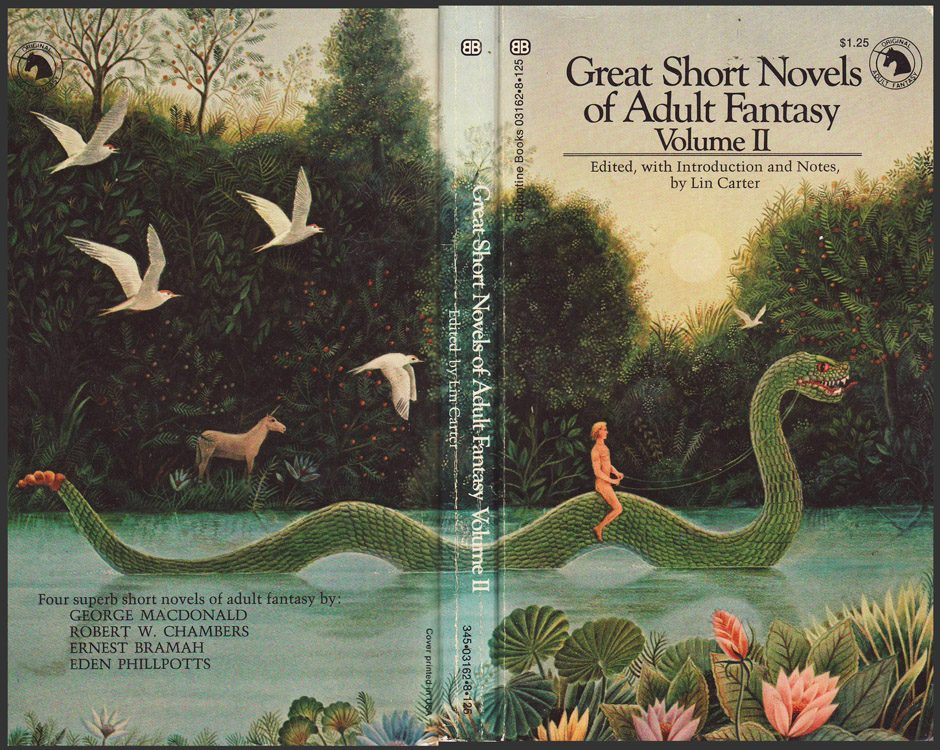
Inspired by Fletcher Vredenburgh's recent critiques of modern fantasy cover design, I here offer some of my favorite wrap-around cover art from the Ballantine Adult Fantasy series. All images are scanned from my personal collection.

To my knowledge, four artists are represented: Gervasio Gallardo, Robert LoGrippo, David Johnston, and Bob Pepper. (The two Eddison volumes give no credit to the cover artist; one website claims the great Keith Henderson, who did do the interior ornaments.)

In Gallardo, I see a lot of influence from weird/surreal art old and new: Hieronymus Bosch, Odilon Redon, Henri Rousseau, Rene Magritte. As a matter of fact, the Internet informs me that Gallardo (b. 1934) is himself a Spanish surrealist. You can see some of his work here and here. I wonder what became of his Ballantine paintings?

I haven't been able to find much about the other artists, but I love Johnston's covers for their spontaneous appearance and glowing, flowing colors.

Great Short Novels of Adult Fantasy: Volume II, 1973.
Cover art by Gervasio Gallardo.
Inspired by Henri Rousseau?
 
Poseidonis, Clark Ashton Smith, 1973.
Cover art by Gervasio Gallardo.
 
Evenor, George MacDonald, 1972.
Cover art by Gervasio Gallardo.
 
The Night Land (Vol. II), William Hope Hodgson, 1972.
Cover art by Robert LoGrippo.
This one calls to mind Bosch's depiction of
hell in The Garden of Earthly Delights.
 
The Song of Rhiannon, Evangeline Walton, 1972.
Cover art by David Johnston.
 
The Water of the Wondrous Isles, William Morris, 1971.
Cover art by Gervasio Gallardo.
 
The Children of Llyr, Evangeline Walton, 1971.
Cover art by David Johnston.
 
Xiccarph, Clark Ashton Smith, 1972.
Cover art by Gervasio Gallardo.
Another one that reminds me of Bosch.
 
The Wood Beyond the World, William Morris, 1969.
Cover art by (?) Gervasio Gallardo.
 
The Boats of the "Glen Carrig", William Hope Hodgson, 1971.
Cover art by Robert LoGrippo.
 
The Island of the Mighty, Evangeline Walton, 1970.
Cover art by Bob Pepper.
 
New Worlds for Old, 1971.
Cover art by David Johnston.
The cover of my novel Dragonfly is an unabashed
homage to this lovely piece of work, as well as
other images in our festival.
 
The King of Elfland's Daughter, Lord Dunsany, 1969.
Cover art by Bob Pepper.
 
Prince of Annwn, Evangeline Walton, 1974.
Cover art by David Johnston.
 
Red Moon and Black Mountain, Joy Chant, 1971.
Cover art by Bob Pepper.
 
The Lost Continent: The Story of Atlantis, C. J. Cutcliffe Hyne, 1972.
Cover art by Dean Ellis.
 
Some of the Ballantine covers have only a single panel, generally repeated on front and back. As I said before, I've read that the Eddison volumes feature cover paintings by Keith Henderson, but he's credited only for the interior "decorations."

Mistress of Mistresses, E. R. Eddison, 1967.

A Fish Dinner in Memison, E. R. Eddison, 1968.
 
Imaginary Worlds, Lin Carter, 1973.
Cover art by Gervasio Gallardo.
I find this one slightly unsettling, like a
Rene Magritte painting.
 
Last but not least, the cover art for the Gormenghast books is by Bob Pepper, e.g.,

Titus Groan, Mervyn Peake, 1968.
Cover art by Bob Pepper.

The images don't wrap around, but seem to be clipped from a single large image.

Thursday, April 14, 2016

Hard at Work or...

Let's take a little break from our long-winded castigations of much-loved children's book authors to take a look at what I've been working on lately.

First exhibit, the cover of my upcoming book The King of Nightspore's Crown:


Ha ha ha, just kidding. (I probably had too much fun making that.) Here is the actual painting, in its current state of completion:


For your viewing pleasure, here's a close-up of the lovely mosses:


and here's the two dudes fighting:


As you can see, I've got some Oceanic and Central American influences going on here. Wouldn't this make a cool movie? I'd go see it. Maybe I'll try to interest Guillermo del Toro in optioning the series. If that works out, I'll probably insist that Doug Jones portray at least some of the abhuman characters.

I'm still leaning toward making the left-hand side of this image the front cover, which would maybe look something like this:


As I hope is abundantly clear, I'm still going for the Ballantine Adult Fantasy look. The design's a bit busy, perhaps, but that's kind of my trademark.

*

I've been listening to Joseph Conrad while painting, which seems fitting. I've also been re-listening to the Imaro books, in anticipation of acquiring the further volumes. Something about the Imaro stories reminds me of the freshness of the old pulps. No doubt this owes partly to the newness of the setting, but there's an earnest seriousness to Saunders' stories that puts me in mind of Robert E. Howard. I like the wilderness stories the best.

A reader objected the other day to attempts to "erase" authors from history. Regular readers of my blog know that, while I may get in a high dudgeon about this or that, I'm quite shameless when it comes to filling my own skull with garbage. I would also defend to the death (or some such rhetorical extremity) the right of the writer to depict the ugly side of life in an ambiguous way. And I don't apologize for reading and liking authors who hold opinions that I or others regard as morally repugnant.

But that doesn't mean that commenting on authors' viewpoints is off-limits, either. It's a free country!

So, suppose you get irritated by something that pervades an author's work – an author you happen to really like on the whole. You want to do something about it. There's a few things you can try. You can grouse about it on your blog, and see where that gets you. That's one approach. You can repudiate and utterly contemn the author's works and urge others to do so. We might call this the bonfire-of-the-vanities approach. Or you can just write your own awesome stories in the same genre, with a certain amount of subversion and subtle commentary.

Which seems like the most fun?

Inspired by such ruminations, I here announce the inception of an alternate-history sword-and-sorcery subgenre set during the time of the Spanish conquests. Of course my protagonist will hail from Puerto Rico. Of course he will be of mixed ancestry. And of course his adventures will take him across an alternate Texas in search of God, gold, and glory. Just like me!

After careful consideration, I propose "sword-and-santería" as a name for the subgenre, having briefly considered but ultimately rejected the "arquebus-and-sorcery" label. I've written one story so far, set in the location of the town where I live. From here I think he will wander out to the painted canyons of the west, to encounter cosmic weirdness and mete out sudden vengeance. No doubt his perambulations will eventually take him to all the really interesting places in the American Southwest, Mexico, and Central America. It's Conrad and Cather meet Howard and Lovecraft, Kane and Conan meet Coronado and Cortés. I wish my antihero luck in his morally dubious adventures.

Saturday, October 24, 2015

William Hope Hodgson Festival

I have been apprised of a William Hope Hodgson festival going on during the month of October at the website greydogtales.com of author John Linwood Grant. Hodgson is constant source of inspiration to me, as I've mentioned in the past, and it's always encouraging to see WHH-related activity going on around the Internet. Mr. Grant's website is (partially) dedicated to longdogs, which, irrelevantly speaking, are something like how I imagine the Night Hound. He's in the middle of posting a eclectic mix of Hodgsoniana, including several interviews with well-known authors influenced by Hodgson, and I recommend you take a look. While you're there, be sure to check out the gallery of WHH cover art.

Here is my own contribution to the festivities: Robert LoGrippo's wraparound cover art from the Ballantine Adult Fantasy edition of The Boats of the "Glen Carrig":


Scanned from my own copy. Lovely, isn't it? While not particularly evocative of the story in its details, it captures the general mood of weird horror on the high seas.

Monday, August 24, 2015

The Local Styles of Clark Ashton Smith

Unless you've been living under a rock, or are perhaps a well-adjusted adult belonging to 99.7% of the general population, you are no doubt aware of the recent Hugo award controversy. After careful deliberation, I've decided to signal my views on this embarrassing public display extremely important, historic debate by blogging about something completely different.

While working on various projects over the spring and summer, I had the opportunity to listen to all five volumes of Clark Ashton Smith's collected stories published by Night Shade Press. I was already familiar with Smith's various settings and stories, and indeed had read certain of his stories many times over. But hearing them all at once, from beginning to end, in the order in which they were written (and not grouped according to setting and internal chronology, as Lin Carter attempted to do), I was struck very much by the extreme variability of his work.

Anyone who knows anything about Smith has heard of Hyperborea, Zothique, and Averoigne. Less well-known are his planetary fantasies, his science fiction stories, and his supernatural tales. Here's rough account of the milieus that appear in more than one story:
  • Xiccarph*: a planet described without any reference to earth or human exploration; ancient, weird, sublime, alien, terrifying, and perverse. Cf. "The Maze of Maal Dweb," "The Flower Women." The one Lophai story, "The Demon in the Flower," is pretty similar.
  • Hyperborea*: a prehistoric Arctic realm of steaming jungles and wicked cities that slowly succumbs to the advance of the glaciers. Cf. "The Seven Geases," "The Tale of Satampra Zeiros," "The Door to Saturn," "The Coming of the White Worm."
  • Poseidonis*: the last remnant of foundered Atlantis. Cf. "The Death of Malygris," "A Voyage to Sfanomoë."
  • Averoigne: a fictional province of medieval France filled with mysterious forests and ancient ruins and isolated abbeys and quiet hamlets, and inhabited by monks, bishops, witches, and lycanthropes.
  • California: a state on the western coast of the United States, where stories are typically narrated by one Philip Hastane, writer of fantastic fiction. Cf. "The City of the Singing Flame."
  • Colonial Mars (Aihai): man's colonies on the Red Planet, which are shared with enigmatic aborigines. Cf. "Vulthoom," "The Dweller in the Gulf," "The Vaults of Yoh-Vombis."
  • The Alcyone: an "ether-ship" on a voyage to circumnavigate the universe. Cf. "Marooned in Andromeda," "A Captivity in Serpens."
  • Zothique*: the "last continent on earth," a far-future amalgam of the Orient of Victorian romance, mysterious and cruel. These works are classics in the Dying Earth canon. Cf. "The Isle of the Torturers," "The Charnel God."
Most of these stories can be found at Eldritch Dark. Milieus with a star (*) were featured as Ballantine Adult Fantasy editions. There are many miscellaneous stories as well, but most fall under one of these headings.

What I've noticed is that Smith's style varies considerably from story to story, but that the mood and voice of a story seem dictated by its setting. Let me give some examples.

The Xiccarph stories are planetary fantasies with a setting quite different from anything I can think of. They are ornate – bejeweled – but altogether joyless. Their telling is luxuriously sedate and cruel and pointless. There is little climax. They are, in fact, expressions of the ennui bred by indolence and splendor. Which is fitting, given that this is what moves the inexorable protagonist (the sorcerer Maal Dweb) to action. Smith's one Lophai story, "The Demon in the Flower," a planetary fantasy that is dark and ornate but not languorous, seems closely related.

The Hyperborea fantasies are typically told in a tone of lofty irony. Most are dryly humorous. Much of the humor derives from the elevated speech of the characters (reminding one of Jack Vance) and the detached commentary on their actions. The protagonists generally come to some high and unpleasant doom.

The Poseidonis stories are similar in some respects, but typically lack the ironic tone. In "A Voyage to Sfanomoë," for instance, the principals escape the final disaster by voyaging via space ship to Venus only to be devoured by teeming flora, but their fate is presented as weirdly joyous and horrific rather than amusingly nasty. Really the effect is rather hard to describe.

The telling of the Averoigne stories is quite different from any of the above. They're elegant without being ornate or florid. They sound like tales from an old book of romances, and have a certain charming naivety. The supernatural elements are rather ordinary, consisting mostly of sorceresses, werewolves, and vampires. Religion, a matter of dark irony in the Hyperborea cycle, is treated diffidently here. Morality is a matter of concern.

(Averoigne, I have to say, is my least favorite of Smith's invented milieus. I don't know what this says about me, but I prefer votaries of Tsathoggua to Benedictine monks.)

The Philip Hastane stories are written in unadorned prose. The tone is earnest and straightforward, the descriptions vivid, the dialogue commonplace. The descriptions of California are well-grounded in reality. The stories generally concern the irruption of cosmic weirdness into the mundane world. Here I see the influence of British supernatural horror writers like Arthur Machen, Oscar Wilde, and William Hope Hodgson.

The voyages of the Alcyone are recounted with stolid prose and reserved, half-humorous dialogue. I could almost imagine Mr. Peabody doing a voiceover. I've never heard them much commented upon, but find their descriptions of alien life uniquely enjoyable. The unfathomability of alien psychology is particularly well handled. Their plots are pretty similar, each involving a sequence of adventures on some mysterious planet, followed by a narrow escape into space. But it's refreshing to read such quaint (by modern standards) science fiction from the thirties.

To me, the Zothique tales recall Victorian imaginings of the Orient as encountered in works like Burton's One Thousand and One Nights or Beckford's Vathek. Their tone is dark and frequently ironic, but never humorous. It has the slow and somber richness of a grand mausoleum, but here the mausoleum is the world itself. Smith wrote more stories set in Zothique than in any other place. It's a pity that the Ballantine edition is so hard to find.

What intrigues me about all this is the fact that Smith, who invented more settings than any other author I can think of, apparently felt that these trappings were inextricably linked to style. I think he was onto something. I've written in the past about style in fantasy, and in particular the opposing viewpoints of C. S. Lewis and Ursula K. LeGuin. I incline more toward the latter, but in my opinion neither quite gets it right. It's a point I'll have to return to sometime soon.

At any rate, compare this to someone like H. P. Lovecraft, who grew out of his early Dunsanian phase (which owed a large debt to its model) only to settle into the stylistically monolithic Chthulu-mythos phase for which he is most famous. The latter stories are all told in precisely the same voice, even when supposedly narrated by a character. The Lovecraft style is easy to parody precisely because it is so uniform. Taken individually, Lovecraft's stories are much more substantial that most of Smith's, but as a stylist I think Smith can skate circles around him.

It's a shame that Smith is not better known (as noted at Black Gate today), because, for sheer versatility and inventiveness, he has no peer.

Saturday, June 27, 2015

Strange Islands

In my last post, I discussed Martin Buber's philosophy of I-Thou and my own attempts to people my world with minor gods, concluding with a promise to apply these ideas to fantastic literature.

What brought all of this back to my mind was a reading of The Spiritual Canticle by St. John of the Cross. St. John is, they say, one of the great poets of Spanish literature; his Spiritual Canticle is an exposition of his poem of the same name ("Cántico Espiritual"). To me, Stanzas 14 and 15 stand out in particular:
Mi Amado, las montañas,
los valles solitarios nemorosos,
las ínsulas extrañas,
los ríos sonorosos,
el silbo de los aires amorosos,

la noche sosegada
en par de los levantes de la aurora,
la música callada,
la soledad sonora,
la cena que recrea y enamora.
In my deep and extensive knowledge of sixteenth-century Spanish, and lamentable liability to poetic licence, I render this thus:
My Beloved, towering range,
deep-delved lonesome wood,
islands strange,
thunder-flood,
zephyr's nocturne of love,

the tranquil dim
of dawn's lifting aperture,
silent hymn,
solitude's laughter,
feast that feeds and enraptures.
Regarding Line 3 of Stanza 14, John says:
Strange islands are girt by the sea; they are also, because of the sea, distant and unknown to the commerce of men. They produce things very different from those with which we are conversant, in strange ways, and with qualities hitherto unknown, so as to surprise those who behold them, and fill them with wonder. Thus, then, by reason of the great and marvelous wonders, and the strange things that come to our knowledge, far beyond the common notions of men, which the soul beholds in God, it calls Him the strange islands. 
We say of a man that he is strange for one of two reasons: either because he withdraws himself from the society of his fellows, or because he is singular or distinguished in his life and conduct. For these two reasons together God is called strange by the soul. He is not only all that is strange in undiscovered islands, but His ways, judgments, and works are also strange, new, and marvelous to men. 
It is nothing wonderful that God should be strange to men who have never seen Him, seeing that He is also strange to the holy angels and the souls who see Him; for they neither can nor shall ever see Him perfectly... [O]nly to Himself is He neither strange nor new.
God is strange; indeed, he is much stranger than even the angels could ever imagine. A point often forgotten by the dogma-bound. There is hope here for me. The strange islands of my own mind, which find their way into my stories, are, I suppose, not the strangeness of which John speaks, but perhaps they touch those outer waters as the net of islands and shifting shadows ring Tolkien's blessed Aman. Then again, perhaps not.

Regarding Line 3 of Stanza 15, John says:
In this silence and tranquility of the night, and in this knowledge of the divine light, the soul discerns a marvelous arrangement and disposition of God's wisdom in the diversities of His creatures and operations. All these, and each one of them, have a certain correspondence with God, whereby each, by a voice peculiar to itself, proclaims what there is in itself of God, so as to form a concert of sublimest melody, transcending all the harmonies of the world. This is the silent music, because it is knowledge tranquil and calm, without audible voice; and thus the sweetness of music and the repose of silence are enjoyed in it. The soul says that the Beloved is silent music, because this harmony of spiritual music is in Him understood and felt.
This calls to mind the mysterious Psalm 19:
The heavens are telling the glory of God;
     and the firmament proclaims his handiwork.
Day to day pours forth speech,
     and night to night declares knowledge.
There is no speech, nor are there words;
     their voice is not heard;
yet their voice goes out through all the earth,
     and their words to the end of the world.
It seems paradoxical. There is no speech, nor are there words; their voice is not heard; yet their voice goes out through all the earth, and their words to the end of the world. But their voice and words are their very being. By being what they are, they speak. Try to "listen" to them on any other wavelength, and you miss it. Or worse, manufacture their speech for yourself.

For me this is a cogent truth of practical import, for I tried – really tried – to hear the music of the spheres for many years. I'm currently reading A Wrinkle in Time to my kids, and enjoying it very much; but I was almost obsessed with it and Madeleine L'Engle's other books when I was about nine or ten, and, in hindsight, I think they had a tremendous influence on how I saw the world. It wasn't until I finally gave up trying to hear the "voices of the stars" that the cosmos came rushing back like a breaker crashing ashore. St. Augustine speaks of something similar in Book X of his Confessions, in his questioning of the deeps and the heavens, and their answering him in their beauty of order.

This is the kind of thing I think about while composing my sword-and-planet tales.

As I said above, I'm often really looking for a certain kind of silence in fantasy. It's not easy to put your finger on it, but lack of silence seems tied to the flippant or frivolous use of fantastic elements, to the failure to reserve these things for their proper places, to the devolution of the invented milieu into a muddled slurry which bores in its very freedom from restraint. The presence of silence brings about the recovery of which Tolkien speaks, a reconciliation with the universe.

Many modern fantasists have understood this. Their work is characterized by a spirit of listening, a sense of wonder, a willingness to go along and let things happen and see what the world has to show us. Various passages come to mind: Koshtra Belorn; the Night Land; Middle-Earth; Perelandra; Earthsea. Mystical silence isn't limited to fantasy, but fantasy is uniquely equipped to make the most of it. It's not something that can be established through the mere manipulation of material elements, and the works of your safe genre writers possess it to a much lesser degree. For there the sense of wonder has been worn away by familiarity, and the startlement that cleanses the eyes of the soul and brings recovery is no longer possible. The reader's heart becomes jaded, and she looks for new sources, of which this world contains all too few.

In these days of isolation and frustration, I admit that I find myself drawn more to hard-boiled writers like Hammett and Chandler, or to amoral S&S and weird horror by the likes of Robert E. Howard, Clark Ashton Smith, Fritz Lieber, or Michael Moorcock. But perhaps here, too, there is a kind of silence. In Hammett, for instance, there's his unrelenting desire to pare away everything but the naked skeleton of the narrative. The utter absence of any kind of moralizing (which is really just chatter in a story) comes as a great relief. To quote Nietzsche on the point:
The desert…where the strong, independent spirits withdraw and become lonely – oh, how different it looks from the way educated people imagine a desert! – for in some cases they themselves are this desert, these educated people.
To be continued!

Wednesday, February 25, 2015

Hodgson and Lovecraft on the Net

One blog I keep up with is william hope hodgson, a site dedicated to Hodgson's life and writing, being as I am a great admirer of said author's work.

I first discovered it through The Night Land Website, begun by the late Andy Robertson and maintained at its new home by Kate Coady. This latter is a kind of Internet shrine, a wonderful source of information and speculation regarding The Night Land, and host to short fiction in the Hodgson mythos. Among other things, it features a really cool timeline.

I was saddened by Mr. Robertson's passing, for, though I didn't know him personally, I enjoyed his site and appreciated the devotion it represented. I actually submitted a short piece for his consideration only days before his departure. I'm grateful that his tribute to a great but largely unknown work of literature lives on.

What prompted this post was the news on the aforementioned blog that a 1924 letter of H. P. Lovecraft's was found at the Harry Ransom Center (UT Austin), which I happened to visit a few times when I was in school there. It's quite a read – scanned images of the entire letter, typed on hotel stationery, are posted at the HRC website – and divulges (in his prolix style) HPL's candid thoughts on the state of weird and "phantastical" fiction, the craft of writing, and the lack of imagination in the average American reader and writer.
Actually, the typical reader has very little true taste; and judges by absurd freaks, sentimentalities, and analogies. So it has come to be an accepted tradition that American fiction is not an art but a trade---a thing to be learnt by rule by almost anybody, and demanding above all else a complete submergence of one's own personality and thought in the general stream of conventional patterns which correspond to the bleakly uniform view of life forced on us by mediocre leadership. Success therefore comes not to the man of genius, but to the clever fellow who knows how to catch the public point of view and play up to it. Glittering tinsel reputations are built up, and dumb driven hundreds of otherwise honest plumbers take correspondence courses and try to be like these scintillant "great ones" whose achievements are really no more than charlatanry. Such is our fictional situation---indiscriminate hordes of writers, mostly without genius, striving by erroneous methods toward a goal which is erroneous to start with!
No, tell us how you really feel, Mr. Lovecraft! He goes on to praise A. Merritt's The Moon Pool, a book I remember fairly fondly, though I haven't read it in a long time. Anyway, I always find a writer's musings on their own craft – even (and perhaps especially) the very practical aspects – more illuminating than any criticism. All in all an interesting read for anyone into that period and vein of literature.

Perhaps sometime I'll post my Night Land story here or hawk it on Amazon, seeing as there's not a huge demand for wordy Hodgson-mythos fanfic in the mags these days. I've written two so far, actually, the latter being a tale set in the days when cities moved across the earth, following the sun. That one has made it to second rounds of consideration, so it can't be that bad.

Sunday, December 21, 2014

Enter the Dragonfly

This is a self-congratulatory post about making art. Art is a bit like sausage and laws, so read on only if you have the stomach for it!

A while back I mentioned that I was working on a painting inspired by the book covers of the Ballantine Adult Fantasy series, which ran in the seventies and made a lot of hard-to-find pre-mass-market fantasies available in the form of cheap trade paperbacks. Many of the editions featured wrap-around images executed in inks or watercolors, often crude, garish, or badly drawn, but rather pretty for all that. The best part was the spine, and a shelf full of them (as I have on my bookcase) presents a pleasing potpourri of color and form.

Anyway, I've been meditating on self-publishing my novel, Dragonfly, for the simple reason that I'm particular about presentation, and feel that I'd do a better job of presenting it than some graphic designer who hasn't read it and doesn't know where I'm coming from. (Okay, that's not the only reason.) So I figured, why not make a Ballantine-style cover while you're meditating?

Well, it took me a few months, but here it is:

Dragonfly, 12" x 9", watercolor on hot-pressed paper.
I'm excessively pleased with it, as I am with all my work. It's most similar in color and composition to the cover of New Worlds for Old, a short-story collection edited by the inimitable Lin Carter (with art by David Johnston), but has some things inspired by Xiccarph, The Night Land, and others. The plants in the foreground are drawn from plates in Ernst Haeckel's Kunstformen der Natur, which influenced and was influenced by Art Nouveau motifs. The lady owes to the posters of Alphonse Mucha, the great Art Nouveau designer. All in all, it's meant to have an Art Nouveau vibe.

Monday, December 15, 2014

The Last Unicorn

I just finished The Last Unicorn by Peter S. Beagle. It was first published by Viking in 1968, though I know it through its Ballantine edition, shown in the picture to the right. Would that fantasy might again be so fanciful and free as it was in those days, before it was defined and delineated!

The Last Unicorn is a curious and beautiful work, full of whimsy and self-reference, but not limited to them. Normally I detest such things, but their presence in this book is simple, humorous, and woven into the cloth of the story. The story itself has the childish convolution and arbitrariness of the fairy tale, but also its economy and power. It's really like no other fantasy I've read, which might be said of many entries in the Ballantine Adult Fantasy series. Its general tone is perhaps a bit like T. H. White's Once and Future King, but it has more power and heart and beauty, to my mind at least.

In this particular "reading" I actually listened to the audiobook, narrated by the author in a 2005 recording. I'd been hesitant to try it, for the reviews I'd read of Mr. Beagle's performance were mixed, but I really can't understand what the naysayers don't like. It's delightfully read, with some first-rate comic voices and an excellent Gypsy. Mr. Beagle has a pleasant reading voice, and he makes his characters talk the way one feels they must when reading the book in print.

Now I'll have to watch the Rankin/Bass animated film version, whose screenplay was also written by Mr. Beagle.

Tuesday, October 21, 2014

Clark Ashton Smith

Clark Ashton Smith 1912.jpgAs I mentioned recently, I've been listening to a book of Clark Ashton Smith's short stories as I paint at night. My knowledge of his stories comes chiefly from the Ballantine books (Poseidonis, Xiccarph, and Hyperborea; the fourth Ballantine volume, Zothique, is inexplicably hard to find and expensive, and I don't have a copy). Some take place in the prehistoric, Atlantean past; others in the Dying-Earth future; and still others on weird planets circling unknown suns. I've also read a number of stories at the excellent, excellent website, Eldritch Dark, which features the text of many of his stories as well as images of his drawings and sculptures, articles, bibliographies, and more.

Smith was born in California in 1893, and stayed close to home until his death in 1961. He is said to have had a fear of crowds, and never went to high school, completing his education at home instead. You can sense his self-educatedness in his writing, which exhibits an encyclopedic scope and (perhaps) shallowness, and a varied, idiosyncratic, precise use of words, ranging from a staid, journalistic prose to ironic detachment to heavy-laden verbal ornament. His wide reading and knowledge of history and mythology add a pleasant depth to his fiction. Many of his stories are really prose poems, and he achieved some fame as a poet before becoming known as a fiction writer.

He had his heyday in the period from 1929 to 1937, when he was one of the First Triumvirate of Weird Tales authors, together with the better-known H. P. Lovecraft and Robert E. Howard. With the death by cancer and suicide, respectively, of these two author-friends, as well as of his parents, whom he supported through his writing endeavors, he largely ceased to write. To the best of my knowledge, no one really knows why. He married late in life, and seems a person who was fairly content with loneliness. He was generally poor, and supported himself through hard manual labor at times.

I am a great admirer of his work. My favorites in this particular collection (The Door to Saturn, the second volume of the collection put out by Night Shade Books) include the title story (a Hyperborean tale taking place largely on the superbly imagined, inhospitable ringed planet), "The Gorgon" (a George MacDonald-esque horrific encounter with mythology in a London backstreet), "The Red World of Polaris" and "A Captivity in Serpens" (long science fiction stories featuring the circumnavigating Captain Volmar and the crew of his ether-ship), and "The City of the Singing Flame" and "The Hunters from Beyond" (weird tales set – partly! – in California, and narrated by bookish pulp fantasy author "Philip Hastane," who happens to be second cousin to a middling sculptor of the grotesque).

Smith's Vathek-esque oriental pieces and Averoigne stories are less appealing to me. The stories I like best are those that take place in bizarre, surreal landscapes brooded over by cruel adepts and high priests and nightmarish yet eminently practical primeval monster-gods. But there's also something about the sheer inventiveness of the pre-Golden Age science fiction you get from the thirties; the Volmar stories exemplify this.

I identify with Smith for many reasons, including my dislike of crowds and almost paralyzing fear of personal interaction, my isolation in an insular provincial town, my self-education (for, though I have a doctorate in mathematics, I am largely self-educated – such are the vagaries of modern schools!), and my struggles with material limitations. His most well-known literary model was Poe, whose complete works I carried around in my backpack when I was a boy, but he also apparently admired George MacDonald (e.g., Lilith) and (later) Tolkien. He pursued his own lodestar, now through poetry, now prose, now painting or sculpture, all of a grotesque turn, with little regard for worldly approbation. My short fiction approaches his style more than anything else, though I feel that my pieces are both more serious and less charming. Well, everyone is different, as my mother would say.

Smith never has been extremely well known. I don't know why this should be. Perhaps he is too poetic, too insubstantial to appeal to a popular taste for plot-driven narrative. But if you have any interest at all in the idiosyncratic speculative fiction of the Weird Tales era, you'll want to take a look at Eldritch Dark.

Tuesday, October 7, 2014

Night Thoughts

A few random updates.

I've written a longish short story, an homage to some of my favorite pieces from the wild and free pre-Tolkien epoch, with flavors of H. Rider Haggard, H. G. Wells, Edgar Rice Burroughs, Robert E. Howard, Mervyn Peake, and others. Right now it's simmering on the back burner. Maybe I'll submit it, maybe not. I hold half my stuff back. They say you're not supposed to do this, but all the stuff I've actually published contains material incorporated from stories I've deemed unsuccessful for one reason or another, so I don't feel that I'm wasting my time.

My evenings have been taken up with painting. I'm still working on my groovy Ballantine-style mass-market fantasy book cover. I've gotten into the painting stage at last. I think it's going pretty well so far, but I never can tell if the parts will coalesce in the end. As I paint, I'm listening to the audiobook of The Door to Saturn, Book 2 of a Clark Ashton Smith collection put out by Night Shade Books. The stories vary from middling to excellent, but the readings are all quite good. Smith's stories are often mordantly humorous, and the best way to achieve the proper effect when reading aloud is to adopt a rather dry, reserved manner, as most of the readers, happily, have done.

Next I'd like to do a couple of maps. I'll need one large-scale "overworld" map and one local city map, perhaps with a cut-away view to show the layered structure. Seems to me there are two kinds of maps in fantasy: those that are shaped by the story (and therefore subservient to it), and those that shape the story. The latter tend to generate bad coupon-quest stories, but not always: Orson Scott Card's Hart's Hope, which I'm fond of, apparently began as a city map.

Me, I've been drawing fantasy maps since before I started reading fantasy. My third grade teacher was into various New Age ideas. She told us stories about having personally seen flying saucers and communicated with them with her mind; she made us talk to the plants when we were on watering duty, to encourage them to grow; and, most significantly, she conducted meditation sessions in which she would sit cross-legged on her desk, rub a crystal bowl with a crystal rod, and narrate a sequence of events beginning with a giant egg that was also a house and had our name on it. The egg-country took on a life of its own in my mind, and it wasn't long before I was peopling the land and drawing maps of it. These were always contour maps, and used standard map symbols, with a legend and a compass rose, as my dad had recently taught me map-reading and orientation.

So it should go without saying that the maps in Tolkien's books were a big draw when I encountered them in high school. The map in The Lord of the Rings is definitely the first kind of map, the kind shaped by the story, a literary artifact, as is apparent from his correspondence. What gets you when you read LOTR is all the walking. The story takes place in plains, mountains, forests, deserts, swamps; there is only one city to speak of, and it's a compact walled fortress. The sense of space is what really made the book appeal to me. My own fantasy is rather more urban, though it certainly isn't "urban fantasy." Most of it takes place along the weedy margins of a great city. Actually, my city is little more than margin, being long and thin and all-encompassing, like Dido's stretched hide.

Much of it is inspired by my own experiences in San Antonio, where I grew up. In its slow growth, the city has reached arms around tracts of countryside and then enclosed them on the far side, so that now you have these hidden pockets of farmland or brush country surrounded on all sides by urban development. Some of these pockets are quite old. On the South Side there's an old Spanish acequia and aqueduct that still function to irrigate crops. The inner city is a strange otherworld, larger on the inside than its perimeter would seem to allow, with very old things here and there, like fossils in a prehistoric fluvial deposit. My most recent story, "Day of the Dragonfly," was prompted by a quest into its depths to find an actual fossil, an ammonite, for my little boy, who requested one for his birthday.

I worked on a land surveying crew in high school. We had to crawl or hack our way through all the forgotten nooks and crannies of the city, through the back rooms of warehouses that stank of urine, under bridges and around stagnant pools lined with rank weeds, across back lots overgrown with mesquite where people had left old cars to rust decades ago, into the foyer of Planet Hollywood on the Riverwalk. Sometimes we saw beautiful things, like a family of roosting barn owls in a short brick structure with a twisted metal roof. At other times we saw ugly things, which I'll not describe here. Once I was bitten by a dog as we crossed a series of unfenced lots, and had to be taken to a hospital, where I shared a room with a young man who'd just been savagely beaten with a baseball bat because of road rage. It was summer, with temperatures in the triple digits, and clouds of mosquitoes in the heavy humid air.

The men I worked with had a certain Dickensian eccentricity. There was one guy who would sidle up to the rear-view mirror to pop his pimples, who liked to take us to the Taco Bell where his wife's former lover worked, to gloat. There was another guy so skinny and stringy he looked like he'd been microwaved too long; he lived on peanuts and coffee, until one day he turned purple and fell over in a juniper thicket, the victim of heat stroke and exhaustion. Then there was the guy with the braid, biker mustache, and bandana, who lived with his mother, and liked to get me alone to tell me cautionary tales about his former crack habit. Another guy, a Louisiana Cajun, had a vendetta against prickly pear, which he believed sucked the moisture from the land, killing the "good" plants; every time he saw one (which was quite often) he hacked it to pieces with his machete, not reflecting, I suppose, that this is one of the ways such cacti propagate.

None of them wore seatbelts, but they would loop the belts over their shoulders so as not to get pulled over. They honked the horn and shouted lewd things at every pretty woman they saw. They lied to their superiors daily, about the pettiest of things. Once they chewed me out for emptying the trash bucket in the company dumpster, because they knew the foil wrappers would give them away – they'd been getting breakfast tacos while on the clock, which wasn't allowed.

All in all, it was dirty, oppressive work. I lived from one little touch of beauty to the next. One morning as I left the house for work I looked up in the eastern sky and saw Venus centered just above the upturned horns of a thin crescent moon. That one vision bore me through weeks of work.

Like Tolkien, I find myself deeply troubled by modern urbanization and the general speeding-up of life. But unlike him I feel that I've had to make my peace with it. I'm not an Oxford don, but an anonymous guy of very mixed ancestry stuck – permanently, it seems – in the South Texas brush country. I write to cope with it.

On a related note, one reason for my low output on this blog lately has been a serious mental disturbance. It may seem ridiculous, but this stemmed from the renovation of the house next door. You see, I live next to this big, fine house built by a great public figure of yore for his mother. Harry S Truman actually spent the night there once, supposedly. I've seen the room he stayed in. Also, as everyone within a thirty-mile radius knows, the bathroom is marble and has gold faucets, and the master bedroom is big enough to play arena football in. Our own humble domicile used to belong to the family as well, and once housed the foreman of their massive ranch.

Anyway, the house is kind of a status item, and was recently bought up by an old branch of the local gentry. (We have gentry here.) They proceeded to cut down every one of their pecan trees, trees that provided my property with as much shade as theirs. The yard is a now a gravel pit surrounded by a temporary chain-link fence. Half the bricks and siding have been cut off the building. A sheet-metal portable lies alongside my driveway. There's a constant sawing and dumping and shouting and jackhammering. It's been going on for over a month. And I haven't even ever seen the owners! They've never deigned to stop by to say, hey, we're super-rich and are going to be causing some serious disturbance in your lives for the next half-year or so. This is Texas, the Friendship State, and we just don't do things like that here. But as I said, this is the local gentry, and around here I'm regarded as singled out for a special blessing on account of my new neighbors' mere presence.

It's the trees that really get me, though. They were big, old trees, and they just hacked 'em down. Some were kind of in bad shape from the drought, granted, but certainly not all. The tree trimmer himself felt so bad for us he brought us a pizza one day (hey, we take what we can get), and, on his own time and without my asking him, took up a big brush pile I'd had in the backyard, which would have taken me days to break up and haul on my own. Now that's Texas decency. Anyway, without the trees I feel like Sam in the scouring of the Shire, but I have no mallorns to plant. I've gotten more used to it now, but for a while I felt like I was just drifting through space.

Now I'm tempted to plant a line of hackberries down the property line, and maybe build a big ugly chicken coop for my chickens up against the fence.

Saturday, August 23, 2014

The Archangelic Knight

My most recent piece:

Saint Michael the Archangel
5" x 7"
Oil on clay ground.
There's nothing particularly original about it. The format was sort of inspired by Pieter Brueghel's Fall of the Rebel Angels. Brueghel is one of my favorite painters. As I mentioned in an earlier post, I was listening to The Book of the New Sun as I painted it, and I like to think that that came through a bit in the colors.

I'm hoping to sell it somewhere around here once I get tired of sitting back and admiring it. Saint Michael was a popular subject in the old Spanish days; one often encounters images like this in mission churches across the Southwest, which I'm fond of visiting.

For my next project I'm doing a big watercolor piece that's supposed to look like a groovy wrap-around mass-market book cover from the seventies. Whether it will actually be used for its intended purpose remains to be seen. But hopefully it'll at least be nice to look at as a painting.

Here's an initial sketch for the front:


It recalls certain Ballantine covers, but I've also been looking a lot at the Art Nouveau designs of Alphonse Mucha. The negative space will be filled out by mosses, critters, and swirls, of course. My plan is to use watercolor, like I said, though I suppose inks were used on the Ballantine covers. It's an experiment, so we'll see how it goes!
"O see not ye yon narrow road,
  So thick beset wi thorns and briers?
  That is the path of righteousness,
  Tho after it but few enquires. 
"And see not ye that braid braid road,
  That lies across yon lillie leven?
  That is the path of wickedness,
  Tho some call it the road to heaven. 
"And see not ye that bonny road,
  Which winds about the fernie brae?
  That is the road to fair Elfland,
  Where you and I this night maun gae."

Sunday, July 13, 2014

She

I just finished reading She by H. Rider Haggard (1887). I'd read it once before, when I was about seventeen. I remember ordering it from Dover Publications – before I discovered used Ballantine paperbacks, Dover was my main supplier of classic weird and fantastic fiction – based on the description in the catalog, which said something about ancient civilizations, reincarnation, and the supernatural. The novel was something of a revelation to me, and it now strikes me as strange that I never returned to it until this summer.

The main reason for this is, I suppose, that I found the book profoundly disturbing. It moved me in ways I didn't like. I remembered the details of the story pretty well as I began my second reading: there were no surprises, though I'm twice as old. The denouement remained just as shockingly horrifying as it ever had been, if not more so. I actually found myself reluctant to continue as I neared it. But, as I said, the plot held no surprises. What did surprise me was the sheer number of allusions to She that I'd missed in other books, books I'd read many times even before picking it up for the first time. More on that in a moment.

It's a Lost Race novel – perhaps the Lost Race novel – set in the wilds of equatorial Africa. Haggard, who lived and worked in Africa for a time, spins a convincing tale with marvelous verisimilitude and an eye for local detail. Here is no flimsy tissue of dialogue relying on the movies you've seen to supply the missing scenery. It's worth reading just for that. Call Victorian literature turgid and unreadable if you will. Perhaps the charge is just in many cases. But this book is, in my opinion, one of the great accomplishments of the period.

Its most enduring image is the terrifying veiled figure of She herself – Hiya (in the Arabic) or She-who-must-be-obeyed, the near-immortal queen ruling over the ruins of imperial Kôr – a woman whose very shape, down to the sinuous curve of her neck, is unspeakably evil, yet maddeningly beautiful. She variously plays the role of temptress, lover, dutiful wife, rival, mother, and fiend. Both Freud and Jung, I believe, cite her as an instance of the anima archetype.

As I said, though, what most struck me upon this second reading was a recognition of its pervasive influence. Without it there would have been no Tarzan or John Carter, no Narnia or Middle-Earth, at least as we know them.

Case in point: the figures of Jadis and Galadriel are, I realized, modeled on She. Consider, for instance, the following passage, from Holly's first interview with She in her sepulchral "boudoir":
"Dost thou wonder how I knew that ye were coming to this land, and so saved your heads from the hot-pot?"
"Ay, oh Queen," I answered feebly.
"Then gaze upon that water," and she pointed to the font-like vessel, and then, bending forward, held her hand over it.
I rose and gazed, and instantly the water darkened. Then it cleared, and I saw as distinctly as I ever saw anything in my life – I saw, I say, our boat upon that horrible canal. There was Leo lying at the bottom asleep in it, with a coat thrown over him to keep off the mosquitoes, in such a fashion as to hide his face, and myself, Job, and Mahomed towing on the bank.
I started back, aghast, and cried out that it was magic, for I recognised the whole scene – it was one which had actually occurred.
"Nay, nay; oh Holly," she answered, "it is no magic, that is a fiction of ignorance. There is no such thing as magic, though there is such a thing as a knowledge of the secrets of Nature. That water is my glass; in it I see what passes if I will to summon up the pictures, which is not often."
Who could not be reminded of "The Mirror of Galadriel" in The Fellowship of the Ring? She, or Ayesha, as she is truly called, goes on to exult in her beauty when asked to unveil by the curious Holly:
She lifted her white and rounded arms – never had I seen such arms before – and slowly, very slowly, withdrew some fastening beneath her hair. Then all of a sudden the long, corpse-like wrappings fell from her to the ground, and my eyes travelled up her form, now only robed in a garb of clinging white that did but serve to show its perfect and imperial shape, instinct with a life that was more than life, and with a certain serpent-like grace that was more than human. [...] I have heard of the beauty of celestial beings, now I saw it; only this beauty, with all its awful loveliness and purity, was evil – at least, at the time, it struck me as evil. How am I to describe it? I cannot – simply I cannot! The man does not live whose pen could convey a sense of what I saw. I might talk of the great changing eyes of deepest, softest black, of the tinted face, of the broad and noble brow, on which the hair grew low, and delicate, straight features. But, beautiful, surpassingly beautiful as they all were, her loveliness did not lie in them. It lay rather, if it can be said to have had any fixed abiding place, in a visible majesty, in an imperial grace, in a godlike stamp of softened power, which shone upon that radiant countenance like a living halo. Never before had I guessed what beauty made sublime could be – and yet, the sublimity was a dark one – the glory was not all of heaven – though none the less was it glorious. Though the face before me was that of a young woman of certainly not more than thirty years, in perfect health, and the first flush of ripened beauty, yet it had stamped upon it a look of unutterable experience, and of deep acquaintance with grief and passion. Not even the lovely smile that crept about the dimples of her mouth could hide this shadow of sin and sorrow. It shone even in the light of the glorious eyes, it was present in the air of majesty, and it seemed to say: "Behold me, lovely as no woman was or is, undying and half-divine; memory haunts me from age to age, and passion leads me by the hand – evil have I done, and from age to age evil I shall do, and sorrow shall I know till my redemption comes."
Drawn by some magnetic force which I could not resist, I let my eyes rest upon her shining orbs, and felt a current pass from them to me that bewildered and half-blinded me. [...]
"Rash man!" she said; "like Actaeon, thou hast had thy will; be careful lest, like Actaeon, thou too dost perish miserably, torn to pieces by the ban-hounds of thine own passions. I too, oh Holly, am a virgin goddess, not to be moved of any man, save one, and it is not thou. Say, hast thou seen enough!"
"I have looked on beauty, and I am blinded," I said hoarsely, lifting my hand to cover up my eyes.
"So! what did I tell thee? Beauty is like the lightning; it is lovely, but it destroys – especially trees, oh Holly!" and again she nodded and laughed.
Here we have the vision of what Galadriel might have become had she succumbed to temptation when Frodo proffered her the Ring at the end of that chapter. "All shall love me, and despair!" are her words. And indeed, the rumor of the Witch of the Golden Wood among the Rohirrim is not unlike the legends of She in the outside world. So it seems to me that the ultimately humble, self-effacing beauty of Galadriel is intended as a counterpoint or rejoinder to the awful splendor of Ayesha.

Other echoes abound. Sam Gamgee bears a close resemblance to Job, the adventurers' manservant, and serves a similar role. The vast sepulchers that honeycomb the sheer cliffs surrounding the caldera in which Kôr lies remind one of Moria. The city itself, ringed as it is by precipices and reached by way of a tunnel that flows with a subterranean stream, is similar to Gondolin.

Then, too, we have the figure of Jadis (later the White Witch) in The Magician's Nephew, the (ahem) sixth book in the Chronicles of Narnia. The inexorable power Ayesha exerts over Holly and Leo is lampooned in the infatuation of Uncle Andrew for the witch-empress brought by his nephew to Victorian England. In fact, the whole humorous episode of Jadis' rampage through London seems inspired by Ayesha's intention of returning to England with Leo and establishing herself as the goddess-empress of the earth.
I instantly informed Ayesha that in England "blasting" was not an amusement that could be indulged in with impunity, and that any such attempt would meet with the consideration of the law and probably end upon a scaffold.
"The law," she laughed with scorn – "the law! Canst thou not understand, oh Holly, that I am above the law, and so shall my Kallikrates be also? All human law will be to us as the north wind to a mountain. Does the wind bend the mountain, or the mountain the wind?"
"And now leave me, I pray thee, and thou too, my own Kallikrates, for I would get me ready against our journey, and so must ye both, and your servant also. But bring no great quantity of things with thee, for I trust that we shall be but three days gone. Then shall we return hither, and I will make a plan whereby we can bid farewell for ever to these sepulchres of Kôr. Yea, surely thou mayst kiss my hand!"
So we went, I, for one, meditating deeply on the awful nature of the problem that now opened out before us. The terrible She had evidently made up her mind to go to England, and it made me absolutely shudder to think what would be the result of her arrival there. What her powers were I knew, and I could not doubt but that she would exercise them to the full. It might be possible to control her for a while, but her proud, ambitious spirit would be certain to break loose and avenge itself for the long centuries of its solitude. She would, if necessary, and if the power of her beauty did not unaided prove equal to the occasion, blast her way to any end she set before her, and, as she could not die, and for aught I knew could not even be killed, what was there to stop her? In the end she would, I had little doubt, assume absolute rule over the British dominions, and probably over the whole earth, and, though I was sure that she would speedily make ours the most glorious and prosperous empire that the world has ever seen, it would be at the cost of a terrible sacrifice of life.
I would wager that The Magician's Nephew originated in part as a recasting of She. The ruined civilization of Kôr was changed to the post-apocalyptic world of Charn. The figure of Ayesha became Jadis, but here it was the woman herself who destroyed the civilization, whereas She came upon its ruins from without. The power of She over the adventurers is mirrored by Digory's (and, more overtly, his uncle's) infatuation with Jadis, while the failure of Polly to be impressed with the witch parallel's Ustane's defiance of her immortal mistress for love of Leo. And Jadis' attempt to make herself queen of the world through terror and her power of "blasting" plainly had its origin in this passage of Haggard, which, fortunately for Queen Victoria, failed of its promise.

The idea of erotic love persisting from incarnation to incarnation is central the plot of She. Lovers are portrayed as finding one another again and again, over tens of thousands of years, while the universe continues to die its slow death of entropy. The narrative takes on a truly cosmic perspective. Quoth Ayesha:
"My life has perchance been evil, I know not – for who can say what is evil and what good? – so I fear to die even if I could die, which I cannot until mine hour comes, to go and seek him where he is; for between us there might rise a wall I could not climb, at least, I dread it. Surely easy would it be also to lose the way in seeking in those great spaces wherein the planets wander on for ever. But the day will come, it may be when five thousand more years have passed, and are lost and melted into the vault of Time, even as the little clouds melt into the gloom of night, or it may be to-morrow, when he, my love, shall be born again, and then, following a law that is stronger than any human plan, he shall find me here, where once he knew me, and of a surety his heart will soften towards me, though I sinned against him; ay, even though he knew me not again, yet will he love me, if only for my beauty's sake."
Of course this reminds me of another great work in the canon of great British fantasy, namely, The Night Land by William Hope Hodgson. She goes on thus:
"Tell me, stranger: life is – why therefore should not life be lengthened for a while? What are ten or twenty or fifty thousand years in the history of life? Why in ten thousand years scarce will the rain and storms lessen a mountain top by a span in thickness? In two thousand years these caves have not changed, nothing has changed but the beasts, and man, who is as the beasts. There is naught that is wonderful about the matter, couldst thou but understand. Life is wonderful, ay, but that it should be a little lengthened is not wonderful. Nature hath her animating spirit as well as man, who is Nature's child, and he who can find that spirit, and let it breathe upon him, shall live with her life. He shall not live eternally, for Nature is not eternal, and she herself must die, even as the nature of the moon hath died. She herself must die, I say, or rather change and sleep till it be time for her to live again."
Any reader of Edgar Rice Burroughs will see many influences on his work as well, from the Lost Sea of Korus to the hidden realm of Lothar. Indeed, the Sword-and-Planet subgenre is an offshoot of the Lost Race subgenre, which owes its origins to the unfortunate annihilation of all blank space on terrene maps.

I've said little about the metaphysical import of She and its place in the upheavals of late Victorian society, but about that each reader will have to make up his own mind. It's definitely worth a read, and any lover of heroic fantasy should give it a try, as well as the best of Haggard's other works, including King Solomon's Mines and Allan Quatermain. These are two others I read in adolescence but haven't returned to. I've promised my wife that we'll read KSM together once we finish our current project, forming as it does an excellent compromise between our tastes in reading (Victorian for her, heroic-fantastic for me), so perhaps I'll be reflecting on it in a couple months.

Apparently Haggard went on interminably writing sequels (and crossovers!), but I've never heard of anyone who read them. Among all the noble traits he bequeathed to his descendants, I suppose that is the one unfortunate one. The sequel to She – Ayesha (1905) – I also read, but definitely did not care for. It attempts to rehabilitate Ayesha, but I prefer her in all her domineering terror, as she is in She.