Showing posts with label philosophy. Show all posts

Saturday, November 12, 2016

Vast Active Living Intelligence System

I've never been much of a science fiction reader. My attempts at writing it have been pretty unsuccessful, too, at least to my mind. Sometimes this embarrasses me. When a "real-life" acquaintance finds out I write, and they ask, "Oh! What sorts of things?" I stammer a bit, and say, "Oh, you know, sci-fi fantasy stuff." But that's not quite honest, is it? It's just that, if I come right out and say, I write fantasy, people don't seem to know what I'm talking about. Maybe it's just where I live. It sounds like I'm confessing to writing, you know, fantasies, as in the "fantasy suites" down at the Ramada Inn. But sci-fi they understand, and it gets the basic idea across.

Me, I like the prose laid on thick, as in Conrad or Melville. That's probably obvious to readers of my books. But you don't find many gothic edifices or thickets of purple prose in the science fiction field. Descriptions are terse and often rather vague. Everything is done by suggestion. My eye just glides right over it. I'm not particularly intrigued by fictional advances in science or technology, either. Maybe I spent too many years studying spin geometry and quantum field theory.

Leaving aside romancers of the cosmic future like Herbert and Wolfe, whom I personally consider to write a species of fantasy rather than science fiction, what I find when I look at the authors I most enjoy (A. E. van Vogt, Alfred Bester, Philip K. Dick) is a preoccupation with philosophy, religion, and psychology.

What brings on this little soliloquy is the fact that I've just read (or listened to, at any rate) Philip K. Dick's VALIS yet another time. I find myself reading Dick whenever I go through a particularly severe bout of depression and isolation. His books tend to be about people who are depressed and isolated, of course, but I find them strangely consoling for that very reason. He's a humane writer with a sympathy that never becomes sentimental.

Though possibly his most idiosyncratic work, VALIS is one that I've returned to again and again. It's Dick's hilarious yet deeply sad semi-autobiographical account of one seriously fucked-up (as Dick would put it) person's (or is it persons'?) slightly brain-fried search for God (or whatever) in paranoid post-Nixon 1970s California. Unlike a lot of Dick's fiction, drugs play only a peripheral role. Religious experience has taken their place. I remember my mother once telling me that, to her, it seemed like the Jesus People of the seventies had merely traded one drug for another (that is, dionysian ecstasy). Maybe that sums up Dick's experience.

The milieu described in a number of Dick's drugs-and-religion books bears a disturbing resemblance to a certain phase of my own life, when I spent all my time with card-carrying prophets, traveling evangelists, drug addicts, professional bead-necklace-making drifters, hippies living in station wagons, cell group leaders, paranoid schizophrenics, Hare Krishnas, recovering vampires, and undercover missionaries. I was scared out of my mind, autistic without knowing it, and, for a while, on the verge of homelessness and utter ruin. But that was my world, and the only thing I could do was try to find meaning in it. My general situation was, like Horselover Fat's, fucked up. Actually, it was just after I'd divorced myself from that world that I first started reading Philip K. Dick, starting with And Now Wait for Last Year. What I'm trying to say is, Dick's whacked-out religious novels hit close to home.

You might call VALIS an exploration of lowercase-g gnosticism, that is, salvation through special knowledge (or "information," as Dick puts it). The Exegesis runs all through it, with frequent citations from the New Testament and the pre-Socratic philosophers. What's strange is that it seems to call into question the very concept of saving knowledge, reaffirming John of the Cross's path of negation. A message is only as reliable as the messenger. Sensory impressions, interior locutions, and emotional experiences can always be questioned. Maybe they come from a divine source, or maybe someone's just playing with microwave transmissions. Maybe you're speaking to an incarnation of the pleroma, or maybe it's just a little girl rigged with wires and speakers. Looking in from the outside of Dick's universe, it seems to me that a god whose communication of himself takes place solely on the plane of "information" will always turn out to be a resident of some star system or other, that is, a being more powerful but commensurate with human beings.

It strikes me as ironic that Fat's friend David, a Catholic (and, apparently, a stand-in for Tim Powers), always tries to bring C. S. Lewis into his theodicy. Lewis was himself a gnostic, in that his descriptions of faith, in both his fiction and his apologetic works, amount to a kind of secret knowledge. The heaven described in The Last Battle is a thoroughly gnostic heaven; both Dick and Lewis routinely cite Plato. I wonder how much Lewis Dick had actually read, if any. The David character resists, but ultimately accepts the import of Fat's revelations and the significance of the Eric Lampton film. But then it all just fizzles out, gets explained away (if one can call it that) as the operation of mundane technology and delusion...

I think I'll read The Divine Invasion sometime soon. No doubt I'll have more to say then.

Some other posts on Dick-related material that you might enjoy:

Saturday, October 22, 2016

The Incredible Shrinking Man

I recently watched (for the second time, I think) The Incredible Shrinking Man (1957). The screenplay is by Richard Matheson, the writer to whom we owe the novel upon which it is based, as well as I Am Legend (1954), Hell House (1971), and What Dreams May Come (1978). Amazingly, he also wrote the screenplays for that best of Poe adaptations, The Pit and the Pendulum (1961), as well as two other Roger Corman productions, namely, the memorable but somewhat inferior House of Usher (1960), and the ridiculous but entertaining The Raven (1963); he wrote the famous Twilight Zone episode "Nightmare at 20,000 Feet"; the Star Trek episode "The Enemy Within"; The Legend of Hell House (1973), which I talked about earlier this year; the made-for-TV movie Trilogy of Terror (1975), whose little doll continues to pursue me through my worst nightmares; and numerous other things.

Anyway, The Incredible Shrinking Man. It's one profound movie. An ordinary man starts shrinking, more or less inexplicably, becoming a tiny bit smaller each day. He undergoes humiliation, alienation, and, finally, cosmic isolation. His resentment becomes tyrannical petulance, then terror, then utter loneliness. His white-collar insecurities gradually crumble before Pascal's fear of the eternal silence of the infinite spaces. In the last act, the basement-hell to which he finds himself consigned stretches before him like an alien landscape in which he must fight like an insect to survive. More so even than the protagonist of I Am Legend, he finds himself marooned in an inimical new universe. He triumphs over the spider, only to go on shrinking smaller, and smaller still.

But despair turns to acceptance and finally hope. The film ends in epiphany, as the protagonist wanders out through the grating, looking up at the stars, soliloquizing, as the viewer receives flashes of distant galaxies:
I was continuing to shrink, to become... what? The infinitesimal? What was I? Still a human being? Or was I the man of the future? If there were other bursts of radiation, other clouds drifting across seas and continents, would other beings follow me into this vast new world? So close – the infinitesimal and the infinite. But suddenly, I knew they were really the two ends of the same concept. The unbelievably small and the unbelievably vast eventually meet – like the closing of a gigantic circle. I looked up, as if somehow I would grasp the heavens. The universe, worlds beyond number, God's silver tapestry spread across the night. And in that moment, I knew the answer to the riddle of the infinite. I had thought in terms of man's own limited dimension. I had presumed upon nature. That existence begins and ends in man's conception, not nature's. And I felt my body dwindling, melting, becoming nothing. My fears melted away. And in their place came acceptance. All this vast majesty of creation, it had to mean something. And then I meant something, too. Yes, smaller than the smallest, I meant something, too. To God, there is no zero. I still exist!
Profound words, but merely quoting them fails to convey the feeling they give me when I watch the movie. It really brings tears to my eyes, because it captures so well what has tormented me all my life. That is, the terror of the senseless cosmos.

What people miss when they talk about how insignificant man is in the universe is the fact that man is also gigantic. The truth is, man hangs suspended between two extremes, the infinite and the infinitesimal, a fact that the mathematician-philosopher Blaise Pascal, mentioned above, wrote about at some length:
Let man [...] contemplate the whole of nature in her full and grand majesty, and turn his vision from the low objects which surround him. Let him gaze on that brilliant light, set like an eternal lamp to illumine the universe; let the earth appear to him a point in comparison with the vast circle described by the sun; and let him wonder at the fact that this vast circle is itself but a very fine point in comparison with that described by the stars in their revolution round the firmament. But if our view be arrested there, let our imagination pass beyond; it will sooner exhaust the power of conception than nature that of supplying material for conception. The whole visible world is only an imperceptible atom in the ample bosom of nature. No idea approaches it. We may enlarge our conceptions beyond all imaginable space; we only produce atoms in comparison with the reality of things... 
Returning to himself, let man consider what he is in comparison with all existence; let him regard himself as lost in this remote corner of nature... What is a man in the Infinite? 
But to show him another prodigy equally astonishing, let him examine the most delicate things he knows. Let a mite be given him, with its minute body and parts incomparably more minute, limbs with their joints, veins in the limbs, blood in the veins, humours in the blood, drops in the humours, vapours in the drops. Dividing these last things again, let him exhaust his powers of conception, and let the last object at which he can arrive be now that of our discourse. Perhaps he will think that here is the smallest point in nature. I will let him see therein a new abyss. I will paint for him not only the visible universe, but all that he can conceive of nature's immensity in the womb of this abridged atom. [...] Let him lose himself in wonders as amazing in their littleness as the others in their vastness. For who will not be astounded at the fact that our body, which a little while ago was imperceptible in the universe, itself imperceptible in the bosom of the whole, is now a colossus, a world, or rather a whole, in respect of the nothingness which we cannot reach? He who regards himself in this light will be afraid of himself, and observing himself sustained in the body given him by nature between those two abysses of the Infinite and Nothing, will tremble at the sight of these marvels; and I think that, as his curiosity changes into admiration, he will be more disposed to contemplate them in silence than to examine them with presumption. 
For in fact what is man in nature? A Nothing in comparison with the Infinite, an All in comparison with the Nothing, a mean between nothing and everything. Since he is infinitely removed from comprehending the extremes, the end of things and their beginning are hopelessly hidden from him in an impenetrable secret, he is equally incapable of seeing the Nothing from which he was made, and the Infinite in which he is swallowed up. [Pensées 72]
So you see, the universe is considerably more terrifying than your rather unimaginative New Atheist types generally realize. The Incredible Shrinking Man is a profound exploration of that terror, and a moving attempt to answer it. But it's also a gripping film apart from its philosophical implications, with wonderful sets and meticulous attention to detail in its depiction of the protagonist's rapidly growing world. And the battle with the giant spider toward the end is very cool.

Truly one of the great science fiction films of all time.

Wednesday, June 1, 2016

Land of Enchantment and Atom Bombs

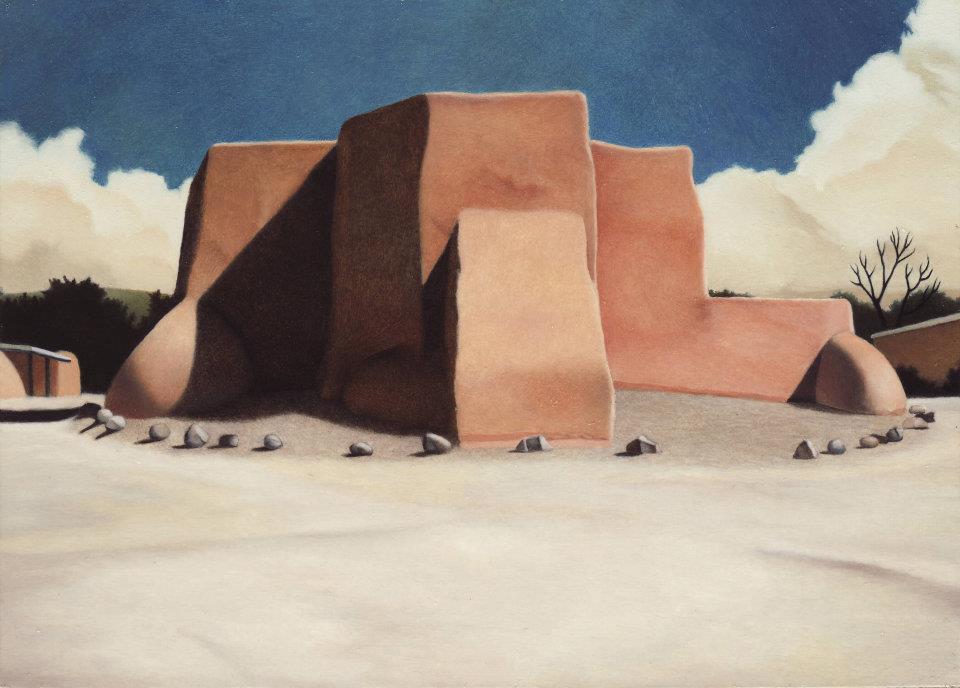
My painting of Taos Pueblo.
I just spent the better part of a week in the Santa Fe area. I've traveled, camped, and backpacked in New Mexico too many times to count, and Santa Fe is my favorite place to visit. Anyone who reads my blog knows that I delight in finding connections between seemingly far-separated subjects. Thanks to my trip, my brain is a whirl of such connections right now.

One thing that strikes me about Santa Fe is the almost painful juxtaposition of old and new. The region is the setting of Willa Cather's backward-looking Death Comes for the Archbishop (1927) as well as Aldous Huxley's forward-looking Brave New World (1931). For both authors, the pueblos represent a link to a world rooted in the past. From the former:
Father Latour lay with his ear to this crack for a long while, despite the cold that came from it. He told himself he was listening to one of the oldest voices of the earth. What he heard was the sound of a great underground river, flowing through a resounding cavern. The water was far, far below, perhaps as deep as the foot of the mountain, a flood moving in utter blackness under ribs of antediluvian rock. It was not a rushing noise, but the sound of a great flood moving with majesty and power.
     "It is terrible," he said at last, as he rose.
     "Si, Padre." Jacinto began spitting on the clay he had gouged out of the seam, and plastered it up again.
Whenever I'm in the area I pay a visit to Bandelier National Monument, where the Frijoles Canyon shelters the ruins of the ancient town of Tyuonyi, the descendants of whose builders dwell at Cochiti Pueblo to the south; perched almost on top of it is the National Laboratory at Los Alamos, where the Manhattan Project was undertaken and where the first atomic bombs were created; beyond that is San Ildefonso Pueblo. Thus are the forces of preservation and destruction violently juxtaposed.

Upon passing the National Laboratory on this trip, I was reminded of a quote from E. F. Schumacher's A Guide for the Perplexed, which I recently read:
The pursuit of science is a matter of taking stock and formulating recipes for action. Every recipe is a conditional sentence of the type, "If you want to achieve this or that, take such and such steps." [...] The test of a recipe is purely pragmatic – the proof of the pudding being in the eating. The perfections of this type of science are purely practical – the objective, i.e. independent of the character and interests of the operator, measurable, recordable, repeatable. Such knowledge is "public" in the sense that it can be used even by evil men for nefarious purposes; it gives power to anyone who manages to get hold of it. (Not surprisingly, therefore, many attempts are always being made to keep parts of this "public" knowledge secret!)
Schumacher opposes knowledge for manipulation (described here) to knowledge for understanding, without which our civilization is sinking ever deeper into "anguish, despair, and lack of freedom."

The Trinity nuclear test. [source]
"I am become Death, the destroyer of worlds."
[from the Bhagavad Gita, quoted by Robert Oppenheimer]
My interest in the history and culture of the region has led me to begin collecting pottery from the local pueblos. Each pueblo has its own distinctive style, such as the famous black-on-black technique developed by Maria Martinez of San Ildefonso Pueblo, which has been exhibited at world's fairs and major museums around the country.

My modest pottery collection. The second and third from the left are from
San Ildefonso, where many of Maria Martinez' kin are still in business.
The others are from Taos, Santa Clara, Acoma, and Santo Domingo.
I prefer to acquire the pottery by visiting the native artisans and sellers. Entering a pueblo is like stepping into a small foreign country, and you are very conscious of being a guest who might be tolerated but is not particularly welcome. Some, such as Santa Clara Pueblo, are fairly friendly and informal; others are quite strict, and some discourage outsiders altogether. On this trip I was fairly run off from Santo Domingo Pueblo for unknowingly approaching during a day of ceremonial dances, which are closed to outsiders.

Maria Martinez, who developed a new style of blackware, with physicist
Enrico Fermi, who worked on the Manhattan Project and created
the world's first nuclear reactor. [source]
At Santa Clara, a dealer from whom I ultimately bought a couple of pieces had a long talk with my family, explaining to my children in steps how the pottery was made. At one point he showed us a wedding picture of his grandparents: his grandfather, recently returned from service in World War I, in full uniform, beside his grandmother, looking rather sullen to have her picture taken, in a buckskin dress or robe, and two other men in full costume, with feathered headdresses. A wedding vase sat on the earth at their feet; ruinous adobe brick dwellings loomed behind.

My painting of the adobe church at Los Ranchos de Taos. This church
was painted many times by Georgia O'Keeffe. A thoroughly modern
abstract painter, she found refuge in northern New Mexico after her
years in New York.
Another site I never fail to visit is the Santuario de Chimayó, a major pilgrimage site and, depending on your outlook, a holy place or an instance of irrational fanaticism (or possibly a curious mixture of the two). The small adobe chapel, built in about 1816, lies at the bottom of a narrow valley on the High Road to Taos, surrounded by rocky red hills and juniper trees.

Chimayo in 1934. [source]
It resembles many such churches in northern New Mexico, with this exception: a tiny square room, called el pocito ("the little well"), reached through a door beside the altar, contains a round pit filled with "holy dirt," which can be taken away by the pilgrims and is reputed to perform cures. The long room running from el pocito alongside the nave holds numerous photos, ex-votos, and discarded crutches.

The town of Chimayó was named for a local hill, known as Tsi Mayoh in the Tewa tongue. Whether it was a site of devotion for the natives before colonial times is not clear. An old tradition holds that a pueblo formerly stood in the area; a book I have (purchased, of all places, at a tacky tourist gift shop in Clines Corners) describes the experiences of Maria Martinez upon visiting the chapel from nearby San Ildefonso.

My own picture of the Sanctuario, taken in 2007.
Most accounts have the chapel built by Don Bernardo Abeyta. An early member of Los Hermanos de la Fraternidad Piadosa de Nuestro Padre Jesús Nazareno (more commonly known as the Penitentes, about which more in a moment), Don Abeyta supposedly discovered an ancient crucifix at the pit's location while performing penitential exercises there on Good Friday sometime around 1810.

Signs in the Santuario museum suggest that the crucifix was left there by Spanish explorers. However that may be, Don Abeyta was seemingly devoted to the Christ of Esquipulas, worshiped at a basilica in Guatemala where the clay is also held to have curative properties, a belief possibly adopted from the native culture and "baptized" by the Spaniards. The museum speaks of the ceiba tree, which holds a central place in Maya mythology, hinting (on somewhat slender evidence, it is true) at other connections between Chimayó and the pre-Columbian religions of Central America.

Esquipulas Basilica, Guatemala, in 1895. [source]
The Penitentes are credited by some with preserving the Catholic faith in the area during the tumultuous period after the Catholic religious orders were expelled from Mexico. Cather's novel deals with the aftermath of this dark time very effectively. Linked with the medieval Flagellants (in spirit if not in historical continuity), the Penitentes were a secretive sect that the Church sought to suppress after the capture of the Southwest by the United States and the division of the current archdiocese from that of Durango.

An interesting book I have, Missions and Pueblos of the Old Southwest (1929), written by one Earle R. Forrest, who had once worked as a cowboy in the Arizona desert and had traveled throughout the area extensively before the arrival of the first automobiles, devotes a chapter to the Penitentes. According to him, the brothers would scourge themselves with chunks of cholla cactus woven into thongs of rope; crucifixion ceremonies were held in remote places at night, and sometimes the Cristo whose ardor was thus tested never returned.

The book is illustrated with photographs taken by the author; one depicts a Penitente morada, or meeting house, and another purports to be the only known photograph of a Penitente procession:


The piety of the Penitentes plays a role in Brave New World. The protagonist, John, raised on a Savage Reservation in New Mexico, becomes a sign of contradiction in the World State, and creates a public spectacle in his attempts at purification through self-flagellation:
"But I don't want comfort. I want God, I want poetry, I want real danger, I want freedom, I want goodness. I want sin."

Sunday, May 15, 2016

Gene Wolfe and A. E. van Vogt on the Soul

I have a number of times made known my great admiration of the stories and early novels of A. E. van Vogt. My favorite of his works are the two Null-A books, The World of Null-A (1948) and The Pawns of Null-A (1956; a.k.a. The Players of Null-A). My love is not shared by everyone. Indeed, I am quite aware of their shortcomings myself. But to me van Vogt's best works are a kind of poetry, despite a prose style that is at times almost hilariously awkward. I'm drawn to their naïve earnestness, and also the fact that main plot-movers are philosophical principles (however inadequately digested by Mr. van Vogt) rather than gadgetry.

I remember finding The World of Null-A at a used bookstore (called Treasure Aisles, I believe) in college, and taking it home, and reading it. It was a refreshing, exhilarating experience.
Gosseyn was crawling frantically along the grass when the first bullet actually struck him. It hit one shoulder and sent him spinning into the path of a burning energy beam. His clothes and flesh flared in an insanity of flame; and then he had rolled over and the bullets were focused again. They began to rip him apart as he burned with an incandescent fury. 
The unbearable part was that he clung to consciousness. He could feel the unrelenting fire and the bullets searching through his writhing body. The blows and the flame tore at his vital organs, at his legs, his heart, and his lungs even after he had stopped moving. His last dim thought was the infinitely sad, hopeless realization that now he would never see Venus and its unfathomed mysteries. 
Somewhere along there, death came.
Curtains for Gosseyn I. But then, without a word of explanation, at the beginning of the next chapter:
A curious, heavy sound impinged upon Gosseyn's attention.
As I said, van Vogt's best novels tend to explore innovations, not in technology, but in ideas. That's one of the things I like about him. One thing that often comes up in his writing is the relationship between identity and memory.

In The World of Null-A, I think it's fair to say that identity is portrayed as neither more nor less than memory. The Games Machine explains the method of posthumous transference to Gosseyn II, saying that "the death of one body is recorded on an electronic receiver, which then triggers the new body into consciousness." Prescott later tells Gosseyn that if "two energies can be attuned on a twenty-decimal approximation of similarity [units???], the greater will bridge the gap of space between them just as if there were no gap, although the juncture is accomplished at finite speeds." He goes on: "How do you explain the fact that you have in your mind the details of what Gossen I did and thought? You must have been attuned, you and he; in fact, it is the only theoretically sure method of thought transmission – you have to do it with yourself."

Thus memory and identity in The World of Null-A: the "soul" (if we may call it such) consists of a certain set of memories and traits. Copy those into a new body, and you have the very person, continued.

Now, when I blogged about van Vogt's The Book of Ptath last year, I noted a number of resemblances to the world of Gene Wolfe's Book of the New Sun. Having just finished reading that work's sequel and coda, The Urth of the New Sun (1987), which is just as rich, profound, and delightfully elliptical as the rest, I'm struck by another parallel with van Vogt's writing. Several, actually, but we'll only discuss one here.

[Spoiler alert!!!]

The reader eventually discovers that the protagonist, Severian, is going through a Gosseyn-like succession of bodies. Each body is apparently formed by directed energies and converted into a substantial form through the subsequent consumption of stable matter.
"What we did here for you, Severian, the mighty Tzadkiel accomplished there, remembrance taking from your dead mind to build your mind and you anew." 
"Do you mean that when I stood before Tzadkiel's Seat of Justice, I was an eidolon Tzadkiel himself had made?" 
Ossipago muttered, "Made's too strong a term, if I have as much access to your tongue as I like to think. Made tangible, possibly." 
I looked from him to Famulimus for enlightenment. 
"You were reflected thought in your dead mind. He fixed the image, made it whole, mended the fatal wound you'd borne." 
"Made me a walking, speaking picture of myself."
They go on:
"But I'm dead – not even here, dead back there on Tzadkiel's ship."
"Your twin lies dead there," Barbatus told me. "As another lies dead here. I might say in passing that if he weren't dead, we couldn't have done what we did, because every living being is more than mere matter." He paused and glanced toward Famulimus for help, but received none. "What do you know of the anima?" 
I thought then of Ava, and what she had said to me: "You're a materialist, like all ignorant people. But your materialism doesn't make materialism true." Little Ava had died with Foila and the rest. "Nothing," I muttered. "I know nothing of the anima." 
"In a way, it's like a line of verse. Famulimus, what was the one you quoted to me?" 
His wife sang, "Awake! For Morning in the Bowl of Night, Has flung the Stone that puts the Stars to Flight." [The first line of The Rubáiyát of Omar Khayyam. – raphordo]
"Yes," I said. "I understand." 
Barbatus pointed. "Suppose I were to write those lines upon that wall – and then to write them again upon that other wall. Which would be the true lines?" 
"Both," I said. "And neither. The true lines are not writing, nor speech either. I can't say what they are." 
"That is the way of the anima, as I understand it. It was written there." He indicated the dead man. "Now it is written in you."
Perhaps I'm seeing allusions where there are none (I have a knack for that), but in these explanations I find a gentle rebuttal to van Vogt's low-minded mechanical transference of memory data, framed as a step up to the level of metaphysics. Ironically, one has only to read Aristotle's De Anima to see how far short A. E. van Vogt fell in understanding questions involved in the nature of what is commonly called the soul.

As for Wolfe, as always, I find him a rich source of ideas for writing about eternal questions like the immortality of the soul without veering into scientific reductionism on one side or outright religiosity on the other. His explanation here strikes me as being quite close to the Aristotelian (and Scholastic) idea of the soul as the "form" of the human person.

I do dabble in such philosophy from time to time, but for me the real lesson here is a stylistic one. With a little metaphysics, Wolfe is able to take his characters through mind-blowing experiences and transfigurations without violating their basic humanity.

Friday, April 15, 2016

A Guide for the Perplexed

So, I've been reading E. F. Schumacher's A Guide for the Perplexed.

Schumacher (1911 – 1977) was by profession an economist and statistician. He was a leading figure of the ecology movement in the seventies, served as the Chief Economic Advisor to the UK National Coal Board for many years, and coined the term "Buddhist economics." He's chiefly famous for his 1973 collection of essays, Small is Beautiful: A Study of Economics As If People Mattered, which, among other things, sets forth the principles of Buddhist (or village-based) economics. Schumacher's thought is refreshingly ecumenical and global. He avoids polemics (unlike me) and cites a variety of Eastern and Western philosophical-religious insights at every level of his writing.

A Guide for the Perplexed is the perfect book for the thoughtful undergraduate. I wish I had had it back when I was a student! (Not that I was thoughtful, exactly.) Simply stated, it's a brief map of the human experience. Instead of giving answers, it teaches the student to ask the right kinds of questions.

Because he inevitably devours everything I give him, my student-friend is certain to read both books before very long, and may even wish to discuss them with me. So it has seemed wise to delve into Schumacher once again, that I might have the text fairly fresh on my mind. Despite being an aged hermit by profession (though I'm not quite as old as Dennis the Peasant), I'm still an enthusiastic freshman in life, and am getting quite a lot out of the book myself.

All of which is just a long-winded* way of saying that I read the following passage, and it stood out to me:
As regards the bodily senses, all healthy people possess a very similar endowment; but no one could possibly overlook the fact that there are significant differences in the power and reach of people's minds. As regards the intellectual senses, it is therefore quite unrealistic to try to define and delimit the capabilities of "man" as such – as if all human beings were much the same, like animals of the same species. Beethoven's musical abilities, even in deafness, were incomparably greater than mine, and the difference did not lie in the sense of hearing; it lay in the mind. Some people are incapable of grasping and appreciating a given piece of music, not because they are deaf, but because of a lack of adaequatio in the mind. The sense of hearing receives nothing more than a succession of notes; the music is grasped by intellectual powers… For every one of us, only those facts and phenomena "exist" for which we possess adaequatio, and as we are not entitled to assume that we are necessarily adequate to everything, at all times, and in whatever condition we may find ourselves, so we are not entitled to insist that something inaccessible to us has no existence at all and is nothing but a phantom of other people's imagination.
This daring intellectual humility applies to lots of things. My little artistic dust-up a couple years ago comes to mind. There's an aptness in a certain loud subset of the Internet sci-fi community to roundly condemn artistic products they don't like as mere posturing, as assaults on the senses or insults against the intellect, and to promote their own products as the truly true art. I don't have anything profound to say about it all, but the interested reader (I know you're out there somewhere) can follow the link and see the application.

* Man, I really need to work on writing shorter posts. I just don't have the time...!

Saturday, June 27, 2015

Strange Islands

In my last post, I discussed Martin Buber's philosophy of I-Thou and my own attempts to people my world with minor gods, concluding with a promise to apply these ideas to fantastic literature.

What brought all of this back to my mind was a reading of The Spiritual Canticle by St. John of the Cross. St. John is, they say, one of the great poets of Spanish literature; his Spiritual Canticle is an exposition of his poem of the same name ("Cántico Espiritual"). To me, Stanzas 14 and 15 stand out in particular:
Mi Amado, las montañas,
los valles solitarios nemorosos,
las ínsulas extrañas,
los ríos sonorosos,
el silbo de los aires amorosos,

la noche sosegada
en par de los levantes de la aurora,
la música callada,
la soledad sonora,
la cena que recrea y enamora.
In my deep and extensive knowledge of sixteenth-century Spanish, and lamentable liability to poetic licence, I render this thus:
My Beloved, towering range,
deep-delved lonesome wood,
islands strange,
thunder-flood,
zephyr's nocturne of love,

the tranquil dim
of dawn's lifting aperture,
silent hymn,
solitude's laughter,
feast that feeds and enraptures.
Regarding Line 3 of Stanza 14, John says:
Strange islands are girt by the sea; they are also, because of the sea, distant and unknown to the commerce of men. They produce things very different from those with which we are conversant, in strange ways, and with qualities hitherto unknown, so as to surprise those who behold them, and fill them with wonder. Thus, then, by reason of the great and marvelous wonders, and the strange things that come to our knowledge, far beyond the common notions of men, which the soul beholds in God, it calls Him the strange islands. 
We say of a man that he is strange for one of two reasons: either because he withdraws himself from the society of his fellows, or because he is singular or distinguished in his life and conduct. For these two reasons together God is called strange by the soul. He is not only all that is strange in undiscovered islands, but His ways, judgments, and works are also strange, new, and marvelous to men. 
It is nothing wonderful that God should be strange to men who have never seen Him, seeing that He is also strange to the holy angels and the souls who see Him; for they neither can nor shall ever see Him perfectly... [O]nly to Himself is He neither strange nor new.
God is strange; indeed, he is much stranger than even the angels could ever imagine. A point often forgotten by the dogma-bound. There is hope here for me. The strange islands of my own mind, which find their way into my stories, are, I suppose, not the strangeness of which John speaks, but perhaps they touch those outer waters as the net of islands and shifting shadows ring Tolkien's blessed Aman. Then again, perhaps not.

Regarding Line 3 of Stanza 15, John says:
In this silence and tranquility of the night, and in this knowledge of the divine light, the soul discerns a marvelous arrangement and disposition of God's wisdom in the diversities of His creatures and operations. All these, and each one of them, have a certain correspondence with God, whereby each, by a voice peculiar to itself, proclaims what there is in itself of God, so as to form a concert of sublimest melody, transcending all the harmonies of the world. This is the silent music, because it is knowledge tranquil and calm, without audible voice; and thus the sweetness of music and the repose of silence are enjoyed in it. The soul says that the Beloved is silent music, because this harmony of spiritual music is in Him understood and felt.
This calls to mind the mysterious Psalm 19:
The heavens are telling the glory of God;
     and the firmament proclaims his handiwork.
Day to day pours forth speech,
     and night to night declares knowledge.
There is no speech, nor are there words;
     their voice is not heard;
yet their voice goes out through all the earth,
     and their words to the end of the world.
It seems paradoxical. There is no speech, nor are there words; their voice is not heard; yet their voice goes out through all the earth, and their words to the end of the world. But their voice and words are their very being. By being what they are, they speak. Try to "listen" to them on any other wavelength, and you miss it. Or worse, manufacture their speech for yourself.

For me this is a cogent truth of practical import, for I tried – really tried – to hear the music of the spheres for many years. I'm currently reading A Wrinkle in Time to my kids, and enjoying it very much; but I was almost obsessed with it and Madeleine L'Engle's other books when I was about nine or ten, and, in hindsight, I think they had a tremendous influence on how I saw the world. It wasn't until I finally gave up trying to hear the "voices of the stars" that the cosmos came rushing back like a breaker crashing ashore. St. Augustine speaks of something similar in Book X of his Confessions, in his questioning of the deeps and the heavens, and their answering him in their beauty of order.

This is the kind of thing I think about while composing my sword-and-planet tales.

As I said above, I'm often really looking for a certain kind of silence in fantasy. It's not easy to put your finger on it, but lack of silence seems tied to the flippant or frivolous use of fantastic elements, to the failure to reserve these things for their proper places, to the devolution of the invented milieu into a muddled slurry which bores in its very freedom from restraint. The presence of silence brings about the recovery of which Tolkien speaks, a reconciliation with the universe.

Many modern fantasists have understood this. Their work is characterized by a spirit of listening, a sense of wonder, a willingness to go along and let things happen and see what the world has to show us. Various passages come to mind: Koshtra Belorn; the Night Land; Middle-Earth; Perelandra; Earthsea. Mystical silence isn't limited to fantasy, but fantasy is uniquely equipped to make the most of it. It's not something that can be established through the mere manipulation of material elements, and the works of your safe genre writers possess it to a much lesser degree. For there the sense of wonder has been worn away by familiarity, and the startlement that cleanses the eyes of the soul and brings recovery is no longer possible. The reader's heart becomes jaded, and she looks for new sources, of which this world contains all too few.

In these days of isolation and frustration, I admit that I find myself drawn more to hard-boiled writers like Hammett and Chandler, or to amoral S&S and weird horror by the likes of Robert E. Howard, Clark Ashton Smith, Fritz Lieber, or Michael Moorcock. But perhaps here, too, there is a kind of silence. In Hammett, for instance, there's his unrelenting desire to pare away everything but the naked skeleton of the narrative. The utter absence of any kind of moralizing (which is really just chatter in a story) comes as a great relief. To quote Nietzsche on the point:
The desert…where the strong, independent spirits withdraw and become lonely – oh, how different it looks from the way educated people imagine a desert! – for in some cases they themselves are this desert, these educated people.
To be continued!

Wednesday, June 17, 2015

I Encounter No Dryad

This is a post from 2013; I'd intended to continue it at the time, but other things came up, and I forgot about it. I've been thinking about the topics lately, though, so here it is again, in slightly modified form, to be followed by its continuation shortly, unless something comes up and I wait another two years.
Masters of the interior life teach that it's inadvisable to dwell on one's own mystical experiences, and especially to speak about them with others. As John of the Cross has it: The Bride says in her heart, my secret for myself. Part of the danger is that we come to regard them as a species of personal property or, worse, as spiritual cosmetics; still more dangerous is the fact that true contact with the divine takes place, not on the plane of concept or feeling or experience, interior or exterior, but on the plane of relation. To speak of experience is to savor the peel and throw away the meat.
O secrecy without a secret! O accumulation of information!
So I will not attempt to quantify my own experiences (insofar as I've had any). But any writer's mystical and metaphysical outlook inevitably colors his writing; my own has been profoundly affected by I and Thou (1923), the slim but rich volume by the great Jewish religious philosopher Martin Buber.

Buber begins by asserting that man's twofold attitude toward the world accords with the two "primary words" that can be spoken by man.
     Primary words do not signify things, but they intimate relations.
     Primary words do not describe something that might exist independently of them, but being spoken they bring about existence.
     Primary words are spoken from the being.
The two words, he says, are compound words. Each involves the I; when I speak a primary word, I enter it and take my stand in it. Any use of the word I is really a use of one or another of these words.
     The one primary word is the combination I-Thou.
     The other primary word is the combination I-It; wherein, without a change in the primary word, one of the words He and She can replace It.
He goes on to say:
     The primary word I-Thou can only be spoken with the whole being.
     The primary word I-It is never spoken with the whole being.
To speak I-Thou is to be in mutual relation. To speak I-It is to objectify. Think of talking to a person you love, of looking them in the eyes and addressing them as You, and how different this is from talking about someone not present as He or She. The thing is, you can use the word You and still mean It; there are people out there – narcissists and flatterers and manipulators, objectifiers and personifiers and conceptualizers – who are incapable of speaking in any other way. Such people never really live; the present is to them not the realm of eternal being, but the infinitesimal endpoint of the past.
The present is not fugitive and transient, but continually present and enduring. The object is not duration, but cessation, suspension, a breaking off and cutting clear and hardening, absence of relation and of present being.
     True beings are lived in the present, the life of objects is in the past.
Our relation with other men stands in the middle place. Below it is our relation with the world of nature; above it is our relation with the divine. Our address of I-Thou to (say) a tree may be somewhat mysterious, and take place on a dark, subliminal level, but it is real for all that. The I-It analyzes the tree according to utility, or form and color, or chemical composition, or what have you; the I-Thou sees it as it is in itself.
It can…also come about, if I have both will and grace, that in considering the tree I become bound up in relation to it. The tree is now no longer It. I have been seized by the power of exclusiveness. […]
     The tree will have a consciousness then, similar to our own? Of that I have no experience. But do you wish, through seeming to succeed in it with yourself, once again to disintegrate that which cannot be disintegrated? I encounter no soul or dryad of the tree, but the tree itself.
When we speak Thou on any plane, says Buber, we address the eternal Thou. But there is an attempt to evade this dichotomy between the past and the present, It and Thou, object and subject, by appealing to a world of ideas, by raising up a conceptual structure and dwelling in it as a bulwark against the onset of nothingness.
But the mankind of mere It that is imagined, postulated, and propagated by such a man has nothing in common with a living mankind where Thou may truly be spoken. The noblest fiction is a fetish, the loftiest fictitious sentiment is depraved. Ideas are no more enthroned above our heads than resident in them; they wander amongst us and accost us. The man who leaves the primary word unspoken is to be pitied; but the man who addresses instead these ideas with an abstraction or a password, as if it were their name, is contemptible.
When we erect such a framework and dwell in it, we barricade ourselves from relation with nature, with man, with god. Yet how frequently do men try to scale the divine heights by such means! There will come a time – in the afterlife, if not sooner – when doctrines and confessional differences will fade in significance. For there are two fundamentally different ways of approaching the divine, and the dividing line cuts right across the world of ideas, confessional boundaries, and the human heart. It isn't the division between polytheism and monotheism, but between what I (for lack of better words and at the risk of being misunderstood) will label the pagan and the mystic. It is possible to be a pagan and yet believe in one god; it is possible to be a mystic and believe in many gods. Every person is at least part pagan. A pagan is someone who speaks only I-It. To him the gods are objects to be acted upon; to him a tree is nothing unless it be fictively personified, or conceptualized, or dissected and analyzed.
[W]ithout It man cannot live. But he who lives with It alone is not a man. 
Think of the old atheists' myth about the ebbing of belief. In the beginning, the legend goes, man believed that spirits inhabited trees and springs and other such things. As his familiarity with the world in which he found himself grew, he moved the divine agencies to the relatively inaccessible mountaintops. Further exploration forced him to relegate the gods to the distant heavens. And now, enlightened by precise astronomical observations, man has to locate god in the realm of abstraction.

Whatever the historical merits of this myth – asserted by some people with the ardent faith of the fundamentalist – I would counter it with a myth of my own construction. I would say that the peopling of hill and dale with rational spirits represents an attempt to deal with a fall. (Perhaps this is the source of the myth of the Fall, as hinted by Buber.) Man, alienated from the life of things, sought to regain his place by superimposing fictive animating agencies on the world of nature. No longer able to address the tree as Thou, at least on a subliminal level, he created the dryad. The impatient atheist is indeed fighting against one front when he denounces dryads and intelligent design. He is fighting paganism. But a pagan is really only a dishonest atheist; and there are atheists who, without realizing it, are mystics.

I've written a number of posts about how my perception of nature became warped when I was a teenager, due in part, perhaps, to my cognitive disability. At the time, I sought desperately to people my increasingly empty and meaningless world with minor gods. With all the data-acquisition-lust of my autistic mind, I pored over books about nature deities, demigods, elementals, fairies, and the like, collating and cataloging. I actually sought such beings in the woods and rivers.

Surely, I thought, the testimony of so many diverse cultures could not be without foundation. And perhaps it isn't! But I never found my fairies. Despairing, I sculpted goddesses from clay; I began the construction of a pagan shrine in the backyard, never to be completed. (My parents finished the garden after I went to college, but without the statue that was to have crowned it.) My point is that my alienation from the world of nature went hand in hand with my retreat into paganism.

When man fell, Our Father Who Art in Heaven became Jupiter; literally, the names mean much the same thing, but I speak in terms of connotations. Again, I'm not opposing monotheism to polytheism. Certainly the objectification of the divine lends itself to a multiplication of gods, which is always a movement of rationalization and conceptualization. But who could argue that the polytheist Socrates lived exclusively in the world of I-It?

I have some thoughts about how these two primary words, these two attitudes, play out in art, especially in the fantasy novel. Perhaps that would best be relegated to a second post. For the time being, you, my reader, who find yourself trapped in the world of objects, consider the following, as I have, and find hope and a path to life:
Believe in the simple magic of life, in service in the universe, and the meaning of that waiting, that alertness, that "craning of the neck" in creatures will dawn upon you. Every word would falsify; but look! round about you beings live their life, and to whatever point you turn you come upon being.

Wednesday, December 3, 2014

Arts of the Beautiful: The Complete Set

Here, for convenience, are links to all of my award-winning* Arts of the Beautiful posts, collected into one handy list:
And here is a link to my earlier Arts of the Ugly post, which is thematically related.


* Not actually award-winning.

Tuesday, December 2, 2014

Arts of the Beautiful: Part III

This is a continuation of my Arts of the Beautiful post. Here is Part I, and here is Part II. We formerly noted four marks required by our interlocutor in a work of art:
  1. The work must require skill.
  2. The work must represent an object from nature.
  3. The work must evoke an emotion.
  4. The work must refer to something.
Thus far we have considered the first three. To the first we replied that skill is an accidental though humanly necessary quality, but that the skill of the artist is not precisely the same as the skill of the draftsman; also, apparent ease of execution my be the fruit of years of discipline. To the second we replied that the requirement to closely imitate physical objects in pigment confuses the categories of Art and Nature, identifying the beauty of the subject with the beauty of the painting; but we also suggested that no painting worthy of the name can be truly independent of nature, however high the degree of abstraction. To the third we replied that mood and emotion are inherently subjective, and that the only relevant emotion is the pleasure that comes from seeing a beautiful object made by hand.

So, on to the fourth mark.

Art and Word

The objection to a piece of art on the grounds that it does not refer to something is the objection of the writer. Critics and art historians are, occasionally, philistines, unable to appreciate a painting for its purely visual qualities, but their breadth of knowledge, urbanity, and circumspection make them much more difficult to detect than their less-refined country cousins.

The reason art-writers are sometimes philistines is quite simple: their trade consists of blather, and if a painting doesn't say something or express something then there's not much blather to be gotten out of it. A mute does not need an interpreter. So paintings are made to say things.* Which, by the way, they often do; only, their beauty does not flow from the artist's ideas or feelings.

Though art-writers often speak authoritatively, they rarely say anything about craftsmanship or visual appearance, which is, I think, very telling. But what indeed could really be said without sounding pedestrian? And when they do comment on visual impressions, their opinions generally boil down to, "I like this, and you should, too," or, "I don't like this, and neither should you." As such they serve a humble but important function. Find a critic whose tastes conform to your own, and you can save yourself the trouble of attending an exhibition you're not likely to enjoy. But that's the extent of their role, if what we're talking about is truly visual art.**

As to that, I confess that I find it a little peculiar to hear the objection to non-referential art from someone who decries such insults to civilization and intelligence and the tax-paying public as Piss Christ. Because it's this tragic confusion of art with communication that has led to the scourge of conceptual art, which is pure communication, in reality a pretentious form of drama masquerading as art, with the artist as star or prophet. Here is where I take a low view of modern art, which seems to me to have lost its way, with artists deliberately setting out to make for purposes wholly divorced from and sometimes diametrically opposed to visual harmony.

I recently attended a gallery opening featuring the work of an MFA student. I thought the pieces (collages, mostly) visually arresting and skillfully executed. But her artist's statement explained that she seeks to combine bad art with good art. Surely one needn't obtain an MFA to do that! Really I suppose that her statement is a coded message, and that by bad art she really means "bad art," i.e., art perceived by the arts community (or rather, the arts-appreciating but not quite with-it public viewership) as kitsch. Because what she's clearly doing is attempting to transform this "bad art" into something worth looking at.

If I were to take her at her word, though, I'd have to conclude that she's actively striving to vitiate the end to which she aspires to attain. It's like a mountain-climber giving out that he seeks to combine good with bad mountain-climbing, deliberately blundering into blind ravines and tumbling down slopes in order to make an ironical statement about the lowbrows who just climb competently to the top. You see, once he admits that mountain-climbing is no longer his primary end, he becomes something other than a mountain-climber. I can just imagine an artist, in dismissing some of her older work, saying, oh, that was my naïve good phase, when I only produced good work; I've moved past that now, into my more mature bad phase! As I say, I don't take this particular artist at her word, because her craftsmanship says otherwise, but there certainly have been many artists who did set out to produce either bad art or something that isn't art at all, to jab a thumb in the eye of the bourgeois, their great forerunner being "R. Mutt" and his famous Fountain.***

Here we have the decline of civilization! Here I earn back a bit of my curmudgeon street cred. I remember seeing a piece that consisted of Pieter Brueghel's 1563 Tower of Babel printed on a curved sheet of metal with a big piece of stovepipe or dryer hose coming out. This is just as derivative and impoverished as the statues of the late Roman emperors that recycled the old bodies of gods and heroes created in times of higher cultural attainment, replacing their heads with crude new caesars' heads. But at least Constantine wasn't pretentious about it.

To me there's nothing duller and more demoralizing than seeing a bubbling glass bowl with glowing thingees, or stacks of clay tiles on the floor, or chains of communion wafers dangling from suspended bones, or a stuffed goat with a rubber tire around it, and thinking, okay, what's this supposed to be? And then reading the placard, and saying, oh, I see. Boring and annoying.

These little artefacts are not necessarily bad, mind you. They're just not visual art as I use the term. They're a form of communication or drama. In fact, these items are nothing apart from the chatter that surrounds them, and exist as a kind of fiat currency or line of trading cards for the cultural elites, with critics serving as the guarantors of validity. I wrote about the matter at some length in my post Arts of the Ugly, which is a kind of appendix to this series.

Abstract art, though, is not a case of the Emperor's New Clothes. It is, rather, an attempt by artists to recover the essence of painting, which consists, not in trompe-l'oeil effects and topical allusions, but in being pleasing to the eye.
The extraordinary modern adventure of abstract art precisely expresses the decision, made by certain artists, to turn out works whose beauty will obviously owe nothing to that of the subject. [Arts of the Beautiful]
Vuillard, Whistler, Matisse, Mondrian, Klee, O'Keefe and the rest did not set out to create objects that offend the eye and accustom man to ugliness. Quite the contrary. They stand on the side of beauty. Marcel Duchamp's urinal militates against their project just as surely as it does against the Pre-Raphaelites'.

Beauty and Truth

Those who insist that paintings must look like something or say something true, or else face the charge of irrationality, are making a mistake in conflating the transcendentals of Beauty and Truth, which are not reducible to one another. Beauty is truth, truth beauty, but the truth of beauty is not the beauty of truth.

There is a tendency, among those with a philosophical or logical bent, to try to annex every branch of human activity into some form of inquiry, and they are particularly discomfited to find judgments of beauty beyond the reach of their syllogisms. But the true philosopher recognizes the limits of his methods. We may philosophize about art, as about anything, and debate its nature, as we've done here, but as to giving a formal logical proof of why one painting is better than another? No.

How indeed would such a proof go? "Well, this painting is bad because it violates such-and-such law." What law? Who says it's a law? Why should I regard it as universal? One can certainly argue that a given painting is no good, and list the reasons, and perhaps persuade the undecided. But no formal deductive proof is possible without axioms, and the "science" of the beautiful is simply not an axiomatic science. Any "laws" we erect are necessarily ad hoc, and liable to be violated by a master of his craft.

There's an element of the subjective in the perception of beauty. This seems obvious, but apparently it needs to be said. Beauty is, in a manner of speaking, in the eye of the beholder. This wouldn't be a cliché if there weren't some truth to it. Perceptions vary from person to person. If someone thinks a picture beautiful then you can abuse their judgment but you can't really argue with them. This is not to say that beauty is purely subjective, as some might claim. When deconstructionists assert that "beauty is in the eye of the beholder," they really mean that there is no beauty except what people choose to call beauty. I'm not saying that at all. No, the beauty is in the object, and if one man perceives it then we can expect others of similar tastes to perceive it as well. But just because one does not perceive it does not mean that it is not there.

Of course, someone may be mistaken about the ends of art, and frame their judgments accordingly, and then we may argue against their position. If they say that a painting is bad because it doesn't imitate nature, evokes no emotion, and communicates no idea, then we may reply that they aren't really talking about the beauty of art at all, and may in fact be insensible to such beauty, as the tone-deaf are insensible to music. If they say that a painting is bad because it's butt-ugly in a purely visual sense, then we may privately opine that they have a poor or unformed taste in such matters, but little remains to be said.

A Defense of Paul Klee

And now, despite everything I've just said, I'm going to attempt the thankless task of defending the work of my favorite modern artist, Paul Klee. When I say "defend," I hope by now that it's clear I don't intend to prove his work to be good. Indeed, I hold such an endeavor to be ridiculous.

Our interlocutor has said that, while tastes differ as to the beauty of women, when he meets someone whose tastes do not coincide with his own, he can at least concede that they are both talking about women, and that there is probably something to be said for the other's preferences. The same, he says, applies to representational art.**** But when it comes to abstract painting, the differences are of kind, not of degree, and the very notion of comparing the two is so offensive to reason and common sense and human decency that it makes him physically ill with disgust. As I have argued, I think him mistaken about the nature and ends of art. However, I also think the differences are of degree, not of kind, and this shall be made clear in what I have to say concerning Klee's art.

Klee, Siblings
Anyway, I'm at a loss to explain whence our interlocutor's disgust proceeds. I suppose that if a person has been trained that a painting should be a naturalistic picture of something they recognize, and is instead presented with some more abstract arrangement of color and form, they may receive a mild shock. But physical illness? I confess that the drawings of the mentally ill sometimes make me uneasy. But the drawings of children do not. Those of non-Western or pre-modern cultures do not. I am not offended by the cave paintings of Lascaux or the stylized depictions in Egyptian tombs. Why should I be disgusted by a Klee or a Picasso?

"Well," you might say, "it's all very well for a child or a savage to draw a naïve picture, but for an adult in full possession of his powers to do so designedly is worthy of nothing but contempt." But this tacitly assumes that our "primitive" painter was trying and failing to achieve the trompe-l'oeil effects so highly valued by our scientific civilization, and that his output, while good for its time, is but a crude approximation to our sophisticated techniques. This is, to say the least, a shallow view of art, culture, human perception, history, and pretty much everything. Some cultures may be more "mature" than others according to various metrics, but when it comes to perception of beauty we are all children, or should be.

Klee, Uncomposed Objects in Space
It's not uncommon for art history books to begin at the Renaissance, pretending that International Gothic doesn't even exist, or to patronize the Medievals for their flattened perspective and decorative use of color and pattern.
Let them look at Gothic Figures & Gothic Buildings, & not talk of Dark Ages or of Any Age! Ages are All Equal. But Genius is Always Above The Age. [Blake's marginalia to the works of Sir Joshua Reynolds]
Is the use of linear perspective truly more advanced? It may be more mathematical, but from a certain point of view it less advanced, dwelling as it does on chance appearances to the exclusion of what things actually are. I once saw an old photographic portrait of an Indian dignitary which had been "corrected" so as to have the richly patterned carpet parallel to the picture plane, because that's what looked more natural to the viewers for which it was intended, used as they were to Mughal miniatures and the like. Perhaps they had a point.

So I find no reason to be disgusted by a Klee painting for being childlike, flattened, distorted, or stylized. To declare oneself unable to distinguish between a child's drawing and a madman's demented scrawl is to take a low view of children indeed. And Klee's paintings are the work of no madman, either in truth or by affectation.

Klee, Mask of Fear
Perhaps a short biography is in order. Klee married in his late twenties after a somewhat loose youth, and was for a number of years a stay-at-home husband, raising his young son Felix and keeping house while his wife worked as a piano instructor. He kept a diary (the "Felix calendar") about his son's progress, and later created a puppet theater with an array of puppets to amuse him. He made no hard divisions between the art of his own childhood and his work as a professional artist, and it was during his "happy househusband" years that he developed his approach to art. He and his wife were both talented musicians with strongly conventional inclinations.

Klee was for a time an instructor at the Bauhaus, an arts academy and community that attempted to infuse a Medieval work-ethic into modern art. As his work became better known he fell under the notice of the Nazis. He began receiving subtle threats in print that expressed disgust with his work, made sneering references to his supposed Jewish heritage, and opined that his paintings were foisted upon the public by Jewish dealers intent on financial gain. At last he was forced to emigrate to Switzerland, and there died at the age of sixty before receiving citizenship, which, despite his having been born in that country, had been delayed because of his radical, "degenerate" art.

Is this the portrait of a deranged madman, a pervert, or a conspirator against all that is good and holy? None of this says that Klee's work was any good, of course, but I think it does at least suggest that a quick dismissal on culture-war grounds is unwarranted.

Our interlocutor describes Klee's work as "random," an opinion I find strangely contrary to my own visual impressions. The artist's own elliptical attempts to articulate his theory of creation indicate an intense mental concentration, as evidenced by his short but dense Pedagogical Sketchbook, which is, for me, a constant source of inspiration. It's well worth perusing for someone trying to form an understanding of Klee's method of creation.

Klee, Signs in Yellow
The book is divided into four parts. The first deals with the transformation of the travelling dot into the line, and of the line into the planar region. It identifies the open curve with the active, and the planar region with the passive, while the closed curve is referred to as medial, standing between the two. Active: I fell (a tree with an ax). Medial: I fall (under the strokes of the ax). Passive: I am being felled (with an ax). It considers the growth of structure ("purely repetitive and therefore structural") as frieze ornament and lattice ornament (my terms); these can be classified mathematically, and there are exactly seven types of the first and seventeen of the second, though Klee considers only the simplest. He also ponders the golden ratio. But throughout the motif is the "trichotomy" of active, medial, passive. Active: brain; medial: muscle; passive: bone. Or: Active: anthers; medial: bee; passive: fruit.
Already at the very beginning of the productive act, shortly after the initial motion to create, occurs the first counter motion, the initial movement of receptivity. This means: the creator controls whether what he has produced so far is good. The work of human action (genesis) is productive as well as receptive. It is continuity. (Productivity is limited by the manual limitation of the creator (who has only two hands). / Receptivity is limited by the limitations of the perceiving eye. The limitation of the eye is its inability to see even a small surface equally sharp at all points. The eye must "graze" over the surface, grasping sharply portion after portion, to convey them to the brain which collects and stores the impressions.) The eye travels along the paths cut out for it in the work.
This last is significant to me. I have sometimes wondered if my love of Klee's work is connected to my cognitive disorder, which has the effect of hyperfocusing my attention. This inability to integrate particulars into a coherent whole is a matter of degree, however, and is part of the human condition, so I'm not suggesting that an appreciation of Klee is necessarily limited to those with this disability. But perhaps his deep understanding of perception renders his work more accessible to me than that of some other artists. Perhaps.

Klee, Polyphony
Perusing the rest of the Sketchbook more cursorily, we have Part II [dimensionality: perspective and balance], Part III [the elements: earth/water/air and continuity, which may be rigid, rhythmic, or loose], and Part IV [symbol: the plumb-radius and logarithmic spiral; the arrow ("The father of the arrow is the thought: how do I expand my reach?"), vector addition, and gravity; color and the color wheel]. That Klee was such a sensitive colorist makes this last section especially worthy of study. It describes the role of color-flow in movement, and in particular its description of incandescence (blue to orange) and cooling (orange to blue) calls to mind Separation in the Evening, cited in Part II of this post. The section concludes with:
We have arrived at the spectral color circle where all the arrows are superfluous. Because the question is no longer: "to move there" but to be "everywhere" and consequently also "There!"
Klee, The Goldfish
So let's look at a couple of my favorite pictures. Here we have The Goldfish (1925), painted in oil and watercolor on paper on cardboard. Its glowing colors achieve a profound visual effect, indicating skill in the use of mixed media. It imitates nature: its subject is clearly a fish. In me it evokes various emotions, an admixture of the dread and glory of nature, particularly of the primal oceanic black night. Admittedly it refers to nothing that I know of, save the godlike golden Fish from which all others flee in terror. But as we have said, these are all material.

What I like about it, visually speaking, is the intense electric (yet patterned) warmth of the Fish itself, surrounded by a pool of inky black, with deep-sea-blue water plants and purple fishes around the periphery. The contrast presented by the near-complements is pleasing to the eye. The purples and blues of the border are nicely balanced (with warmer purples and reds at the corners), and the Fish, weighted toward the front, is well placed in the rectangular format. Change one of these things and the picture suffers severely. Even the shapes of the peripheral fish are well chosen. The eye begins at the Fish, circumambulates through the murky blues and reds and blacks, and finally returns to the Fish again, focusing, perhaps, on its staring pink eye.

Klee, Ad Parnassum
Another personal favorite, Ad Parnassum (1932), is regarded by many as Klee's masterpiece. It is painted in oil, with imprinted lines and points, the points overpainted, on casein color on canvas. Once again, it exhibits great skill in the use of materials in achieving its effects. It is plainly a picture of a mountain, with the sun and the sky and something like a ruined archway in the foreground (or maybe it's meant to be a positive shape against a sea of orange light); its title, though, announces it to have a musical theme. Parnassus was, of course, the home of Apollo and the muses, and I've read that Ad Parnassum was the title of a common musical scale or exercise. It evokes in me an emotion of serenity tinged with the melancholy of twilight.

Ad Parnassum was, incidentally, my introduction to Klee's work; I first saw it in a book called 100 Famous Paintings purchased by my mother at a Target when I was a teenager. It was the only book on art history that we owned. At the time I thought the painting one of the most beautiful things I'd ever seen. I mention this because culture warriors sometimes like to ascribe a taste for such things to the influences of a warped education, whereas my own reaction was spontaneous and untutored; my study of art history in school, such as it was, had been limited to ancient art, International Gothic, and the Renaissance.

I will note here, before proceeding to the painting's visual qualities, that its musical theme is shared by a number of Klee's pictures, e.g., Polyphony, shown above, which is similar in execution to Ad Parnassum but has a subtler unifying principle. Klee was, as I've mentioned, conventional in his musical tastes, but music seems to have run ahead of painting in its pursuit of abstraction, with compositions appreciable for their purely audible qualities appearing well before similar developments in the visual arts. To me it seems about as reasonable to reject a painting for being abstract as to reject something like Beethoven's Fifth. At any rate, I would argue that Klee's radical, "degenerate" art went hand-in-hand with his "conventional" tastes in music.

The painting appears constructed from roughly rectangular regions of flat color, but these regions are overpainted with dot-grids, and some of these dots colored so as to either blend in or complement their background, creating an almost miraculous shimmering effect. At the same time, the boldly imprinted lines create a strongly architectural quality. The warm foreground "ruins" lead the eye upward and to the right, to the middle of the right-hand side; then the majestic "mountain" ascending from the velvet gloaming leads the eye skyward into sunlit heights, until we come to rest at the general focal area: peak, sun, and cloud. The sun itself, a flat, dull orange, sets the rest of the colors on fire.

Church, The Parthenon
The painting's overall effect, from visual structure and color scheme to mood and theme, is, to me, comparable to Frederick Edwin Church's 1871 painting of the Parthenon. The color here is not as saturated as in a book I own, so the effect of the colors isn't quite the same as what I'm referring to, though of course you can't ever really trust reproductions.

Well, perhaps this is as good a place as any to stop. Klee's output was massive, and it's not uncommon to pick up two monographs with little intersection. Some of his pictures are, in my opinion, not as successful as the ones I've presented here, but he never ceased experimenting with styles and materials.

It seems appropriate to end with his own words:
Presumptuous is the artist who does not follow his road through to the end. But chosen are those artists who penetrate to the region of that secret place where primeval power nurtures all evolution. 
There, where the power-house of all time and space—call it brain or heart of creation—activates every function; who is the artist who would not dwell there? 
In the womb of nature, at the source of creation, where the secret key to all lies guarded. 
But not all can enter. Each should follow where the pulse of his own heart leads. [Paul Klee on Modern Art]
Or, as a final epigraph:

Art does not reproduce the visible;
rather, it makes visible.


* Rather, recent paintings are made to say things. In books of art history, old paintings are reduced to sets of allusions. If you want to get really depressed, pick up a fine art history book put out by Phaidon or some such publisher and actually read the garbage they print in the white space left over by the pictures. The historical, scriptural, and mythological tidbits trotted out (cloppety-cloppety-clop) by the people they find to write these things seem to have come from hazy memories of the appendix at the back of the workbook they were given in their undergraduate art appreciation class. A book I have on Piero della Francesca, for instance, solemnly states that Christ's family "settled in Jerusalem." Another, a book on the Pre-Raphaelites, explains that Rossetti's painting of the Annunciation was controversial because it places a halo around the dove, which was an unconventional treatment for "animals" at the time. This was, it seems, the author's own construction. No evidence of controversy is given, nor any sign that the author has the least familiarity with the countless paintings of the same subject produced throughout Europe from the Middle Ages on.

** I'm speaking of art criticism here, not literary or film criticism; fiction doesn't seem to fit neatly into the category of arts of the beautiful, and the problem of identifying the causes of failure or success is a manifold one, requiring considerable powers of reason.

 
*** The original, I mean, not the limited-edition replicas, which are priceless art treasures to be protected at all costs from being used for their apparent purpose.

**** A comparison fraught with danger for two reasons. First, women are human persons, not objects, whereas paintings are objects. Second, an appreciation for the beauty of women involves an element of sexual desire, whereas an appreciation for the beauty of a painting as such is purely intellectual. It has been pointed out that there are no tactile, olfactory, or gustatory arts  of the beautiful because these senses are too involved in the animal appetites, which run toward sex and food (as observed by Aquinas, I believe). Only visual and auditory arts are possible. The admiration of a cheesecake picture or an actual physical body involves, at least unconsciously, an imaginary physical encounter, and so takes place on a different plane from the disinterested pleasure evoked by a beautiful painting.