Showing posts with label noireviews. Show all posts

Monday, October 23, 2017

Noir Reviews: The Big Sleep, August 1946

I've been stalling in my rain-soaked, smoke-stained traipse through film noir because I've gotten to what's probably the second most well-known noir (after The Maltese Falcon, of course): The Big Sleep. In short, The Big Sleep is simply too big for me to cover. I mean, it's a Chandler adaptation, written by Leigh Brackett (!) and William Faulkner (!!), directed by Howard Hawks, and starring Bogart & Bacall! So, instead of "reviewing" it, I'll just pontificate on what's struck me about the movie down through the years.

The Big Sleep was one of the first noirs I ever saw. This was long before I read the novel, which I've now read many times. Reading the book has, unfortunately, diminished my enjoyment of the movie considerably, but I'll come back to that in a moment. Back when I first saw The Big Sleep I became obsessed with it. I watched it numerous times, trying to capture something that eluded me. That something was an understanding of the plot. To put it simply, I loved the movie, but found it incomprehensible at the same time.

Now, I can be a little slow on the uptake when it comes to the humans and their motivations, but I've come gradually to realize that my lack of comprehension wasn't altogether my fault. This is for two related reasons:
  1. The Big Sleep speaks in what we might call "Hays code," a language I didn't understand at the time.
  2. The Big Sleep does not, in fact, make a great deal of sense.
Let's look at each in turn.

I remember reading the description of The Big Sleep on the back of the box before watching it for the first time. Pornographers were mentioned. Pornographers! Imagine my disappointment when I got to the Bogie-and-Bacall cigarettes smoldering in their shared ashtray at the end with nary a hint of these sleazy, soulless pornographers having passed before my eyes. I watched and rewatched the movie. I even asked third parties. Nothing. In the end (I'm embarrassed to admit this now) I concluded that the "pornographers" were just a figment of marketing hyperbole.

And then I read the novel, and I was like, O-o-o-o-oh.

But listen. I grew up in the eighties and nineties. If a director wanted to show us something, they showed it. None of this implicit stuff. But so much that goes on in noir isn't stated explicitly. It has to be inferred. I can think of a reference to abortion in They Live by Night, for instance, or to make-up sex in Criss Cross. In a way, movies these days, with all their box-checking and point-counting for MPAA ratings, might go far beyond Hays code films in isolated F-bombs and nipples, but never come near the alienation, the raw cynicism, and the savage moralism of film noir.

All that said, The Big Sleep leaves so much to inference that the plot suffers. Carmen Sternwood, instead of being stark naked when Geiger is killed, is fully clothed, as she is when Marlowe finds her in his apartment. If the games Geiger plays with Carmen amount to taking pictures with a weird Buddha head while she's high on laudanum, it's hard to see what all the fuss is about. There's the whole play with the books, of course, but so much is removed from the narrative that there's hardly even a hint left. (Though perhaps a part of the problem is that I've grown up in an era when porn is a lot easier to come by.)

A few other plot elements that get washed out for one reason or another include Carol Lundgren's characterization as Geiger's young male lover, the transformation of the novel's Vivian Regan (the wife of the man whose murder Marlowe is unwittingly investigating) into the Vivian Rutledge of the movie, and Carmen's almost terrifying depravity.

The film's incoherence doesn't end with all that, however. The dialogue goes in circles from scene to scene. Clues mysteriously appear and disappear. For instance, in one scene, Vivian brings up Eddie Mars voluntarily, telling Marlowe that Shawn Regan ran off with Mars's wife. Later, during that famous horse-race sexytalk scene (which is delightful), Marlowe asks Vivian whether she knows that Shawn Regan ran off with Eddie Mars's wife. "Who doesn't?" she nervously replies, apparently forgetting that she's the one who told him.

Immediately after that conversation ends, Marlowe telephones Mars from the restaurant and makes plans to meet him at his gambling house. Mars tells him to come on up at once, and he does. When he arrrives, he finds that Vivian has somehow beaten him there, despite (apparently) having stopped somewhere to change into a completely new outfit, and is now ensconced with the band as though she's been there all night. (It's a little sad that the gambling house is everything Chandler mocks in Hollywood gambling houses.) And then he goes and talks to Mars and starts making perceptive guesses about...Mrs. Mars and Shawn Regan! After which a scene is staged to convince Marlowe that Mars and Vivian have no connection, although she's the one who told him about the "bond between Eddie Mars and the Sternwoods" in the first place!

To be fair, the horse-race scene, and, to some extent, the resulting incoherence, is the result of a re-shoot aimed at emphasizing the chemistry between Bogart and Bacall. And some confusion comes straight from a plot hole in Chandler's novel. But I think that what really mixes the movie up is the fact that someone, somewhere, decided that Vivian Regan Rutledge had to be the damsel in distress, whereas the novel makes it clear that Carmen is the princess who must be rescued – Carmen, the vicious, unintelligent little-girl-in-a-woman's-body who poses for high-class smut and pulls the wings off of flies. In contriving to have Vivian become central to the plot, the script is forced to minimize Carmen's role and have Vivian continually pop up where she doesn't belong. I mean, why on earth would she be hanging out at a hot car drop with Mona Mars?

Obligatory Dead Men Don't Wear Plaid reference. Carl Reiner gets it.
So the displacement of Carmen spoils the plot's dark irony and violates Chandler's maxim that the private investigator loses his integrity by settling down with a love interest. Somehow, though, the ending remains undeniably cool, comparable in a way to the dynamic and uncertain ending of Blade Runner (in the director's and "final" cuts, of course).

* * *

I give The Big Sleep a grade of A for awesome on the following scale:
  • A: awesome noir film, to be owned and watched a zillion times or until you have it memorized
  • B: good (bueno) noir film with excellent passages but significant flaws, to be watched on occasion
  • C: fairly commonplace noir film, to be watched once or twice
  • D: dud of a noir film, to be avoided if possible
Yes, it's nonsensical, which just goes to show you that movies don't have to make sense to be awesome. High points include pretty much every moment of dialogue, but perhaps especially the hothouse scene, the horse-race sexytalk scene, and the tough-guy scene with Elisha Cook, Jr., plus the two cigarettes at the end.

Takeaway quote from The Big Sleep:

"Get up, angel, you look like a Pekingese."

*** If you've enjoyed this review, maybe you'd enjoy my reviews of other noir films: IntroductionPhantom LadyDouble IndemnityMurder, My SweetDetourScarlet Street The Blue DahliaThe Lost WeekendGilda and The Lady from ShanghaiThe Stranger ***

Friday, August 4, 2017

Noir Reviews: The Stranger, July 1946

Our last noir review took in a 1947 Orson Welles film; moving back in time, let's look at his lesser-known movie The Stranger.

Welles himself plays the villainous main character, Franz Kindler, a clockwork-obsessed high-ranking Nazi fugitive who has somehow already gotten himself a job as a prep school teacher (alias Charles Rankin) in one of those irritatingly picturesque New England towns you see in movies. What's more, he's engaged to be married to the daughter of a Supreme Court justice! Their wedding takes place in the first few minutes of the movie, right after he murders his former right-hand man Meinike and buries his body in the woods.

Edward G. Robinson plays the investigator who tails Meinike into town, hoping the little fish will lead him to a bigger fish. Loretta Young plays the wife who gradually discovers that she's married to a monster.

The plot is fairly suspenseful. For someone like me, though, who enjoys noirs for their skewed morality, there's not a lot going on here. The villain is indubitably wicked and portrayed without an ounce of sympathy. He's not even interesting. The investigator is a stolid, righteous man bent on bringing an evildoer to justice. The wife is good and kind, and carefully absolved of psychological collusion. Her deadly coolness at the end does a lot to redeem the movie. For the most part, though, it's unworthy of its director.

Still, The Stranger does have some nice touches. The garrulous checkers-playing drugstore owner (Billy House) steals every scene he's in, even when he shares it with Edward G. Robinson. A couple of scenes move fluidly from the street into the drugstore, and there are some other subtle long takes.

Apart from a bizarre, impassioned anti-German speech intended to throw the investigator off the scent, Kindler's ideology doesn't play a big role – he could have been any kind of criminal, really – but the film does make use of some actual death camp footage, which is a bit shocking even at this distance and must have been much more so at the time. Now that's moral grayness for you: using one of the greatest atrocities the world has ever known as fodder for a trite thriller not two years after Auschwitz closed.

Nietzsche isn't mentioned by name, but I suspect that Welles tried to make his character resemble the famous photo portrait of the philosopher.


Nietzsche has been widely blamed (somewhat unjustly, I believe) for having inspired the Nazis. He adulated Frederick the Great, as the Nazis also did, and Kindler is shown delivering a lecture on Frederick to his prep school students.

The Stranger is in the public domain; you can watch it here.

* * *

I give The Stranger a grade of C for commonplace on the following scale:
  • A: awesome noir film, to be owned and watched a zillion times or until you have it memorized
  • B: good (bueno) noir film with excellent passages but significant flaws, to be watched on occasion
  • C: fairly commonplace noir film, to be watched once or twice
  • D: dud of a noir film, to be avoided if possible
It's not a bad movie, but it's more of a Hitchcock-style thriller than a true noir. Film noir is about good, ordinary, decent people being guilty, not about evil monsters being guilty. High points in The Stranger include the strangulation scene, the drugstore checkers games, and the clock tower confrontation.

Takeaway quote from The Stranger:

"Good night, Mary. Pleasant dreams."

*** If you've enjoyed this review, maybe you'd enjoy my reviews of other noir films: IntroductionPhantom LadyDouble IndemnityMurder, My SweetDetourScarlet Street The Blue DahliaThe Lost WeekendGilda and The Lady from Shanghai ***

Monday, July 31, 2017

Noir Reviews: Gilda and The Lady from Shanghai

The first was released in February 1946; the second, in December 1947 (France) and June 1948 (United States). Both star the unbearably sexy Rita Hayworth with a singing voice dubbed by Anita Kert Ellis. Both take place at least partly in exotic locales. In each, a rich and powerful but impotent older man hires a virile younger man to watch over his seductive younger wife, leading to trouble of the femme fatale variety. I'm therefore going to take the liberty of reviewing them together. A little compare-and-contrast.

In Gilda, Glenn Ford plays small-time gambler Johnny Farrell, who uses cleverness, knavery, and machismo to become the right-hand-man of swordstick-toting Buenos Aires nightclub owner Ballin Mundson (George Macready). Mundson likes to talk about his "little friend" (the swordstick):
Mundson: It is a most faithful and obedient friend: it is silent when I want it to be silent, but talks when I want to talk.
Johnny: Is it that your idea of a friend?
Mundson: That is my idea of a friend.
Johnny: You must lead a gay life.
There's a certain...undertone...to their relationship. How intentional it is I don't know. But it's definitely there.

Before long, though, Mundson acquires a trophy wife, a nightclub performer named Gilda (Hayworth) with whom Johnny happens already to be acquainted. Hayworth's kittenish head-toss must be one of the most memorable entrances in movie history. When I first saw Gilda, I racked my brain to remember where I'd seen it before, and then it came to me: it's the shot used in The Shawshank Redemption, which is a movie a lot of people like and I hate.

Johnny and Gilda very clearly still love one another, but it's a sick kind of love that expresses itself in hate. They're obsessed with punishing and destroying each other. There are some rather improbable happenings involving tungsten mines and plane crashes. I won't bore you with the details. Suffice it to say [spoiler alert!] that the movie stabs the viewer in the back by letting the principals off with a sentimental happy ending when they clearly should have killed each other or something. Hey! Didn't someone tell me this was a film noir?

Now, if the plot of Gilda is improbable, then the plot of The Lady from Shanghai is utterly bonkers. This seems to be at least partly an editing issue. It was directed by Orson Welles, who ran into the production problems that plagued his entire career. What we have of The Lady from Shanghai is magnificent, if bizarre and nonsensical; I don't suppose we'll ever know what it might have been.

The sturdy young man, Michael O'Hara, is played by Welles himself. He's hired by a disabled defense attorney named Arthur Bannister (Everett Sloane) to serve aboard his yacht and keep his wife Elsa (Hayworth) company as they sail from New York to San Francisco by way of the Panama Canal. Bannister's weird, slightly unhinged partner Grisby comes aboard partway through the journey.

Michael finds himself increasingly entangled in the Bannisters' depraved, world-weary emotional intrigues. An atmosphere of fever, madness, and apocalyptic gloom hangs over it all. Even apart from Grisby's ravings, there's an overarching sense that things are coming apart, that the world is ceasing to cohere. Soon bombs are going to start falling; already men are feeding on men. At a grim picnic on a torrid tropical beach Michael observes:
Once, off the hump of Brazil I saw the ocean so darkened with blood it was black and the sun fainting away over the lip of the sky. We'd put in at Fortaleza, and a few of us had lines out for a bit of idle fishing. It was me had the first strike. A shark it was. Then there was another, and another shark again, till all about, the sea was made of sharks and more sharks still, and no water at all. My shark had torn himself from the hook, and the scent, or maybe the stain it was, and him bleeding his life away drove the rest of them mad. Then the beasts to to eating each other.In their frenzy, they ate at themselves. You could feel the lust of murder like a wind stinging your eyes, and you could smell the death, reeking up out of the sea. I never saw anything worse...until this little picnic tonight. And you know, there wasn't one of them sharks in the whole crazy pack that survived.
That monologue, incidentally, appears to be based on a chapter of Moby-Dick, a book that fascinated Welles throughout his career; he later explored it with a play, and himself played Father Mapple in John Huston's film.

What a beautiful, unsettling movie The Lady from Shanghai is. True, I've never been able to make head or tail of the murder plot. Who was supposed to shoot whom and why? Who was fooled and by whom and for what purpose? I'm still not certain. Maybe the film was just cut too deeply in the editing process. On the other hand, it does end in a surreal empty funhouse, which happens to be a perfect metaphor for the movie as a whole. It's crazy, so you just have to surrender yourself to it and gaze at what you see in wonder.

So, if you want a decent, reliable movie with a happy ending, watch Gilda; if you want the deeply flawed yet enigmatically beautiful work of a genius, watch The Lady from Shanghai.

Wait, what's that? You just want to look at Rita Hayworth for an hour or so? Well, my lowbrow friend, if you want to see the long red hair she's famous for, watch Gilda. If you settle for The Lady from Shanghai, be prepared to see her locks cut short and bleached blonde. Welles and Hayworth were going through a divorce at the time.

Me? I'll take The Lady from Shanghai on both counts.

* * *

I give Gilda a grade of C for commonplace and The Lady from Shanghai a grade of B for Bueno on the following scale:
  • A: awesome noir film, to be owned and watched a zillion times or until you have it memorized
  • B: good (bueno) noir film with excellent passages but significant flaws, to be watched on occasion
  • C: fairly commonplace noir film, to be watched once or twice
  • D: dud of a noir film, to be avoided if possible
High points in Gilda include Hayworth's entrance and her "Put the Blame on Mame" performance (which is dubbed over, though she sings it on her own later in the movie). High points in The Lady from Shanghai include the dreary tropical picnic, the hall of mirrors shoot-out, and every time Grisby says "tarrrrrr-get practice."

Takeaway quote from Gilda:

"Hate is a very exciting emotion. Haven't you noticed?"

From The Lady from Shanghai:

"It's a bright, guilty world."
*** If you've enjoyed this review, maybe you'd enjoy my reviews of other noir films: IntroductionPhantom LadyDouble IndemnityMurder, My SweetDetourScarlet Street The Blue DahliaThe Lost Weekend ***

Tuesday, June 6, 2017

Noir Reviews: The Lost Weekend, November 1945

Billy Wilder, the director responsible for three of the best noirs (Double Indemnity, Sunset Boulevard, and Ace in the Hole), claimed that he made The Lost Weekend in order to explain Raymond Chandler to himself. Portraying the anatomy of an alcoholic's binge in excruciating psychological detail, it's regarded as one of the best depictions of addiction in film.

Ray Milland plays a washed-up writer named Don Birnam who, despite the best efforts of his long-suffering brother and girlfriend, remains a hopeless, self-loathing drunk. The film follows him over the course of the titular weekend, from the ebullience of his first drinks down through an inferno of desperation and humiliation to the uttermost nadir, the horror of delerium tremens. His backstory is told in flashbacks, portraying him, not as a promising writer who fell prey to alcohol, but as a precocious hack who turned to booze as a crutch for his inadequacies. He's painfully honest with himself about who he is, roasting perpetually in shame and self-hatred.
Don't wipe it away, Nat. Let me have my little vicious circle. You know, the circle is the perfect geometric figure. No end, no beginning.
Playing the faithful girlfriend Helen St. James, is Jane Wyman, who went on to become Ronald Reagan's first wife. (Did you remember that he was divorced?) Don treats her like dirt, of course, and her almost maniacally bright and hopeful face as she forcefully cares for him and forgives him again and again almost gives me the creeps. Am I just a cynic, or is this intentional? You almost want to take her by the shoulders and shout, "What are you thinking? Get out while you still can!"

More to my warped taste is Gloria, a barfly and "escort" who has a liking for Don. She's a relatively minor character, but I like the way she's drawn. The half-fascinated, half-disgusted bartender Nat is another nice touch. The two actors (Doris Dowling and Howard Da Silva) also appeared in The Blue Dahlia.

The film ends [spoiler alert!] on a hopeful note that I find a bit jarring. Don's binge is portrayed as just the latest in a series, but it resolves itself with the promise of a new beginning. In fact, Don appears to have been "cured" by Helen (who never finds out about his dalliance with Gloria, fortunately). He plans triumphantly to tell his inspirational story in print and thus become a true writer at last. The thing is, I don't think it's ever as easy as that.

Maybe Wilder intends us to imagine this happy ending as just another false hope, the final act in a drama that repeats itself endlessly, and will replay in about two weeks, when Don is once again mischievously hiding bottles from his brother while promising that he's still on the wagon. That would certainly make The Lost Weekend the perfect noir. And yet I don't get the feeling that this is what Wilder intends. Which, alas, forces me to view The Lost Weekend as lying somewhere on the periphery of film noir.

* * *

I give The Lost Weekend a grade of B for bueno on the following scale:
  • A: awesome noir film, to be owned and watched a zillion times or until you have it memorized
  • B: good (bueno) noir film with excellent passages but significant flaws, to be watched on occasion
  • C: fairly commonplace noir film, to be watched once or twice
  • D: dud of a noir film, to be avoided if possible
Remember, I'm rating films as films noir, not as films. A great film may be a lousy noir. Despite being a gritty, realistic, psychologically grueling depiction of addiction, and an excellent movie in its own right, The Lost Weekend ends in a way that keeps it out of the dark, guilt-sodden heart of true film noir.

High points in The Lost Weekend include the dancing coats and the horrid bat-attack. Takeaway quote:

"Delirium is a disease of the night. Good night."

*** If you've enjoyed this review, maybe you'd enjoy my reviews of other noir films: IntroductionPhantom LadyDouble IndemnityMurder, My SweetDetourScarlet Street The Blue Dahlia ***

Tuesday, March 14, 2017

Noir Reviews: The Blue Dahlia, April 1946

Thus far in our seamy traipse through the back alleys of film noir, we've viewed a screenplay co-written by Raymond Chandler and a film based on his novel Farewell My Lovely. Tonight (it's always night here) we consider our first film written by Chandler alone: an Alan Ladd / Veronica Lake vehicle called The Blue Dahlia.

This is the first Ladd-Lake noir I've reviewed, incidentally, but it's not the first they made. It followed This Gun For Hire (based on a Graham Greene novel) and The Glass Key (based on a Dashiell Hammett novel). I think the acting is best in This Gun For Hire. What fascinates me about The Blue Dahlia are the personalities involved in its making.

Ladd plays Johnny Morrison, a discharged naval officer returning home to find his wife dallying (well, more than dallying) with a shady nightclub owner. There's an extraordinarily tense and well-acted domestic scene, in which his inebriated wife reveals having killed their son in a drunk-driving accident. Things get ugly, he walks out, and she gets murdered. It's your standard whodunit, though it could have been so much more, about which more in a moment. I've never been much into mysteries; the mystery stories I like are compelling because of their action, whether or not I happen to know who the killer is. So I'm a bit tepid about The Blue Dahlia.

But it does contain some excellent noir sequences, mostly stemming from Johnny's descent into the social underworld after he becomes the prime suspect. (That's a theme we've been seeing a lot: the ever-present threat of slipping from an ordinary, respectable life into a world to which an entirely different logic pertains.) Other than his having served in the navy and married a tramp, we don't know much about Johnny, but apparently he's a tough guy. He gives a hotel owner who tries to blackmail him an efficient but thorough beat-down, and single-handedly takes out a few gangsters at a remote cabin.

I can see why some people find the Ladd/Lake pairing so compelling, but they're hardly at their top form here. Too well-known, I suppose. Veronica Lake's performance is particularly bland, and vastly inferior (to my mind, at least) to her work in This Gun For Hire. You're always reading about how short they both were and how this is the reason they appeared together so often; since I'm shorter than Ladd, and my wife is about Lake's height, I'm probably less amazed by this than other people, but I suppose it is usual to use tall people in movies.

Lake had a sad life, destroyed by alcohol and ending in destitution. Her last film, Flesh Feast, a low-budget horror picture shot in 1967, has a terse synopsis on Wikipedia: "While convincing everyone the flesh-eating maggots are for regeneration research, she simply wants to throw them in the resurrected Hitler's face, which she does." She died not long after of hepatitis and kidney failure.

The characters in The Blue Dahlia very well-drawn, as one would expect in a Chandler screenplay. The sneaky house dick, "Dad" (Will Wright), is particularly good, as are Johnny's war buddy, Buzz (William Bendix), and the nightclub owner (Howard Da Silva). Doris Dowling is excellent as Johnny's wife, Helen. Though not a large role, it's fairly subtle, as the script doesn't allow us to view her as a simple tramp, and Dowling performs it with considerable nuance. And the reaction of the maid upon finding Helen's corpse, when we expect her to scream but she just says something like "Oh, brother!", cracks me up.

The ending, unfortunately, is a bit forced, not to mention corny. But thereon hangs a tale. A legend, really.

[Spoiler alert!]

Apparently, Chandler originally had Buzz, a wounded veteran with a plate in his head, who suffers frequent blackouts and has a faulty short-term memory, as the killer. Buzz was supposed to have executed the wife under great stress and anger, and then blanked out completely, never putting his own thoughts together enough to discover that he is the culprit, though the fact becomes apparent to everyone around him. Unsurprisingly, the Navy didn't like this resolution, and Chandler was forced to change the ending. A massive bout of writer's block ensued. As studio pressure mounted, Chandler finally promised that he would complete the screenplay if he resumed drinking and was guaranteed six secretaries and two limousines standing by at all times. He finished the script in eight days, apparently more or less drunk the whole time. But what had been a daring psychological study had turned into a simple murder mystery.

All of which reminds me that I somehow skipped The Lost Weekend, in which Billy Wilder purports to explain Chandler to himself. It happens also to star Doris Dowling and Howard Da Silva. I'll go back to it right away.

* * *

I give The Blue Dahlia a grade of C for commonplace on the following scale:
  • A: awesome noir film, to be owned and watched a zillion times or until you have it memorized
  • B: good (bueno) noir film with excellent passages but significant flaws, to be watched on occasion
  • C: fairly commonplace noir film, to be watched once or twice
  • D: dud of a noir film, to be avoided if possible
Not a bad noir film, but it could have been ever so much better.

Takeaway quote:

"How often do they change the fleas?"

*** If you've enjoyed this review, maybe you'd enjoy my reviews of other noir films: IntroductionPhantom LadyDouble IndemnityMurder, My SweetDetourScarlet Street ***

Wednesday, March 1, 2017

Noir Reviews: Scarlet Street, December 1945

Continuing our guilt-sodden adventure through film noir, we arrive at Scarlet Street, the first of our entries directed by Fritz Lang.

Lang was one of the great directors of the German Expressionist period. His work includes the historical fantasy Die Nibelung and the science fiction epic Metropolis (both silent) as well as the proto-noir M, starring a young Peter Lorre in the lead role of a child murderer. His American work includes several understated noirs that I think should be better known.

These include both Scarlet Street and its sister film, The Woman in the Window, which feature the same principal actors (Edward G. Robinson, Joan Bennett, Dan Duryea) and follow a somewhat similar plot. The Woman in the Window came out earlier, and is well worth watching, aside from one almost fatal flaw. If you've seen it you know what I mean. Maybe I'll come back to it later.

Incidentally, Scarlet Street is in the public domain: watch it here or here. As usual, I've taken this as an invitation to decorate my post with my favorite stills.

Based on the French novel La Chienne (I'll let you Google-translate that), which had been dramatized and turned into a film in the 1930s, Scarlet Street is, by parts, a sex farce, a satire on the art world, and a psychological thriller. More than anything, it's the cruel dissection of a shy, naive little clerk who becomes an adulterer and murderer and literally descends to hell.


Strangely, it's also full of intentional humor. I actually laugh out loud when I watch it. Some scenes might almost have come from a Frank Capra film. The cheap, chiseling duo played by Dan Duryea and Joan Bennett seem like they'd be more at home in a screwball comedy. And Edward G. Robinson's character could be one of the artistic eccentrics in You Can't Take It with You.


One scene in particular, which provides an unexpected twist toward the end, cracks me up every time I see it. Taken as a whole, it's hard to know what to make of Scarlet Street. It's like a Capra film gone off the rails, ending in perdition.

Chris Cross (Robinson) is a lowly cashier who just received his gold watch for long and dedicated service to his employer. We first see him at the foot of the table, viewing the back of his round head well before we see his face. All eyes are on the opposite end of the room, making him a dark counterweight to the center of attention. He, too, is focused on his host, but our own eyes are drawn to his negative presence. He already looks like a culprit.


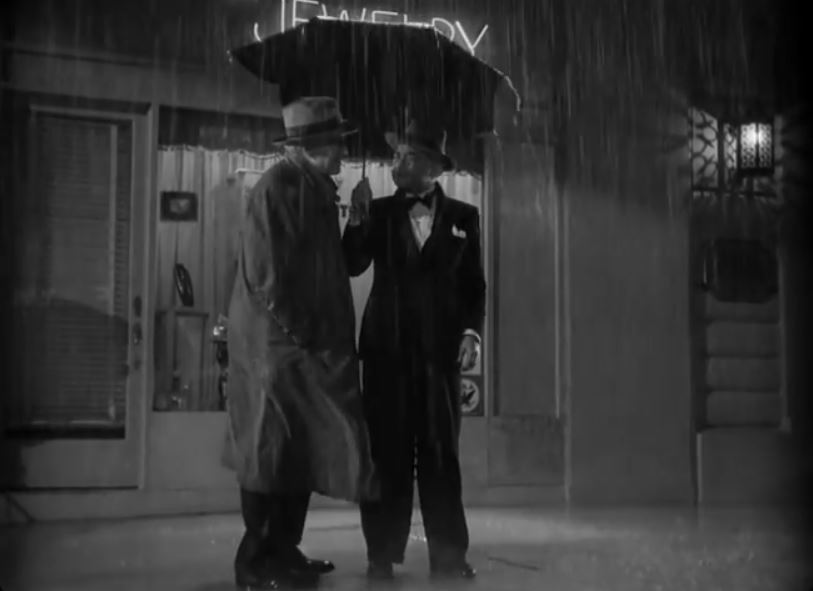
The city into which he emerges is a lonely closed world. Maze-like sets with no visible exit make the viewer feel boxed in. Squalor and shabbiness seem ubiquitous. In one of the film's many strange, striking shots, Chris balances a jewelry sign on a broken umbrella as he waits with his friend for a bus. Nothing says noir like dark, rainy streets with neon signs.


Chris is a Sunday painter with no formal training, somewhat like Henri Rousseau, on whom I suspect his character is partly modeled. Like Rousseau, he plods through a workaday existence while pursuing his art when he can, however he can.


He paints in the bathroom because his domineering landlady-become-wife is quite vocal in her contempt for his pastime. Indeed, it's her threat to destroy his work that drives him over the brink. There's a delightful scene in which Chris, after having listened to her shrilly berate him and order him to do the dishes (a task for which he dons a frilly apron), sits through the opening of "The Happy Household Hour" and a brassy soap commercial blasted from the radio downstairs.


Nevertheless, for all his amateurishness, self-effacement, and desperation, Chris is a true artist with the heart of a poet, dedicated to his vision of reality and his craft.
Sometimes [it takes] a day [paint a picture], sometimes a year. You can't tell. It has to grow...
     Feeling grows. You know, that's the important thing, feeling. You take me. No one ever taught me how to draw, so I just put a line around what I feel when I look at things...
     It's like falling in love I guess. You know, first you see someone, then it keeps growing, until you can't think of anyone else...
     The way I think of things, that's all art is. Every painting, if it's any good, is a love affair...
     There aren't many people you can talk to this way. So you keep it to yourself. You walk around with everything bottled up.
Kitty March (Bennett), a.k.a. "Lazylegs," an attractive but stupid and slovenly young woman who stands in for the prostitute of the original story, enters the picture when Chris "rescues" her from her boyfriend, Johnny Prince (Duryea), as the latter beats her for holding out on him.


Of course Chris misapprehends the whole situation. He comes to idolize Kitty and starts sending her schoolboy love letters. He naively translates the episode into paint, turning Johnny into a serpent from which Kitty must be protected.


The picture is a glimpse into Chris's brain, a visualization of his jarringly childlike view of reality. He never guesses that Johnny and Kitty, thinking him a well-respected, affluent artist, have hatched a plot to string him along and soak him for cash.


Incidentally, Chris's paintings, which I find reminiscent of Rousseau and other self-taught artists, were executed by the artist John Decker, one of whose works plays a central role in the prison noir Brute Force. Most of them look like deliberate attempts at naive art or outsider art, with the exception of a beautiful and unsettling portrait of Joan Bennett. (Funny that both Scarlet Street and The Woman in the Window revolve around portraits of Joan Bennett. I like this one much better.)


Looking at these paintings, we get the sense that Chris inhabits a very different world from the people around him. His work, however, is discovered by a highbrow art critic, and, because everyone thinks the beautiful Kitty is the artist, it's a sensation.


Because, obviously, no one would be interested in paintings produced by an ugly little cashier. Chris admits as much himself. But he's overjoyed by his "discovery," happy only to have his work appreciated and caring nothing for the fame.

Nevertheless, his many secret compromises, obviously never clearly thought out, are putting him in an impossible situation. As the strain increases, so does his willingness to do anything to escape. Every so often we glimpse how close he is to the edge. Like the subtly acted scene in which he tries to "help" his wife off with her coat while cutting liver.


It comes as a shock to see how close he is to murdering someone. But no one around him is aware of his increasing desperation. Then the walls close in at last and his illusions are shattered, leaving him with only one way out. Here the film takes an abruptly dark and nasty turn.


Now, if you're a member of the "literally" police, you might have noted my use of that word up above, and thought, what, are there fires and devils with pitchforks? Well, it all depends on what you mean by hell.

To the scandal of the Hays Office, Chris escapes punishment by the legal system. He doesn't know it, but he's got the perfect fall guy lined up.


(Dan Duryea must be one of my favorite actors of this period. His portrayal of cheap crooks ranges from cool and sinister to shrill and brassy. I've never seen him in a role I didn't like, and he's delightfully slimy in this one.) At first, Chris seems utterly unfazed by Kitty's murder and Johnny's going to the chair. "When do they throw the switch?" But the ghosts begin to haunt him as we reach the film's dark, throbbing little heart.


When the film had problems getting past the Hays Office, Lang supposedly went to see the censor, Joseph Breen, and said, in effect, "Look, we're both Catholics. We know that Christopher Cross goes to hell. That's a much greater punishment than prison." What he was getting at was the belief, explicitly portrayed in the film, that every sin carries its own burden of punishment. Hell is not a location. Hell is, literally, a state. You can find that in the Catechism. At any rate, Lang appears to have won the argument.


Nevertheless, Scarlet Street was banned in New York, Milwaukee, and Atlanta. The city censor of Atlanta branded it as "licentious, profane, obscure and contrary to the good order of the community." Now that's my kind of movie.

* * *

I give Scarlet Street a grade of B for bueno on the following scale:
  • A: awesome noir film, to be owned and watched a zillion times or until you have it memorized
  • B: good (bueno) noir film with excellent passages but significant flaws, to be watched on occasion
  • C: fairly commonplace noir film, to be watched once or twice
  • D: dud of a noir film, to be avoided if possible
Because I'm a horrible person, the stand-out scene for me is the flashing-sign hotel hell at the end of the film.

Takeaway quote:

"Paint me, Chris... They'll be masterpieces."


*** If you've enjoyed this review, maybe you'd enjoy my reviews of other noir films: IntroductionPhantom LadyDouble IndemnityMurder, My SweetDetour ***

Monday, February 20, 2017

Noir Reviews: Detour, November 1945

I've been remiss in not continuing our tour through my favorite and not-so-favorite films noir. I had intended to discuss Mildred Pierce (September 1945) next, but, despite many noirish elements, including a gigolo who switches his attentions from mother to daughter, I regard it more as a turgid melodrama than a true film noir. So, for the time being at least, we're going to skip that one, and proceed to one of the greatest of them all: Detour.

Incidentally, Detour is fairly short and in the public domain, so you can easily watch it right now if you want to. And here's a better version. Some of what follows might be called spoilers. You have been warned!

Now, the first thing you may notice about Detour is that it doesn't exactly have the highest production values. Directed by Edward G. Ulmer, a Jewish-Moravian immigrant who spent his obscure career on the fringes of Hollywood, it's a "poverty row" picture, having been produced by a B-movie studio on the cheap. It's hard not to smile at its goofs and shortcuts. The foggy backlot "New York" street scene. The awkward one-sided phone "conversation." The hitchhiking scenes in which the filmstrip has been reversed, so that the action moves from right to left, that is, east to west, resulting in drivers mysteriously sitting on the wrong side of the car. The rambling voice-over with its attempted hardboiled wisecracks sounding as though shouted into a bathtub.

Somehow, though, it all contributes to an atmosphere of profound desperation, which, in some weird way, actually adds to the film. And I tell you, it's as gloriously seedy and guilty as films noir come. It fits the description with which I began this series perfectly:
Films noir tend to involve detached or alienated elements of a fragmented society chained by the relentless logic of guilt and futility, using low-key lighting and visual abstraction to create an atmosphere of moral and emotional detachment. The settings are generally seedy, the scale is small, and the characters are bit players on the world stage.
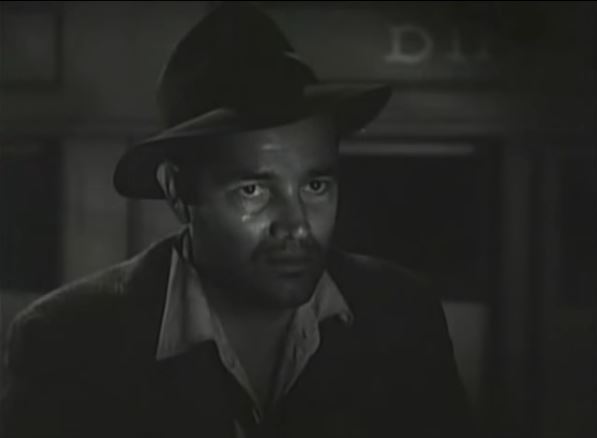
Detour opens with Al Roberts (Tom Neal), a disheveled, paranoid traveler, sitting in a diner, picking fights with customers, soliloquizing about fate. Once he was a fairly happy piano player; now he's a guy forever cut off from society. From the first moment you see his self-pitying mug, it's hard not to dislike him.

That's life. Whichever way you turn, Fate sticks out a foot to trip you.
The plot as he recounts it follows his cross-country trek as he goes to join his girl in L.A., thumbing rides from New York to California, with most of the action taking place in Arizona and California.

Ever done any hitchhiking? It's not much fun, believe me.
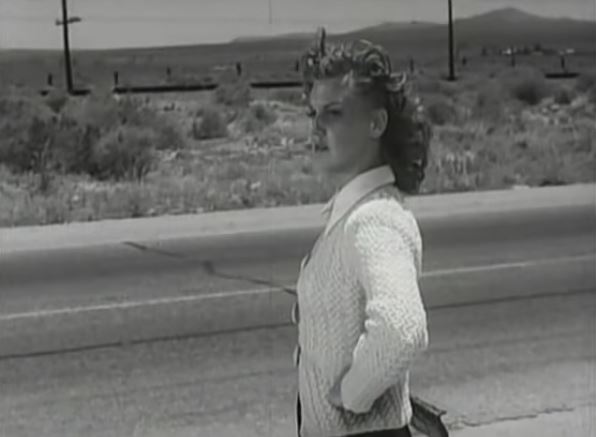
He's picked up by a spendthrift chiseler named Haskell, "a piece of cheese, a big blowhard," who had a run-in with a "dame with claws" a few states back.
I guess at least an hour passed before I noticed those deep scratches on his right hand. They were wicked: three puffy red lines about a quarter inch apart.
Haskell's a friendly guy. Unfortunately, Roberts accidentally kills him by letting him crack his skull on a rock in the middle of a rainstorm.

Until then I had done things my way, but from then on something
stepped in and shunted me off to a different destination than the
one I'd picked for myself.
In order to avoid suspicion, he does the guiltiest thing he can think of: he buries the body in the desert and assumes the dead man's identity. Then, in yet another bout of extremely bad judgment, he picks up a trail-worn hitchhiker named Vera (Ann Savage), who turns out to be a psycho. She also happens to be the one person who would know he's not the real Haskell...because she's the dame with claws.

What kind of dames thumb rides? Sunday school teachers?
Rather than turn him in, she blackmails him into going along with her crazy get-rich-quick schemes, which include impersonating Haskell so they can claim his inheritance when his rich father dies.  Roberts, powerless to resist, gets himself deeper and deeper in trouble, until he accidentally strangles Vera with a telephone cord through a door.

The world is full of skeptics.
 Sounds crazy, and is.

Despite my jibes about its production values, I find Detour a fine piece of directing. And Ann Savage's Vera, a vicious, trashy, not-very-intelligent schemer who enjoys having Roberts at her mercy, is the best thing about it. Supposedly a trucker actually tried to pick her up while they were filming the hitchhiking scene, they'd made her look so realistic; in this interesting interview, Savage notes how unusual it was at the time to let a leading lady appear so unglamorous.

"Know how to work it?" "I invented it."
Supplanting Roberts' classy blonde girlfriend, who's out of reach now because of the jam he's in, she embodies his nightmare descent into society's underworld. She gloats over him. She bullies him. She comes on to him. He takes it. They were made for one another. The drawn-out hotel-room scene, in which she gets in the mood after taking a shower and downing a bottle of liquor, is delightfully depressing.

Too bad! I wanted to get tight tonight!
On one level, the film is parable about how you can just be an ordinary guy trying to get through life when "fate sticks out a foot to trip you." As with many noirs, the framing and voice-over assure you that the protagonist is doomed from the first moment you set eyes on him. But there's a little more to it than that. Roberts seems like a guy things are waiting to happen to. He's a loser with a guilt complex from the outset.

Listen, mister, I been around, and I know a wrong guy when I see one.
What'd you do, kiss him with a wrench?
There's a theory floating around the critical world that Roberts is an unreliable narrator. Think about it. Maybe he's just heading out west to mooch off his girlfriend, who moved because she was anxious to get away from him. After all, we don't hear her side of the phone conversation! All she does is smile in Roberts' memory. Maybe Roberts really did knock Haskell over the head with a rock. Maybe he did steal Haskell's clothes, wallet, and car. And maybe he strangled Vera on purpose to get out of an impossible situation. According to this view, what we see in the film is Roberts' weak attempt to make himself believe he didn't really mean to kill those people, that he's just a victim of fate.


Personally, I have a hard time believing that a writer or director would create something with such a well-layered double meaning without somehow calling attention to the fact within the narrative. But the theory wouldn't have come into being if Roberts the character and the film as a whole didn't seem so very guilty.

Detour ends with an arrest added in to get past the Hays office, but it's clearly only hypothetical, a part of Roberts' soliloquy. Roberts goes his way, free but damned, disappearing into the murky night of film noir, trapped by fate, a placeless, nameless unperson.


One last note about the actor, Tom Neal. He dated the actress Barbara Payton both before and during her engagement to Franchot Tone; he and Tone came to blows over it in her front yard, and he beat Tone severely while she watched. That pretty much ended his Hollywood career. Later in life Neal became a landscape gardener. In 1965 he was involved in the death of his wife. According to him, they'd gotten into a tussle with a gun, which had accidentally discharged and shot her in the head. He was convicted of involuntary manslaughter.

* * *

Despite the fact that Detour is literally a B film, with B production values, I give it a grade of A for awesome on the following scale:
  • A: awesome noir film, to be owned and watched a zillion times or until you have it memorized
  • B: good (bueno) noir film with excellent passages but significant flaws, to be watched on occasion
  • C: fairly commonplace noir film, to be watched once or twice
  • D: dud of a noir film, to be avoided if possible
The main attraction is Ann Savage, a talented actress who really makes the movie come together.


Takeaway quote:

"Fate, or some mysterious force, can put the finger on you or me for no good reason at all."

Sunday, January 8, 2017

Noir Reviews: Murder, My Sweet, December 1944

Today we go from a screenplay written by Chandler to a film based on a Chandler novel: Murder, My Sweet, directed by Edward Dmytryk and adapted from Farewell, My Lovely. It appears to be the first movie based on Chandler, beating The Big Sleep by a year and a half. It's also the first film in this series to feature an honest-to-God trenchcoat-wearing, chain-smoking, wisecracking private eye. Maybe Dick Powell's Marlowe is the one all those other laconic dicks are trying to be.

Now, I have to confess here that I'm a bit biased. I've read Farewell, My Lovely many times, which has tended to make me overly critical of Murder, My Sweet. Every little line that's altered, replaced, spoken by a character who didn't speak it in the novel, or repeated because the writer apparently thought it so effective ("cute as lace pants") makes the creative thought-process a little too obvious. Even the change in the title irritates me. Significant plot alterations make it worse, e.g., putting an actual jade necklace into play, turning spunky sidekick Anne Riordan into lady-in-distress Ann Grayle, and making a jealous jade-collecting husband central to the resolution. The omnipresent seediness of the novel is sanitized away. And it's got a cute, happy ending, which is not what we want in a film noir, especially one about a private detective.
A really good detective never gets married. He would lose his detachment, and this detachment is part of his charm. [Chandler, "Notes on the Mystery Story"]
Or, to put it more succinctly,


That said, considered on its own and not as an adaptation of a novel, there are worse ways to spend an hour and a half. Murder, My Sweet packs an insanely meandering plot with an assortment of bizarre characters into an incredibly narrow compass. The world it depicts is dark, dirty, and corrupt. The dialogue, being mostly Chandler's, is fast, sharp, and funny. And there are some interesting special effects sequences, particularly when Marlowe's hopped up on dope.

The femme fatale is played by the versatile Claire Trevor, already a bit past her prime but still with an Academy Award in her future (for playing a past-her-prime torch singer in John Huston's Key Largo). Mike Mazurki plays Moose Malloy. I'm fond of Mazurki, a pro-wrestler-turned-actor. He's not the best of actors, and he's not exactly what I imagine for Moose Malloy, but you can't deny that he makes a good big galoot. Two big galoots from the novel are actually combined into his character, which doesn't help the logic of the plot any, but his interactions with Marlowe are enjoyable to watch.

In general, however, everyone seems to be mouthing Chandler's dialogue rather than inhabiting it. I much prefer Humphrey Bogart and The Big Sleep, though that one also suffers from happy-ending-with-romantic-interest syndrome.

* * *

I give Murder, My Sweet a grade of C for commonplace on the following scale:
  • A: awesome noir film, to be owned and watched a zillion times or until you have it memorized
  • B: good (bueno) noir film with excellent passages but significant flaws, to be watched on occasion
  • C: fairly commonplace noir film, to be watched once or twice
  • D: dud of a noir film, to be avoided if possible
Others will disagree with this assessment. But I've got it in my DVD collection, and I've only watched it twice. What else can I award it?

High points in Murder, My Sweet include...well, nothing much stands out to me, sorry. I kind of like the swirling black clouds that appear whenever Marlowe is struck unconscious, which happens with disconcerting frequency. Takeaway quote:

"Only reason I took the job was because my bank account was trying to crawl under a duck."

Thursday, December 29, 2016

Noir Reviews: Double Indemnity, April 1944

Yes, I killed him. I killed him for money – and a woman. I didn't get the money and I didn't get the woman. Pretty, isn't it?
After the good but uneven Phantom Lady, we proceed directly to the murky, guilty heart of noir, to Double Indemnity, directed by the great Billy Wilder, whose work we'll be reviewing several times in this series.

If you don't know (and really, you should; if you haven't seen this movie, go watch it right now), Double Indemnity is a murder story told from the point of view of the murderer. He's a likeable insurance salesman named Walter Neff, played by Fred MacMurray, who one day grabs hold of a red-hot poker and isn't able to let go. (Let those who think film noir is all about private detectives take note!) The supporting role of Neff's coworker and mentor, claims manager Barton Keyes, is played by the immortal Edward G. Robinson, who handily steals every scene he's in.
To me, a claims man is a surgeon. That desk is an operating table and those pencils are scalpels and bone-chisels. And those papers are not just forms and statistics and claims for compensation. They're alive. They're packed with drama, with twisted hopes and crooked dreams. A claims man, Walter, is a, is a doctor and a bloodhound and a – [Phone rings.] Who? Okay, hold on a minute. A claims man is a doctor and a bloodhound and a cop and a judge and a jury and a father confessor all in one.
He delivers a couple of monologues that make me want to stand up and cheer every time, while his final assessment of the case is grimly, delightfully terse: "Walter, you're all washed up." The tableau he and Walter Neff form in the last shot is an icon of of noir tough love.

The femme fatale, on the other hand, is played by Barbara Stanwyck, who can chill you to the bone with a single look. She wears a hideous George Washington wig, a directing mistake retroactively explained as a deliberate artistic decision, and hilariously spoofed by Steve Martin in drag in Dead Men Don't Wear Plaid. But what a role!

Walter narrates his story into a dictaphone while nursing a cigarette and a bullet wound. His guilt and doom are predetermined from the first moment we see him. That's typical of film noir. There's no emotional hook, no what's-going-to-happen-to-these-characters-I-care-about??? You know from the outset that everyone is damned. In a strange way, that takes the pressure off, allowing the viewer to be engrossed by the mechanics of how, precisely, this damnation occurs. Wilder, who I think understood this very well, later topped himself in having Sunset Boulevard narrated by a dead guy floating face-down in a swimming pool. Your average melodrama, on the other hand, keeps you interested by making you fret about what's going to happen to the people. Its watchability depends on getting your emotions involved, a game that cloys pretty quickly. No one buys a melodrama to watch over and over again. (At least no one I know.)

Double Indemnity is certainly no melodrama. It's not a cautionary tale, either, despite the fact that it's about a crime that doesn't pay. On the contrary, it compels you to connive at a man's murder. You like Walter Neff. The very real love that exists between him and Keyes only makes this all the more poignant. Horribly, you want his plot to succeed and fear his exposure, even though you know it won't succeed and he will be exposed. When he starts befriending the victim's daughter to keep her quiet, you're acutely conscious of what a heel he is, yet you're anxious to keep her quiet, too. Nevertheless, you're aware at each moment of the impossibility of his position and know that an evasion of justice would be intolerable. A lesser movie would either make Walter an out-and-out bad guy or else try to exculpate him in some manner.

Apart from the wig, everything about Double Indemnity is perfect. Though based on the novel by James M. Cain, the screenplay was cowritten by Billy Wilder and Raymond Chandler. Chandler's influence is felt at every turn. The dialogue is a delight to listen to, abounding in witty repartee and colorful metaphor.
They know more tricks than a carload of monkeys. And if there's a death mixed up in it, you haven't got a prayer. They'll hang you just as sure as ten dimes will buy a dollar.
Chandler makes a cameo appearance sitting outside Keyes' office, looking very much the sourpuss he was. The score, composed by the legendary Miklós Rózsa, perfectly captures the feeling of an exciting, relentless drive toward some predetermined destination. It supports the plot, instead of attempting to comment on it or accentuate it, or (worse still) merely providing background noise, as many of the thundering scores of the period do. (Rózsa, incidentally, also scored Dead Men Don't Wear Plaid, one of his final films.)

Wilder's direction eschews studio sets in favor of filming on location. There's a wonderful long take right at the beginning, in a midnight elevator ride from a lobby to a big, empty insurance office inhabited by nocturnal workers. Numerous night-for-night scenes make Double Indemnity a true black film, the most memorable being when the body is placed on the tracks, for which each telephone pole had to be individually illuminated by spotlights. The indoor scenes tend to be barred with light falling through half-open blinds.

For me, Double Indemnity is the quintessential film noir.

* * *

I give Double Indemnity a grade of A for awesome on the following scale:
  • A: awesome noir film, to be owned and watched a zillion times or until you have it memorized
  • B: good (bueno) noir film with excellent passages but significant flaws, to be watched on occasion
  • C: fairly commonplace noir film, to be watched once or twice
  • D: dud of a noir film, to be avoided if possible
High points in Double Indemnity include the opening, Walter Neff's practiced "sales pitch," the body-placement scene, and pretty much every scene with Edward G. Robinson, especially the suicide statistics monologue. Takeaway quote:

"How could I have known that murder could sometimes smell like honeysuckle?"