Showing posts with label noir. Show all posts

Thursday, January 11, 2018

Nightmare Alley

Question: What does William Lindsay Gresham, the American author of Nightmare Alley, a bitingly vitriolic, pessimistic, cynical novel about the rise and fall of a carnie conman, have in common with C. S. Lewis, the popular apologist and beloved writer of children's fantasy books?

Answer: They were both married to Joy Davidman.

I first learned of Nightmare Alley, which came out in 1946, when I watched the film noir of the same name starring Tyrone Power. After being rather difficult to find for a long time, it was available for streaming through Amazon for a brief period last fall, but has now mysteriously vanished again. It's an excellent film, a true gem among noirs. I must be getting worldly-wise, because I could tell exactly where the film was glossing over seedy details or pulling its punches. Most importantly, I could tell exactly how the story was supposed to end. I don't want to spoil it, but it's hard to think of a darker ending.

If the film is excellent, the novel is only that much better, a detached, merciless dissection of a man destroyed by his own small-mindedness and lack of self-understanding. Stanton Carlisle, the protagonist, uses what he learns at the carnival to start a big-time mentalist act, then reinvents himself as a spiritualist minister in a bid for money, lots of money. I don't think I'm giving anything away when I say that it all blows up in his face. He shows no mercy to marks and gets none when it's his turn to be the prey. The last line of the novel is so cold it burns.

And yet it's impossible not to pity Stan. There are several flashbacks to his childhood: you can't really look at a well-portrayed kid and say, yeah, he gets what's coming to him. As the pieces of his backstory fall into place, you see the picture of a child warped by selfish parents whose dysfunctional marriage pushes him into the adult world of fear, lies, compromise, manipulation, frustration, and abuse. The novel leans heavily (though not explicitly) on certain well-known Freudian theories, but its examination of Stan's psychology is no less incisive for all that.

Nightmare Alley is a grotesque but beautiful kaleidoscope of twisted humanity, in which the only freaks, inside the carnival or out, are those who aren't freaks. It's aptly named, because you can see the monstrous ending from far off in the very first pages, then proceed to step slowly toward it with the inevitability of a nightmare. Nightmare Alley is a masterpiece of noir.

A brief but detailed account of Gresham's life can be found here. He got to know the ins and outs of the carny world through a fellow volunteer in the Spanish Civil War. Shortly after the war his first marriage ended in divorce. He began drinking heavily and attempted suicide, after which he turned to writing and editing, marrying Davidman, his second wife, in 1942. They had two sons. His abiding interest in sideshows, spiritualism, magic acts, and debunking molded his literary career as a writer of both fiction and nonfiction.

In an account I can't seem to locate right now, I read that he and his wife both became interested in Christianity and the works of C. S. Lewis; he ultimately moved on to other things (like Spiritualism and Scientology, strangely enough), but Davidman, who was a Jewish atheist, became a Christian and traveled to England to meet Lewis. Gresham had an affair with Davidman's cousin, Renee Rodriguez, while she was away. He had also become abusive toward her and their children, and their marriage ended in divorce, after which he married Rodriguez. Davidman's subsequent marriage to Lewis was made famous by his writings, most notably by A Grief Observed, written after her death in 1960. Gresham's sons remained with Lewis.

Gresham committed suicide at a Manhattan hotel in 1962 after being diagnosed with cancer of the tongue. In his pockets they found business cards that read: No Address. No Phone. No Business. No Money. Retired.

Sunday, October 15, 2017

Blade Runner 2049

The original Blade Runner is what first got me into film noir. It evokes noir's guilty heart where other attempts at "future noir" only get the trappings right. Rick Deckard isn't what you'd call a hero: compelled by self-interest, he's hunting down escaped replicant-slaves whose only crime (so far as he's concerned) is their presence on earth. Though he tries to hide it from himself, he's fully conscious of their humanity and fear as he blows them away, as in that slow, sad scene where he shoots a terrified female replicant in the back as she flees into a department store. It's Roy who "earns" his soul at the end, who, with his crucified hand, saves Deckard's life and possibly his soul; we're never quite sure whether Deckard is even really human.

Blade Runner also has a poignant but seriously messed-up love affair, another noir element ratcheted up almost to the intensity of myth. The vast dark urban abysses (reminiscent of night scenes in Phantom Lady and others) and mountainous decayed buildings (like the Bradbury, where the classic noir D.O.A. also ends) meld seamlessly with the iconic score and the plot's moral grayness and lack of resolution.

And, as with noir, I've somehow also found Blade Runner a solace when going through bad times. I can remember one period in my life when I watched it once or twice a week. I think a lot of people would say something similar. And there's not all that much to the plot. It's more of an immersive audiovisual mood experience than a movie. So there's probably a lot of other people who think it's okay but kind of dull. They're mystified by people like me, to whom it means so much.

All of which is to say, Blade Runner 2049 has a lot to live up to. Well, I went and saw it at the $4.00 matinee this weekend, and I...think it kind of succeeds. For me, at any rate. Not quite, of course. How could it? But it continues the story, adds to the background, and deepens the world without doing any violence to the thrust of the original, all while maintaining its own narrative independence.

I have to say, I went into it with pretty low expectations. I've been less than impressed with Ridley Scott's attempts to rekindle the Alien magic, and as for Harrison Ford's reprising the roles that made him famous, well, um, yeah, same thing. So I'm very excited that Blade Runner 2049 proved so much better than I'd expected.

I don't want to say too much, because it's got a good plot with plenty to spoil. But I will say that it's another true noir, with a written-off protagonist, a bizarre love story, and an ambiguous ending. What we see of Deckard (not much, thankfully) does little to explain or humanize him. Like the original, it's elliptical and rather sad. The city is the same, down to the now-retro-futuristic Atari signs. The texture is as rich, too, though perhaps a bit contrived in places, and not quite as authentic feeling. We get to see the world outside L.A., including a protein farm and a humongous waste dump, and it's a beautifully unlovely place. The CGI is some of the best I've seen, though, for me, nothing could ever quite equal the practical effects of the original.

There are some interesting allusions. The protagonist, a replicant Blade Runner, is called K, seemingly a reference to Kafka's bewildered protagonists. One of the short "prequel" films that came out in advance (Blade Runner 2048: Nowhere to Run) centers on a copy of Graham Greene's The Power and the Glory, a novel about a hunted priest – a broken "whisky" priest – in the aftermath of the Mexican Revolution. The parallel is obvious, and, given the film's preoccupation with the nature of the soul, fitting. Other religious and mythological allusions abound.

In the end, I think it's movie that I'll have to rewatch once or twice to decide what to make of it, but it's passed the first test so far.

Monday, November 28, 2016

West Texas, the USSR, and Reprehensible Reading

This is the kind of post I write when I have things floating around the pelagic zone of my head but no single topic to focus on. I seem to be emerging from one of the phases of isolation I pass through whenever I've been overstimulated or taxed by too much interaction. Ugh.

I have been keeping busy with my Texas stories, my next novel, and a painting for The Worm Ouroboros, however. That's the key to being productive. When you're tempted to look the gorgon in the eye, just keep working. The stuff you bring to light at the end of the tunnel will be about as strange as what you'd expect a blind painter to produce, but there just might be a certain aureole of beauty about it as well. You can't tell while you're still in the pit. You just have to keep going and hold on to all the shards until you're competent to judge them.

Still, I think anyone who produces in isolation is apt to go at least a little bit insane, and not necessarily in a good way. I'm a great admirer of William Blake, as readers of my blog know, chiefly for his early poetry and his lifetime output of paintings and prints. I have to admit that I find most of his "prophetic" books unreadable, as I think most people do. But he wrote what he felt he had to write, in utter isolation, in the face of decades of neglect and incomprehension, and he's my hero for that.

Nevertheless, when I consider how much he warmed up to even the smallest token of appreciation for his work (as, in the evening of his life, he became the center of a circle of young artists), I wonder how much his outrageous, elliptical style owed to the scorn and amused indifference his works tended to arouse. Perhaps, if he'd found himself placed in slightly more congenial surroundings, or his education or personality had been slightly other than what they were, then his life's work wouldn't have forced down such eccentric channels, and he would be a Universal Man like Goethe or somebody instead of a kind of "cult classic" of English letters. Then again, maybe he wouldn't have done anything memorable at all.

I went to that West Texas con a few weeks ago and gave a slideshow talk about the Ballantine series. Four people attended my talk. Ouch. This owed partly to personnel changes just prior to the con. But the room also cleared out before I got up, so I think it's more that the topic and speaker were too off-the-wall for common interest. That's too bad (for them), because I really put together a spanking good slideshow (festival of wrap-around covers and all) and gave a brilliant talk. (I'm better at speaking in public than you might suppose, despite my almost total inability to navigate small talk; after all, I make my living giving lectures on abstruse topics to persons of varied backgrounds.) Anyway, it was kind of a bummer. I don't take it personally, though I did write down who left the room before my talk. (Just kidding.) The episode just underscores how very isolated I am out here. Without the Internet, I could never survive as a writer-artist guy.

There was a bit of a silver lining to the whole experience, however. A local seller of vintage comic books saw my talk on the schedule and donated a stack of Ballantine paperbacks to hand out as visual aids. He even let me keep the leftovers for proselytization purposes. We chatted a bit, and he told me that he's collected (and sold) the entire series twice over. Now that's impressive. So, by going to the con, I discovered that there's at least one other person (and probably only one other person) between San Antonio and El Paso interested in what I'm interested in.

In other news, my intellectual life seems to be coming up against Soviet Russia for some reason. It began with my decision to begin reading John le Carré, most famous for The Spy Who Came in from the Cold and Tinker Tailor Soldier Spy. I've enjoyed what I've read immensely. It calls to mind both Graham Greene and Joseph Conrad, two of my favorite authors.

Then I acquired the first part of Aleksandr Solzhenitsyn's The Gulag Archipelago from the county library book shop for $0.25 and read it straight through. I'd read a couple of Solzhenitsyn's novels back in school, and had then perused the Archipelago, but without really delving into it. There's nothing I can say about it that won't sound trite, but it's a book that I think everyone should read at least once.

Last but not least in my encounters with the USSR, I recently attended a seminar by a now-nonagenarian friend of a friend of mine, a journalist who spent the bulk of his career (through the late 1970s, I think) as a war correspondent, covering such conflicts as Vietnam and visiting a total of 120 countries. Last fall when he was in town (our mutual friend brings him for a series of public talks every year at Veteran's Day), we all split a six pack of Spaten Optimator in a hotel lobby. His stories about intrigues and death on the Russian borders of Red China came immediately to mind when I read The Honourable Schoolboy, which centers on the community of foreign correspondents in 1970s Hong Kong.

But his entire life is almost unbelievably storied. He started out as a child actor, his parents being vaudeville performers in New York. He was a cast member in the original production of Thornton Wilder's Our Town, which went on to win a Pulitzer. During World War II, his family performed for troops around the country through the recently founded USO. He enlisted once he was old enough and fought in the Battle of Okinawa. After the war he went to college.

As a journalist, he became an enemy of communism, and he counts among his greatest achievements his having been labeled a "very dangerous man" by the KGB. He was actually escorted out of Russia by the KGB, and subsequently refused reentry until after the fall of the USSR. (In later years he managed to get a glimpse of his old case file through a contact in Moscow.) He lost none of his energy with retirement, and used to appear on CNN's Crossfire among other things. He still travels to France, Russia, China, and elsewhere, giving talks at universities and meeting with State Department officials. Did I mention that he's 90? A gentleman of the old school, a hell of a speaker with a biting sense of humor, and a principled professional. Quite a person to have had a beer with.

Getting back to John le Carré and Solzhenitsyn, I've started to realize that it's not very good for me to read fantasy while I'm engaged in writing fantasy. Reading Lord Foul's Bane over the summer made me pretty cranky, but I would probably have gobbled it up if I were writing spy novels. That's how I've always been. I can't do my job well as a math professor if I don't paint at night, and my painting suffers if there's no math or logic going on. I think it's just that I'm very immature, and most productive when I feel like I'm getting away with something by working on a project that the little voice in my head says is the opposite of what I should be doing.

So I recently read Mickey Spillane's I, the Jury, another little item I picked up at the library bookstore. It was enjoyable enough, I suppose, but also quite moronic. It made me think of Raymond Chandler's soliloquy on lurid pulp stories and the apocalypse:
Their characters lived in a world gone wrong, a world in which, long before the atom bomb, civilization had created the machinery for its own destruction, and was learning how to use it with all the moronic delight of a gangster trying out his first machine gun.
I've always loved Robert Altman's incoherent noir apocalypse, Kiss Me Deadly, which skewers the Mike Hammer character, but I'm big enough to appreciate both satire and subject. So there are two more Spillane rocker-shockers in the hopper.

Speaking of reprehensible reading, I may venture into Gor in the not-so-distant future. I've never read (or been tempted to read) a single Gor novel, though it's been hinted that I work coded references to the series into my stories. People tell me that they start out okay, but get sicker and sicker as you go on. However, under a humorous post on the subject over at Black Gate last month, a commenter linked an interview with John Norman so straight-facedly bizarre that I kind of want to read a few now. After all, as authors, we have quite a bit in common, being otherwise-obscure academics who write pseudonymous sword-and-planet stories set in the counter-earth. Actually, given some of the things I've written about, it's not terribly surprising that someone would assume I'm a fan.

But I'm not, of course, and don't suppose I ever will be. It's kind of strange, though, that those who would normally speak out against censorship are perfectly okay with keeping people from reading stuff they think is really bad. And maybe the Gor books are really bad! But everyone who tries to ban something thinks that what they're banning is bad. Otherwise they wouldn't ban it. If you say you're against banning as a general principle, you have to be against the banning of any book, even "bad" ones; otherwise you're just a viewpoint advocate with a penchant for moral posturing.

You can argue, as a commenter at the Black Gate article does, that John Norman's excommunication from the mainstream publishing world isn't an example of censorship but of free-market capitalism. To be honest, that's what sounds most likely to me. But people like Michael Moorcock did advocate "strategies which marginalize" John Norman's output, and his output has in fact been marginalized. In my opinion, the specific action Moorcock suggested (placing the books on the top shelves to keep them out of the hands of young adults) is perfectly reasonable. But some books celebrated during Banned Books Week have faced far less opposition. So what's the difference?

I don't have much of an opinion either way. It's just something I've thought about.

Well, I guess that's about it for now. I may start a series of short reviews of my favorite films noir. I've got about a zillion titles on DVD that I like to watch and rewatch. It'll be a good thing to keep me posting on my blog while I devote the other parts of my brain to my ongoing writing projects and other things.

Wednesday, July 20, 2016

Comic Book Adventures

So, I've been reading me some Batman comics. Surprised? I don't put them down in my "Books I've Read This Year" list because I have my dignity, you know? Anyway, it's been a very, very long time since I read an actual honest-to-goodness comic book. But I like Batman so much that it seemed high time to delve deeply into the actual, um, literature. Graphic literature.

So far I've focused on the iconic entries of the eighties and nineties. I think my favorite is Year One (1987) by Frank Miller, David Mazzucchelli, et al. I love the way it drops the Batman story into the gritty urban reality of a Scorsese film. It was obviously inspired by Taxi Driver at several points. It also reminds me of Serpico. The art is awesome: clear, dynamic, and distinctly noirish, with dark, muted colors and free-flowing hand lettering. I much prefer it to the polished, digitized look of more recent comics. And the part where Batman battles the police in a bombed building and calls bats to make his getaway is super cool.

I also think Frank Miller's The Dark Knight Returns (1986) is really great. It cracks me up, actually. With its over-the-top TV segments and epic brutality, it reminds me of Paul Verhoven's satirical sci-fi actioners, especially RoboCop (of which I'm rather fond). Its Batman is like a humongous, creeptastic Dirty Harry; the girl Robin looks about the size of his thigh. I know it's a polarizing comic. Personally I don't care much for the art. But as for the general plot, I think that Batman and Superman are big enough to take a little satire. Some people need to take a chill pill. It's got a storyline of almost mythic proportions, with tank battles, atom bomb detonations, apocalyptic showdowns, and Batman retreating to the underground with a creepy race of mutant followers at the end.

Another fave is The Long Halloween (1997) by Jeph Loeb, Tim Sale, et al. It's got more of a slow-burning mystery plot, using the origin story of Two-Face to describe the descent of Gotham from merely crime-ridden to downright maniacal. The story, though suffering a bit from serialization (and the apparent need to work just about every single villain into the plot), is supremely engrossing. And the expressionistic art, with its big pools of black, snaky pen lines, and dynamic linear perspective, is simply beautiful. Every page is a joy to behold.

One thing that gets on my nerves a little bit is its constant use of one-liners from the Godfather movies. Do it once or twice, and it's a sly allusion. More than that, and it gets cute. All the time, and I start thinking that maybe the writer hasn't done all that much homework on the Mob. Halloween also takes a lot from The Silence of the Lambs. In general, I've noticed that comics are much more open to lifting material from mainstream sources than, say, books or movies. Not that that's a bad thing, as William Blake says in my sidebar. But it has to be done artfully.

Still, The Long Halloween is a monumental piece of work, and the chief inspiration for what's probably the greatest superhero movie ever made: Christopher Nolan's The Dark Knight.

A more recent entry that I've enjoyed, though not nearly so much, is Hush (2003) by Jeph Loeb, Jim Lee, et al. The art is beautiful, though so polished that I find it a bit boring at times. It does have lots of heaving bosoms, rippling muscles, and gritted teeth, if you like that sort of thing. The story is OK, too; it just suffers from expanded universe syndrome.

You see, unlike practically every other fanboy in the galaxy right now, I prefer my superhero stories to be self-contained. I avoid Marvel movies for that reason. They're like sitcom crossover episodes, or The Jetsons Meet the Flintstones. Ugh. To me it makes the superhero concept too familiar. I like Batman to exist in his own dark little universe, where you never quite lose the surprise and wonder that there is such a person as Batman. Bring Superman into it, and superhero-dom starts to feel like an exclusive yet chummy clubhouse.

But I do very much like Superman on his own turf. I'll probably delve into some of his comics before long, though I'm more familiar with them from of old. For me, Batman represents the mythologizing of hardboiled fiction and film noir, the melding of gothic horror with urban drama. Superman, on the other hand, seems to more akin to John Carter, Tarzan, and the supermen of early sci-fi. Both are inspirations in my own writing.

Oh, last but not least, I also read The Killing Joke (1988) by Alan Moore, Brian Bolland, & Co. A little sadistic for me, but I like the way it explores the weird love-hate relationship between Batman and the Joker. Its "origin story" for the Joker, presented through flashbacks in a delightfully noirish, nightmarish style, is distinctly underwhelming, but then again the Joker himself undercuts its reliability at the end of the comic. And the ending about as artful as they come. I mention this one mainly because the animated film, starring the voice talent of Mark Hamill, is soon to be released. I watched Batman: The Animated Series every day after school when I was in junior high, and, to me, Mark Hamill is the Joker. (Never knew it was him at the time, though.)

So, what's next? Do I venture into the New 52? I don't know if I'm ready for that yet, especially with all the dithering about DC has been doing lately. There are still a few titles from the eighties and nineties that I have my eye on.

Tuesday, July 12, 2016

D.O.A.

I can breathe and I can move, but I'm not alive because I took that poison, and nothing can save me.
I watch a lot of film noir. To some people, the term means trenchcoated detectives, laconic voiceovers, femmes fatales, and cigarette smoke. I think of it more as a directorial style, a style that uses harshly geometric, minimalistic (= dark) photography and unpityingly logical plots taking place beyond the boundaries of "normal" society to create an atmosphere of emotional detachment and alienation. Yes, chain-smoking dicks and dames figure largely in such films, but that's because the world they inhabit lends itself so readily to the style. Some of my favorite films noir don't involve detectives at all.

That includes D.O.A., a film that wasn't appreciated at the time of its release (1950) and isn't very well known today. It's in the public domain, and you can watch it at the Internet Archive, which no doubt has to do with its obscurity. Edmund O'Brien plays Frank Bigelow, an accountant and notary public who, months prior to the opening, notarized a seemingly innocuous transaction, a chance happening that sends him down a black rabbit-hole of madness and murder. Most films noir have a certain sense of predestination, but this one takes it a step further: it's narrated by a dead man.

Grim humor and dark irony punctuate Bigelow's nightmare urban odyssey. In confronting his nonsensical, undignified position (the human position), he seizes control of his destiny, loses all fear, and achieves a kind of justice, only to keel over in the film's final minutes. One of the last lines is the homicide captain's dispassionate "Call the morgue!"

D.O.A. has some corny elements toward the beginning, as many films noir do, but rapidly descends into darkness, madness, sweat, and grit. I appreciate it a little more every time I watch it. It also has an almost science-fictional feel, with a search for stolen iridium and a "luminous toxin" that glows in the dark. And it must have one of the best openings of any movie ever:
Bigelow: I want to report a murder.
Captain: Sit down. Where was this murder committed?
Bigelow: San Francisco, last night.
Captain: Who was murdered?
Bigelow: I was. 
Anyway, because this is my blog, and I can do whatever I like, here's some of my favorite stills:
 
The opening sequence. Bigelow marches through a dark police station.

"I want to report a murder."

Pamela Britten plays Paula, Bigelow's sweet but slightly clingy
secretary-girlfriend back home.

The madness begins: a San Francisco jive club.

"He's flipped. The music's drivin' him crazy." Meanwhile, the faceless
killer prepares the luminous toxin.

"You've got it, all right." A doctor confirms his diagnosis with a glowing
test tube. Bigelow has one day to live.

"I don't think you fully understand, Bigelow. You've been murdered."
Bigelow races down a crowded street. A neat sequence filmed without
permit, and without the bystanders' knowing what was happening.

Irony.

Now on the trail of his own killer, he journeys to Los Angeles, where he
encounters tart, unprofessional secretaries...

...and gun-toting models.

Soon he's getting shot at...

...and chasing phantom gunmen through abandoned warehouses.

Someone doesn't like him sticking his nose in.

But he's utterly fearless now. "He's not afraid," says Majak. "You can tell
from a man's eyes when he is afraid. Look at his eyes."

Chester, one of the creepiest henchmen I've seen. "That's the way I wanna
see you go, Bigelow...niiice and slooow."

But it's Chester who goes, in a drugstore shoot-out.

Beautiful on-site night photography.

The final interview with a not-so-grieving widow.

Surrounded by people but utterly alone.

Crawling on hands and knees to gain a few hours of life.

A few hours to go to the final confrontation at...

...the Bradbury Building, Los Angeles. Is this actually the exterior of the
Bradbury, though? I don't think so.

This, however, is clearly the interior. Recognize it? It's where the climax
of Blade Runner takes place. A lot of movies have been filmed there.

The faceless killer.

The final shot. "Better make it 'Dead on arrival.'"

Monday, November 10, 2014

Nightcrawler


I went and watched Nightcrawler on Friday night. I was one of five in the theater, and the movie opened only a week ago, so clearly the film is not of great interest to my fellow townsmen. As a rule, I don't watch movies at the theater unless they involve explosions, space ships, giant monsters, and/or awesome stunts, but I made an exception for Nightcrawler because everyone keeps calling it "neo-noir" and comparing it to Taxi Driver, a film I greatly admire. Whether it lives up to these comparisons I'll discuss below.

The film, if you don't know, is the origin story of a "stringer," a freelance cameraman who films bloody wrecks and crimes and sells to the local news. The protagonist (Lou Bloom, played by Jake Gyllenhaal) works his way up from a life of petty thievery of copper wire and fencing. It's Gyllenhaal's acting that really makes the movie. He's like a human gecko with his unremitting, unblinking, bug-eyed stare, dashing from shadow to shadow to get his footage and peer fascinatedly into sinks of human suffering and depravity. Skinny and pale, with glistening, glowing eyes, he reminds me of Gollum more than anything else, a nameless thing creeping out from beneath a stone.

How realistic Lou's path to success is I can't comment on, not being privy to trade secrets of the morning news. Now, I never watch the local news. It's all about pushing your buttons to get you to watch massive amounts of commercials. But despite my dislike of the industry, I'll cautiously submit that the events of Nightcrawler are preposterous. Not that that's a bad thing; I'm usually willing to suspend my disbelief if the story is good. But when a stringer sabotages his rival's van to cause a near-fatal wreck you know you've crossed from quasi-reality into fantasy or farce. Not to mention the ridiculously over-the-top footage this news show releases. Lou brazenly uses his growing importance to obtain favors from the much-older morning news director (Rene Russo) to whom he sells his footage, but (strangely) this takes place off screen. It also results in no EEOC complaints.

The film, shot mostly at night in L.A., is visually beautiful. The banal glow of nighttime traffic and corporate signage and street lighting is used to paint picture after picture with supreme artistry, and this, I suppose, is one thing that has earned the comparison with Taxi Driver. The glowing pools of light spilled into a sea of urban darkness and alienation remind me of Edward Hopper's painting Nighthawks as well.

All in all, though, I find myself a bit disappointed with the movie, especially considering the high ratings it's gotten. Based on reviews, I went to the theater in the hope of finding something that really approaches noir in its pointed dialogue and exploration of the seamy underbelly of humanity. Alas, the "dialogue" was mostly dull monologue, and the depravity was flat and cartoonish.

By way of comparison, consider Sweet Smell of Success (1957). Both movies take place in the electric glare of urban night. Both feature despicable protagonists with high ambitions in media professions. In Sweet Smell, press agent Sidney Falco (Tony Curtis) sinks from depth to depth in trying to ingratiate himself with the great syndicated columnist J. J. Hunsecker (Burt Lancaster). His depravity unfolds gradually, like a flower; this is where much of the interest lies.  Hunsecker himself is a monster who takes pleasure in making the elite debase themselves for his favor, to whom the rest of humanity are nothing but insects. He is a great man where Sidney is a small one, but he has one weakness: his unhealthy, creepy attachment to his younger sister.
In contrast, Lou Bloom of Nightcrawler is too flatly bad to be shocking. After he crawls out of his hole in the first minutes of the movie, nothing remains to be guessed about his character. His grasping unscrupulousness makes him a cartoon rather than a human being. He crosses no Rubicon. Sidney Falco, on the other hand, crosses line after line, at least in the viewer's estimation. And as to the differences in the scripts, Lou Bloom delivers monologues seasoned with the corporate-world clichés he's picked up from online business courses. These are supposed to be ironic and humorous. The dialogue in Sweet Smell, on the other hand, is barbed, wicked, and witty. It achieves a shocking brutality without the use of a single f-bomb.

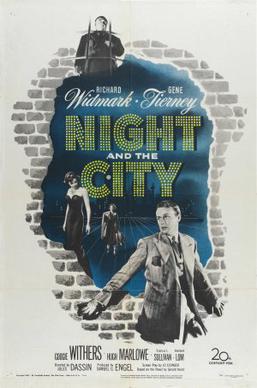
Jules Dassin's Night and the City (1950) is another delightfully bleak and dark urban film about the self-degradation of the social climber. Harry Fabian (Richard Widmark), an American club tout and conman in London, just wants "to be somebody." He's a hustler who goes from one get-rich-quick scheme after another, wearing suits one size too big (literally) and trying (usually unsuccessfully) to swagger his way though trouble. He's "an artist without an art," a phony out to make a name for himself by taking advantage of the real artists, practitioners, craftsmen, and tradesmen (honest or otherwise) with whom he is surrounded. For some reason, Mary, a nightclub singer played by the lovely Gene Tierney, is in love with him. His schemes to set himself up as a wrestling promoter blow up in his face, bringing ruin on pretty much every person he knows, and drawing him into the utmost nadir of moral abjection: betraying Mary. The last act is a frenetic all-night chase through a lurid urban underworld: he's the rabbit, and the greyhounds are in pursuit. Even his last-ditch effort to redeem himself in death fails miserably, as he's strangled by the Strangler and tossed like refuse into the Thames. Just my kind of film! The parallels with Nightcrawler are numerous, but the principal difference once again is that in Night and the City we have a thrilling descent into depravity – a narrative arc – rather than the static depiction given us by Nightcrawler.

However transgressive Hollywood types nowadays like to paint themselves, they're really too squeamish to depict true depravity. They can't have an unsympathetic protagonist without either making him out to be Robin Hood (and, thus, not unsympathetic) or else turning him into a farcical cipher. What makes Travis Bickle (Taxi Driver) so engrossing a subject is that you see his good points, and see also how isolation and alienation drive him into psychosis. He's a man who just doesn't know how to act, how to relate. You're also kept in suspense as to what his final actions will be, and the fact that he ends up a media hero instead of an assassin owes to pure chance. Louis Bloom, by contrast, has the flatness of allegory, much like Nicole Kidman's character in To Die For (1995), who's also driven by media aspirations. The comparison goes even further, for Lou subverts every person around him just as surely as Kidman's femme fatale. But To Die For is a black comedy, a farce, while Nightcrawler seems to be aiming at something else.

Sweet Smell of Success and Night and the City have protagonists who get what's coming to them. That's partly production codes, I know. But still, a film about human depravity is essentially moralistic (or else boring), and the viewer is left a bit deflated if the worm escapes without being crushed. Really it's not so much a moral requirement as a requirement of the story's logic. Even Nicole Kidman's character ends up under ice, with someone skating on her grave.

Hollywood has largely lost its ability to depict virtue, heroism, goodness. In my opinion this has more to do with unintelligent, uninspired writing and muddled characterization than lack of moral education. Unfortunately for me, it seems to have lost its ability to depict abject depravity as well.

Tuesday, June 24, 2014

Tim Burton's Batman

Yesterday was the twenty-fifth anniversary of Batman, Tim Burton's 1989 film. This came to my attention because Yahoo! News, which I read every day, being a man who likes to keep abreast of important current events, has positively deluged us with stories about it. (This is neither here nor there, but I sometimes wonder if someone (Warner Brothers, in this case) puts down cash for these stories. For instance, I recall seeing quite a few articles about the cast of Full House earlier this year. Not that I read them or anything.)

Anyway, the fact that Batman is a quarter of a century old has me feeling slightly dated, as it was my favorite movie when I was a teenager. I didn't see it in the theater, of course. We went to the movies only rarely, and never to see something as dark and violent as Batman. I was ten at the time. That Christmas I received the VHS tape as a gift from my Granny, but my parents wouldn't allow me to watch it until I was fourteen. Fourteen!

Why they singled out this particular film I'll never know. It did depict Antoine the Gangster being fried to a crisp by a joy-buzzer, but then again we sat down and watched movies with gun violence and nudity as a family. What makes it more ironic is that we got Big Top Pee-Wee at the same Christmas, and no one blinked an eye. Now, Big Top Pee-Wee is a sick, twisted little film, featuring Pee-Wee Herman, unsavory character that he is, happily two-timing away with some not-so-subtle, er, Hitchcockian imagery, his girlfriend winding up engaged to four acrobatic brothers, the Shim (half man, half woman) married to shimself, the ringmaster married to a little lady he keeps in his pocket, a reluctant pig-hippo romance, and various other things. But it was for kids, so no problem. That's the Eighties for you.

Well, being a parent myself now, I know better than to be critical of these little inconsistencies. The truth is, they (the A.P.s) probably did me a favor, because I was of an age to really appreciate Batman when I finally saw it. Once I did see it I watched it repeatedly, obsessively, almost, until it was displaced at the top of my list by The Road Warrior. (I guess I go for dark stories about loners and outcasts.)

What did I like about it? Not the plot, of course, because it's impossible to like (or dislike) something that doesn't exist. What drew me to it was partly the visual style, and partly the tableau it presents of a dark hero who is himself somehow a part of the chaos and madness he fights.

The portrait of Gotham is dark and apocalyptic, with city streets that look like something out of Piranesi's prison pictures. Its visuals owe a great deal to German Expressionism; the final scenes in the ridiculously tall Gothic cathedral are lifted straight from Fritz Lang's Metropolis. The buildings, the news office, the Axis chemical plant – all seem drawn from some nightmare extrapolation of noir cinema, a black cityscape heaped upon itself by a confused, obsessed mind, akin to the urban imaginings of Proyas' The Crow and Dark City, or the sublime middle act of Phantom Lady (1944).

And as for the dark vision of Batman, well, I recall that people objected to it at the time on grounds of nostalgia, but in my opinion the darkness is part of his DNA. It's a far cry from the campy Adam West period, yes, but Batman existed before that. His persona originated at the beginning of the noir era, and his adventures have varied quite a bit in tone. I've mused a bit about Batman's role as the dark knight and its relation to mythology and the hardboiled school of literature; for instance, here, and here, and here.

Batman films have this tendency to subtly ask difficult questions about the role of heroism in an ordered society, generally leaving them unresolved. Burton’s vision of Batman standing before the neon Axis sign encapsulates this. Wayne Enterprises is responsible for creating (and losing) the microwave emitter in Batman Begins and the nuclear reactor in The Dark Knight Rises, while Batman himself is credited with the rise of the Joker in The Dark Knight as well as in the 1989 Batman.

Jack Nicholson’s Joker is, of course, quite entertaining to watch. He's a hoodlum turned mad supervillain but also a pretentious avant-garde artist-vandal. His acts of sadism and terrorism (the shoot-out at City Hall ("It's your uncle Bingo!"), the disfigurement of Alicia, the mass poisoning ("Love that Joker!"), the anniversary parade) are self-conscious pieces of performance art. In the museum desecration scene he and his goons "decorate" pieces by Rembrandt and Degas and other masters while pointedly leaving a Goya (?) intact. ("I kind of like that one, Bob.") It's darkly amusing that his appreciation of Vicki Vale's work parallels Bruce Wayne's; they make a number of the same comments regarding Miss Vale. ("Nice apartment. Lots of space.")

All that said, it's too bad that Batman is such a plotless movie. It's of a piece with Tim Burton's other works, which generally strike me as visually brilliant but spiritually empty. I never have cared for Batman Returns, though other people seem to regard it as the better film. It's just got too many cheesy parts. And the later, non-Burton Batman movies that came before the Nolan rebirth are too stupid to comment on, except to say that the batsuit should not have nipples.


Wingéd bat flies by night.

Saturday, February 15, 2014

An American Fairytale

Fairytales don’t tell children that dragons exist. Children already know that dragons exist. Fairytales tell children that dragons can be killed. [G. K. Chesterton]*
This is a continuation of my previous post.

I've always loved myths and fairy tales. I have most of the colors of Andrew Lang's fairy tale collection, and have read most of the stories in them. I grew up reading Lang and Edith Hamilton and Padraic Colum and Bulfinch. Among fairy tales, my favorite were and remain Grimms', in all their unbowdlerized savagery: Snow White, Hansel and Gretel, The Juniper Tree, Bearskin, Rapunzel, The Goose Girl. It's hard to find much in modern literature to compare with them for strange, sudden beauty and violent resolution. Flannery O'Connor comes close.

At any rate, this probably explains why I find The Night of the Hunter (1955) such a beautiful movie. Though set in the countryside of the Great Depression, it's as close as a fairy tale has ever come to being turned into film. It's closest to Hansel and Gretel, perhaps, but bears relation to a great many others, and (to my mind, at least) well effects what Tolkien calls Recovery. Amazingly, it is the only film Charles Laughton ever made.

The Wikipedia entry describes it as a film noir, but that it most certainly is not. It may share common roots in German expressionism, I suppose. It opens with the kindly old rescuer, Rachel who has a lot in common with George MacDonald's recurring wise-woman character, talking about the Sermon on the Mount to a ring of disembodied children, all superimposed against a field of pulsating stars that make me think of the Babel myth image in Metropolis. She's warning them to beware of false prophets.

The False Prophet being, of course, the Preacher, Harry Powell, the fellow with HATE and LOVE tattooed on his knuckles.** A serial killer of widows, a thief, and an itinerant preacher who, far from being a mere hypocrite, prays to God whenever he's alone, and believes God to be on his side.
Well now, what's it to be Lord? Another widow? How many has it been? Six? Twelve? I disremember. [Tips hat.] You say the word, Lord, I'm on my way. You always send me money to go forth and preach your Word. The widow with a little wad of bills hid away in a sugar bowl. Lord, I am tired. Sometimes I wonder if you really understand. Not that You mind the killin's. Your Book is full of killin's. But there are things you do hate Lord: perfume-smellin' things, lacy things, things with curly hair.
A worthy descendant of Bluebeard.

The Ohio River flows as a living thing through the story, like the Deluge of Noah and the Nile that bore the baby Moses. There is a scene – how did Laughton even film this? – of the preacher's murdered wife sitting in her car at the bottom of the river, her long pale hair waving with the trailing plants that grow there.
Ah, if you could have seen it, Bess, down there in the deep place, with her hair waving soft and lazy like meadow grass under flood water, and that slit in her throat, like she had an extra mouth.
The scene of the children's escape from the monster, drifting with the current in their little skiff, as Pearl sings her curious song –
Once upon a time there was a pretty fly,
he had a wife this pretty fly
but one day she flew away, flew away.
She had two pretty children,
but one night those pretty children
flew away into the sky, into the moon.
– and the night creatures – the bullfrogs, the rabbits, the spiders – watch them, must be the most beautiful in American film.

And the film is very American, and strongly reminiscent of American art. The landscapes could have been painted by Grant Wood (American Gothic) or Thomas Hart Benton (Persephone). Some of the shots remind one particularly of Benton's lithographs. The boat scene has a spiritual connection with Edward Hicks' Peaceable Kingdom and the like. There's an image of the old woman, Rachel, rocking in a chair while holding a shotgun that must surely be a reference to Whistler's Mother. Laughton also emphasizes the link to American or Southern gothic through use of points and spires, the most memorable instance being the killing scene, when the violently steep cathedral ceiling echoes Powell's open stick-knife.

As in Flannery O'Connor, the Bible is woven unapologetically  into the texture of the landscape. And there are no cheap, ham-fisted denunciations of religious hypocrisy here. Even the villain is complex, in his way. Because, as I said, he believes. He believes and he is a rank puritan, horrified and disgusted by sex. That is what defines him. In a revealing opening scene, he sits in the dark in a cabaret, watching a girl dance on the stage, meditating on killing her but reflecting that there are too many such in the world. He puts his hand in his coat pocket, and the blade of his stick-knife tears through the cloth; apparently, the original screenplay had it tearing through his pants pocket instead.

It's probably Robert Mitchum's most memorable role. He's delightfully creepy – Children! Childre-e-e-en? – and cruel, but also comically mawkish at times, capable of losing all dignity in an instant, driven by his sordid desires. The scene where Rachel shoots him after the cat attacks him and he runs, howling like a wounded animal, into the barn, is both terrifying and hilarious. And Lillian Gish is wonderful as Rachel. Her goodness and strength is a perfect contrast to Powell's perfidy.
I'm a strong tree with branches for many birds. I'm good for somethin' in this old world, and I know it, too.
I'm not sure I've been particularly coherent here, but that's where I'll stop. If you haven's seen this film, and you treasure the silence, beauty, and arresting strangeness that would-be fantasy-filmmakers seem incapable of producing in their films, then please watch The Night of the Hunter. I'll close with Rachel's words, spoken after she watched a barn owl pounce on a rabbit, bringing us full circle to the Chesterton quote up top:
It's a hard world for little things.

* Not actually Chesterton, though he said something similar.
** I find it difficult not to think of Sideshow Bob throughout the movie.

Tuesday, November 5, 2013

Soylent Green

I just watched Soylent Green for the first time. This is a review, forty years late.

Let me begin by saying that I gravitate toward classic film noir. Of course, no one seems to be able to say what exactly film noir is; it's a fuzzy set, I suppose, defined by proximity to certain central films. Stylistically, it recalls German Expressionism, with low-key lighting, night-for-night shooting, sharp chiaroscuro, asymmetrical picture formats, unusual angles, an emphasis on stark lines and patterns, an equation of actors with objects, etc. Thematically it varies, but always carries a sense of emotional detachment; this is tied to its style.

This isn't to say that the stories are less than engrossing. On the contrary. But emotional involvement in minimal. The protagonists are frequently annoying or despicable, and even when they're not, you're not so much afraid of what's going to happen to them as interested to see what form their own particular doom is going to take. This appeals to me; being autistic, I'm generally unresponsive on an emotional level, but once my emotions do get stirred they flare up almost uncontrollably, and I get really agitated and lose a lot of sleep. So, in general, I avoid movies that try to stimulate empathy and that kind of thing. Which means that noir films are perfect for me.

What ever happened to film noir, really? Did it die, or just morph into other forms? At the time, of course, no one really knew they were making noir films. That would have ruined it. And that's part of the answer right there. It's hard to make a self-conscious noir film that isn't really stupid. A voiceover and a trench coat do not a film noir make. It's not a genre! More than that, though, I think movies with that much detachment are just a hard sell. Theater-goers, God bless them, want to care about the characters, or at least want to feel like the movie wants them to care about the characters.

Which brings us to future noir or tech noir or whatever you want to call it. My personal theory is that the reason so many noir elements get reincarnated in science fiction films nowadays is that people will go see a sci-fi film simply because it's sci-fi. The futuristic elements add an extra level of interest that makes up for the lack of emotional investment. Plus, dystopian visions — which are inherently attractive for various reasons (what a chimera is man!) — naturally go hand in hand with doom and predestination. There was always something dystopian or post-apocalyptic about film noir and the hard-boiled genre.

The difference is that, in future noir, instead of Robert Mitchum or Fred MacMurray chain-smoking cigarettes while narrating his fall, it's the whole ruined world doing a voiceover. You could even argue that the careful attention to set design in future noir (which sometimes comes at the expense of acting and plot, as in Blade Runner) reflects the visual equation of persons with objects and the sense of alienation so prevalent in film noir. Unfortunately future noir has become a Thing now, so that big directors try to make big-budget future-noir films and botch it.

At any rate, I have to regard Soylent Green as one of the first true future noirs. It features two of the great noir stars — Edward G. Robinson (who steals every scene in every movie he's in, and who died a mere twelve days after making SG) and Joseph Cotten — and thus links true film noir with its bastard offspring. Charlton Heston, the lead actor, also starred in the last of the great noirs, Touch of Evil, a film in which Cotten had a cameo role.

Further, SG leaves the viewer emotionally detached. The citizens of the horribly overcrowded New York of the future evoke fear and disgust rather than sympathy. We aren't particularly concerned with the protagonist's ultimate fate, either, but with his actions as he goes about a murder case and the generally brutal life of a police officer in 2022. And the sequence in which Robinson's character flees the horror of the world by going "Home" (checking in at a euthanasia clinic) is more full of dark irony than pathos.

I have to admit that I found the part where Heston's character sneaks through the Soylent Green factory genuinely horrifying, despite knowing (as I suppose everyone does) the precise ingredients of that nutritious little wafer. On that note, it's interesting, isn't it, that several scenes, including the final one, take place in a Catholic church crowded with homeless people, a church in which Mass is no longer said because there's no room for it? Soylent Green is thus the antitype of the transubstantiated Host. The cooked meal shared by the detective and his partner has strongly Eucharistic overtones as well.

I also admire the production design. The flat where Cotten's character is murdered and where the protagonist subsequently romances the house "furniture" (apartment concubine) is a beautiful retro picture of its time; it reminds me of a futuristic hotel I once stayed at in Amsterdam. The crowded streets and slums are quite effective as well, and the soothing, hospitable euthanasia clinic is exactly how I've always imagined such places.

We all know how the movie ends. What I never realized was that the horror comes, not from realizing the ingredients of Soylent Green, but from the sense of utter despair that man has been driven to feed on himself in his uttermost extremity, and that this is a dead end from which there will be no emergence. The last shot of the protagonist being borne out of the cathedral focuses on his his blood-drenched, raised hand, and fades beautifully into a field of red flowers and green grass, providing the perfect denouement to this bleak and paranoiac 70's film.

All that said, I do have a slight issue with the film's premise. It never states the world population, but Wikipedia tells me that in Make Room! Make Room! (the novel on which the film is based) the world population is 7 billion. Which is…about what it is right now. Less, actually. And, well, things aren't that bad, you know, globally speaking, and certainly not in the United States. Yes, I know that there's hunger in the world, but to me this seems due less to overcrowding than to social problems resulting from mass industrialization, exploitation, and the disruption of traditional norms and structures. Yes, we have to be prudent and look to our resources, but we also need to remember that people are people, deserving of dignity, and that for every new mouth to feed there are two hands, a brain, and a beating heart to make the world a better place.

When I was a kid I went to this week-long environmental training workshop. This was the early nineties, when everyone was talking about CFCs and acid rain; I recall that I was the only one there with a notebook made from recycled paper, and that my friends made fun of me for it. A very intense, angry man ran the session on population, and the image he painted of our future, unless drastic steps were taken right now, was Soylent Green on steroids, so bleak and horrifying and misanthropic that it literally took years to get it out of my system. Because I wholeheartedly believed it.

He was, I suppose, a disciple of Paul Ehrlich, whose 1968 book The Population Bomb predicted mass starvation by the 1980s and other terrifying things that, disappointingly, did not come to pass. It's interesting to me that The Late, Great Planet Earth came out around the same time and continued to be popular long after its expiration date. I've always thought it would be interesting to do a parallel analysis of the two sets of readers.

Anyway, there's a disturbing scene in Soylent Green where "scoopers" (dump trucks with big buckets like front-end loaders) come in to quell a riot by scooping the people up in heaps and dumping them like garbage into the receptacles in back. Well, that's exactly where this alarmism about overpopulation gets you if you're not careful: into viewing human beings as garbage to be cleared out of the way or vermin to be exterminated or strays to be sterilized. What's more, when it comes to predicting the future, Ehrlich, et al., seem about as accurate with statistics as Tim LaHaye is with the Book of Revelation, and as apt to reinterpret things after the fact. So the model we're using to justify whatever control measures the leaders of the moment are telling us we need might very well be total crap. Frightening.

Welp, this is getting a little political, and I don't really care to go there on my blog, so I'll stop. I don't mean to fault the movie. Not in the least. It made me think, which is what sci-fi is supposed to do, right? If we extrapolate this trend, what will happen? Here's one possible answer. Actually, I think Soylent Green is a terrific movie, and vastly underrated for reasons that I don't entirely understand. So, if you haven't seen it, and you like future noir and dystopian sci-fi, please do yourself a favor and watch Soylent Green.

[SPOILER ALERT]

Tuesday, September 17, 2013

Tom Cruise and Tech-Noir

I've now advanced to the point where, instead of watching only movies that come out in the $5.00 bin at Wal-Mart, I actually rent them online, through a company that shall remain nameless, because I haven't been paid for an advertisement, although it isn't one whose CEO publicly insults the intelligence of its American patrons. Now, generally these movies consist of either sci-fi action flicks from the eighties — preferably with my favorite actor, Arnold Schwarzenegger (no, really) — or else Japanese kaiju films, because what I really like is film noir, and it isn't easy to find obscure noir titles available for streaming. But last night I got out of my rut by renting a more recent sci-fi action flick, and that despite its having my least favorite actor, Tom Cruise; the reason being that the flick in question has frequently been described as neo-noir or tech-noir, and was based on a Philip K. Dick story.

I speak, of course, of The Minority Report. Alas, it disappointed in the film noir department. Before I get to that, though, let me discuss…product placement.

Off the top of my head, I saw ads — not just products, but overt ads — for Lexus, Guinness, The Gap, Aquafina, Pepsi… The neat thing about advertisements in the dystopian future is that they scan your eyes so as to tailor their annoying, intrusive, soul-crushing distractions specifically to you, in public places. Now, think about this. We all know what it's like to have Google or Facebook or whatnot try to guess what we're into and adapt their ads accordingly, with sometimes rather mortifying results. Can you imagine a giant animated billboard shouting at you—using your own first name—while you're drifting along with a crowd of strangers, blasting something like: "HEY JOHN WE KNOW YOU SUFFER FROM INCONTINENCE WHY NOT TRY DEPENDS FOR A CHANGE?" Yeah. I mean, would there be an Adblocker for that? And, if that future Adblocker began working so well that it threatened to burst the public advertising bubble, would it begin admitting certain ads so that the world as we know it wouldn't come crashing down around our ears in a case of the parasite killing the host and, thus, itself? But I digress. What I really want to know is why these mega-corporations thought such product placement was a good idea. Do they want to be seen as intrusive, soul-crushing mega-corporations that stalk you every waking moment of every day? Apparently!

This might all seem like a quibble, but I think it says something about the sold-out nature of the movie and of Hollywood in general. The ads obviously aren't intended as dystopian satire, although Spielberg does leave that escape route open to himself, despite having taken whatever money he took to place them in the movie in the first place. How much more cynical can you get? Placing soul-crushing advertisements under cover of satirizing soul-crushing advertisements! Compare it with the true tech-noir, Blade Runner. We do see obtrusive advertisement in Blade Runner, but it's presented as dreary, frightening, and/or weird. Yes, there are some actual brands here and there, but they stay where they're supposed to: in the story.

The comparison with Blade Runner is an apt one. It is, as I said, the true tech-noir. It maintains emotional detachment. It follows an unsympathetic protagonist through a dirty job and a twisted romance with one of the replicants he's assigned to destroy. It closes without closure, bringing the plot to a logical conclusion while leaving you in the air regarding the protagonist's destiny (or identity). It definitely stands in the line of Kiss Me Deadly and The Maltese Falcon.

This is the kind of picture Hollywood is afraid to present us with now, on a large budget at any rate. It can't give us a seemingly unsympathetic character without making sure we know it's only skin deep and stems from some awful tragedy that the character will get over by the end of the film. Another movie that masquerades as noir — L. A. Confidential — shows the same squeamishness. The two movies — L. A. Confidential and The Minority Report — actually have a lot in common, including pivotal scenes and plot elements. That's neither here nor there, perhaps, but at any rate they share this merely superficial resemblance to film noir. The Minority Report borrows classical music from Kiss Me Deadly, makes a variety of nods to various noir motifs, uses a desaturated palette, etc. But just as it takes more than bleached-out filmstrips to approach the stylistic marks of film noir, so does it take a lot more than an emotionally justified substance-abuse problem to make a true noir protagonist.

As an aside, I find it remarkable that, under the restrictions of the Hays Code, Hollywood could plumb the very depths of human depravity — sure, sometimes you have to read between the lines, but it's definitely there — while in our more liberal time it can show you a lot more, but to little effect, because it's evidently lost its sense of good and evil and their dirty mixture in a man's soul. Characters like Orson Welles' Hank Quinlan can't exist anymore. Everyone is a white hat or a black hat, and writers think they're being profound when they reveal a white hat to have secretly been a black hat all along.

More generally, The Minority Report doesn't take up the challenge it sets itself. It has the potential to ask profound questions about time and free will, but is content with letting the protagonist run around trying to clear his name. The philosophical difficulties with using precogs to prevent crimes and incarcerate the would-be offenders are raised but left more or less to the side; in the end the program is shut down because it happened to screw up. This is Philip K. Dick turned it into a Mission Impossible adventure story with a happy ending; indeed, the specific questions Dick raises are lost in the shuffle. And yes, I've heard the argument that the protagonist is hallucinating the last scenes while in deep freeze or whatever, but I don't buy it. If you ask me, it's just another way the movie compromises its principles while leaving an out for the cultists.

All that said, it's not a bad movie. I don't understand the praise lavished upon it, but I enjoyed watching it. The plot holes, though numerous, aren't that obvious, and the backdrops are quite memorable. The technology really does seem prescient at some points. There are a lot of nice little touches, like the dancing figures on the cereal box that won't turn off like they're supposed to. So, if you're reading this (!), and hanging on my very words (!!), I would say, watch it if you haven't. Just don't expect Blade Runner.

And if you're really wanting to see a great Spielberg movie, go watch Duel. That's where it's at.