Showing posts with label cather. Show all posts

Wednesday, June 1, 2016

Land of Enchantment and Atom Bombs

My painting of Taos Pueblo.
I just spent the better part of a week in the Santa Fe area. I've traveled, camped, and backpacked in New Mexico too many times to count, and Santa Fe is my favorite place to visit. Anyone who reads my blog knows that I delight in finding connections between seemingly far-separated subjects. Thanks to my trip, my brain is a whirl of such connections right now.

One thing that strikes me about Santa Fe is the almost painful juxtaposition of old and new. The region is the setting of Willa Cather's backward-looking Death Comes for the Archbishop (1927) as well as Aldous Huxley's forward-looking Brave New World (1931). For both authors, the pueblos represent a link to a world rooted in the past. From the former:
Father Latour lay with his ear to this crack for a long while, despite the cold that came from it. He told himself he was listening to one of the oldest voices of the earth. What he heard was the sound of a great underground river, flowing through a resounding cavern. The water was far, far below, perhaps as deep as the foot of the mountain, a flood moving in utter blackness under ribs of antediluvian rock. It was not a rushing noise, but the sound of a great flood moving with majesty and power.
     "It is terrible," he said at last, as he rose.
     "Si, Padre." Jacinto began spitting on the clay he had gouged out of the seam, and plastered it up again.
Whenever I'm in the area I pay a visit to Bandelier National Monument, where the Frijoles Canyon shelters the ruins of the ancient town of Tyuonyi, the descendants of whose builders dwell at Cochiti Pueblo to the south; perched almost on top of it is the National Laboratory at Los Alamos, where the Manhattan Project was undertaken and where the first atomic bombs were created; beyond that is San Ildefonso Pueblo. Thus are the forces of preservation and destruction violently juxtaposed.

Upon passing the National Laboratory on this trip, I was reminded of a quote from E. F. Schumacher's A Guide for the Perplexed, which I recently read:
The pursuit of science is a matter of taking stock and formulating recipes for action. Every recipe is a conditional sentence of the type, "If you want to achieve this or that, take such and such steps." [...] The test of a recipe is purely pragmatic – the proof of the pudding being in the eating. The perfections of this type of science are purely practical – the objective, i.e. independent of the character and interests of the operator, measurable, recordable, repeatable. Such knowledge is "public" in the sense that it can be used even by evil men for nefarious purposes; it gives power to anyone who manages to get hold of it. (Not surprisingly, therefore, many attempts are always being made to keep parts of this "public" knowledge secret!)
Schumacher opposes knowledge for manipulation (described here) to knowledge for understanding, without which our civilization is sinking ever deeper into "anguish, despair, and lack of freedom."

The Trinity nuclear test. [source]
"I am become Death, the destroyer of worlds."
[from the Bhagavad Gita, quoted by Robert Oppenheimer]
My interest in the history and culture of the region has led me to begin collecting pottery from the local pueblos. Each pueblo has its own distinctive style, such as the famous black-on-black technique developed by Maria Martinez of San Ildefonso Pueblo, which has been exhibited at world's fairs and major museums around the country.

My modest pottery collection. The second and third from the left are from
San Ildefonso, where many of Maria Martinez' kin are still in business.
The others are from Taos, Santa Clara, Acoma, and Santo Domingo.
I prefer to acquire the pottery by visiting the native artisans and sellers. Entering a pueblo is like stepping into a small foreign country, and you are very conscious of being a guest who might be tolerated but is not particularly welcome. Some, such as Santa Clara Pueblo, are fairly friendly and informal; others are quite strict, and some discourage outsiders altogether. On this trip I was fairly run off from Santo Domingo Pueblo for unknowingly approaching during a day of ceremonial dances, which are closed to outsiders.

Maria Martinez, who developed a new style of blackware, with physicist
Enrico Fermi, who worked on the Manhattan Project and created
the world's first nuclear reactor. [source]
At Santa Clara, a dealer from whom I ultimately bought a couple of pieces had a long talk with my family, explaining to my children in steps how the pottery was made. At one point he showed us a wedding picture of his grandparents: his grandfather, recently returned from service in World War I, in full uniform, beside his grandmother, looking rather sullen to have her picture taken, in a buckskin dress or robe, and two other men in full costume, with feathered headdresses. A wedding vase sat on the earth at their feet; ruinous adobe brick dwellings loomed behind.

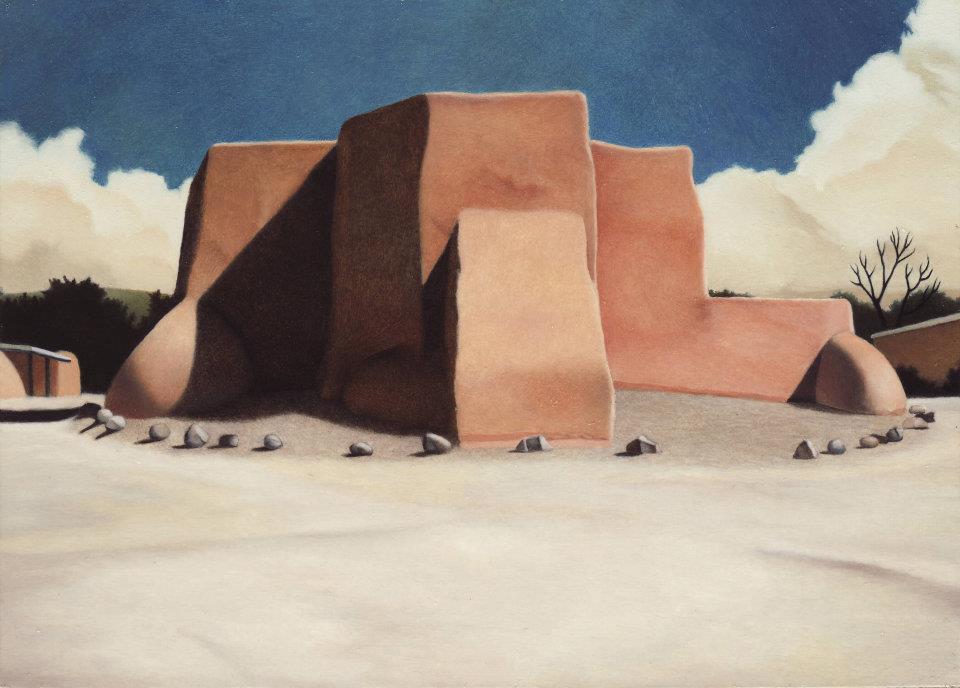
My painting of the adobe church at Los Ranchos de Taos. This church
was painted many times by Georgia O'Keeffe. A thoroughly modern
abstract painter, she found refuge in northern New Mexico after her
years in New York.
Another site I never fail to visit is the Santuario de Chimayó, a major pilgrimage site and, depending on your outlook, a holy place or an instance of irrational fanaticism (or possibly a curious mixture of the two). The small adobe chapel, built in about 1816, lies at the bottom of a narrow valley on the High Road to Taos, surrounded by rocky red hills and juniper trees.

Chimayo in 1934. [source]
It resembles many such churches in northern New Mexico, with this exception: a tiny square room, called el pocito ("the little well"), reached through a door beside the altar, contains a round pit filled with "holy dirt," which can be taken away by the pilgrims and is reputed to perform cures. The long room running from el pocito alongside the nave holds numerous photos, ex-votos, and discarded crutches.

The town of Chimayó was named for a local hill, known as Tsi Mayoh in the Tewa tongue. Whether it was a site of devotion for the natives before colonial times is not clear. An old tradition holds that a pueblo formerly stood in the area; a book I have (purchased, of all places, at a tacky tourist gift shop in Clines Corners) describes the experiences of Maria Martinez upon visiting the chapel from nearby San Ildefonso.

My own picture of the Sanctuario, taken in 2007.
Most accounts have the chapel built by Don Bernardo Abeyta. An early member of Los Hermanos de la Fraternidad Piadosa de Nuestro Padre Jesús Nazareno (more commonly known as the Penitentes, about which more in a moment), Don Abeyta supposedly discovered an ancient crucifix at the pit's location while performing penitential exercises there on Good Friday sometime around 1810.

Signs in the Santuario museum suggest that the crucifix was left there by Spanish explorers. However that may be, Don Abeyta was seemingly devoted to the Christ of Esquipulas, worshiped at a basilica in Guatemala where the clay is also held to have curative properties, a belief possibly adopted from the native culture and "baptized" by the Spaniards. The museum speaks of the ceiba tree, which holds a central place in Maya mythology, hinting (on somewhat slender evidence, it is true) at other connections between Chimayó and the pre-Columbian religions of Central America.

Esquipulas Basilica, Guatemala, in 1895. [source]
The Penitentes are credited by some with preserving the Catholic faith in the area during the tumultuous period after the Catholic religious orders were expelled from Mexico. Cather's novel deals with the aftermath of this dark time very effectively. Linked with the medieval Flagellants (in spirit if not in historical continuity), the Penitentes were a secretive sect that the Church sought to suppress after the capture of the Southwest by the United States and the division of the current archdiocese from that of Durango.

An interesting book I have, Missions and Pueblos of the Old Southwest (1929), written by one Earle R. Forrest, who had once worked as a cowboy in the Arizona desert and had traveled throughout the area extensively before the arrival of the first automobiles, devotes a chapter to the Penitentes. According to him, the brothers would scourge themselves with chunks of cholla cactus woven into thongs of rope; crucifixion ceremonies were held in remote places at night, and sometimes the Cristo whose ardor was thus tested never returned.

The book is illustrated with photographs taken by the author; one depicts a Penitente morada, or meeting house, and another purports to be the only known photograph of a Penitente procession:


The piety of the Penitentes plays a role in Brave New World. The protagonist, John, raised on a Savage Reservation in New Mexico, becomes a sign of contradiction in the World State, and creates a public spectacle in his attempts at purification through self-flagellation:
"But I don't want comfort. I want God, I want poetry, I want real danger, I want freedom, I want goodness. I want sin."

Thursday, April 14, 2016

Hard at Work or...

Let's take a little break from our long-winded castigations of much-loved children's book authors to take a look at what I've been working on lately.

First exhibit, the cover of my upcoming book The King of Nightspore's Crown:


Ha ha ha, just kidding. (I probably had too much fun making that.) Here is the actual painting, in its current state of completion:


For your viewing pleasure, here's a close-up of the lovely mosses:


and here's the two dudes fighting:


As you can see, I've got some Oceanic and Central American influences going on here. Wouldn't this make a cool movie? I'd go see it. Maybe I'll try to interest Guillermo del Toro in optioning the series. If that works out, I'll probably insist that Doug Jones portray at least some of the abhuman characters.

I'm still leaning toward making the left-hand side of this image the front cover, which would maybe look something like this:


As I hope is abundantly clear, I'm still going for the Ballantine Adult Fantasy look. The design's a bit busy, perhaps, but that's kind of my trademark.

*

I've been listening to Joseph Conrad while painting, which seems fitting. I've also been re-listening to the Imaro books, in anticipation of acquiring the further volumes. Something about the Imaro stories reminds me of the freshness of the old pulps. No doubt this owes partly to the newness of the setting, but there's an earnest seriousness to Saunders' stories that puts me in mind of Robert E. Howard. I like the wilderness stories the best.

A reader objected the other day to attempts to "erase" authors from history. Regular readers of my blog know that, while I may get in a high dudgeon about this or that, I'm quite shameless when it comes to filling my own skull with garbage. I would also defend to the death (or some such rhetorical extremity) the right of the writer to depict the ugly side of life in an ambiguous way. And I don't apologize for reading and liking authors who hold opinions that I or others regard as morally repugnant.

But that doesn't mean that commenting on authors' viewpoints is off-limits, either. It's a free country!

So, suppose you get irritated by something that pervades an author's work – an author you happen to really like on the whole. You want to do something about it. There's a few things you can try. You can grouse about it on your blog, and see where that gets you. That's one approach. You can repudiate and utterly contemn the author's works and urge others to do so. We might call this the bonfire-of-the-vanities approach. Or you can just write your own awesome stories in the same genre, with a certain amount of subversion and subtle commentary.

Which seems like the most fun?

Inspired by such ruminations, I here announce the inception of an alternate-history sword-and-sorcery subgenre set during the time of the Spanish conquests. Of course my protagonist will hail from Puerto Rico. Of course he will be of mixed ancestry. And of course his adventures will take him across an alternate Texas in search of God, gold, and glory. Just like me!

After careful consideration, I propose "sword-and-santería" as a name for the subgenre, having briefly considered but ultimately rejected the "arquebus-and-sorcery" label. I've written one story so far, set in the location of the town where I live. From here I think he will wander out to the painted canyons of the west, to encounter cosmic weirdness and mete out sudden vengeance. No doubt his perambulations will eventually take him to all the really interesting places in the American Southwest, Mexico, and Central America. It's Conrad and Cather meet Howard and Lovecraft, Kane and Conan meet Coronado and Cortés. I wish my antihero luck in his morally dubious adventures.

Sunday, May 10, 2015

Willa Cather on the Art of Fiction

One of my favorite literary authors is Willa Cather. I like her more than anything else for her sensitivity to the land as a living, vital force shaping the destinies of her characters rather than a mere backdrop for action. She's also a person I admire as having found her own way through life. After a youth marked by a certain amount of what must have seemed eccentric behavior to her fellow townsmen (conducting scientific experiments, adopting men's clothing and a masculine nickname, etc.), she set out to become a physician and subsequently became a writer, yet retained a deep respect for and understanding of the milieu that had produced her, whereas a lesser person would merely have shaken the dust from her feet.

A few years ago I made a detour whilst traveling through Nebraska to visit Red Cloud, her hometown and the setting of many of her novels. As I've mentioned before, there's nothing quite like visiting the place that most influenced an artist you admire.

On the Divide, near Red Cloud, Nebraska.
We took the tour of her childhood home and visited all the salient landmarks, including the drug store (where she performed dissections), the opera house (where she performed in plays), and so forth, guided by the kindly old ladies at the visitors' center. Being great admirers of Death Comes for the Archbishop (which happens to be set in the Santa Fe area), we made the mistake of mentioning it to said ladies, only to have it hastily brushed aside, despite their glowing praise of works set in the Red Cloud area. Amusing.

On right edge of the window you can see the drug store.
Anyway, what brought this post on is my discovery of the following short essay, offered for your inspiration (emphasis mine):

On the Art of Fiction 

One is sometimes asked about the "obstacles" that confront young writers who are trying to do good work. I should say the greatest obstacles that writers today have to get over, are the dazzling journalistic successes of twenty years ago, stories that surprised and delighted by their sharp photographic detail and that were really nothing more than lively pieces of reporting. The whole aim of that school of writing was novelty—never a very important thing in art. They gave us, altogether, poor standards—taught us to multiply our ideas instead of to condense them. They tried to make a story out of every theme that occurred to them and to get returns on every situation that suggested itself. They got returns, of a kind. But their work, when one looks back on it, now that the novelty upon which they counted so much is gone, is journalistic and thin. The especial merit of a good reportorial story is that it shall be intensely interesting and pertinent today and shall have lost its point by tomorrow. 
Art, it seems to me, should simplify. That, indeed, is very nearly the whole of the higher artistic process; finding what conventions of form and what detail one can do without and yet preserve the spirit of the whole—so that all that one has suppressed and cut away is there to the reader’s consciousness as much as if it were in type on the page. Millet had done hundreds of sketches of peasants sowing grain, some of them very complicated and interesting, but when he came to paint the spirit of them all into one picture, "The Sower," the composition is so simple that it seems inevitable. All the discarded sketches that went before made the picture what it finally became, and the process was all the time one of simplifying, of sacrificing many conceptions good in themselves for one that was better and more universal. 
Any first rate novel or story must have in it the strength of a dozen fairly good stories that have been sacrificed to it. A good workman can't be a cheap workman; he can't be stingy about wasting material, and he cannot compromise. Writing ought either to be the manufacture of stories for which there is a market demand—a business as safe and commendable as making soap or breakfast foods—or it should be an art, which is always a search for something for which there is no market demand, something new and untried, where the values are intrinsic and have nothing to do with standardized values. The courage to go on without compromise does not come to a writer all at once—nor, for that matter, does the ability. Both are phases of natural development. In the beginning the artist, like his public, is wedded to old forms, old ideals, and his vision is blurred by the memory of old delights he would like to recapture.
Courtesy of Project Gutenberg.