
 |
| Though the cover features a katchina dancer, they never really come up in the book. I've read that the katchina cult, which seems strongest among the modern Hopi, is something of an innovation. At any rate, it has its own complicated and little-known history. |
Louis L'Amour, if you don't know, is arguably the all-time most popular writer of westerns. He wrote 89 novels in all, a number of which were turned into films and television shows. His presence, though increasingly tattered and faded, was inescapable for someone growing up in Texas in the eighties and nineties, which I did. But I've had an aversion to westerns as long as I can remember, and I was never tempted to crack open one of the zillions of L'Amour paperbacks underfoot back then.
(Perhaps my aversion dates from the time we got free 3D movie glasses from the county courthouse to watch a 3D John Wayne movie on the local UHF station. I think it was Hondo, which is based on a L'Amour story. Our county seat happened to be called Hondo as well...! Anyway, I remember looking over at my family, all gaping at the TV screen with big grins on their faces, and silently removing my own glasses, content to watch the movie in overlapping red-and-blue, which gave me a headache. But did I really need John Wayne's horse's nose popping out of the screen at me?)
Anyway, recent events have conspired to soften my old contempt, the primary one being my ill-considered decision to begin writing "Weird Westerns" myself. So I'd already been toying with the idea of picking up a L'Amour novel or two when I learned that L'Amour himself had written a science fiction novel set in the Four Corners area!
Haunted Mesa, which came out in 1987 and appears to have been the author's last novel, combines the parallel universe conceit with elements of modern Puebloan and ancient Mayan mythology to explicate the mysterious disappearance of the Anasazi1 from cultural centers like Mesa Verde and Chaco Canyon. Since I've taken my own stab at that sort of thing, and have driven and camped around the Four Corners region too many times to count2, I headed over to our beloved county library and checked it out.
The novel tells the story of Mike Raglan, a middle-aged professional debunker-of-mysterious-claims, who's called to a remote mesa in Navajo country by the frantic summons of his friend Erik Hokart, an eccentric but wealthy inventor. Hokart has been living on the mesa with the intent of building a house there, but the discovery of mysterious ruins, including a well-preserved kiva with a strange window, has precipitated events resulting in his disappearance. It gradually unfolds that he's held prisoner in a parallel universe, the Third World from which the ancient Anasazi emerged into our world, the Fourth World, and to which they subsequently returned. Raglan spends the first two thirds of the novel investigating the disappearance on this side of the veil, and the last third in his rescue attempt on the Other Side.
All in all, Haunted Mesa was an enjoyable novel that kept me turning the pages. Unfortunately, it has more plot holes than interdimensional portals, and more loose ends than desert jeep trails. I won't bore you with the details, but if you're someone who notices things like that, they'll jump out at you on every page. Just one example: the story begins with Raglan reading Hokart's journal, which takes him right up to the very instant Hokart was abducted from a cafe. If we pause to reflect on this, we're forced to picture Hokart leaning over the cashier's counter, writing, while shadowy forces are seizing him and firebombing the building.
Incidentally, the novel's opening chapters remind me strongly of William Hope Hodgson's The House on the Borderland. Come to think of it, the discovered journal in Borderland also ends with an absurd account of the writer's last minutes. Here's to dedicated diarists! In Haunted, though, the atmosphere of mystery and doom is quickly dissipated by a night at a resort condo.
L'Amour was a veteran writer, and I assume that issues like the ones I describe above don't represent his best work. Did he have a hard time transitioning from westerns to something set in the modern world? That can't be it. After all, he also wrote plenty of well-regarded crime stories. He died of lung cancer the very next year, so perhaps he was simply suffering from ill health. It's possible that the bulk of the book was drafted much earlier, and that he simply put together what he had to get it out there while he still could. That's just speculation, of course.
There's a lot of historical exposition, mostly consisting of the kinds of things you might have heard from a Mesa Verde park ranger circa 1987. (I camped at Mesa Verde in 1991, 2001, and 2017, and the ranger talks were different every time. Not so much in facts as in assertions and interpretations.3) These digressions are fairly repetitive and sometimes last through multiple pages. They often begin, for no discernible reason, right in the middle of the action. It struck me that a little critical editing could have made the narrative considerably tighter.
One thing I appreciate about Haunted Mesa is how conscious it is of place. Settings are described with vivid, concrete details. The plot unfolds, not against some vague southwestern backdrop, but at specific geographical locations. Actually, most of it reads like L'Amour took a trip to the area, stayed at a certain resort near Cortez, Colorado, drove (or had himself driven) up and down certain roads, and plotted his story around what he saw, which...I'm pretty sure is exactly what he did. Still, it's not a bad effect.
I took the contour map inside the back cover and (because I'm old-school like that) compared it to my folding AAA Indian Country Map, locating all the roads and landmarks mentioned in the text. Then, because I'm not an absolute luddite, I found it all on Google Earth. In case you're curious, the novel begins on a disused dirt road paralleling No Man's Mesa and passing through 37° 10' 1" N, 110° 29' 27" W; the coordinates of the haunted mesa itself are 37° 14' 30" N, 110° 31' 58" W, though I think L'Amour conflates it with the neighboring Nokai Dome when it suits him. Are all his novels that specific, I wonder? Maybe I'll find out. Or maybe not.
Without a doubt, the best part of the novel is the last third, when Raglan finally ventures into the Third World. I don't mind a bit that L'Amour took so long to get him there, because I think these things are best when nicely built up. There he teams up with a female Anasazi leader, a grizzled but genteel old cowboy trapped in the Third World for decades, and various other characters, encountering unknown technologies, a "modern" Chacoan city, a mysterious, giant-lizard-infested ruined city more ancient than Egypt or Babylon, a vast labyrinth / government palace / temple complex / library filled with traps and armed enemies, and an impending "spacequake." Pretty awesome.
So, yeah, despite the issues which a bit of good editing could have taken care of, I'm going to give Haunted Mesa a two-thumbs-up.
*
But hey, since we're on the topic of the Four Corners region, how about some pictures from my latest vacation??? We made a big counterclockwise loop, beginning with Chaco Culture National Historic Park, which lies at the end of thirty miles of rough washboard road.
 |
Fajada Butte in Chaco Canyon. It's famous for the its "sun dagger"
petroglyph, which appears to have been used by ancestral Puebloans to
mark the equinoxes and solstices. The site has shifted due to hordes of
people tramping up there to see it, and is now closed to visitors. Another casualty of the Cultural Uncertainty Principle. |
 |
| A great kiva in the Casa Rinconada complex in Chaco Canyon. Nowadays it's theorized that the canyon served as a kind of center for ceremony and trade. |
 |
| A famous view in the Pueblo Bonito complex, the largest and most intricate of the Great Houses in Chaco Canyon. It was inhabited for about 300 years before being abandoned in the twelfth century. |
 |
| I've read that Pueblo Bonito was carefully oriented according to the solar cycle. You can get a better idea of the grandeur of the structure from this aerial view. |
 |
| Chaco Canyon at sunset, looking toward Pueblo Bonito from Pueblo del Arroyo. |
 |
| A reconstructed great kiva at the incorrectly named Aztec Ruins National Historic Site, which lies between Chaco Canyon and Mesa Verde. This is something like what the ruined kiva above might have resembled. |
 |
| Mesa Verde from Balcony House. Though mostly famous for its cliff dwellings, Mesa Verde is just as remarkable for its geology. It's a giant table of rock, tilted toward the south, with immense cliffs along its western edge, where it towers over the desert. From its highest point you can see Shiprock in New Mexico. |
 |
| Cliff Palace, the most famous of the cliff dwellings at Mesa Verde, abandoned sometime before 1300. |
 |
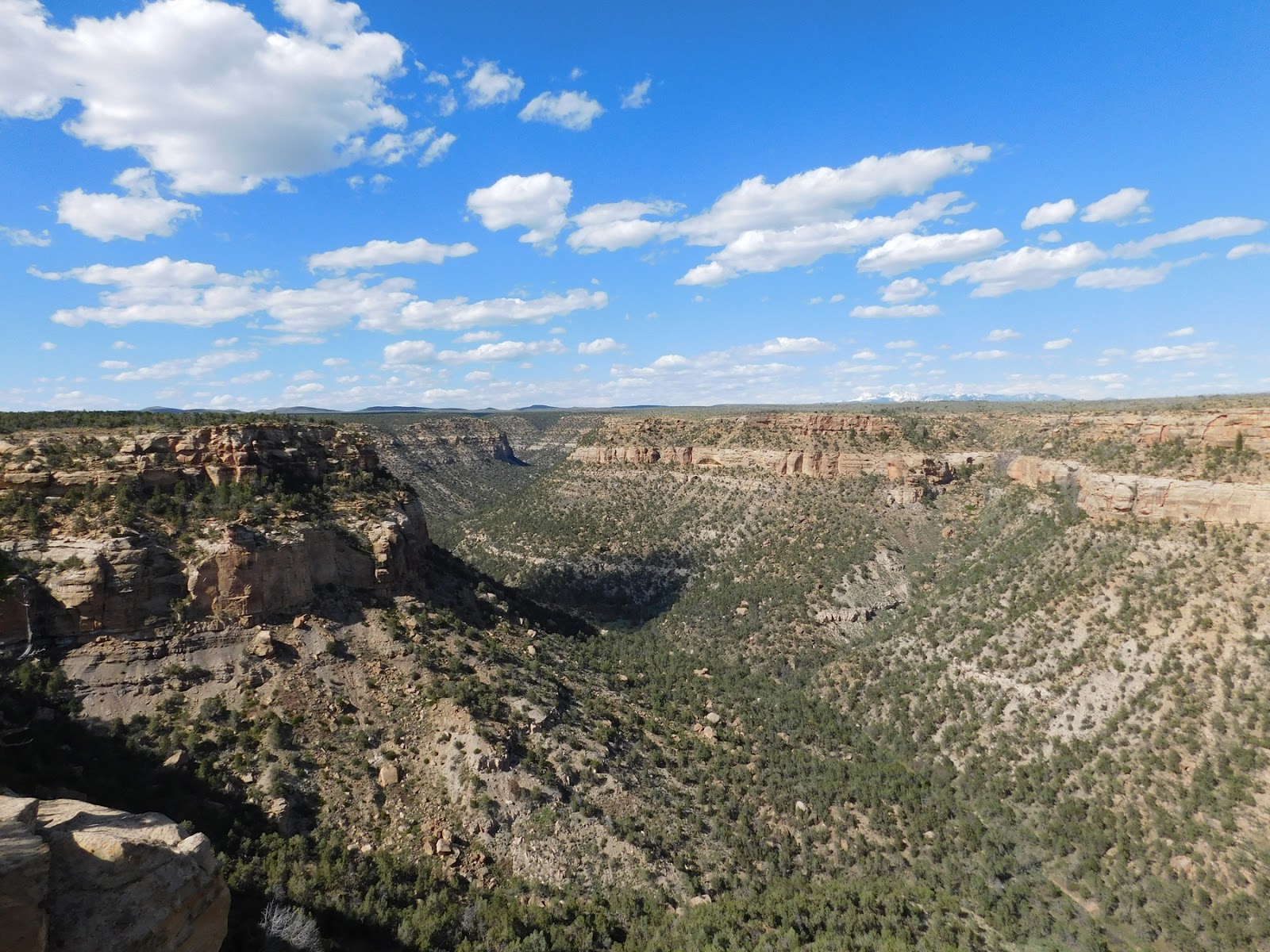
| Mesa Verde, looking south along Navajo Canyon. |
 |
| Canyon de Chelly, which is in the Navajo Nation, in Arizona. The Navajo still farm and herd at the bottom of the canyon, which is mostly closed to visitors. The cliffs are sheer and tower 600 to 700 feet. |
 |
| Spider Rock in Canyon de Chelly. The canyon was home to ancestral Puebloans before the coming of the Navajo. |
 |
| El Morro, a site frequented by travelers in northwestern New Mexico since prehistoric times. Visitors came for the water, but left records of their passage in the form of inscriptions on the walls. The ruins of a pueblo occupy the top, and the Ancestral Puebloans left the earliest petroglyphs. |
 |
| The waters of El Morro. |
 |
| The oldest Spanish inscription, left by Juan de Oñate, conquistador and first governor of New Mexico, in 1605. He's famous mostly for his massacre of Acoma Pueblo, in which 800 Acoma were killed, and after which all male prisoners over the age of twenty-five were sentenced to have their right foot cut off. Oñate was later banished from New Mexico and exiled from Mexico City for his use of excessive force. |
Modern pueblos I've visited include Taos, Santa Clara, San Ildefonso, Santo Domingo, Jemez, Zuñi, and Shongopavi (on the Hopi Reservation). The first and last mentioned are among the oldest continuously inhabited dwellings in the United States. Someone I talked to on the Hopi Reservation told me that, according to their traditions, their villages existed contemporaneously with the cliff dwellings at Mesa Verde, and that they absorbed some of the subsequent diaspora. Their kivas are square-shaped.
1 Nowadays the term ancestral Puebloan seems preferable to Anasazi, which is a Navajo term. The "disappearance" L'Amour talks so much about, and which was mentioned quite often when I toured the area in 1991, is now typically ascribed to migration. The modern pueblos are held to be at least partially descended from the "Anasazi" cultures, an explanation that seemingly wasn't taken seriously back then, but is now.
2 Actually, it's not too many times to count. I think it's eight.
3 Listen, everyone! Tour guides are not experts! I repeat, tour guides are not experts! They are friendly people who've memorized a number of facts and know how to answer silly questions while keeping tourists from climbing over things. That applies to most park rangers!


