Wednesday, March 1, 2017

Noir Reviews: Scarlet Street, December 1945

Continuing our guilt-sodden adventure through film noir, we arrive at Scarlet Street, the first of our entries directed by Fritz Lang.

Lang was one of the great directors of the German Expressionist period. His work includes the historical fantasy Die Nibelung and the science fiction epic Metropolis (both silent) as well as the proto-noir M, starring a young Peter Lorre in the lead role of a child murderer. His American work includes several understated noirs that I think should be better known.

These include both Scarlet Street and its sister film, The Woman in the Window, which feature the same principal actors (Edward G. Robinson, Joan Bennett, Dan Duryea) and follow a somewhat similar plot. The Woman in the Window came out earlier, and is well worth watching, aside from one almost fatal flaw. If you've seen it you know what I mean. Maybe I'll come back to it later.

Incidentally, Scarlet Street is in the public domain: watch it here or here. As usual, I've taken this as an invitation to decorate my post with my favorite stills.

Based on the French novel La Chienne (I'll let you Google-translate that), which had been dramatized and turned into a film in the 1930s, Scarlet Street is, by parts, a sex farce, a satire on the art world, and a psychological thriller. More than anything, it's the cruel dissection of a shy, naive little clerk who becomes an adulterer and murderer and literally descends to hell.


Strangely, it's also full of intentional humor. I actually laugh out loud when I watch it. Some scenes might almost have come from a Frank Capra film. The cheap, chiseling duo played by Dan Duryea and Joan Bennett seem like they'd be more at home in a screwball comedy. And Edward G. Robinson's character could be one of the artistic eccentrics in You Can't Take It with You.


One scene in particular, which provides an unexpected twist toward the end, cracks me up every time I see it. Taken as a whole, it's hard to know what to make of Scarlet Street. It's like a Capra film gone off the rails, ending in perdition.

Chris Cross (Robinson) is a lowly cashier who just received his gold watch for long and dedicated service to his employer. We first see him at the foot of the table, viewing the back of his round head well before we see his face. All eyes are on the opposite end of the room, making him a dark counterweight to the center of attention. He, too, is focused on his host, but our own eyes are drawn to his negative presence. He already looks like a culprit.


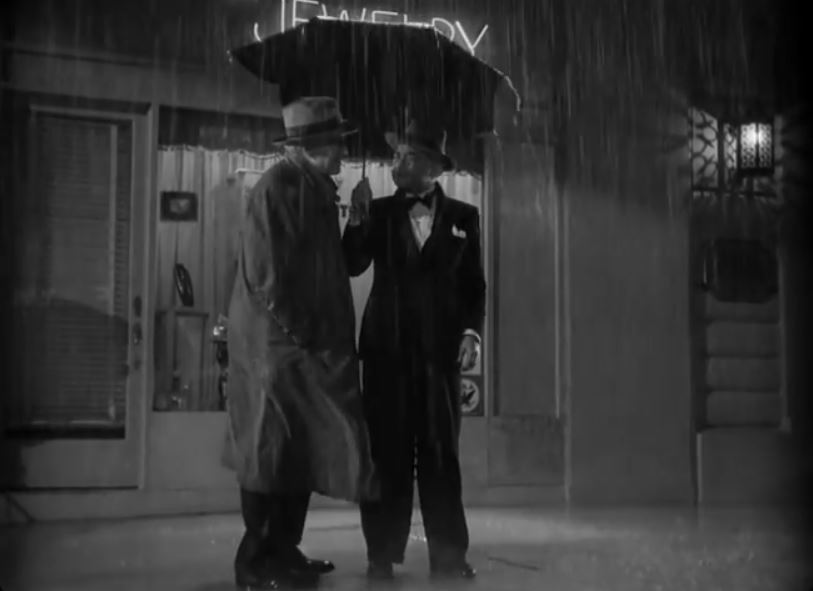
The city into which he emerges is a lonely closed world. Maze-like sets with no visible exit make the viewer feel boxed in. Squalor and shabbiness seem ubiquitous. In one of the film's many strange, striking shots, Chris balances a jewelry sign on a broken umbrella as he waits with his friend for a bus. Nothing says noir like dark, rainy streets with neon signs.

Chris is a Sunday painter with no formal training, somewhat like Henri Rousseau, on whom I suspect his character is partly modeled. Like Rousseau, he plods through a workaday existence while pursuing his art when he can, however he can.


He paints in the bathroom because his domineering landlady-become-wife is quite vocal in her contempt for his pastime. Indeed, it's her threat to destroy his work that drives him over the brink. There's a delightful scene in which Chris, after having listened to her shrilly berate him and order him to do the dishes (a task for which he dons a frilly apron), sits through the opening of "The Happy Household Hour" and a brassy soap commercial blasted from the radio downstairs.


Nevertheless, for all his amateurishness, self-effacement, and desperation, Chris is a true artist with the heart of a poet, dedicated to his vision of reality and his craft.
Sometimes [it takes] a day [paint a picture], sometimes a year. You can't tell. It has to grow...
     Feeling grows. You know, that's the important thing, feeling. You take me. No one ever taught me how to draw, so I just put a line around what I feel when I look at things...
     It's like falling in love I guess. You know, first you see someone, then it keeps growing, until you can't think of anyone else...
     The way I think of things, that's all art is. Every painting, if it's any good, is a love affair...
     There aren't many people you can talk to this way. So you keep it to yourself. You walk around with everything bottled up.
Kitty March (Bennett), a.k.a. "Lazylegs," an attractive but stupid and slovenly young woman who stands in for the prostitute of the original story, enters the picture when Chris "rescues" her from her boyfriend, Johnny Prince (Duryea), as the latter beats her for holding out on him.


Of course Chris misapprehends the whole situation. He comes to idolize Kitty and starts sending her schoolboy love letters. He naively translates the episode into paint, turning Johnny into a serpent from which Kitty must be protected.


The picture is a glimpse into Chris's brain, a visualization of his jarringly childlike view of reality. He never guesses that Johnny and Kitty, thinking him a well-respected, affluent artist, have hatched a plot to string him along and soak him for cash.


Incidentally, Chris's paintings, which I find reminiscent of Rousseau and other self-taught artists, were executed by the artist John Decker, one of whose works plays a central role in the prison noir Brute Force. Most of them look like deliberate attempts at naive art or outsider art, with the exception of a beautiful and unsettling portrait of Joan Bennett. (Funny that both Scarlet Street and The Woman in the Window revolve around portraits of Joan Bennett. I like this one much better.)


Looking at these paintings, we get the sense that Chris inhabits a very different world from the people around him. His work, however, is discovered by a highbrow art critic, and, because everyone thinks the beautiful Kitty is the artist, it's a sensation.


Because, obviously, no one would be interested in paintings produced by an ugly little cashier. Chris admits as much himself. But he's overjoyed by his "discovery," happy only to have his work appreciated and caring nothing for the fame.

Nevertheless, his many secret compromises, obviously never clearly thought out, are putting him in an impossible situation. As the strain increases, so does his willingness to do anything to escape. Every so often we glimpse how close he is to the edge. Like the subtly acted scene in which he tries to "help" his wife off with her coat while cutting liver.


It comes as a shock to see how close he is to murdering someone. But no one around him is aware of his increasing desperation. Then the walls close in at last and his illusions are shattered, leaving him with only one way out. Here the film takes an abruptly dark and nasty turn.


Now, if you're a member of the "literally" police, you might have noted my use of that word up above, and thought, what, are there fires and devils with pitchforks? Well, it all depends on what you mean by hell.

To the scandal of the Hays Office, Chris escapes punishment by the legal system. He doesn't know it, but he's got the perfect fall guy lined up.


(Dan Duryea must be one of my favorite actors of this period. His portrayal of cheap crooks ranges from cool and sinister to shrill and brassy. I've never seen him in a role I didn't like, and he's delightfully slimy in this one.) At first, Chris seems utterly unfazed by Kitty's murder and Johnny's going to the chair. "When do they throw the switch?" But the ghosts begin to haunt him as we reach the film's dark, throbbing little heart.


When the film had problems getting past the Hays Office, Lang supposedly went to see the censor, Joseph Breen, and said, in effect, "Look, we're both Catholics. We know that Christopher Cross goes to hell. That's a much greater punishment than prison." What he was getting at was the belief, explicitly portrayed in the film, that every sin carries its own burden of punishment. Hell is not a location. Hell is, literally, a state. You can find that in the Catechism. At any rate, Lang appears to have won the argument.


Nevertheless, Scarlet Street was banned in New York, Milwaukee, and Atlanta. The city censor of Atlanta branded it as "licentious, profane, obscure and contrary to the good order of the community." Now that's my kind of movie.

* * *

I give Scarlet Street a grade of B for bueno on the following scale:
  • A: awesome noir film, to be owned and watched a zillion times or until you have it memorized
  • B: good (bueno) noir film with excellent passages but significant flaws, to be watched on occasion
  • C: fairly commonplace noir film, to be watched once or twice
  • D: dud of a noir film, to be avoided if possible
Because I'm a horrible person, the stand-out scene for me is the flashing-sign hotel hell at the end of the film.

Takeaway quote:

"Paint me, Chris... They'll be masterpieces."


*** If you've enjoyed this review, maybe you'd enjoy my reviews of other noir films: IntroductionPhantom LadyDouble IndemnityMurder, My SweetDetour ***

Monday, February 20, 2017

Noir Reviews: Detour, November 1945

I've been remiss in not continuing our tour through my favorite and not-so-favorite films noir. I had intended to discuss Mildred Pierce (September 1945) next, but, despite many noirish elements, including a gigolo who switches his attentions from mother to daughter, I regard it more as a turgid melodrama than a true film noir. So, for the time being at least, we're going to skip that one, and proceed to one of the greatest of them all: Detour.

Incidentally, Detour is fairly short and in the public domain, so you can easily watch it right now if you want to. And here's a better version. Some of what follows might be called spoilers. You have been warned!

Now, the first thing you may notice about Detour is that it doesn't exactly have the highest production values. Directed by Edward G. Ulmer, a Jewish-Moravian immigrant who spent his obscure career on the fringes of Hollywood, it's a "poverty row" picture, having been produced by a B-movie studio on the cheap. It's hard not to smile at its goofs and shortcuts. The foggy backlot "New York" street scene. The awkward one-sided phone "conversation." The hitchhiking scenes in which the filmstrip has been reversed, so that the action moves from right to left, that is, east to west, resulting in drivers mysteriously sitting on the wrong side of the car. The rambling voice-over with its attempted hardboiled wisecracks sounding as though shouted into a bathtub.

Somehow, though, it all contributes to an atmosphere of profound desperation, which, in some weird way, actually adds to the film. And I tell you, it's as gloriously seedy and guilty as films noir come. It fits the description with which I began this series perfectly:
Films noir tend to involve detached or alienated elements of a fragmented society chained by the relentless logic of guilt and futility, using low-key lighting and visual abstraction to create an atmosphere of moral and emotional detachment. The settings are generally seedy, the scale is small, and the characters are bit players on the world stage.
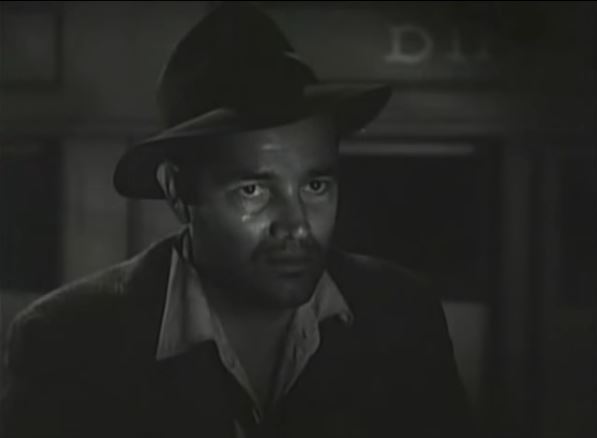
Detour opens with Al Roberts (Tom Neal), a disheveled, paranoid traveler, sitting in a diner, picking fights with customers, soliloquizing about fate. Once he was a fairly happy piano player; now he's a guy forever cut off from society. From the first moment you see his self-pitying mug, it's hard not to dislike him.

That's life. Whichever way you turn, Fate sticks out a foot to trip you.
The plot as he recounts it follows his cross-country trek as he goes to join his girl in L.A., thumbing rides from New York to California, with most of the action taking place in Arizona and California.

Ever done any hitchhiking? It's not much fun, believe me.
He's picked up by a spendthrift chiseler named Haskell, "a piece of cheese, a big blowhard," who had a run-in with a "dame with claws" a few states back.
I guess at least an hour passed before I noticed those deep scratches on his right hand. They were wicked: three puffy red lines about a quarter inch apart.
Haskell's a friendly guy. Unfortunately, Roberts accidentally kills him by letting him crack his skull on a rock in the middle of a rainstorm.

Until then I had done things my way, but from then on something
stepped in and shunted me off to a different destination than the
one I'd picked for myself.
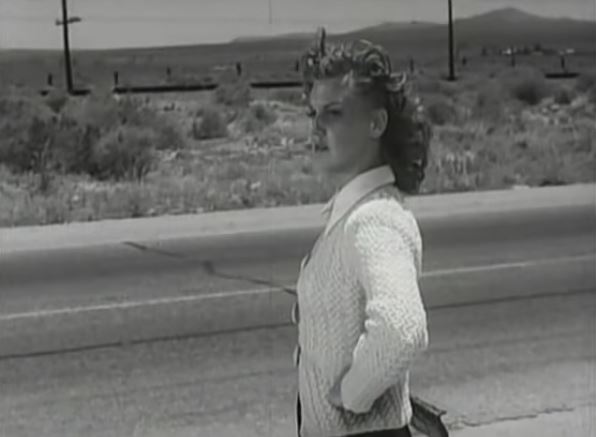
In order to avoid suspicion, he does the guiltiest thing he can think of: he buries the body in the desert and assumes the dead man's identity. Then, in yet another bout of extremely bad judgment, he picks up a trail-worn hitchhiker named Vera (Ann Savage), who turns out to be a psycho. She also happens to be the one person who would know he's not the real Haskell...because she's the dame with claws.

What kind of dames thumb rides? Sunday school teachers?
Rather than turn him in, she blackmails him into going along with her crazy get-rich-quick schemes, which include impersonating Haskell so they can claim his inheritance when his rich father dies.  Roberts, powerless to resist, gets himself deeper and deeper in trouble, until he accidentally strangles Vera with a telephone cord through a door.

The world is full of skeptics.
 Sounds crazy, and is.

Despite my jibes about its production values, I find Detour a fine piece of directing. And Ann Savage's Vera, a vicious, trashy, not-very-intelligent schemer who enjoys having Roberts at her mercy, is the best thing about it. Supposedly a trucker actually tried to pick her up while they were filming the hitchhiking scene, they'd made her look so realistic; in this interesting interview, Savage notes how unusual it was at the time to let a leading lady appear so unglamorous.

"Know how to work it?" "I invented it."
Supplanting Roberts' classy blonde girlfriend, who's out of reach now because of the jam he's in, she embodies his nightmare descent into society's underworld. She gloats over him. She bullies him. She comes on to him. He takes it. They were made for one another. The drawn-out hotel-room scene, in which she gets in the mood after taking a shower and downing a bottle of liquor, is delightfully depressing.

Too bad! I wanted to get tight tonight!
On one level, the film is parable about how you can just be an ordinary guy trying to get through life when "fate sticks out a foot to trip you." As with many noirs, the framing and voice-over assure you that the protagonist is doomed from the first moment you set eyes on him. But there's a little more to it than that. Roberts seems like a guy things are waiting to happen to. He's a loser with a guilt complex from the outset.

Listen, mister, I been around, and I know a wrong guy when I see one.
What'd you do, kiss him with a wrench?
There's a theory floating around the critical world that Roberts is an unreliable narrator. Think about it. Maybe he's just heading out west to mooch off his girlfriend, who moved because she was anxious to get away from him. After all, we don't hear her side of the phone conversation! All she does is smile in Roberts' memory. Maybe Roberts really did knock Haskell over the head with a rock. Maybe he did steal Haskell's clothes, wallet, and car. And maybe he strangled Vera on purpose to get out of an impossible situation. According to this view, what we see in the film is Roberts' weak attempt to make himself believe he didn't really mean to kill those people, that he's just a victim of fate.


Personally, I have a hard time believing that a writer or director would create something with such a well-layered double meaning without somehow calling attention to the fact within the narrative. But the theory wouldn't have come into being if Roberts the character and the film as a whole didn't seem so very guilty.

Detour ends with an arrest added in to get past the Hays office, but it's clearly only hypothetical, a part of Roberts' soliloquy. Roberts goes his way, free but damned, disappearing into the murky night of film noir, trapped by fate, a placeless, nameless unperson.


One last note about the actor, Tom Neal. He dated the actress Barbara Payton both before and during her engagement to Franchot Tone; he and Tone came to blows over it in her front yard, and he beat Tone severely while she watched. That pretty much ended his Hollywood career. Later in life Neal became a landscape gardener. In 1965 he was involved in the death of his wife. According to him, they'd gotten into a tussle with a gun, which had accidentally discharged and shot her in the head. He was convicted of involuntary manslaughter.

* * *

Despite the fact that Detour is literally a B film, with B production values, I give it a grade of A for awesome on the following scale:
  • A: awesome noir film, to be owned and watched a zillion times or until you have it memorized
  • B: good (bueno) noir film with excellent passages but significant flaws, to be watched on occasion
  • C: fairly commonplace noir film, to be watched once or twice
  • D: dud of a noir film, to be avoided if possible
The main attraction is Ann Savage, a talented actress who really makes the movie come together.


Takeaway quote:

"Fate, or some mysterious force, can put the finger on you or me for no good reason at all."

Monday, February 13, 2017

Strangling the Behemoth in Full Color

I've been tinkering with digital coloring, having enjoyed colorizing my Carvajal picture the other day. I had a pen-and-ink sketch of Keftu strangling the behemoth lying about, so, though it's really more of a doodle than a finished work of art, I decided to attempt coloring it.

Given what I started with, I think it came out rather well.


Here's the original line art:


The behemoth is based on several things: the estemmenosuchids of the Middle Permian, the Behemoth in Blake's illustrations to Job, these weird green dog/lion statuettes my Granny kept in her living room, and a vicious chihuahua named Paco who used to get into my backyard to terrorize my children. (Not that you wanted to know all that.)

I began by creating a layer of colored flats to provide the base color for the image.


Then came the fun part: adding tone and special effects. Here's the final image, sans line art:


I think it's pretty cool-looking like that, a bit like a Frazetta painting (if I do say so myself).

And now let's see that final image one more time:


This is only my second attempt at digital coloring, but I'm beginning to realize what I can do with it. It goes much faster than watercolor, and might turn out to be more marketable a skill in today's increasingly digitized blah blah blah. My next goal is to do a good line drawing with the express purpose of digital coloring.

Thursday, February 9, 2017

"Heart of Tashyas" at Heroic Fantasy Quarterly

I'm excited to announce the appearance of my story "Heart of Tashyas" in the blood-spattered, slightly burnt e-pages of Heroic Fantasy Quarterly!

All my published fiction up to now has taken place in and around Enoch, the omega-city at the cosmic antipodes. "Heart of Tashyas," on the contrary, takes place in and around the site of the town where I reside, in the southwest Texas badlands, during the early years of an alternate-historical Spanish conquest.

The editors were kind enough to let me illustrate it myself...


...with a pen-and-ink drawing that I colored digitally. The colorization was an afterthought; I guess all those comic books got me inspired.

For some time I'd been wanting to write "ethnic" heroic fantasy (ethnofantasy?) that would be cool to read in its own right, rather than thinly veiled social commentary, set during the conquest of Mexico. But I also wanted it to have a strong local flavor, more than I could give it with my limited experiences south of the border. Fortunately for me, Cabeza de Vaca, who was shipwrecked on the Texas coast in 1528, wrote a detailed ethnographic account of his many adventures. I was also thinking about things like Heart of Darkness, Prescott's histories of CortƩs and Pizarro, and Herzog's Aguirre, the Wrath of God, as well as bits and pieces of local lore gleaned from newspaper articles and historical records.

"Heart of Tashyas" will (I hope) be the first of many tales about Francisco Carvajal y Lopez, half-breed of Borinquen, vagabond of the Tashyan hinterlands, conquistador in his own mind.

Friday, January 13, 2017

Superman Comics!


I am and will always be a DC man. I guess it comes of watching all those episodes of Superfriends when I was a kid. It saddens me that DC movies have been so crummy lately, though I do have high hopes for Wonder Woman. But I'm allergic to tie-ins and sprawling media franchises. I've seen only one Marvel movie to date (Guardians of the Galaxy, which was light on crossover stuff), and my exposure to the comics is limited to the inept newspaper Spider-Man.

Really, though, the DC trinity captures everything I'd ever want in a superhero. You've got Superman representing science fiction and planetary romance, Wonder Woman representing mythological fantasy, and Batman representing the purely human. What more do you need?


I read some Batman comics last spring, and enjoyed them so much that I decided to move on to Superman. Superman is, of course, the superhero, the exemplar of the breed, descended from the science fictional supermen of the thirties and the long-jumping John Carter of Mars. He's certainly the first superhero I ever knew about. The only comics I read as a kid were Superman comics.

To get myself in the mood, I rewatched Richard Donner's Superman: The Movie, which is, I suppose, the best Superman movie we're ever going to get. That John Williams score still gives me a thrill. What struck me this time around is how closely it follows the life of Christ, with an infancy narrative marked by danger and assumed poverty and a kind of kenosis, a brief boyhood idyll among the green fields and blue skies of Kansas, a coming-of-age and period of testing in the wilderness, and a beginning of work at the age of thirty. The sequel is a lesser movie but still watchable (especially in the recently released "Donner cut"), while the rest of them just go downhill from there.

As I wrote at the time, I was less than impressed with the recent Man of Steel, which replaces the mythic conformation of Superman to Christ's life with a vulgar, superficial, commercially-motivated appeal to Christian consumers (and relentless, painfully overt product placement, which forces us to contemplate an alternate America in which Superman is unknown but IHOPs abound). And I have no desire to watch the grim and superviolent Batman vs. Superman. (Well, maybe just a little desire.)

But we'll always have Superman: The Movie.

*

When I read comics, I'm not terribly interested in consistent character arcs reaching across decades. All the metafictional infinite-earths-crisis stuff just makes my head spin. It also strikes me as unnecessary. For me, Superman is a mythical character like Heracles or King Arthur. The stories don't all have to match up. I'm coming at it from the point of view of a casual, occasional reader, of course. At any rate, I tend to gravitate toward one-off stories that seem reasonably self-contained. I'm also not averse to a little tweaking or even subversion.

In making my selections, I tried to find comic books graphic novels that are well-regarded by fans, with 4+ stars on Amazon. I wanted at least one modern take on the origin story and at least one Justice League story. I also wanted stories meditating on what Superman really means as a pop culture icon.

I had the most fun reading All-Star Superman (2005 – 2008), which follows Superman through a sacrificial death-mission into the sun, an episodic account of twelve mythic labors accomplished as a kind of zany Silver-Age bucket list, and an implied immolation-apotheosis. It portrays Superman as a kind of predestined solar deity while sending him on nutty space-age adventures with all his old friends, from Jimmy Olsen (now a flamboyant columnist) to Krypto the Superdog, as he fights for truth and justice against the likes of Lex Luthor and Bizarro. Time-pretzels and near-death experiences return him to his roots on Krypton and his coming-of-age in Smallville. Lex pontificates on what life is all about in an exclusive interview / supervillain prison riot. Sun-eaters eat rogue sentient suns. Superman descends to the underworld with Lois Lane and arm-wrestles for her love. You get the idea.

All-Star Superman is an exuberant, funny, nostalgic, and poignant celebration of the Superman you grew up with (if you're my age, anyway), and more brightly colored than a bubble gum wrapper containing the secrets of the universe. If someone were to read only one Superman comic in their lifetime, I think this is the one I would recommend.

To satisfy my craving for a good origin story, I tried Superman: Birthright (2003 – 2004). There's nothing daringly new or different about it, but then again that's what you want in an origin story: an update hitting all the main points from a contemporary point of view, an exploration and temporal "localization" of a well-known myth-cycle. Amirite?

That's not to say Birthright isn't genuinely engrossing, however. This is partly because it goes far beyond kryptonite in exposing Superman's deep and very human vulnerabilities. It paints a sensitive portrait of the person behind the artificial Metropolis Clark Kent: there's Superman, of course, but there's also Smallville Clark Kent, which you're made to realize is an integral part of his genuine personality. Smallville Clark is who Superman is when he's just being himself.

Superman is a person with dual identities – last son of Krypton and Kansas farmboy – encountering the same obstacles any child adopted as an infant by parents of another culture might face. Much of the story focuses on his struggles to realize his Kryptonian heritage while dealing with the guilt and fear of betraying his adopted parents' love. The meditations on tribal identity that arise during Clark's coverage of an African conflict mirror his eventual adoption of the Kryptonian "S" symbol as his symbol. The story's climax, which involves his troubled boyhood chum Lex Luthor, is, of course, insanely over-the-top, with giant robots and wholesale destruction, as it should be in an decent Superman story, but also dwells on Superman's need to win the trust of a suspicious public.

I would recommend Superman: Birthright to anyone looking for a sensitive, modern take on Superman's origin story.

Now, you know how Superman stands for truth, justice, and the American way? Have you ever wondered what might have happened if his rocket had landed, not in Kansas, but on a collective farm in the USSR? Wonder no more, my friend, but pick up a copy of Superman: Red Son (2003). It's bizarre, terrifying, and a bit sad, with a mind-bending twist at the end. All of which is to say, it's right up my alley.

Life under Superman the benevolent communist dictator is about as fun as you might imagine. Oh, but he has only the best of intentions, comrade! Intentions that gradually transform him from the workers' champion into an incarnation of the all-seeing, all-knowing Big Brother of 1984 (complete with compulsory brain surgery), in an arc not unlike that of the pigs in Animal Farm.

Red Son interweaves Superman's public career with an alternate history beginning in the Eisenhower administration, pitting him against chess-wizard supergenius Lex Luthor and everything Luthor can throw against him. Superman's presence in the USSR sparks a kind of superhero arms race. The time around, the USA is on the losing side, growing increasingly isolated and eventually turning into a capitalist North Korea.

Wonder Woman comes into the story, throwing in with the USSR and adopting a Soviet version of her usual costume. Batman is a freedom fighter / terrorist with a distinctly Soviet backstory, a crazy, creepy grin, and a bat-ushanka with earflaps. Colonel Hal Jordan, a.k.a. Green Lantern, is a crazed, commie-hating zealot who went off the deep end after years of waterboarding in an Asian POW camp.

Red Son uses its inversion of actual history infused with heavy overtones of George Orwell to prompt questions about American foreign policy yesterday and today as well as the nature of human progress. Not bad for a comic book. What's more, the art is really cool, resembling Soviet propaganda posters at some points and the old Fleischer cartoons at others.

Red Son isn't to everyone's tastes, but I thought it was terrific.

The Superman mythos is subjected to even closer scrutiny in Kingdom Come (1996), which takes place in the not-so-distant future, pitting an older generation of out-of-touch, retired superheroes – Superman and company – against a younger generation of amoral, violent vigilantes who've begun tearing the world apart in ruthless turf wars. Narrated by a pastor who views and sometimes takes part in events in a series of visions, replete with ominous quotations from the Book of Revelation and fiery visions of angelic battles in the heavens, it looks and reads at times almost like one of William Blake's books of prophecy. It's an unabashedly religious, quasi-biblical comic-book apocalypse whose antichrists are metahumans like the horned Magog and "the Captain of Lightning and Thunder" and whose false gods are the superheroes of yore.

I imagine this hit a nerve in the late nineties, when everyone halfway expected the world to end with the coming of the new millennium.

Kingdom Come is more a Justice League story than a Superman story. It features pretty much everybody you've ever heard of, and probably some you haven't. For me, Batman steals the show. (As he always does.) He's a cynical, hardboiled old recluse whose battered body is now encased in a steel exoskeleton, remotely patrolling Gotham's streets with scary, crime-fighting robot drones from a ruined Wayne Manor. Wonder Woman, as beautiful and high-minded as ever, battles demons of her own as an outcast from Themyscira.

But Superman is the central protagonist, no doubt about it. He swings from bitter hermit to fascist avenger, coming out of self-imposed retirement after millions of people die in a superhero-sparked atomic blast, only to make things worse before he makes things better. The battle that begins as a riot in Superman's Kansas Gulag is like something out of a Brueghel painting, ending in a second holocaust that leaves the barren battlefield strewn with charred superhero skeletons.

Are superheroes really a blessing, or are they a curse in disguise? That's the question Kingdom Come asks without offering a satisfying answer.

The art is quite different from what you typically see in comic books; quite different, and quite beautiful. It was executed in gouache, using black-and-white underpaintings with a transparent color overlay, touched up here and there with airbrush or opaque paint. Lightning flashes. Flesh glows. Metal gleams. Every page is a feast for the eyes.

*

As you can probably tell, when it comes to Superman – who seems hard to write for – I gravitate toward the meta. There are some other Superman stories I'd like to dip in to. Before I do that, though, I may try to acquire some well-regarded, fairly modern (post-crisis) Wonder Woman comics, in anticipation of her upcoming film, the trailers for which look pretty cool. Do you know what Wonder Woman's theatrical debut is? The Lego Movie. Isn't that wrong? For her sake, I hope they don't come out with another stinker.

Sunday, January 8, 2017

Noir Reviews: Murder, My Sweet, December 1944

Today we go from a screenplay written by Chandler to a film based on a Chandler novel: Murder, My Sweet, directed by Edward Dmytryk and adapted from Farewell, My Lovely. It appears to be the first movie based on Chandler, beating The Big Sleep by a year and a half. It's also the first film in this series to feature an honest-to-God trenchcoat-wearing, chain-smoking, wisecracking private eye. Maybe Dick Powell's Marlowe is the one all those other laconic dicks are trying to be.

Now, I have to confess here that I'm a bit biased. I've read Farewell, My Lovely many times, which has tended to make me overly critical of Murder, My Sweet. Every little line that's altered, replaced, spoken by a character who didn't speak it in the novel, or repeated because the writer apparently thought it so effective ("cute as lace pants") makes the creative thought-process a little too obvious. Even the change in the title irritates me. Significant plot alterations make it worse, e.g., putting an actual jade necklace into play, turning spunky sidekick Anne Riordan into lady-in-distress Ann Grayle, and making a jealous jade-collecting husband central to the resolution. The omnipresent seediness of the novel is sanitized away. And it's got a cute, happy ending, which is not what we want in a film noir, especially one about a private detective.
A really good detective never gets married. He would lose his detachment, and this detachment is part of his charm. [Chandler, "Notes on the Mystery Story"]
Or, to put it more succinctly,


That said, considered on its own and not as an adaptation of a novel, there are worse ways to spend an hour and a half. Murder, My Sweet packs an insanely meandering plot with an assortment of bizarre characters into an incredibly narrow compass. The world it depicts is dark, dirty, and corrupt. The dialogue, being mostly Chandler's, is fast, sharp, and funny. And there are some interesting special effects sequences, particularly when Marlowe's hopped up on dope.

The femme fatale is played by the versatile Claire Trevor, already a bit past her prime but still with an Academy Award in her future (for playing a past-her-prime torch singer in John Huston's Key Largo). Mike Mazurki plays Moose Malloy. I'm fond of Mazurki, a pro-wrestler-turned-actor. He's not the best of actors, and he's not exactly what I imagine for Moose Malloy, but you can't deny that he makes a good big galoot. Two big galoots from the novel are actually combined into his character, which doesn't help the logic of the plot any, but his interactions with Marlowe are enjoyable to watch.

In general, however, everyone seems to be mouthing Chandler's dialogue rather than inhabiting it. I much prefer Humphrey Bogart and The Big Sleep, though that one also suffers from happy-ending-with-romantic-interest syndrome.

* * *

I give Murder, My Sweet a grade of C for commonplace on the following scale:
  • A: awesome noir film, to be owned and watched a zillion times or until you have it memorized
  • B: good (bueno) noir film with excellent passages but significant flaws, to be watched on occasion
  • C: fairly commonplace noir film, to be watched once or twice
  • D: dud of a noir film, to be avoided if possible
Others will disagree with this assessment. But I've got it in my DVD collection, and I've only watched it twice. What else can I award it?

High points in Murder, My Sweet include...well, nothing much stands out to me, sorry. I kind of like the swirling black clouds that appear whenever Marlowe is struck unconscious, which happens with disconcerting frequency. Takeaway quote:

"Only reason I took the job was because my bank account was trying to crawl under a duck."

Saturday, January 7, 2017

Metapost: 2016

Ah, 2016! To be known to future historians as the Year from Hell. You know what I mean.


On the positive side, 2016 saw the release of my novelette "Salt and Sorcery," which takes place in a salt pan and appeared in Beneath Ceaseless Skies, in August, as well as my novel The King of Nightspore's Crown, the second installment in my Enoch series (reviewed here), which also came out in August. I wrote several other stories, one of which is to appear next month, and am at work on the third Enoch novel.


I also wrote quite a bit on my blog, whose name changed from Alone with Alone to Cosmic Antipodes. Some of my favorite posts from 2016 include:
These aren't necessarily the most popular posts as measured by clicks, but they're the ones I like the best. I also wrote a really nifty glossary, some form of which will accompany future editions of my Enoch books.


Now, most importantly (for me, at any rate), the list of stuff I read in 2016, arranged in reverse chronological order:
There are sixty-four entries in all. Some came in the form of audiobooks, which I listen to while painting, as it relieves the extreme anxiety I typically experience while working on art. But I rarely listen to an audiobook if I haven't already read the book in print -- it's too easy to miss important details. Right now I'm listening to the Parallel Lives of Plutarch, which will probably carry me through a corner of my current painting project. Maybe two corners.


True "literary" novelists on my list include Austen, Conrad, Dickens, and Dostoevsky. Nothing new there! I read quite a few ghost/horror stories, by the likes of Sheridan le Fanu, Oliver Onions, Rudyard Kipling, Henry James, Edith Wharton, M. R. James, Bram Stoker, Shirley Jackson, and Stephen King. I also read a number of books having to do with the Soviet Union and the Cold War, including several spy novels by John le CarrƩ and the first two parts of The Gulag Archipelago.


Several entries were read as research for a cycle of sword-and-sorcery stories set in an alternate sixteenth-century Texas and New Mexico. I've completed two, the first of which is due to appear in Heroic Fantasy Quarterly next month, with an illustration by yours truly. Charles Saunders' Imaro stories are a big inspiration for these, as are Robert E. Howard's tales of Solomon Kane. I'm currently in the planning stages of a third, which will be set in the Santa Fe area.

A number of the entries on my list were read-alouds to my kids, currently aged six and eight, including A Wind in the Door, Bunnicula, Howliday Inn, Mrs. Frisby and the Rats of NIMH, My Side of the Mountain, The Hobbit, Five Children and It, The Last Unicorn, The Book of Three, and A Princess of Mars. When asked to select their top three, they both included A Princess of Mars and The Hobbit, naturally. (I should mention that I sometimes "translated" Burroughs' sentences as I read; being a bit of a hack, he never uses a short Saxon word when a convoluted phrase full of polysyllabic Latin words will do. In contrast, Tolkien, who was a master linguist, writes simply and directly. Reading to kids has made me a lot more sensitive to this.) We also read numerous selections from Andrew Lang's collections of many colors, The Arabian Nights Entertainments, and Tales of King Arthur and the Round Table, as well as Edith Hamilton's Mythology and the Scary Stories to Tell in the Dark series.

2016 also saw our first cautious forays into the world of RPGs. We began by (slowly) playing through Final Fantasy IV together. (We're still not done yet, but we've gotten to the Lunar Subterrane at last.) My kids liked it so much that I decided to start moving toward Dungeons and Dragons, Pathfinder, or something along those lines. We began with Dungeon!, an extremely cool, simple-enough-for-young-kids board-game dungeon crawl that first came out in 1975. Now we've moved up to Wrath of Ashardalon, which is considerably more challenging. However, we successfully completed our first quest together last week. I'll blog about it once we play a bit more.

I also read a few comic books graphic novels in 2016, including:
  • NausicaƤ of the Valley of the Wind
  • The Dark Knight Returns
  • Batman: Year One
  • Batman: The Killing Joke
  • Batman: The Long Halloween
  • Batman: Hush
  • Superman: Birthright 
The first entry is the long-running manga by Hayao Miyazaki, the first parts of which became the animated film of the same name. I'll come right out and say that finding NausicaƤ this year was a major event in the life of my imagination. I'll most likely blog about it once I've had a chance to reread the manga. I got a few more Superman comics with Christmas money, so those are next on my list. This is something of a departure from my usual reading habits. Before 2016, the last comic book graphic novel I'd looked into was The Death of Superman, which I read soon after it came out in, um, 1992.

So there's my 2016 in stories and pictures. All in all, not a bad year. Here's to an even better 2017.

Wednesday, January 4, 2017

Superman and Bishop Ussher

Today I happened to watch some of the terrific Fleischer Superman cartoons from the early 1940s with my almost two-year-old daughter (this is what we do for fun). I'm very fond of them (see here and here for my loving slideshow tributes), less so of the war-propaganda installments produced after Famous Studios took over.

But at any rate, today I noticed something odd in The Arctic Giant, which pits Superman against a thawed-out "Godzilla" clone (though the actual Godzilla was still more than a decade in the future). The voice-over at the beginning announces the monster as having roamed the earth "millions of years ago in the Mesozoic Age." Pleasingly accurate according to the scientific theories of our time. But here's the nameplate on the museum display:


Let's send it through my state-of-the-art html auto-processor:
TYRANNOSAURUS
HABITAT     SIBERIA
DISCOVERED DECEMBER 1940
AGE  ABOUT  2,400  B.C.
DONATED BY ALFRED R. LEY
Stop the presses! 2,400 BC??? That's not what the voice-over guy said!

Being the weird sort of person I am, I couldn't stop thinking about this all day. Then, while washing the dishes, I suddenly recalled having read about Bible-based chronologies many years ago. Various persons, including the Venerable Bede and Sir Isaac Newton, have attempted to construct these, but the most famous is probably the Ussher chronology proposed in the seventeenth century by the Irish bishop James Ussher. I remembered that his chronology sets creation at 4004 BC.

So now I've looked it up, and confirmed my suspicion: according to Ussher's timeline, the Flood took place in 2348 BC, or about the date given on the nameplate.

What's the story here? Is the date a joke on creationists? Is it a subversive visual comment by a creationist animator? Recall that the Scopes Trial had taken place only about fifteen years before. What did the animators know about the voice-over and when? The other "scientific" aspects of the nameplate are so ludicrous that it's possible to see the entire thing as a joke. Especially since Willard Bowsky, one of the two animators, also worked on the hilarious Arabian Nights Popeye cartoons. (Bowsky was killed in action in France two years later.)

Unfortunately, my diligent Internet search for the mysterious Alfred R. Ley failed to turn up further information. In fact, I appear to be the only person on the entire Internet to have noticed the disparity. Hence the post. I'm actually kind of disappointed. I thought this was the sort of thing we invented the Internet for in the first place.

Watch the cartoon here if you like; it's public domain, as are all the Fleischer Superman cartoons. I've been into reading Superman comics and watching the Richard Donner films lately. No doubt I'll have more to say about the Man of Steel before long.