Friday, February 28, 2014

Imaginary Worlds

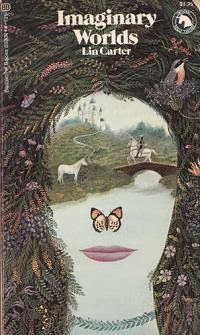
Being a Ballantine Adult Fantasy aficionado, I'm fond of Lin Carter's Imaginary Worlds, despite its (ahem) rather outré cover. (I'm sensitive about book covers.) It's a priceless document: published in 1973, it stands at the watershed moment, when fantasy was at last being widely recognized as a distinctive vein of literature, but before the appearance of The Sword of Shannara and all its consequences for Western civilization.

The first eight of IW's chapters present a history of fantasy literature from the Victorians down through Ursula K. Le Guin. It's not a bad read, though Carter's scholarship is not to be relied upon, and his style is and will forever remain insufferably chatty to me. The last three chapters are a kind of manual for fantasy-writing, many of whose maxims are repeated in Patricia Wrede's excellent guide available at SFWA.

Let's begin with Chapter 9: "Of World-Making: Some Problems of the Invented Milieu."

Lin – I find somehow that I must call him Lin, and not Carter or Mr. Carter – Lin, I say, begins with the common observation that fantasy-writing presents unique technical challenges.
If you stop and think about it, you will realize that fantasy writers face a variety of technical problems that authors working in other genres seldom have to worry about. The problem of creating an imaginary world on paper is the largest and most serious of these, and it is a complex problem involving many different factors.
He goes on to explain that getting James Bond from London to Lisbon is a relatively simple matter, since the readers are presumably familiar with telephones, taxi cabs, airplanes, Portugal, and the like, and no exposition need be expended on these things.

Here I have a quibble. Modern-type books that don't bother to build mental pictures are unspeakably boring to me. The action seems to take place in drab gray rooms and corridors. Perhaps that's a fault of my imagination. But not all modern-type books suffer from this. I enjoy Ian Fleming and Raymond Chandler and Dashiell Hammett considerably – sometimes I'd actually rather read them than fantasy! – one reason being their ability to paint a picture. Chandler is particularly good at this. Though terse, his descriptions are almost painfully vivid and precise, and rely almost exclusively on minor details. On the other hand, quite a few fantasies nowadays read more like the drab modern thriller. There's a broad enough base of reader expectation that they don't have to describe a throne room any more than they would a motel room. How unutterably depressing!

On the other hand, in my opinion, a good fantasy contains a preponderance of what is familiar to the author. A fantasy chock-full of marvels is very dull indeed. It remains a vague, silly dream, failing to take on a life of its own, like the Amadis de Gaul that Don Quixote was so fond of.

But back to Lin Carter. For the most part the chapter confines itself to discussing the construction of a believable milieu. Here I opine that the best of fantasy milieus weren't constructed from scratch as settings for stories. Either the construction was pursued for its own sake and eventually flowered into a story, or the story acquired its milieu in the telling. The most memorable fantasy worlds came into being over the course of decades, and produced stories only late in their authors' lives. Eddison's Mercury, for instance, had its genesis in childhood make-believe, while Tolkien's Middle-Earth was born in the trenches and mess halls of the Great War. It's pretty obvious which fantasies are the result of an author who sat down one day and decided to cook up an imaginary world. (Cf. Diana Wynne Jones' comments on MAPS.)

Lin categorizes the types of milieu most commonly encountered. Many fantasies are set in a known world of myth. Others are set in a purely invented world, the four varieties being: (1) remote antiquity (Hyboria, Poseidonis, Middle-Earth), (2) remote posterity (Zothique, the Dying Earth), (3) an alternate dimension (Narnia, Witch World), and (4) another planet (Barsoom, Perelandra). It's interesting that all of these are linked to our own space and time somehow. Most fantasies set in invented milieus nowadays are content to just take the independent world as a given. Another result of the establishment of reader expectations. Even the novels that came out in the seventies and early eighties still tended to connect their worlds with ours, e.g., The Sword of Shannara, Lord Foul's Bane, Mythago Wood. Earlier examples of complete autonomy include Earthsea and Gormenghast Castle, but these are fairly rare.

A discussion of techniques in world-building follows. Lin recommends familiarity with geology, climatology, and the like. Deserts don't just taper off into jungles. Great cities don't just pop up out of nowhere for the mere sake of being grand and decadent. His points are well taken. However, I note that Tolkien appears to have constructed his geography dramatically. He writes in one of his letters of the impossibility of pleasing at all points, and admits the shortcomings of his geology. In fact, I've always suspected that the parallel lands of Beleriand and Eriador were originally one and the same region, but were separated (and Beleriand submerged) when too many inconsistencies arose. Indeed, Tolkien sometimes takes his correspondents to task for asking questions as though he'd written a history rather than a work of literary art intended for its own sake.

Lin's recommendation to diversify the forms of government is also well taken. Not many people heed this even now, alas. You'd think a lot of writers got all their knowledge of political systems from their sixth grade world history class. Since most fantasy realms are city-states, more or less, I here have to recommend one of my favorite books, J. B. Bury's A History of Greece. It was written back when they could still write all-encompassing histories, as opposed to specialized monographs and revisionist screeds, and as such is eminently readable. It goes into great detail as to the organization of Sparta, the various Athenian democracies, and so on. It's available (used) in a Modern Library edition. Lin uses a de Camp story as an example of governmental variation; it sounds a bit silly to me, but Gene Wolfe's Book of the New Sun strikes me a good example of atypical political world-building.

After this Lin dwells at length on the phony citations that often adorn fantasies. Lin himself delighted in such frippery, of course. Irrepressibly enthusiastic as ever, he can't resist citing examples from his own work:
I learned this trick from Howard, and my Lemurian Books use for their chapter-headings quotations from various historical documents such as "The Lemurian Chronicles" and "The Tsargol Records," magical or occult works such as "The Scarlet Edda" and the grimoire of Sarajsha, epics like "Thongor's Saga," pieces of Lemurian literature such as "Diombar's Song of the Last Battle" and any number of folksongs, sea chanteys, sayings and proverbs, and war or marching songs such as "Drum-Song of the Kodanga Tribesmen," "Battle-Song of the Black Dragons," and "Caravan-Song of the Jegga Nomads."
To which I say, just say No. Unless you've actually written the works yourself, and they're actually kind of good, don't, please don't use silly made-up quotations as your chapter-headings. Don't let your characters quote texts and proverbs in dialogue, either, unless you're trying to be funny and are Jack Vance. Trust me. It sounds like something from Star Trek: Voyager.

Tolkien could throw in snatches of rhyme and passages of epic poetry because he wrote that kind of stuff for its own sake. You get the sense of incalculable ages behind the events of LOTR because of the strata of stories he'd written over the preceding decades. When Túrin Turambar is mentioned in passing it's not just a bit of color. Tolkien knew very well who Túrin was, and had known for years.* That's not the kind of thing you can just manufacture. Lin Carter's "Tsargol Records" comes off as pasteboard scenery.

All that said, I hereby exempt the quotations that head Robert E. Howard's Conan stories from this complaint, by a raw exercise of blogging authority.

Lin goes on to recommend hinting at distant regions and peoples to build up a rich background. To which I say, again, don't do it, unless it's really necessary to the story somehow, and you've really done your homework. Otherwise it just sounds phony. The example he gives from his own work exemplifies this. There's an art to it. When I read LOTR, I'm always wanting to get into Rhûn and Harad, as though they're real places that lie beyond the edge of the map. All a matter of style, I suppose.

Lin concludes by pointing out how carefully he distributed his made-up foreign country-names over the alphabet. This brings us to Chapter 10, which I'll cover in a separate post.

* Queen Beruthiel's cats were apparently just a bit of color. Sometimes even Tolkien takes wing shots!

Wednesday, February 19, 2014

On the Fringes

As advertised above, these posts are my "musings about fantasy, style, symmetry, art, and life." Here is a post about "life."

The other day I was at the Houston Museum of Natural Science, as I mentioned in a previous post. For me, its two really outstanding collections are the minerals and the fossils. The fossils proceed in chronological order from the Paleozoic though the Cenozoic Eras, and the pieces are breathtakingly beautiful. While I was perusing them, a little band of what I took for fundamentalist Christians happened to pass us, and they were saying things like, "It's a good thing the flood came when it did," and, "They're leaving out so much here." So here was an actual group of young-earthers, viewing primeval wonders yielded up by the earth's ancient bosom, completely immune to the evidence set before them. They'd inoculated themselves.

On the long drive home to the blasted wasteland in which we live, the incident came up in a conversation with my lovely and mild-mannered wife. My son had asked her what was the largest star, and this, of course, required some clarification. Largest in what sense? Largest in the universe? Largest that we know of? Largest in the night sky? So we were discussing this, and I mentioned casually that the young-earthers doubtless believed in a small cosmos with painted-on stars (more or less), and, if they had happened to visit the planetarium, probably did so making smug, knowing comments to one another. She expressed some surprise at this, but, you see, dear reader, I have some first-hand experience with such things. More on that in a moment.

Now, let me be clear. These are only theories. There was an annoying news story the other day, saying that such-and-such percent of Americans don't "know" that the earth orbits the sun and that man evolved from lower life forms. I don't know what the wording in the original survey was, but the wording as reported was quite stupid. No one "knows" that the earth orbits the sun. For a brief period during the Renaissance, some scientists held that using a heliocentric model results in a simpler description of various phenomena. This was replaced by Newtonian mechanics, in which the earth and the sun orbit each other, while the system as a whole moves with respect to some fixed frame of reference. In general relativity the situation is subtler. So, if some smart-ass pollster had called me up and asked me if the earth orbits the sun, I would have said, "No." But even if they'd asked the question as though they had some awareness of the march of science since (say) Copernicus, it would still be inadequate, for a theory does not grant "knowledge." It only grants guesses. Observations are the things we feed into the theory; predictions are the things it spits out.

Okay, granted. So these are only theories. But they're theories that were built up by some of the greatest minds in history and are held by virtually all of the academic establishment in our time. Are they inadequate? Most likely, as were the theories they replaced. It's not the rightness or wrongness of the theories that I'm interested in, but the glibness with which young-earthers dismiss them. I've argued with these people. Someone once tried to discredit the Big Bang to me by saying that there's no way we could have astronomical objects spinning both clockwise and counterclockwise if they all came out of the same rotating particle.

But…if you turn the spinning object upside-down… Oh, never mind.

Tuesday, February 18, 2014

Sailor on the Seas of Elric

So, I've been reading those Elric books of Michael Moorcock. It's taken me a while for one reason or another, but so far I've read Elric of Melniboné, The Sailor on the Seas of Fate, and The Weird of the White Wolf. I have Part II of the Elric Saga on my bookshelf, so we'll see how it goes.

I didn't realize before I started them that the latter two works were short story collections rather than fix-ups or novels. Which is fine; I think sword and sorcery works best in a short format, actually. There's just not enough continuity or coherence to warrant calling the Elric Saga a saga. I mean, I've read a good many Icelandic sagas – Egils saga, Njals saga, Laxdæla saga, Vatnsdœla saga, etc. – and they're anything but episodic. I suppose I'm being nitpicky, since the term just used as a marketing label. They call anything a saga if it's long enough.

The opening of Elric of Melniboné is what really got me hooked, I think.
It is the colour of a bleached skull, his flesh; and the long hair which flows below his shoulders is bone-white. From the tapering, beautiful head stare two slanting eyes, crimson and moody…
and so on. Worthy of the finest fantasists of yore. The throne carved of a single ruby took me back to The Worm Ouroboros, which I suppose must have been an influence. (Side note: I always thought these precious-objects-carved-from-single-stones were just fantastic nonsense, until I visited the Houston Museum of Natural Science last weekend, and saw an entire chair carved from a single piece of jasper, and whole goblets carved from quartz and amethyst.) The Dreaming City, Imrryr, and its deadly harbor labyrinth and fleet of floating ziggurats were exactly to my taste, evoking an unspeakably ancient, alien, wicked power. The hokey magical stuff not so much. But that's just me.

Elric himself… Well, let me first say that all the characters are quite flat, more or less defined by their physical features. Nothing necessarily wrong with that – it isn't as though we're expecting (or wanting) Dostoevsky here – but their actions are artificial and almost absurd. And as for absurdity, Elric himself takes the cake. Yes, he's angsty and moody and disdainful, but he's as capricious as a schoolgirl, too.
capricious - (adj.) determined by chance or impulse or whim rather than by necessity or reason. [Webster's 1913 Dictionary]
This about sums up his public policy in Elric: "My wicked cousin Yyrkoon is ambitious and envious. I'll cynically provoke him into trying to take the throne. Then I'll defeat him. Then I'll set him on the throne and go on vacation. Somehow this will end up saving the nation." What? What kind of sense is that? And then afterward he decides he's going to destroy the nation and slay his cousin? Wouldn't it have been easier to have done that at the end of Elric? And his cunning plan to save his ensorcelled betrothed from the city he's about to destroy is to sneak into said city on the eve of the surprise attack, basically announce to everyone that he's there, and arrange to have an unaided old man take his betrothed to a certain tower when the attack begins. To no one's surprise, this doesn't work out very well. After which he goes around the world, sitting in taverns and staring moodily into his beer, cursing his unhappy fate.

I liked the set-up of an unthinkably ancient, antehuman civilization in the midst of the upstart New Kingdoms, and I would have enjoyed a more rational and drawn-out account of Imrryr's downfall, rather than seeing it used as mere angst fodder. The independent short pieces I found more enjoyable, because there Elric's moodiness and irritating egotism are just givens from which the story proceeds. My favorite, I think, is the first part of Sailor, which involves a pair of weird, giant biomechanical aliens from another dimension. In general, this learnéd and moody albino who relies on the strength that flows to him from his soul-stealing sword is a nice counterpoint to the beefy ebullience of Conan and his clones, fond though I am of them.

Now, perhaps this is neither here nor there, but the Law – Chaos continuum has never appealed to my mind. This isn't a criticism of Moorcock particularly. Certainly he didn't originate the paradigm. Or did he? Who did? I don't know. Poul Anderson's Three Hearts and Three Lions (1961) is certainly an early example. But the first Elric story came out then as well.

Anyway, it's a nice metric for role-playing games, but philosophically it doesn't make much sense to me. How can there be a tug-of-war between two such extremes? Law is the exception; chaos is the default. Entropy is easy; order is hard. As Chesterton puts it: "It is always simple to fall; there are an infinity of angles at which one falls, only one at which one stands." Order contains all that is romantic and exciting and beautiful in this world; chaos is flat and tepid and gray. Those who think they prefer chaos are really just drawn by the dramatic first stages of its advance, when order is still mostly present. It's the persisting order that lends it drama and glamor. Let them wait until things even out and heat death sets in and nothing happens ever again forever and ever. Bo-ring!

Well, to conclude, I must confess that I set out to read these books with a less than open disposition, knowing what Mr. Moorcock thinks of the works I hold dearest. I will put it this way: if there were to occur a deathmatch with Túrin Turambar in one corner and Elric of Melniboné in the other, I think the Dragon-helm would win with an arm tied behind his back, and probably be pretty decent about it, to boot. But then, perhaps it's just a matter of taste.

I will continue to read them, though, and see what happens. A greater compliment than that I cannot give any author.

Saturday, February 15, 2014

An American Fairytale

Fairytales don’t tell children that dragons exist. Children already know that dragons exist. Fairytales tell children that dragons can be killed. [G. K. Chesterton]*
This is a continuation of my previous post.

I've always loved myths and fairy tales. I have most of the colors of Andrew Lang's fairy tale collection, and have read most of the stories in them. I grew up reading Lang and Edith Hamilton and Padraic Colum and Bulfinch. Among fairy tales, my favorite were and remain Grimms', in all their unbowdlerized savagery: Snow White, Hansel and Gretel, The Juniper Tree, Bearskin, Rapunzel, The Goose Girl. It's hard to find much in modern literature to compare with them for strange, sudden beauty and violent resolution. Flannery O'Connor comes close.

At any rate, this probably explains why I find The Night of the Hunter (1955) such a beautiful movie. Though set in the countryside of the Great Depression, it's as close as a fairy tale has ever come to being turned into film. It's closest to Hansel and Gretel, perhaps, but bears relation to a great many others, and (to my mind, at least) well effects what Tolkien calls Recovery. Amazingly, it is the only film Charles Laughton ever made.

The Wikipedia entry describes it as a film noir, but that it most certainly is not. It may share common roots in German expressionism, I suppose. It opens with the kindly old rescuer, Rachel who has a lot in common with George MacDonald's recurring wise-woman character, talking about the Sermon on the Mount to a ring of disembodied children, all superimposed against a field of pulsating stars that make me think of the Babel myth image in Metropolis. She's warning them to beware of false prophets.

The False Prophet being, of course, the Preacher, Harry Powell, the fellow with HATE and LOVE tattooed on his knuckles.** A serial killer of widows, a thief, and an itinerant preacher who, far from being a mere hypocrite, prays to God whenever he's alone, and believes God to be on his side.
Well now, what's it to be Lord? Another widow? How many has it been? Six? Twelve? I disremember. [Tips hat.] You say the word, Lord, I'm on my way. You always send me money to go forth and preach your Word. The widow with a little wad of bills hid away in a sugar bowl. Lord, I am tired. Sometimes I wonder if you really understand. Not that You mind the killin's. Your Book is full of killin's. But there are things you do hate Lord: perfume-smellin' things, lacy things, things with curly hair.
A worthy descendant of Bluebeard.

The Ohio River flows as a living thing through the story, like the Deluge of Noah and the Nile that bore the baby Moses. There is a scene – how did Laughton even film this? – of the preacher's murdered wife sitting in her car at the bottom of the river, her long pale hair waving with the trailing plants that grow there.
Ah, if you could have seen it, Bess, down there in the deep place, with her hair waving soft and lazy like meadow grass under flood water, and that slit in her throat, like she had an extra mouth.
The scene of the children's escape from the monster, drifting with the current in their little skiff, as Pearl sings her curious song –
Once upon a time there was a pretty fly,
he had a wife this pretty fly
but one day she flew away, flew away.
She had two pretty children,
but one night those pretty children
flew away into the sky, into the moon.
– and the night creatures – the bullfrogs, the rabbits, the spiders – watch them, must be the most beautiful in American film.

And the film is very American, and strongly reminiscent of American art. The landscapes could have been painted by Grant Wood (American Gothic) or Thomas Hart Benton (Persephone). Some of the shots remind one particularly of Benton's lithographs. The boat scene has a spiritual connection with Edward Hicks' Peaceable Kingdom and the like. There's an image of the old woman, Rachel, rocking in a chair while holding a shotgun that must surely be a reference to Whistler's Mother. Laughton also emphasizes the link to American or Southern gothic through use of points and spires, the most memorable instance being the killing scene, when the violently steep cathedral ceiling echoes Powell's open stick-knife.

As in Flannery O'Connor, the Bible is woven unapologetically  into the texture of the landscape. And there are no cheap, ham-fisted denunciations of religious hypocrisy here. Even the villain is complex, in his way. Because, as I said, he believes. He believes and he is a rank puritan, horrified and disgusted by sex. That is what defines him. In a revealing opening scene, he sits in the dark in a cabaret, watching a girl dance on the stage, meditating on killing her but reflecting that there are too many such in the world. He puts his hand in his coat pocket, and the blade of his stick-knife tears through the cloth; apparently, the original screenplay had it tearing through his pants pocket instead.

It's probably Robert Mitchum's most memorable role. He's delightfully creepy – Children! Childre-e-e-en? – and cruel, but also comically mawkish at times, capable of losing all dignity in an instant, driven by his sordid desires. The scene where Rachel shoots him after the cat attacks him and he runs, howling like a wounded animal, into the barn, is both terrifying and hilarious. And Lillian Gish is wonderful as Rachel. Her goodness and strength is a perfect contrast to Powell's perfidy.
I'm a strong tree with branches for many birds. I'm good for somethin' in this old world, and I know it, too.
I'm not sure I've been particularly coherent here, but that's where I'll stop. If you haven's seen this film, and you treasure the silence, beauty, and arresting strangeness that would-be fantasy-filmmakers seem incapable of producing in their films, then please watch The Night of the Hunter. I'll close with Rachel's words, spoken after she watched a barn owl pounce on a rabbit, bringing us full circle to the Chesterton quote up top:
It's a hard world for little things.

* Not actually Chesterton, though he said something similar.
** I find it difficult not to think of Sideshow Bob throughout the movie.

Tuesday, January 21, 2014

Fantasy in Film

To begin with, I haven't the seen either of the installments of this bloated new Hobbit trilogy. I have nothing against them or people who like such things – well, perhaps just a little bit – but to me they and the LOTR movies are a mere mockery of the works closest to my heart. The spinning-out of subplots in the interests of making millions upon millions of dollars I pass over in silence. Same goes for the utter tone-deafness of the screenplays (or what I know of them, at least). No, right now I just want to focus on the visuals, which many would say is their strong point. For they certainly represent a superbly realized vision (and I use "vision" in the literal sense) but such overabundance of eye-candy is somehow inimical – indeed, diametrically opposed – to Tolkien's own vision.

In his "On Fairy Stories," Tolkien says that one purpose of fantasy is to open our jaded, cynical eyes to the beauty of the common everyday world and its inhabitants. It ennobles grass and trees, bread and wine, sun and moon. This he calls Recovery. In his works, most of the narrative takes place in the unadorned, silent forests, plains, mountains, and deserts of Middle Earth, or else in such homely settings as the Shire. These elements combine their various strands into a wordless litany. Tolkien pays attention to mundane detail (food, plant species, topography) while refusing to constantly bombard the reader with the strange, the wonderful, and the terrifying. Because that, ultimately, is what really does jade the reader, and Tolkien's aim is to make us really see the strangeness, the wonder, and the terror in all that we take for granted.

Alas, this is something that has little chance of making it to the big screen in this sad era of bloated, multimillion-dollar CGI epics.

This isn't to say it couldn't be done. It is possible, I think, to use the art of film to fulfill the functions of fantasy. But film adaptations of fantastic fiction rarely achieve this. Generally they serve as vehicles for special effects instead. The eighties was the heyday of such films, e.g., the Star Wars trilogy, Clash of the Titans, Dragonslayer, Excalibur, Flash Gordon, Conan the Barbarian, Beastmaster, The Dark Crystal, Labyrinth, Dune, and so on. I have more than a little affection for several of these. A few of them occasionally come close to what I call fantasy. I think, for instance, of the last part of Excalibur, from the search for the Grail through the departure of Arthur, though the movie as a whole is something of a mess. But in general these films are content to remain action movies. They simply aren't contemplative enough to be fantasy.

Indeed, it isn't every director who can construct the silent cathedral spaces needed to effect Recovery. Fritz Lang was one. He was aided by the fact that his great works were made during the silent era, of course, but his Die Nibelungen and Metropolis will never be equaled in the genre categories of fantasy and science fiction. Both, of course, are fantasies in the sense that I often use the word.

Andrei Tarkovsky was another. His Andrei Rublev and Solaris are two of my favorite films. The Carver quote on my sidebar says: "At the risk of appearing foolish, a writer sometimes needs to be able to just stand and gape at this or that thing – a sunset or an old shoe – in absolute and simple amazement." Tarkovsky does this with film, and, miraculously, bears the viewer along with him. His movies aren't necessarily "fantasies" in the genre sense, of course, but perhaps the translation of the formal definition from written fiction to film involves a loosening of the matter.

Actually, the film that probably most successfully achieves Recovery – time and space, man and nature – isn't even fiction, but a documentary. I speak of Into Great Silence (2005), an intimate three-hour exploration of life in a Carthusian monastery (the Grand Chartreuse) without background music or a single word of spoken commentary. I went to see it in the theater and have since watched it many times at home; my children, who are four and five, often ask to see it. One of its most beautiful images is of the stars wheeling over the nighted monastery while the monks chant the divine office in a pitch-black church where the tiny red sanctuary candle throbs silently, perpetually. But it also bestows loving attention on mundane details, like ice crystals on green leaves, and jars full of buttons, and the placid surface of holy water in a font, and vegetables ready to be chopped. Its "interviews" consist of the prolonged gaze of the monks themselves.

And perhaps this gives away the extremely high expectations I have of fantasy fiction. I want it to replace, in a small way, the need that in a previous age would have been satisfied by making a retreat at a monastery or visiting a rustic shrine. I'm not speaking of any particular religion here, you understand, but of the universal human need to affirm life's goodness, to open one's eyes to that which is and see one's place in the universe.

I began this post with the intent of writing about a movie I received as a Christmas present, a movie that achieves the goals of fantasy in a distinctively American way, though lying well without the genre. It's gotten away from me now, though, so I'll continue in a second post.

NOTE: Just to show that I'm not just a curmudgeon who doesn't like anything new, I happen to greatly admire Peter Jackson's King Kong. In my humble opinion, he did a service to humanity in making this grand homage to the original film.

Friday, January 17, 2014

An Observation

There is something terrifying and depressing about putting your art out there for people to see.

As long as you're holding something back, you can always say to yourself, I have this in reserve, and can pull it out when I really need to impress. But once it's out there in the cold, clear light of day, you can at last see it from every side, and realize how very small and inadequate it is, and how flawed. Every person who views the work is a curved mirror, and in them you scrutinize your naked self from a million different angles, and are petrified as by the gorgon's head.

It takes a certain humility to strive for any type of greatness, for if you fail then people will see it. It calls for magnanimity, for strict attention to the work itself, for forgetfulness of self. Pusillanimity is secretly tied to pride, the pride that would say to God, I went and buried my talent for I know that you are a hard master, thus flinging his gifts in his teeth.

That is all.

Thursday, January 9, 2014

Getting There

I posted recently about my chosen vein of speculative fiction, namely, planetary romance, or the sword-and-planet novel. One peculiarity of early practitioners of this high and lonely art is the variety of means they employed in getting their protagonists to the Other Side.

Among the earliest we have Jules Verne (From the Earth to the Moon and its sequel) and H. G. Wells (The First Men in the Moon), both of whom use mechanical means. Verne, who was obsessed with gadgets and "realism," has his travelers fired out of a cannon (and, truth be told, they never actually land on the moon), while Wells, who was more interested in ideas and settings, uses a rather absurd physical artifice, giving mere lip-service to theoretical constraints, much as he does in The Time-Machine. Verne, I believe, took him to task for this, but wrongly, to my mind – I find that I can forgive the author any amount of ridiculousness as to means of transport, so long as his style is sufficient to bear it along, and he attends to realism once we get there. Chandler wrote that plausibility is mostly a matter of style, and I agree with him.

And anyway, look at the historical antecedents, such as they are. Ariosto has his hero drawn by hippogriffs to the moon, and Dante is conducted by celestial spirits. Perseus – the archetypal voyager to the Other Side and slayer of fearsome alien foes – flies on winged sandals lent him by the gods, while St. Brendan executes his wonder-voyage through the North Atlantic in a flimsy leather coracle. The whole point is to get there, never mind how.

David Lindsay follows Wells rather than Verne in the absurdity of his conveyance in A Voyage to Arcturus, but the account is mysterious and quite compelling. Once again, I find it easy to suspend my disbelief in the hands of a competent storyteller. And, once we're there, we're caught up in the protagonist's physical and spiritual reactions to the alien landscape of Tormance, and Earth is all but forgotten.

Other writers didn't trouble themselves to employ even the most superficial of mechanical means. In The Worm Ouroboros, E. R. Eddison has Lessingham borne to Mercury in a hippogriff-drawn chariot conducted by a wise martlet (after which he was promptly forgotten). On the other side of the Atlantic we have Edgar Rice Burroughs, whose John Carter has only to look upon the Red Planet with a certain measure of longing to find himself there, though stark naked and seemingly in a different body. Otis Adelbert Kline, a Burroughs imitator from the thirties, uses telepathic body-exchange to get his down-and-out character to Mars. His artifice is less successful, in that we're apparently expected to forget about the fate of the Martian prince trapped in the dispossessed, jilted hero's body back on earth.

Most of the examples we've cited so far have the device of a framing story that involves the principals but is quickly forgotten, which (to me) adds a certain charm not to be found in other veins of literature. Here, then, are the keynotes of classic planetary romance:
  1. The main structure of the tale is that of an everyman observer in an alien milieu.
  2. The observer must be someone with whom we share rapport, hence must originate from Earth or an Earth-based society in something close to our own day and age.
  3. The observer must be immersed in the alien milieu, hence must effectively be cut off from mundane society – marooned, as it were. The milieu must be a closed environment, like a desert island.
  4. Because it's the immersion that matters, the mode of conveyance is of little import. The simpler and quicker, the better.
Some time after the "classic" period, C. S. Lewis wrote two planetary romances, consciously using both mechanical and spiritual means. In Out of the Silent Planet, Ransom is kidnapped by a rogue professor and his gentleman accomplice and taken to Mars in a spaceship. The ship is just as absurd as anything in Wells or Lindsay, but much more artfully introduced and described. The interplanetary voyage itself is starkly beautiful; I can't think of any other description of space that compares with it. In Perelandra Lewis doesn't bother with technology at all, and has his hero conveyed to Venus in a stone sarcophagus carried by angels. By his own account, this was inspired by a reading of A Voyage to Arcturus. Again, the point is to get there, never mind how.

Later writers were apparently uncomfortable with such flights of fancy, I suppose because the growing canon of science fiction and the advances in rocketry were daily making this scientifictional license less acceptable and less necessary. The protagonists in works like Leigh Brackett's The Sword of Rhiannon, Ursula Le Guin's Rocannon's World, and Frank Herbert's Dune get there by means that are purely mechanical and (within the genre) plausible. So, sadly, we have no more hippogriffs, astral projection, angelic sarcophagi, telepathic mind-exchanges, or backyard rocketships. They've lost something essential, though, because a keynote of the subgenre is that travel to the Other Side has to be exceptional. Otherwise we just have space opera or some other form of science fiction.

Some "planetary romances," instead of taking place elsewhere, take place elsewhen, in the very far future. Examples include H. G. Wells' The Time-Machine, William Hope Hodgson's The Night Land, A. E. van Vogt's The Book of Ptath (a.k.a. Two Hundred Million A.D.), Brian Aldiss' The Long Afternoon of Earth, and Gene Wolfe's Book of the New Sun. The keynotes are much the same. There is usually some kind of framing story and a fanciful mode of conveyance, or at least (as in Wolfe's case) some playful description of how the account was obtained.

For me personally, what really defines the subgenre is the sense of remoteness, of otherness. I like an observer I can identify with, or at least some kind of reference point with what I'm familiar with, however tenuous, but equally important is my total immersion in the other sphere. These two factors go hand in hand. A novel taking place in some other planet not linked to our own in any way would be out-and-out fantasy (like The Dark Crystal, say); a novel taking place in a planet linked to our own but not utterly severed in time or space is science fiction or alternate history.

Planetary romance: it's its own thing.

Tuesday, January 7, 2014

Upcoming Fiction

I'm pleased to report that my story "At the Edge of the Sea" is scheduled to appear on Beneath Ceaseless Skies in April, in both print and podcast form. This is my third story to appear in BCS. It's a slightly fractured, fantastic love story with metaphysical flourishes. When I was a kid my dad taught high school marine biology, and sometimes took me on fossil-collecting expeditions in the Hill Country as well as specimen-collecting expeditions to the coast. I loved poring over his copy of the Beachcomber's Guide to Gulf Coast Marine Life. My story is inspired by those memories, and also by Adolf Portmann's Animal Forms and Patterns.

To see (or hear) my previous stories at BCS, click here for Misbegotten and here for The Goblin King's Concubine.

Tuesday, November 26, 2013

Genre and Subgenre

Sometimes I like to try to classify my writing. Perhaps this isn't seemly. But I find that it helps me figure out what I'm trying to do, what I like and what I don't like, what I want to cleave to and what I want to break away from.

So. I've often expressed dissatisfaction with the fantasy/sci-fi dichotomy. It's useful and necessary, I know, but these are basically commercial categories. They do reflect a real division in the literature, but the boundaries don't everywhere coincide. The same holds true to a lesser degree for all the various subgenres. My main problem, I think, is that the classification concerns material elements only. If you have an elf, it's a high fantasy, or maybe an epic fantasy. Unless he hangs out in coffee shops and tattoo parlors, in which case it's an urban fantasy. But I don't read books because of the matter. I read them because of the form. Reading Tolkien was a life-changing experience. Terry Brooks never appealed to me. What was the difference? Certainly not the matter!

Take Perelandra. The pedants usually classify it as a fantasy because it has angels and concerns original sin. But they're wrong; from their point of view, it's science fiction. C. S. Lewis happened to believe in angels and sin, and wrote compelling speculative fiction about them. If we accept the characterization that sci-fi makes the improbable possible while fantasy makes the impossible probable, then Perelandra falls into the first category. How many science fiction writers, I wonder, believe in the immateriality of the human soul? Do we classify all their works as fantasy because of they contain elements of the supernatural? But this underscores the problem. The classification of a story shouldn't change when we uncover some new datum in the author's biography. So, if the pedants were consistent, they would call Perelandra science fiction, but I would still call it a fantasy, not because of its supernatural elements, but because of its structure and aims.

Everyone's heard the canard about how advanced technology is indistinguishable from magic to primitive peoples. What this ignores is that magic is technology. There's no difference. Let me repeat. There is no difference between magic and technology, except in the eyes of conceited modern observers. Just because I've rejected some hypothesis in my systematic attempts to control my environment doesn't somehow render the  hypothesis a member of a different category from the ones I accept. A savage practicing homeopathic magic or whatever it is they do nowadays is merely exhibiting a certain belief regarding cause-and-effect. A medical professional does the same. The latter presumably has better results. But this is a difference of degree, not of kind. A belief in a supernatural world subject to testable and consistent rules and limitations is no less "scientific" than phlogiston theory or M-theory, whatever we may think of the truth of the thesis.

So, when people go on about how a fantasy needs to have a well-defined magic system that's adhered to consistently, they're not talking about fantasy at all. They're talking about science fiction, or, at any rate, technology fiction. Galadriel the queen of Lothlórien gently mocks Samwise for wanting to see "elf magic," confessing that she isn't entirely certain what is meant by the word. Thus does she smile at dragon dice, Magic cards, and other systems. Did Merlinus Ambrosius adhere to a magic system? No. He simply went places, and things happened. Do you get the feeling that the plot is contrived or arbitrary because of that? No. Geoffrey of Monmouth, Thomas Malory, et al., knew what it was to write a romance. It's these systems that allow for contrived, unreal plots. In the end it's no different from Scotty saving the day by rerouting the secondary reactor drive through the main power converters. You know. Just difficult enough to add the right amount of tension.

Anyway, my writing is in the same boat as Perelandra. The pedants would call it fantasy because of various material elements. But really, from their point of view, they should call it science fiction. It is fantasy, just not for the reasons they cite. Its "macrobial" agents are rigorously conceived. It has not an iota of magic, though it might seem otherwise to primitive readers. But it's supposed to hit the fantasy spot. And what is that? I admit that I'm not certain. It's something I've struggled with. Speaking broadly, we might say that fantasy has an ecological, holistic outlook. It integrates. Science fiction is about doing; fantasy is about being.

So let's call my writing fantasy, despite the fact that it features space elevators, prehistoric biota, topological puzzles, etc. What subgenre shall we place it in? There's a jumble of tags to choose from, but they can't be regarded as concrete, mutually exclusive genuses, so we'll just have to pick what seems most appropriate. Let's see, let's see. Much of my fiction features warriors who wear sandals, carry swords, and battle dread Elder Gods and beasts from the Outside, but it isn't sword and sorcery, which is lusty, amoral, action-oriented, and narrow in scope, lacking the ecological sensibility I spoke of before. It displays a global consciousness and is centered around a battle for the soul of the world between forces of order and chaos (as I conceive of them), but isn't high fantasy or epic fantasy, as these connote a nostalgic restriction of technology and a certain elevation of manners alien to my mind. A lot of the action takes place in cities (or, rather, a City) powered by steam engines and decorated with Art Nouveau motifs, but it most certainly is not steampunk, which I leave to those who like such things. It isn't dark fantasy because it's not, well, dark (not that most things marketed as such really are), and it isn't urban fantasy because it isn't contemporary and sparkly.

No, none of these tags really apply. What remains left to us is, I think, the category we're looking for: sword and planet, occasionally (but not interchangeably) referred to as planetary romance. Think of the Mars books of Edgar Rice Burroughs. They couple high technology (mechanical fliers, radium pistols, air plants) with Bronze Age culture. There's a certain focus on action, but an ecological awareness runs right through them as well. A Princess of Mars, with its towering green warriors, haughty oviparous princesses, thoats and zitidars, gladiator pits, fleets of airships, long-range rifles, and age-empty ruined cities, is the epitome of the sword-and-planet subgenre. Planetary romance, on the other hand, is exemplified more by novels like Dune or The Left Hand of Darkness. My own novel and assorted stories are definitely closer to Barsoom than Arrakis. They take place in a counter-earth at the cosmic antipodes inhabited by paleozoic biota and antediluvian races.

Sword-and-planet novels are a threatened breed these days. Edgar Rice Burroughs was the great forerunner, but his descendants have been sadly lacking. The sixties and seventies saw a glut of nostalgiac homages and pastiches, like those awful Green Star books of Lin Carter that you're always seeing in used bookstores, and the Gor books of John Norman, which I haven't read for obvious reasons. I'm always looking for Leigh Brackett's Mars books but they must be good since no one wants to sell their used copies.

Yes, I find the writing of sword-and-planet novels a high and lonely art. I don't mean to imply that my work can be pigeonholed, though. My hope is that it embodies a certain literary flair. The models I adulate (and fall far short of) include Herman Melville, Joseph Conrad, Flannery O'Connor, and Willa Cather. But I'm also inspired by the great exemplars of pre-Tolkien fantasy, from "high" British works like The Well at the World's End, The Night-Land, the short stories of Lord Dunsany, and The Worm Ouroboros, to the "low" works of American pulp writers like Robert E. Howard, H. P. Lovecraft, Clark Ashton Smith, and C. L. Moore.

There, that helps. Now back to work on the sequel of that novel I'm still trying to sell…

Saturday, November 9, 2013

Ender's Game

I went and saw Ender's Game tonight. The verdict: it was okay as a synopsis.

I'm a math/science geek who's into changing coordinate systems to suit different problems and things like that. I first read Ender's Game when I was an undergraduate (in a single night, no less; and actually, I haven't read it since), and what really impressed me were the three-dimensional battle tactics.

Well, they just about cut all that out of the movie! There aren't even any real battle-room games. How can you make a movie of Ender's Game without some detailed games? They kind of mention the psychology of choosing your own coordinates once or twice, but the battles are all horizontal. I guess the production team just didn't get it, or assumed we wouldn't get it.

Also, as I rather suspected, Hollywood's lust for special effects gave the plot twist away. Or at least I suppose it did. Hard to say, since I knew it was coming. The movie completely ignores relativity and its effects on the storyline in the interests of getting Ender somewhere CGI-worthy. I did hear an ansible mentioned in there somewhere. Maybe they don't realize what an ansible is supposed to be a fig leaf for.

Anyway, it strikes me that, on the whole, Ender's Game would have come out better as a movie, though with worse special effects, in the eighties. In many ways the plot kind of goes more with War Games and Real Genius (yes, I loved that movie) and things of that sort than with Star Wars.

Since I just reviewed Soylent Green, I suppose I should mention that a character referred to the bugs' population growth as "unsustainable, just like ours." Still, twenty-whateverth Planet Earth looks pretty neat and green to me.

The surprising and deeply empathetic postlude was what really stayed with me after I read the book, and I was glad to see that the movie retained this. I wasn't emotionally invested enough at that point to really care much, however. Overall, the movie was as faithful to the book as it could have been, with the exception that Ender's sister should have accompanied him at the end. It just had a rushed, cursory feel.

So, it was okay. It had its moments. But could have been better. On the other hand, the town theater only charges $6.00 a ticket, and that on a Saturday night, so I can't really complain. Room was almost empty. The midnight showing of Bad Grandpa seemed to be pretty popular, though.

Sigh.