Tuesday, July 12, 2016

D.O.A.

I can breathe and I can move, but I'm not alive because I took that poison, and nothing can save me.
I watch a lot of film noir. To some people, the term means trenchcoated detectives, laconic voiceovers, femmes fatales, and cigarette smoke. I think of it more as a directorial style, a style that uses harshly geometric, minimalistic (= dark) photography and unpityingly logical plots taking place beyond the boundaries of "normal" society to create an atmosphere of emotional detachment and alienation. Yes, chain-smoking dicks and dames figure largely in such films, but that's because the world they inhabit lends itself so readily to the style. Some of my favorite films noir don't involve detectives at all.

That includes D.O.A., a film that wasn't appreciated at the time of its release (1950) and isn't very well known today. It's in the public domain, and you can watch it at the Internet Archive, which no doubt has to do with its obscurity. Edmund O'Brien plays Frank Bigelow, an accountant and notary public who, months prior to the opening, notarized a seemingly innocuous transaction, a chance happening that sends him down a black rabbit-hole of madness and murder. Most films noir have a certain sense of predestination, but this one takes it a step further: it's narrated by a dead man.

Grim humor and dark irony punctuate Bigelow's nightmare urban odyssey. In confronting his nonsensical, undignified position (the human position), he seizes control of his destiny, loses all fear, and achieves a kind of justice, only to keel over in the film's final minutes. One of the last lines is the homicide captain's dispassionate "Call the morgue!"

D.O.A. has some corny elements toward the beginning, as many films noir do, but rapidly descends into darkness, madness, sweat, and grit. I appreciate it a little more every time I watch it. It also has an almost science-fictional feel, with a search for stolen iridium and a "luminous toxin" that glows in the dark. And it must have one of the best openings of any movie ever:
Bigelow: I want to report a murder.
Captain: Sit down. Where was this murder committed?
Bigelow: San Francisco, last night.
Captain: Who was murdered?
Bigelow: I was. 
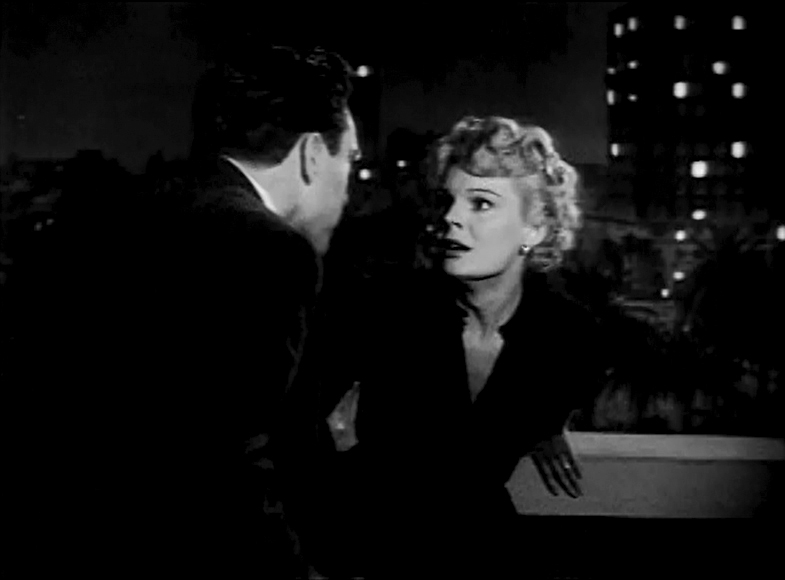
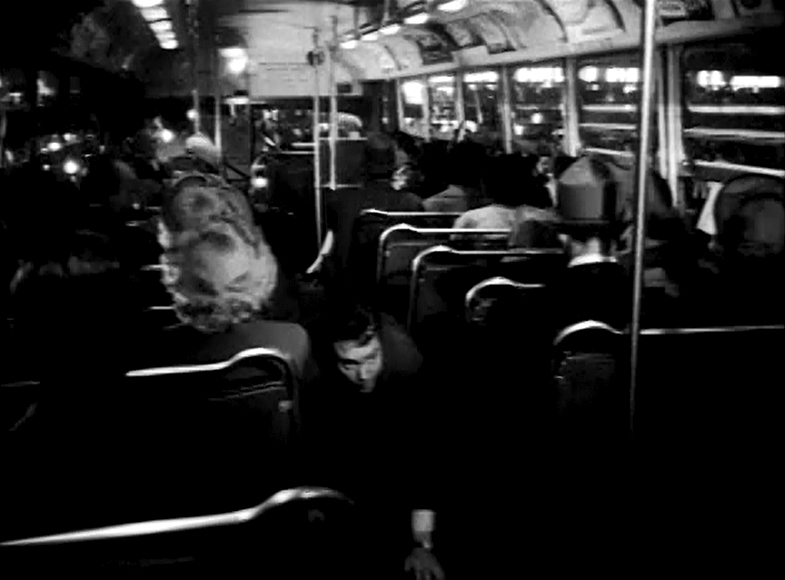
Anyway, because this is my blog, and I can do whatever I like, here's some of my favorite stills:
 
The opening sequence. Bigelow marches through a dark police station.

"I want to report a murder."

Pamela Britten plays Paula, Bigelow's sweet but slightly clingy
secretary-girlfriend back home.

The madness begins: a San Francisco jive club.

"He's flipped. The music's drivin' him crazy." Meanwhile, the faceless
killer prepares the luminous toxin.

"You've got it, all right." A doctor confirms his diagnosis with a glowing
test tube. Bigelow has one day to live.

"I don't think you fully understand, Bigelow. You've been murdered."
Bigelow races down a crowded street. A neat sequence filmed without
permit, and without the bystanders' knowing what was happening.

Irony.

Now on the trail of his own killer, he journeys to Los Angeles, where he
encounters tart, unprofessional secretaries...

...and gun-toting models.

Soon he's getting shot at...

...and chasing phantom gunmen through abandoned warehouses.

Someone doesn't like him sticking his nose in.

But he's utterly fearless now. "He's not afraid," says Majak. "You can tell
from a man's eyes when he is afraid. Look at his eyes."

Chester, one of the creepiest henchmen I've seen. "That's the way I wanna
see you go, Bigelow...niiice and slooow."

But it's Chester who goes, in a drugstore shoot-out.

Beautiful on-site night photography.

The final interview with a not-so-grieving widow.

Surrounded by people but utterly alone.

Crawling on hands and knees to gain a few hours of life.

A few hours to go to the final confrontation at...

...the Bradbury Building, Los Angeles. Is this actually the exterior of the
Bradbury, though? I don't think so.

This, however, is clearly the interior. Recognize it? It's where the climax
of Blade Runner takes place. A lot of movies have been filmed there.

The faceless killer.

The final shot. "Better make it 'Dead on arrival.'"

Friday, July 8, 2016

The City in the Sea

The print edition of The King of Nightspore's Crown, the second book of my Antellus tetralogy, nears completion. I hope to have it out sometime in late July or early August. This works out perfectly, as my novelette "Salt and Sorcery" is due to appear at Beneath Ceaseless Skies in early August. Don't miss it!

But, to tide you over, here's some images. First we have the (tentative) front cover.

 
Then my personal favorite, the spine:

 
And the back cover:

 
In case you can't read it, here's the back pitch as it currently stands:
It has been one year since Keftu, the last phylarch of Arras, established an itinerant society of misfits in the bowels of Enoch, the rust-stained city of stone, mankind's omega. The end of all change is at hand, hastened by the machinations of the veiled warlock Zilla. What can one outcast warrior do to halt the slow slide into tepid chaos? Keftu is about to find out. His quest will take him from the crumbling tenements of Enoch to the black jungles of Ir. He will form alliances the like of which he would never have dreamed. In the end, he may lose his soul to gain...
THE KING OF NIGHTSPORE'S CROWN
Last but not least, here is the map, turned sideways, as you will have to turn it if you wish to consult it while reading the story:


However, I consider it sloppy writing to rely on extraneous objects like maps, and the attentive reader should be able to gather all relevant geographical details from the text. On the second or third reading, at least. Also, I'm always wanting to get into Rhûn and Harad when I read The Lord of the Rings, so it's possible that this map is not entirely adequate...

Rather than pontificate on the story's various influences and antecedents, as I am wont to do, I'll leave you with Edgar Allan Poe's "The City in the Sea," which provides a fitting epigraph.
THE CITY IN THE SEA 
Lo! Death has reared himself a throne 
In a strange city lying alone
Far down within the dim West,
Where the good and the bad and the worst and the best
Have gone to their eternal rest.
There shrines and palaces and towers
(Time-eaten towers that tremble not!)
Resemble nothing that is ours.
Around, by lifting winds forgot,
Resignedly beneath the sky
The melancholy waters lie. 
No rays from the holy heaven come down
On the long night-time of that town;
But light from out the lurid sea
Streams up the turrets silently—
Gleams up the pinnacles far and free—
Up domes—up spires—up kingly halls—
Up fanes—up Babylon-like walls—
Up shadowy long-forgotten bowers
Of sculptured ivy and stone flowers—
Up many and many a marvellous shrine
Whose wreathéd friezes intertwine
The viol, the violet, and the vine.
Resignedly beneath the sky
The melancholy waters lie.
So blend the turrets and shadows there
That all seem pendulous in air,
While from a proud tower in the town
Death looks gigantically down. 
There open fanes and gaping graves
Yawn level with the luminous waves;
But not the riches there that lie
In each idol's diamond eye—
Not the gaily-jewelled dead
Tempt the waters from their bed;
For no ripples curl, alas!
Along that wilderness of glass—
No swellings tell that winds may be
Upon some far-off happier sea—
No heavings hint that winds have been
On seas less hideously serene. 
But lo, a stir is in the air!
The wave—there is a movement there!
As if the towers had thrust aside,
In slightly sinking, the dull tide—
As if their tops had feebly given
A void within the filmy Heaven.
The waves have now a redder glow—
The hours are breathing faint and low—
And when, amid no earthly moans,
Down, down that town shall settle hence,
Hell, rising from a thousand thrones.
Shall do it reverence.
If you haven't yet, I hope you'll consider checking out Dragonfly, the first book in the series, which is available from Amazon.

Friday, June 24, 2016

A Frontispiece and Map for Nightspore

A possible frontispiece for my upcoming novel, The King of Nightspore's Crown:

I spiraled silently down through the night,
slipping in and out of the pyramid's glow.
Scratch drawing in India ink. Since the cover is so organic and curvilinear, I felt that something starkly geometrical and minimalistic was in order.

And here's a pencil sketch of the map. It shows all the small sea of Tethys, rather than just its northeastern corner, where the first installment played out. Obviously the lettering has yet to be worked into it.

 
The Tower of Bel stands in the middle of the sea, linked to the coast-long city by a web of jointed viaducts. The equator, which I haven't drawn, runs through the Tower. This should go without saying, since the Hanging Gardens of Narva (reached from the Tower via space elevator) are in geostationary orbit, and such an orbit must lie over the equator, at a height about equal to the earth's circumference. (There, I knew I didn't take all those physics courses for nothing.)
 
I've decided that the image needs to sit sideways on a single page, rather than be split across two facing pages. The latter expedient is often resorted to in paperbacks, but here seems particularly unsatisfactory, seeing as how everything in my map lines up on the central meridian. The sideways map is a compromise, too, but The Silmarillion features one, at any rate.
 
Anyhow, Enochites imagine the solar system as revolving like a Ferris wheel rather than a carousel, so I suspect that they'd be OK with this either way.

Here, for comparison, is a draft of the map that appeared in Dragonfly:

Tuesday, June 21, 2016

A Bit More Burroughs Art

As promised, here's some more wrap-around Edgar Rice Burroughs cover art. First we have a series of Ballantine editions printed in the sixties and seventies with paintings by Gino D'Achille. I bought them for a quarter apiece at our county library's book sale; no doubt some fortunate fellow townsman is in possession of the first three installments, a murrain seize him/her. I'm less enthusiastic about this art than I am about my Frazetta covers, but – what can I say? – I purchased them solely for the art. My favorite is probably the delightfully bizarre crab-people painting.


While each is more or less monochrome, they're in spectral order, ranging from red through purple, blue, green, yellow, orange, and back to red again. In fact – get ready, I'm about to blow your mind here – in fact, I say, a certain amount of transitional coloration on the left-hand side of each image leads me to conjecture that they're all actually part of a crazy super-long Edgar Rice Burroughs rainbow mural.


Here I've just stuck the covers together so that you can get a general idea of what I'm talking about. They don't quite line up at the edges, and skip space between successive covers here and there. Maybe they're from several panels rather than a single one. In some instances at least I seem to see a single horizon extending from one cover to the next. Searching around the Internet yields images that corroborate the idea without quite confirming it. Here's the artist's website, which makes me think, eh, maybe not, but it's still cool to think.

Finally, here's one wrap-around cover painting by Michael Whelan (copyright 1979). He's a well known fantasy artist – he also did a very creepy wrap-around painting for a volume of H. P. Lovecraft stories that I own – and you can see much better images of his various Burroughs illustrations by performing a judicious Google Image search. The Thuvia painting is my favorite, because, with its dusky, dusty golds and blues, it most closely resembles how I imagine Barsoom.

 
The original is even more beautiful that this mass-produced and rather trashy-looking cover would lead you to believe. But I'll leave it to you to find this out for yourself, and instead conclude by contemplating Thuvia of Ptarth soothing the savage banth, which, to my mind, would look just right airbrushed onto an old van.

Monday, June 20, 2016

The Lost Continent

How is it that, before this summer, I'd never read C. J. Cutcliffe Hyne's The Lost Continent: The Story of Atlantis? I'm glad to say that I've just corrected the omission. Published serially in 1899 and as a book in 1900, it bears the stamp of the best of H. Rider Haggard's novels, but stands alone in being set wholly within antediluvian times, apart from a ridiculous framing story that serves only to explain why the narrative begins and ends so abruptly.

The book seems not very well known or respected these days. E. F. Bleiler in The Encyclopedia of Fantasy dismisses it in one sentence as "a stodgy dynastic romance that is now occasionally laughable." This, in the article on Atlantis; neither Hyne nor his novel have their own entry, and they are not mentioned in the article on Lost Lands and Continents. This judgment seems unduly harsh. Drawing heavily on Ignatius L. Donnelly's "nonfictional" work, Atlantis: The Antediluvian World, published in 1882, it is a work of real power and imagination, and, one suspects, a major influence on the many pulp writers who explored prehistoric civilizations in their stories.

Hailed by Lin Carter and L. Sprague de Camp as the best Atlantis novel out there, The Lost Continent was rescued from obscurity through its publication in the Ballantine Adult Fantasy series. Here is a scan of my copy's cover, with wrap-around painting by Dean Ellis:

 
The story opens in the Yucatan (although, sadly, this setting receives only a cursory glance), but most of the action takes place in the lost continent itself. The narrator and protagonist is Deucalion (as in the Greek deluge myth), a successful viceroy and general called home by the beautiful, capricious, self-deified empress Phorenice. She intends him as her husband, a plan that ends in disaster, owing in part to Deucalion's extreme moral rigidity (in the Atlantean sense). The characters are stiff, the love-making awkward and underdeveloped, the plot strangely meandering. But if you want a good and robust late Victorian romance set against a backdrop of mythic splendor and prehistoric mystery, then look no further.

There's a sea-battle between solar-powered ships and plesiosaurs. There's a seductive empress who rides a colossal wooly mammoth through the streets of the capital. There's a labyrinthine palace in a giant pyramid lit by subterranean fires. There are secret passages. Superdrugs. Volcanoes. Premature burials. Pagan anathemas. Warrior priests. Hairy half-bestial invaders. Pterodactyls that swoop down to steal sacrificial victims. A doomsday escape vessel that seems a cross between the Ark of the Covenant, Noah's ark, and a seed bank.

The novel also shows a creative attention to weird little details, a quality often sadly lacking in later, more derivative fantasy. Consider, for instance, this grotesque description of Deucalion's lover, disinterred from the tomb where she has sat buried alive for nine years:
Her beauty was drawn and pale. Her eyes were closed, but so thin and transparent had grown the lids that one could almost see the brown of the pupil beneath them. Her hair had grown to inordinate thickness and length, and lay as a cushion behind and beside her head. [...] The nails of her fingers had grown to such a great length that they were twisted in spirals, and the fingers themselves and her hands were so waxy and transparent that the bony core upon which they were built showed itself beneath the flesh in plain dull outline. Her clay-cold lips were so white, that one sighed to remember the full beauty of their carmine. Her shoulders and neck had lost their comely curves, and made bony hollows now in which the dust of entombment lodged black and thickly.
Or again, the description of the superbly imagined ark:
A wonderful vessel was this Ark, now we were able to see it at leisure and intimately. Although for the first time now in all its centuries of life it swam upon the waters, it showed no leak or suncrack. Inside, even its floor was bone dry. That it was built from some wood, one could see by the grainings, but nowhere could one find suture or joint. The living timbers had been put in place and then grown together by an art which we have lost to-day, but which the Ancients knew with much perfection; and afterwards some treatment, which is also a secret of those forgotten builders, had made the wood as hard as metal and impervious to all attacks of the weather.  
In the gloomy cave of its belly were stored many matters. At one end, in great tanks on either side of central alley, was a prodigious store of grain. Sweet water was in other tanks at the other end. In another place were drugs and samples, and essences of the life of beasts; all these things being for use whilst the Ark roamed under the guidance of the Gods on the bosom of the deep. On all the walls of the Ark, and on all the partitions of the tanks and the other woodwork, there were carved in the rude art of bygone time representations of all the beasts which lived in Atlantis; and on these I looked with a hunter's interest, as some of them were strange to me, and had died out with the men who had perpetuated them in these sculptures.
At every point the author shows a predilection for grandiose adventure, but tempers it with an attention to visceral detail:
Blood flowed from the mammoth's neck where the spikes of the collar tore it, and with each drop, so did the tameness seem to ooze out from it also. With wild squeals and trumpetings it turned and charged viciously down the way it had come, scattering like straws the spearmen who tried to stop it, and mowing a great swath through the crowd with its monstrous progress. Many must have been trodden under foot, many killed by its murderous trunk, but only their cries came to us. The golden castle, with its canopy of royal snakes, was swayed and tossed, so that we two occupants had much ado not to be shot off like stones from a catapult. [...] 
I braced myself to withstand the shock, and took fresh grip upon the woman who lay against my breast. But with louder screams and wilder trumpetings the mammoth held straight on, and presently came to the harbour's edge, and sent the spray sparkling in sheets amongst the sunshine as it went with its clumsy gait into the water. 
But at this point the pace was very quickly slackened. The great sewers, which science devised for the health of the city in the old King's time, vomit their drainings into this part of the harbour, and the solid matter which they carry is quickly deposited as an impalpable sludge. Into this the huge beast began to sink deeper and deeper before it could halt in its rush, and when with frightened bellowings it had come to a stop, it was bogged irretrievably. Madly it struggled, wildly it screamed and trumpeted. The harbour-water and the slime were churned into one stinking compost, and the golden castle in which we clung lurched so wildly that we were torn from it and shot far away into the water
Refreshingly, the narrator and other characters follow a pagan moral code wholly alien to modern social mores. Deucalion in particular shows utter unconcern with the lives of the peasant and slave classes, whom he plainly despises, and in fact openly reviles in several passages. (Slaves, incidentally, come chiefly from Europe.) Though odious, his attitudes greatly enhance the book's verisimilitude. The destruction of a continent and people to satisfy the zeal of a priestly caste outraged by a single woman who has stolen their secrets is related as a matter of course. Atlantis the nation is mourned, but the people merit not even a second thought.

As I read The Lost Continent, I kept thinking of authors who might have been influenced by it. A comparatively recent example is Michael Moorcock in his Elric books. Like Melniboné, Atlantis is an amoral dynastic island culture fallen into decadence that evinces a strong disdain for the up-and-coming peoples of the mainland; also, interestingly, the approach to both capitals is rendered difficult, the former by a maze of passages, the latter by the twists and turns of an extremely long, narrow, and high-walled inlet. Possible echoes in other works of fantastic literature abound, Edgar Rice Burroughs's stories being the most obvious example.

So if you like to read, not only the great pulp writers, but what influenced them; if you enjoy a good H. Rider Haggard romance and don't mind a bit of Victorian stodginess; if you want an interesting early imagining of ancient high technology; if you're looking for Bronze Age battles with giant prehistoric beasts – if you're into any of these things, I say, then give The Lost Continent a try.

Thursday, June 16, 2016

Frank Frazetta on Barsoom and Pellucidar

Now here, my friends, is some wrap-around cover art. Behold the dust jacket for the Nelson Doubleday book club edition (1971) of The Gods of Mars / The Warlord of Mars, with painting by the peerless Frank Frazetta:


Fond though I am of the Ballantine Adult Fantasy covers, I must admit that most come off as amateurish; here, obviously, we are in the presence of a master. Being a geek, however, I must note that, like most Burroughs illustrators, Frazetta takes some liberties with the green Martians, making them look more human than Burroughs describes them.
Their eyes were set at the extreme sides of their heads a trifle above the center and protruded in such a manner that they could be directed either forward or back and also independently of each other, thus permitting this queer animal to look in any direction, or in two directions at once, without the necessity of turning the head. [A Princess of Mars]
On the other hand, those are some pretty awesome apes. It saddens me that I haven't yet come across a copy of A Princess of Mars in this line. However, as a consolation I do have the Nelson Doubleday book club edition (1972) of Thuvia, Maid of Mars / The Chessmen of Mars.

 
I hereby nominate this as the most glorious wrap-around cover painting ever. It's got it all. Lovely color scheme? Check. Dark sky with multiple satellites? Check. Fabulous retro-future city in the background? Check. Enormous, slavering monster? Check. Manly man defending scantily clad but relatively unconcerned princess from said beast with nothing but a saber? Double check. And the groovy font is just icing on the cake.

Then we have the 1974 edition of Swords of Mars / Synthetic Men of Mars:

 
No wrap-around painting here, but still beautiful.

Since we're on Frank Frazetta and Edgar Rice Burroughs, here's the cover to an Ace edition of At the Earth's Core:

 
And here's the cover to Tanar of Pellucidar:

 
I have some other* Burroughs editions with wrap-around covers, and plan to post a few in the not-so-distant future. In the meantime, enjoy my festival of Ballantine covers.

* I have something like four editions of most of the Mars books. And I'm likely to acquire more if no one stops me. Yes, I need help.

Sunday, June 12, 2016

A Grave in Brownwood

Well, I'm back. Back, that is, from another journey to the land of the in-laws. As I've mentioned, our established route happens to take us through Brownwood, Texas, where Robert E. Howard spent part of his life, went to school, and was ultimately buried. Today we timed our transit so as to attend evening mass at the local parish (coreligionists being scarce in this part of the state), but arrived twenty minutes early, and so decided to find Howard's grave in the interim.

As I now discover, the site lies almost within sight of our route, just off US 377, in Greenleaf Cemetery. A highway sign marks the cemetery entrance, which is on the south side of town, between Howard Payne University (the Baptist university where Howard took classes) and the big 3M and Kohler factories.


The Howard family grave is at the second right on the main road shown above. Thanks to a historical marker, it's very easy to find.


All three family members were buried together. "They were lovely and pleasant in their lives and in their death they were not divided."


And here is what the Texas Historical Commission has to say about the matter:


Yesterday was the eightieth anniversary of Howard's suicide, a fact that somehow did not occur to me until just now.

About twenty or thirty miles to the south on US 377, there's a picnic area marking the (approximate) geographical center of the state. So it's fair to say that the mortal remains of Robert E. Howard repose in the heart of Texas.

Bored? Intrigued? Peruse some of my other ruminations on "Two-Gun Bob" and my forays into the Cross Plains area: