Thursday, June 16, 2016

Frank Frazetta on Barsoom and Pellucidar

Now here, my friends, is some wrap-around cover art. Behold the dust jacket for the Nelson Doubleday book club edition (1971) of The Gods of Mars / The Warlord of Mars, with painting by the peerless Frank Frazetta:


Fond though I am of the Ballantine Adult Fantasy covers, I must admit that most come off as amateurish; here, obviously, we are in the presence of a master. Being a geek, however, I must note that, like most Burroughs illustrators, Frazetta takes some liberties with the green Martians, making them look more human than Burroughs describes them.
Their eyes were set at the extreme sides of their heads a trifle above the center and protruded in such a manner that they could be directed either forward or back and also independently of each other, thus permitting this queer animal to look in any direction, or in two directions at once, without the necessity of turning the head. [A Princess of Mars]
On the other hand, those are some pretty awesome apes. It saddens me that I haven't yet come across a copy of A Princess of Mars in this line. However, as a consolation I do have the Nelson Doubleday book club edition (1972) of Thuvia, Maid of Mars / The Chessmen of Mars.

 
I hereby nominate this as the most glorious wrap-around cover painting ever. It's got it all. Lovely color scheme? Check. Dark sky with multiple satellites? Check. Fabulous retro-future city in the background? Check. Enormous, slavering monster? Check. Manly man defending scantily clad but relatively unconcerned princess from said beast with nothing but a saber? Double check. And the groovy font is just icing on the cake.

Then we have the 1974 edition of Swords of Mars / Synthetic Men of Mars:

 
No wrap-around painting here, but still beautiful.

Since we're on Frank Frazetta and Edgar Rice Burroughs, here's the cover to an Ace edition of At the Earth's Core:

 
And here's the cover to Tanar of Pellucidar:

 
I have some other* Burroughs editions with wrap-around covers, and plan to post a few in the not-so-distant future. In the meantime, enjoy my festival of Ballantine covers.

* I have something like four editions of most of the Mars books. And I'm likely to acquire more if no one stops me. Yes, I need help.

Sunday, June 12, 2016

A Grave in Brownwood

Well, I'm back. Back, that is, from another journey to the land of the in-laws. As I've mentioned, our established route happens to take us through Brownwood, Texas, where Robert E. Howard spent part of his life, went to school, and was ultimately buried. Today we timed our transit so as to attend evening mass at the local parish (coreligionists being scarce in this part of the state), but arrived twenty minutes early, and so decided to find Howard's grave in the interim.

As I now discover, the site lies almost within sight of our route, just off US 377, in Greenleaf Cemetery. A highway sign marks the cemetery entrance, which is on the south side of town, between Howard Payne University (the Baptist university where Howard took classes) and the big 3M and Kohler factories.


The Howard family grave is at the second right on the main road shown above. Thanks to a historical marker, it's very easy to find.


All three family members were buried together. "They were lovely and pleasant in their lives and in their death they were not divided."


And here is what the Texas Historical Commission has to say about the matter:


Yesterday was the eightieth anniversary of Howard's suicide, a fact that somehow did not occur to me until just now.

About twenty or thirty miles to the south on US 377, there's a picnic area marking the (approximate) geographical center of the state. So it's fair to say that the mortal remains of Robert E. Howard repose in the heart of Texas.

Bored? Intrigued? Peruse some of my other ruminations on "Two-Gun Bob" and my forays into the Cross Plains area:

Saturday, June 4, 2016

And Here's Another Wrap-Around Cover

At long last, I have more or less finished the cover painting for The King of Nightspore's Crown, and here it is:


It measures something like 12" x 9", painted on my trusty block of Arches hot-pressed, using a lot of Indian red. Other colors include burnt umber, cadmium red, gold ochre, Naples yellow, sap green, chrome green, cerulean blue, and French ultramarine. No black was used, as I find that it merely deadens the colors, but I have a lamentable weakness for Payne's gray (the only mixed color I use), and this contains some black pigment.


I started the picture in January and finished it today, working mostly late at night. There were about two months in there when I literally didn't have a single weekend to myself, due to various things that came up. A significant portion was painted while rocking a very light-sleeping baby with my foot, which takes a certain amount of coordination. What a life, what a life.


Anyway, on to other material elements. There's a bit of Henri Rousseau here, and also some Samuel Palmer. Like Palmer, I do love a good moon in a painting, especially a crescent moon.


I also looked at some book covers that I like, including one by Kinuko Craft for Perelandra and another by Leo and Diane Dillon for a novel by Ursula K. Le Guin.


Another thing I really like are big murals of prehistoric life, like the ones at the Houston Museum of Natural History, or Zallinger's famous Age of Reptiles mural at Yale. My stories take place in a Paleozoic world, so this seems a fitting inspiration. Here we have a dimetrodon trying (and failing) to hide behind a stand of calamites.


Most of the plants are purely fantastic, however, in the sense that they have a place in neither geological antiquity nor my novel. I honestly just drew the shapes that pleased me, and colored them according to the same principles.


To paraphrase Winnie-the-Pooh, you just have to let things come in where they want. So the cover is more evocative than illustrative. I don't suppose any cover artist is in complete accord with the writer's ideas; I'm no different, even though I'm the same person.


As I've mentioned before, there are a lot of things to think about when making a wrap-around cover. In creating my festival of wrap-around cover art the other day, I began to surmise that much of it (the cover of Xiccarph, for instance) was trimmed down from pieces larger and more symmetrical. To produce a painting that will serve as a cover without serious cropping, you have to make sure that it falls naturally into three sections (front cover, spine, back cover) while remaining a unified whole (because you are a principled artiste who could do no less).

My spine, I think, is particularly successful:


There, wouldn't that look handsome on your bookshelf? Whether the other parts will come together remains to be seen. No doubt I'll have to tweak things a bit.


To get an idea of the truly glacial pace at which I paint, reflect that I worked through unabridged audiobooks of Titus Groan, The Bloody Crown of Conan, Dracula, King Solomon's Mines, Great Expectations, Bleak House, Imaro, Imaro 2, Nostromo, In a Glass Darkly, The Brothers Karamazov, and The House on the Borderland while in progress. That's not counting the time spent listening to Pink Floyd and the Doors.

I wanted very much to listen to Emma, which happens to be one of my favorite novels, but was afraid that Miss Woodhouse would make me lose my take-no-prisoners sword-and-sorcery mojo. I'm not joking about that. There's enough pink in the picture as it is.

Stay tuned for further developments in the publication of my upcoming novel.

Wednesday, June 1, 2016

Land of Enchantment and Atom Bombs

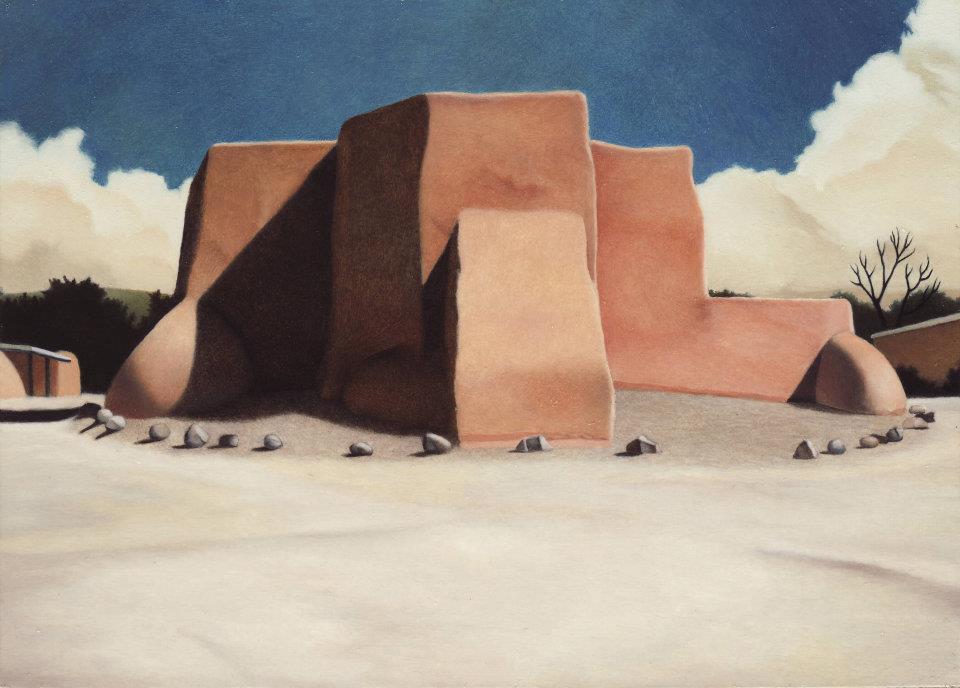
My painting of Taos Pueblo.
I just spent the better part of a week in the Santa Fe area. I've traveled, camped, and backpacked in New Mexico too many times to count, and Santa Fe is my favorite place to visit. Anyone who reads my blog knows that I delight in finding connections between seemingly far-separated subjects. Thanks to my trip, my brain is a whirl of such connections right now.

One thing that strikes me about Santa Fe is the almost painful juxtaposition of old and new. The region is the setting of Willa Cather's backward-looking Death Comes for the Archbishop (1927) as well as Aldous Huxley's forward-looking Brave New World (1931). For both authors, the pueblos represent a link to a world rooted in the past. From the former:
Father Latour lay with his ear to this crack for a long while, despite the cold that came from it. He told himself he was listening to one of the oldest voices of the earth. What he heard was the sound of a great underground river, flowing through a resounding cavern. The water was far, far below, perhaps as deep as the foot of the mountain, a flood moving in utter blackness under ribs of antediluvian rock. It was not a rushing noise, but the sound of a great flood moving with majesty and power.
     "It is terrible," he said at last, as he rose.
     "Si, Padre." Jacinto began spitting on the clay he had gouged out of the seam, and plastered it up again.
Whenever I'm in the area I pay a visit to Bandelier National Monument, where the Frijoles Canyon shelters the ruins of the ancient town of Tyuonyi, the descendants of whose builders dwell at Cochiti Pueblo to the south; perched almost on top of it is the National Laboratory at Los Alamos, where the Manhattan Project was undertaken and where the first atomic bombs were created; beyond that is San Ildefonso Pueblo. Thus are the forces of preservation and destruction violently juxtaposed.

Upon passing the National Laboratory on this trip, I was reminded of a quote from E. F. Schumacher's A Guide for the Perplexed, which I recently read:
The pursuit of science is a matter of taking stock and formulating recipes for action. Every recipe is a conditional sentence of the type, "If you want to achieve this or that, take such and such steps." [...] The test of a recipe is purely pragmatic – the proof of the pudding being in the eating. The perfections of this type of science are purely practical – the objective, i.e. independent of the character and interests of the operator, measurable, recordable, repeatable. Such knowledge is "public" in the sense that it can be used even by evil men for nefarious purposes; it gives power to anyone who manages to get hold of it. (Not surprisingly, therefore, many attempts are always being made to keep parts of this "public" knowledge secret!)
Schumacher opposes knowledge for manipulation (described here) to knowledge for understanding, without which our civilization is sinking ever deeper into "anguish, despair, and lack of freedom."

The Trinity nuclear test. [source]
"I am become Death, the destroyer of worlds."
[from the Bhagavad Gita, quoted by Robert Oppenheimer]
My interest in the history and culture of the region has led me to begin collecting pottery from the local pueblos. Each pueblo has its own distinctive style, such as the famous black-on-black technique developed by Maria Martinez of San Ildefonso Pueblo, which has been exhibited at world's fairs and major museums around the country.

My modest pottery collection. The second and third from the left are from
San Ildefonso, where many of Maria Martinez' kin are still in business.
The others are from Taos, Santa Clara, Acoma, and Santo Domingo.
I prefer to acquire the pottery by visiting the native artisans and sellers. Entering a pueblo is like stepping into a small foreign country, and you are very conscious of being a guest who might be tolerated but is not particularly welcome. Some, such as Santa Clara Pueblo, are fairly friendly and informal; others are quite strict, and some discourage outsiders altogether. On this trip I was fairly run off from Santo Domingo Pueblo for unknowingly approaching during a day of ceremonial dances, which are closed to outsiders.

Maria Martinez, who developed a new style of blackware, with physicist
Enrico Fermi, who worked on the Manhattan Project and created
the world's first nuclear reactor. [source]
At Santa Clara, a dealer from whom I ultimately bought a couple of pieces had a long talk with my family, explaining to my children in steps how the pottery was made. At one point he showed us a wedding picture of his grandparents: his grandfather, recently returned from service in World War I, in full uniform, beside his grandmother, looking rather sullen to have her picture taken, in a buckskin dress or robe, and two other men in full costume, with feathered headdresses. A wedding vase sat on the earth at their feet; ruinous adobe brick dwellings loomed behind.

My painting of the adobe church at Los Ranchos de Taos. This church
was painted many times by Georgia O'Keeffe. A thoroughly modern
abstract painter, she found refuge in northern New Mexico after her
years in New York.
Another site I never fail to visit is the Santuario de Chimayó, a major pilgrimage site and, depending on your outlook, a holy place or an instance of irrational fanaticism (or possibly a curious mixture of the two). The small adobe chapel, built in about 1816, lies at the bottom of a narrow valley on the High Road to Taos, surrounded by rocky red hills and juniper trees.

Chimayo in 1934. [source]
It resembles many such churches in northern New Mexico, with this exception: a tiny square room, called el pocito ("the little well"), reached through a door beside the altar, contains a round pit filled with "holy dirt," which can be taken away by the pilgrims and is reputed to perform cures. The long room running from el pocito alongside the nave holds numerous photos, ex-votos, and discarded crutches.

The town of Chimayó was named for a local hill, known as Tsi Mayoh in the Tewa tongue. Whether it was a site of devotion for the natives before colonial times is not clear. An old tradition holds that a pueblo formerly stood in the area; a book I have (purchased, of all places, at a tacky tourist gift shop in Clines Corners) describes the experiences of Maria Martinez upon visiting the chapel from nearby San Ildefonso.

My own picture of the Sanctuario, taken in 2007.
Most accounts have the chapel built by Don Bernardo Abeyta. An early member of Los Hermanos de la Fraternidad Piadosa de Nuestro Padre Jesús Nazareno (more commonly known as the Penitentes, about which more in a moment), Don Abeyta supposedly discovered an ancient crucifix at the pit's location while performing penitential exercises there on Good Friday sometime around 1810.

Signs in the Santuario museum suggest that the crucifix was left there by Spanish explorers. However that may be, Don Abeyta was seemingly devoted to the Christ of Esquipulas, worshiped at a basilica in Guatemala where the clay is also held to have curative properties, a belief possibly adopted from the native culture and "baptized" by the Spaniards. The museum speaks of the ceiba tree, which holds a central place in Maya mythology, hinting (on somewhat slender evidence, it is true) at other connections between Chimayó and the pre-Columbian religions of Central America.

Esquipulas Basilica, Guatemala, in 1895. [source]
The Penitentes are credited by some with preserving the Catholic faith in the area during the tumultuous period after the Catholic religious orders were expelled from Mexico. Cather's novel deals with the aftermath of this dark time very effectively. Linked with the medieval Flagellants (in spirit if not in historical continuity), the Penitentes were a secretive sect that the Church sought to suppress after the capture of the Southwest by the United States and the division of the current archdiocese from that of Durango.

An interesting book I have, Missions and Pueblos of the Old Southwest (1929), written by one Earle R. Forrest, who had once worked as a cowboy in the Arizona desert and had traveled throughout the area extensively before the arrival of the first automobiles, devotes a chapter to the Penitentes. According to him, the brothers would scourge themselves with chunks of cholla cactus woven into thongs of rope; crucifixion ceremonies were held in remote places at night, and sometimes the Cristo whose ardor was thus tested never returned.

The book is illustrated with photographs taken by the author; one depicts a Penitente morada, or meeting house, and another purports to be the only known photograph of a Penitente procession:


The piety of the Penitentes plays a role in Brave New World. The protagonist, John, raised on a Savage Reservation in New Mexico, becomes a sign of contradiction in the World State, and creates a public spectacle in his attempts at purification through self-flagellation:
"But I don't want comfort. I want God, I want poetry, I want real danger, I want freedom, I want goodness. I want sin."

Friday, May 20, 2016

A Festival of Wrap-Around Cover Art

Inspired by Fletcher Vredenburgh's recent critiques of modern fantasy cover design, I here offer some of my favorite wrap-around cover art from the Ballantine Adult Fantasy series. All images are scanned from my personal collection.

To my knowledge, four artists are represented: Gervasio Gallardo, Robert LoGrippo, David Johnston, and Bob Pepper. (The two Eddison volumes give no credit to the cover artist; one website claims the great Keith Henderson, who did do the interior ornaments.)

In Gallardo, I see a lot of influence from weird/surreal art old and new: Hieronymus Bosch, Odilon Redon, Henri Rousseau, Rene Magritte. As a matter of fact, the Internet informs me that Gallardo (b. 1934) is himself a Spanish surrealist. You can see some of his work here and here. I wonder what became of his Ballantine paintings?

I haven't been able to find much about the other artists, but I love Johnston's covers for their spontaneous appearance and glowing, flowing colors.

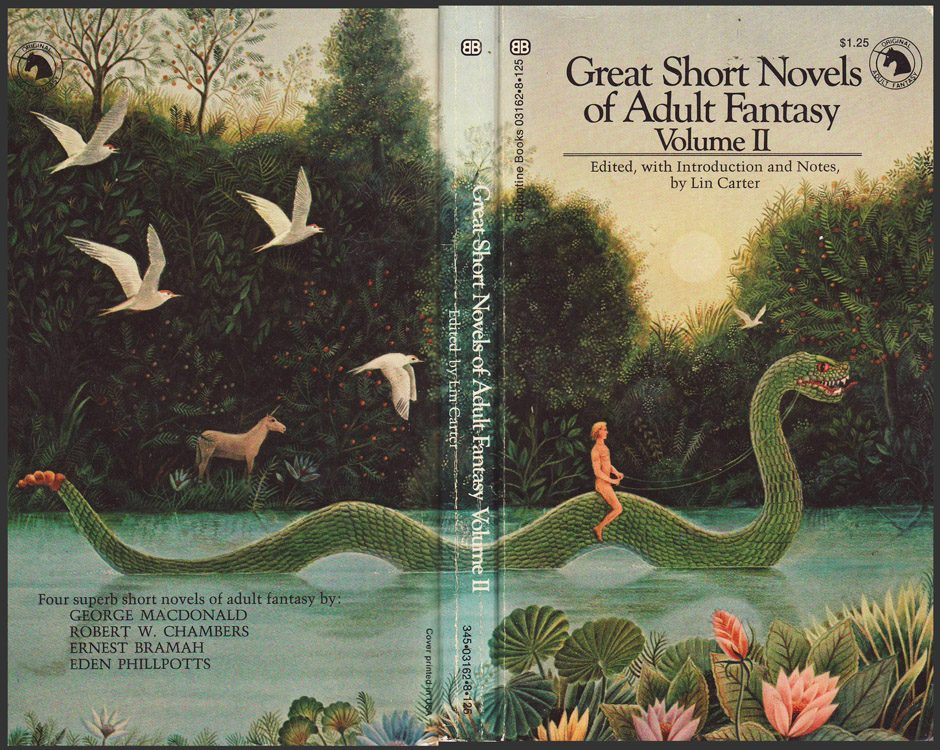
Great Short Novels of Adult Fantasy: Volume II, 1973.
Cover art by Gervasio Gallardo.
Inspired by Henri Rousseau?
 
Poseidonis, Clark Ashton Smith, 1973.
Cover art by Gervasio Gallardo.
 
Evenor, George MacDonald, 1972.
Cover art by Gervasio Gallardo.
 
The Night Land (Vol. II), William Hope Hodgson, 1972.
Cover art by Robert LoGrippo.
This one calls to mind Bosch's depiction of
hell in The Garden of Earthly Delights.
 
The Song of Rhiannon, Evangeline Walton, 1972.
Cover art by David Johnston.
 
The Water of the Wondrous Isles, William Morris, 1971.
Cover art by Gervasio Gallardo.
 
The Children of Llyr, Evangeline Walton, 1971.
Cover art by David Johnston.
 
Xiccarph, Clark Ashton Smith, 1972.
Cover art by Gervasio Gallardo.
Another one that reminds me of Bosch.
 
The Wood Beyond the World, William Morris, 1969.
Cover art by (?) Gervasio Gallardo.
 
The Boats of the "Glen Carrig", William Hope Hodgson, 1971.
Cover art by Robert LoGrippo.
 
The Island of the Mighty, Evangeline Walton, 1970.
Cover art by Bob Pepper.
 
New Worlds for Old, 1971.
Cover art by David Johnston.
The cover of my novel Dragonfly is an unabashed
homage to this lovely piece of work, as well as
other images in our festival.
 
The King of Elfland's Daughter, Lord Dunsany, 1969.
Cover art by Bob Pepper.
 
Prince of Annwn, Evangeline Walton, 1974.
Cover art by David Johnston.
 
Red Moon and Black Mountain, Joy Chant, 1971.
Cover art by Bob Pepper.
 
The Lost Continent: The Story of Atlantis, C. J. Cutcliffe Hyne, 1972.
Cover art by Dean Ellis.
 
Some of the Ballantine covers have only a single panel, generally repeated on front and back. As I said before, I've read that the Eddison volumes feature cover paintings by Keith Henderson, but he's credited only for the interior "decorations."

Mistress of Mistresses, E. R. Eddison, 1967.

A Fish Dinner in Memison, E. R. Eddison, 1968.
 
Imaginary Worlds, Lin Carter, 1973.
Cover art by Gervasio Gallardo.
I find this one slightly unsettling, like a
Rene Magritte painting.
 
Last but not least, the cover art for the Gormenghast books is by Bob Pepper, e.g.,

Titus Groan, Mervyn Peake, 1968.
Cover art by Bob Pepper.

The images don't wrap around, but seem to be clipped from a single large image.

Tuesday, May 17, 2016

New Label, Same Great Flavor!

I've changed my blog's name and banner, because I was bored of the old ones, and decided something less depressing would be nice. But not to worry: I'll continue to provide the incisive commentary and hard-hitting, around-the-clock coverage that you've come to know and love.

In my writing, I like to consider the cosmos as "tending" toward real projective space, or possibly some other spherical 3-manifold, and set my stories at the antipodes of the universe, much as The Divine Comedy portrays Jerusalem and Purgatory as standing diametrically opposite one another on the earth's surface. Hence the new title.


(There, I worked both topology and Dante into my metapost. I couldn't just announce the name change, could I?)

Sunday, May 15, 2016

Gene Wolfe and A. E. van Vogt on the Soul

I have a number of times made known my great admiration of the stories and early novels of A. E. van Vogt. My favorite of his works are the two Null-A books, The World of Null-A (1948) and The Pawns of Null-A (1956; a.k.a. The Players of Null-A). My love is not shared by everyone. Indeed, I am quite aware of their shortcomings myself. But to me van Vogt's best works are a kind of poetry, despite a prose style that is at times almost hilariously awkward. I'm drawn to their naïve earnestness, and also the fact that main plot-movers are philosophical principles (however inadequately digested by Mr. van Vogt) rather than gadgetry.

I remember finding The World of Null-A at a used bookstore (called Treasure Aisles, I believe) in college, and taking it home, and reading it. It was a refreshing, exhilarating experience.
Gosseyn was crawling frantically along the grass when the first bullet actually struck him. It hit one shoulder and sent him spinning into the path of a burning energy beam. His clothes and flesh flared in an insanity of flame; and then he had rolled over and the bullets were focused again. They began to rip him apart as he burned with an incandescent fury. 
The unbearable part was that he clung to consciousness. He could feel the unrelenting fire and the bullets searching through his writhing body. The blows and the flame tore at his vital organs, at his legs, his heart, and his lungs even after he had stopped moving. His last dim thought was the infinitely sad, hopeless realization that now he would never see Venus and its unfathomed mysteries. 
Somewhere along there, death came.
Curtains for Gosseyn I. But then, without a word of explanation, at the beginning of the next chapter:
A curious, heavy sound impinged upon Gosseyn's attention.
As I said, van Vogt's best novels tend to explore innovations, not in technology, but in ideas. That's one of the things I like about him. One thing that often comes up in his writing is the relationship between identity and memory.

In The World of Null-A, I think it's fair to say that identity is portrayed as neither more nor less than memory. The Games Machine explains the method of posthumous transference to Gosseyn II, saying that "the death of one body is recorded on an electronic receiver, which then triggers the new body into consciousness." Prescott later tells Gosseyn that if "two energies can be attuned on a twenty-decimal approximation of similarity [units???], the greater will bridge the gap of space between them just as if there were no gap, although the juncture is accomplished at finite speeds." He goes on: "How do you explain the fact that you have in your mind the details of what Gossen I did and thought? You must have been attuned, you and he; in fact, it is the only theoretically sure method of thought transmission – you have to do it with yourself."

Thus memory and identity in The World of Null-A: the "soul" (if we may call it such) consists of a certain set of memories and traits. Copy those into a new body, and you have the very person, continued.

Now, when I blogged about van Vogt's The Book of Ptath last year, I noted a number of resemblances to the world of Gene Wolfe's Book of the New Sun. Having just finished reading that work's sequel and coda, The Urth of the New Sun (1987), which is just as rich, profound, and delightfully elliptical as the rest, I'm struck by another parallel with van Vogt's writing. Several, actually, but we'll only discuss one here.

[Spoiler alert!!!]

The reader eventually discovers that the protagonist, Severian, is going through a Gosseyn-like succession of bodies. Each body is apparently formed by directed energies and converted into a substantial form through the subsequent consumption of stable matter.
"What we did here for you, Severian, the mighty Tzadkiel accomplished there, remembrance taking from your dead mind to build your mind and you anew." 
"Do you mean that when I stood before Tzadkiel's Seat of Justice, I was an eidolon Tzadkiel himself had made?" 
Ossipago muttered, "Made's too strong a term, if I have as much access to your tongue as I like to think. Made tangible, possibly." 
I looked from him to Famulimus for enlightenment. 
"You were reflected thought in your dead mind. He fixed the image, made it whole, mended the fatal wound you'd borne." 
"Made me a walking, speaking picture of myself."
They go on:
"But I'm dead – not even here, dead back there on Tzadkiel's ship."
"Your twin lies dead there," Barbatus told me. "As another lies dead here. I might say in passing that if he weren't dead, we couldn't have done what we did, because every living being is more than mere matter." He paused and glanced toward Famulimus for help, but received none. "What do you know of the anima?" 
I thought then of Ava, and what she had said to me: "You're a materialist, like all ignorant people. But your materialism doesn't make materialism true." Little Ava had died with Foila and the rest. "Nothing," I muttered. "I know nothing of the anima." 
"In a way, it's like a line of verse. Famulimus, what was the one you quoted to me?" 
His wife sang, "Awake! For Morning in the Bowl of Night, Has flung the Stone that puts the Stars to Flight." [The first line of The Rubáiyát of Omar Khayyam. – raphordo]
"Yes," I said. "I understand." 
Barbatus pointed. "Suppose I were to write those lines upon that wall – and then to write them again upon that other wall. Which would be the true lines?" 
"Both," I said. "And neither. The true lines are not writing, nor speech either. I can't say what they are." 
"That is the way of the anima, as I understand it. It was written there." He indicated the dead man. "Now it is written in you."
Perhaps I'm seeing allusions where there are none (I have a knack for that), but in these explanations I find a gentle rebuttal to van Vogt's low-minded mechanical transference of memory data, framed as a step up to the level of metaphysics. Ironically, one has only to read Aristotle's De Anima to see how far short A. E. van Vogt fell in understanding questions involved in the nature of what is commonly called the soul.

As for Wolfe, as always, I find him a rich source of ideas for writing about eternal questions like the immortality of the soul without veering into scientific reductionism on one side or outright religiosity on the other. His explanation here strikes me as being quite close to the Aristotelian (and Scholastic) idea of the soul as the "form" of the human person.

I do dabble in such philosophy from time to time, but for me the real lesson here is a stylistic one. With a little metaphysics, Wolfe is able to take his characters through mind-blowing experiences and transfigurations without violating their basic humanity.

Tuesday, May 3, 2016

Raphael Ordoñez on Adult Diagnosis

There's a post by your humble blogger over at The Mighty today. I submitted it in response to a prompt for stories by people diagnosed with autism as adults.


If you happen to be a visitor from The Mighty, welcome! Please peruse my blog and enjoy all the extremely important and relevant things I've written about fantasy, logic, beauty, autism, and chickens. You can read my awesome short stories through the sidebar; if you like those, check out my novel Dragonfly through the links at the top of the page.