At long last, I have more or less finished the cover painting for The King of Nightspore's Crown, and here it is:
It measures something like 12" x 9", painted on my trusty block of Arches hot-pressed, using a lot of Indian red. Other colors include burnt umber, cadmium red, gold ochre, Naples yellow, sap green, chrome green, cerulean blue, and French ultramarine. No black was used, as I find that it merely deadens the colors, but I have a lamentable weakness for Payne's gray (the only mixed color I use), and this contains some black pigment.
I started the picture in January and finished it today, working mostly late at night. There were about two months in there when I literally didn't have a single weekend to myself, due to various things that came up. A significant portion was painted while rocking a very light-sleeping baby with my foot, which takes a certain amount of coordination. What a life, what a life.
Anyway, on to other material elements. There's a bit of Henri Rousseau here, and also some Samuel Palmer. Like Palmer, I do love a good moon in a painting, especially a crescent moon.
I also looked at some book covers that I like, including one by Kinuko Craft for Perelandra and another by Leo and Diane Dillon for a novel by Ursula K. Le Guin.
Another thing I really like are big murals of prehistoric life, like the ones at the Houston Museum of Natural History, or Zallinger's famous Age of Reptiles mural at Yale. My stories take place in a Paleozoic world, so this seems a fitting inspiration. Here we have a dimetrodon trying (and failing) to hide behind a stand of calamites.
Most of the plants are purely fantastic, however, in the sense that they have a place in neither geological antiquity nor my novel. I honestly just drew the shapes that pleased me, and colored them according to the same principles.
To paraphrase Winnie-the-Pooh, you just have to let things come in where they want. So the cover is more evocative than illustrative. I don't suppose any cover artist is in complete accord with the writer's ideas; I'm no different, even though I'm the same person.
As I've mentioned before, there are a lot of things to think about when making a wrap-around cover. In creating my festival of wrap-around cover art the other day, I began to surmise that much of it (the cover of Xiccarph, for instance) was trimmed down from pieces larger and more symmetrical. To produce a painting that will serve as a cover without serious cropping, you have to make sure that it falls naturally into three sections (front cover, spine, back cover) while remaining a unified whole (because you are a principled artiste who could do no less).
My spine, I think, is particularly successful:
There, wouldn't that look handsome on your bookshelf? Whether the other parts will come together remains to be seen. No doubt I'll have to tweak things a bit.
To get an idea of the truly glacial pace at which I paint, reflect that I worked through unabridged audiobooks of Titus Groan, The Bloody Crown of Conan, Dracula, King Solomon's Mines, Great Expectations, Bleak House, Imaro, Imaro 2, Nostromo, In a Glass Darkly, The Brothers Karamazov, and The House on the Borderland while in progress. That's not counting the time spent listening to Pink Floyd and the Doors.
I wanted very much to listen to Emma, which happens to be one of my favorite novels, but was afraid that Miss Woodhouse would make me lose my take-no-prisoners sword-and-sorcery mojo. I'm not joking about that. There's enough pink in the picture as it is.
Stay tuned for further developments in the publication of my upcoming novel.
Saturday, June 4, 2016
Wednesday, June 1, 2016
Land of Enchantment and Atom Bombs
![]() |
| My painting of Taos Pueblo. |
One thing that strikes me about Santa Fe is the almost painful juxtaposition of old and new. The region is the setting of Willa Cather's backward-looking Death Comes for the Archbishop (1927) as well as Aldous Huxley's forward-looking Brave New World (1931). For both authors, the pueblos represent a link to a world rooted in the past. From the former:Father Latour lay with his ear to this crack for a long while, despite the cold that came from it. He told himself he was listening to one of the oldest voices of the earth. What he heard was the sound of a great underground river, flowing through a resounding cavern. The water was far, far below, perhaps as deep as the foot of the mountain, a flood moving in utter blackness under ribs of antediluvian rock. It was not a rushing noise, but the sound of a great flood moving with majesty and power.Whenever I'm in the area I pay a visit to Bandelier National Monument, where the Frijoles Canyon shelters the ruins of the ancient town of Tyuonyi, the descendants of whose builders dwell at Cochiti Pueblo to the south; perched almost on top of it is the National Laboratory at Los Alamos, where the Manhattan Project was undertaken and where the first atomic bombs were created; beyond that is San Ildefonso Pueblo. Thus are the forces of preservation and destruction violently juxtaposed.
"It is terrible," he said at last, as he rose.
"Si, Padre." Jacinto began spitting on the clay he had gouged out of the seam, and plastered it up again.
Upon passing the National Laboratory on this trip, I was reminded of a quote from E. F. Schumacher's A Guide for the Perplexed, which I recently read:
The pursuit of science is a matter of taking stock and formulating recipes for action. Every recipe is a conditional sentence of the type, "If you want to achieve this or that, take such and such steps." [...] The test of a recipe is purely pragmatic – the proof of the pudding being in the eating. The perfections of this type of science are purely practical – the objective, i.e. independent of the character and interests of the operator, measurable, recordable, repeatable. Such knowledge is "public" in the sense that it can be used even by evil men for nefarious purposes; it gives power to anyone who manages to get hold of it. (Not surprisingly, therefore, many attempts are always being made to keep parts of this "public" knowledge secret!)Schumacher opposes knowledge for manipulation (described here) to knowledge for understanding, without which our civilization is sinking ever deeper into "anguish, despair, and lack of freedom."
![]() |
| The Trinity nuclear test. [source] "I am become Death, the destroyer of worlds." [from the Bhagavad Gita, quoted by Robert Oppenheimer] |
![]() |
| Maria Martinez, who developed a new style of blackware, with physicist Enrico Fermi, who worked on the Manhattan Project and created the world's first nuclear reactor. [source] |
![]() |
| Chimayo in 1934. [source] |
The town of Chimayó was named for a local hill, known as Tsi Mayoh in the Tewa tongue. Whether it was a site of devotion for the natives before colonial times is not clear. An old tradition holds that a pueblo formerly stood in the area; a book I have (purchased, of all places, at a tacky tourist gift shop in Clines Corners) describes the experiences of Maria Martinez upon visiting the chapel from nearby San Ildefonso.
![]() |
| My own picture of the Sanctuario, taken in 2007. |
Signs in the Santuario museum suggest that the crucifix was left there by Spanish explorers. However that may be, Don Abeyta was seemingly devoted to the Christ of Esquipulas, worshiped at a basilica in Guatemala where the clay is also held to have curative properties, a belief possibly adopted from the native culture and "baptized" by the Spaniards. The museum speaks of the ceiba tree, which holds a central place in Maya mythology, hinting (on somewhat slender evidence, it is true) at other connections between Chimayó and the pre-Columbian religions of Central America.
![]() |
| Esquipulas Basilica, Guatemala, in 1895. [source] |
An interesting book I have, Missions and Pueblos of the Old Southwest (1929), written by one Earle R. Forrest, who had once worked as a cowboy in the Arizona desert and had traveled throughout the area extensively before the arrival of the first automobiles, devotes a chapter to the Penitentes. According to him, the brothers would scourge themselves with chunks of cholla cactus woven into thongs of rope; crucifixion ceremonies were held in remote places at night, and sometimes the Cristo whose ardor was thus tested never returned.
The book is illustrated with photographs taken by the author; one depicts a Penitente morada, or meeting house, and another purports to be the only known photograph of a Penitente procession:
The piety of the Penitentes plays a role in Brave New World. The protagonist, John, raised on a Savage Reservation in New Mexico, becomes a sign of contradiction in the World State, and creates a public spectacle in his attempts at purification through self-flagellation:
"But I don't want comfort. I want God, I want poetry, I want real danger, I want freedom, I want goodness. I want sin."
Friday, May 20, 2016
A Festival of Wrap-Around Cover Art
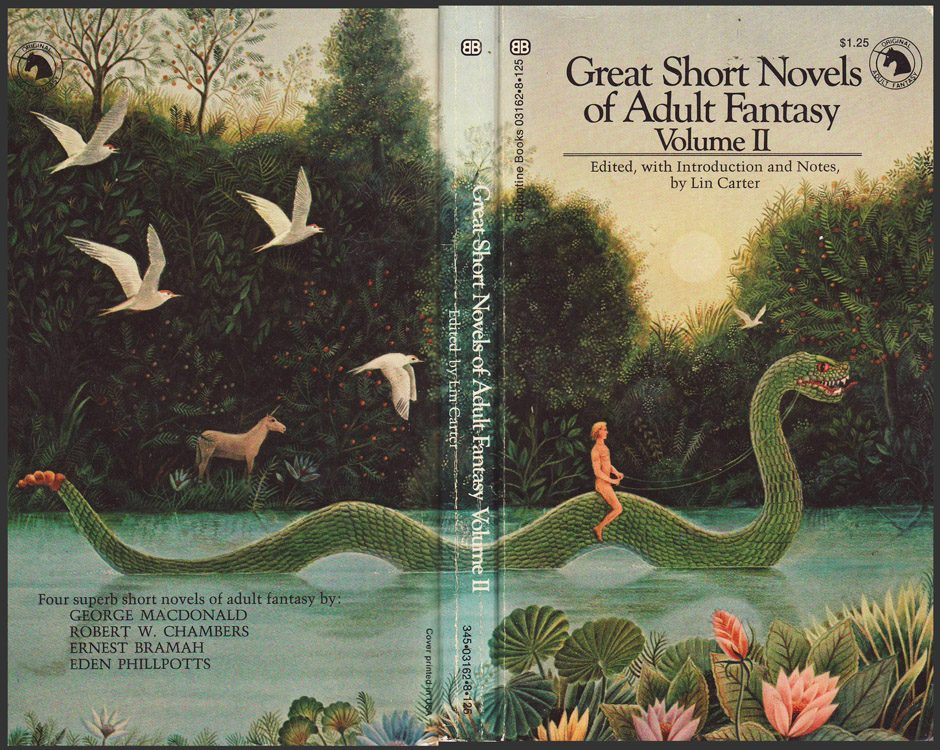
Inspired by Fletcher Vredenburgh's recent critiques of modern fantasy cover design, I here offer some of my favorite wrap-around cover art from the Ballantine Adult Fantasy series. All images are scanned from my personal collection.
To my knowledge, four artists are represented: Gervasio Gallardo, Robert LoGrippo, David Johnston, and Bob Pepper. (The two Eddison volumes give no credit to the cover artist; one website claims the great Keith Henderson, who did do the interior ornaments.)
In Gallardo, I see a lot of influence from weird/surreal art old and new: Hieronymus Bosch, Odilon Redon, Henri Rousseau, Rene Magritte. As a matter of fact, the Internet informs me that Gallardo (b. 1934) is himself a Spanish surrealist. You can see some of his work here and here. I wonder what became of his Ballantine paintings?
I haven't been able to find much about the other artists, but I love Johnston's covers for their spontaneous appearance and glowing, flowing colors.
The images don't wrap around, but seem to be clipped from a single large image.
To my knowledge, four artists are represented: Gervasio Gallardo, Robert LoGrippo, David Johnston, and Bob Pepper. (The two Eddison volumes give no credit to the cover artist; one website claims the great Keith Henderson, who did do the interior ornaments.)
In Gallardo, I see a lot of influence from weird/surreal art old and new: Hieronymus Bosch, Odilon Redon, Henri Rousseau, Rene Magritte. As a matter of fact, the Internet informs me that Gallardo (b. 1934) is himself a Spanish surrealist. You can see some of his work here and here. I wonder what became of his Ballantine paintings?
I haven't been able to find much about the other artists, but I love Johnston's covers for their spontaneous appearance and glowing, flowing colors.
![]() |
| Great Short Novels of Adult Fantasy: Volume II, 1973. Cover art by Gervasio Gallardo. Inspired by Henri Rousseau? |
![]() |
| Poseidonis, Clark Ashton Smith, 1973. Cover art by Gervasio Gallardo. |
![]() |
| Evenor, George MacDonald, 1972. Cover art by Gervasio Gallardo. |
![]() |
| The Night Land (Vol. II), William Hope Hodgson, 1972. Cover art by Robert LoGrippo. This one calls to mind Bosch's depiction of hell in The Garden of Earthly Delights. |
![]() |
| The Song of Rhiannon, Evangeline Walton, 1972. Cover art by David Johnston. |
![]() |
| The Water of the Wondrous Isles, William Morris, 1971. Cover art by Gervasio Gallardo. |
![]() |
| The Children of Llyr, Evangeline Walton, 1971. Cover art by David Johnston. |
![]() |
| Xiccarph, Clark Ashton Smith, 1972. Cover art by Gervasio Gallardo. Another one that reminds me of Bosch. |
![]() |
| The Wood Beyond the World, William Morris, 1969. Cover art by (?) Gervasio Gallardo. |
![]() |
| The Boats of the "Glen Carrig", William Hope Hodgson, 1971. Cover art by Robert LoGrippo. |
![]() |
| The Island of the Mighty, Evangeline Walton, 1970. Cover art by Bob Pepper. |
![]() |
| New Worlds for Old, 1971. Cover art by David Johnston. The cover of my novel Dragonfly is an unabashed homage to this lovely piece of work, as well as other images in our festival. |
![]() |
| The King of Elfland's Daughter, Lord Dunsany, 1969. Cover art by Bob Pepper. |
![]() |
| Prince of Annwn, Evangeline Walton, 1974. Cover art by David Johnston. |
![]() |
| Red Moon and Black Mountain, Joy Chant, 1971. Cover art by Bob Pepper. |
![]() |
| The Lost Continent: The Story of Atlantis, C. J. Cutcliffe Hyne, 1972. Cover art by Dean Ellis. |
Some of the Ballantine covers have only a single panel, generally repeated on front and back. As I said before, I've read that the Eddison volumes feature cover paintings by Keith Henderson, but he's credited only for the interior "decorations."
![]() |
| Mistress of Mistresses, E. R. Eddison, 1967. |
![]() |
| A Fish Dinner in Memison, E. R. Eddison, 1968. |
![]() |
| Imaginary Worlds, Lin Carter, 1973. Cover art by Gervasio Gallardo. I find this one slightly unsettling, like a Rene Magritte painting. |
Last but not least, the cover art for the Gormenghast books is by Bob Pepper, e.g.,
![]() |
| Titus Groan, Mervyn Peake, 1968. Cover art by Bob Pepper. |
The images don't wrap around, but seem to be clipped from a single large image.
Tuesday, May 17, 2016
New Label, Same Great Flavor!
I've changed my blog's name and banner, because I was bored of the old ones, and decided something less depressing would be nice. But not to worry: I'll continue to provide the incisive commentary and hard-hitting, around-the-clock coverage that you've come to know and love.
In my writing, I like to consider the cosmos as "tending" toward real projective space, or possibly some other spherical 3-manifold, and set my stories at the antipodes of the universe, much as The Divine Comedy portrays Jerusalem and Purgatory as standing diametrically opposite one another on the earth's surface. Hence the new title.
(There, I worked both topology and Dante into my metapost. I couldn't just announce the name change, could I?)
In my writing, I like to consider the cosmos as "tending" toward real projective space, or possibly some other spherical 3-manifold, and set my stories at the antipodes of the universe, much as The Divine Comedy portrays Jerusalem and Purgatory as standing diametrically opposite one another on the earth's surface. Hence the new title.
(There, I worked both topology and Dante into my metapost. I couldn't just announce the name change, could I?)
Sunday, May 15, 2016
Gene Wolfe and A. E. van Vogt on the Soul
I have a number of times made known my great admiration of the stories and early novels of A. E. van Vogt. My favorite of his works are the two Null-A books, The World of Null-A (1948) and The Pawns of Null-A (1956; a.k.a. The Players of Null-A). My love is not shared by everyone. Indeed, I am quite aware of their shortcomings myself. But to me van Vogt's best works are a kind of poetry, despite a prose style that is at times almost hilariously awkward. I'm drawn to their naïve earnestness, and also the fact that main plot-movers are philosophical principles (however inadequately digested by Mr. van Vogt) rather than gadgetry.I remember finding The World of Null-A at a used bookstore (called Treasure Aisles, I believe) in college, and taking it home, and reading it. It was a refreshing, exhilarating experience.
Gosseyn was crawling frantically along the grass when the first bullet actually struck him. It hit one shoulder and sent him spinning into the path of a burning energy beam. His clothes and flesh flared in an insanity of flame; and then he had rolled over and the bullets were focused again. They began to rip him apart as he burned with an incandescent fury.
The unbearable part was that he clung to consciousness. He could feel the unrelenting fire and the bullets searching through his writhing body. The blows and the flame tore at his vital organs, at his legs, his heart, and his lungs even after he had stopped moving. His last dim thought was the infinitely sad, hopeless realization that now he would never see Venus and its unfathomed mysteries.
Somewhere along there, death came.Curtains for Gosseyn I. But then, without a word of explanation, at the beginning of the next chapter:
A curious, heavy sound impinged upon Gosseyn's attention.As I said, van Vogt's best novels tend to explore innovations, not in technology, but in ideas. That's one of the things I like about him. One thing that often comes up in his writing is the relationship between identity and memory.
In The World of Null-A, I think it's fair to say that identity is portrayed as neither more nor less than memory. The Games Machine explains the method of posthumous transference to Gosseyn II, saying that "the death of one body is recorded on an electronic receiver, which then triggers the new body into consciousness." Prescott later tells Gosseyn that if "two energies can be attuned on a twenty-decimal approximation of similarity [units???], the greater will bridge the gap of space between them just as if there were no gap, although the juncture is accomplished at finite speeds." He goes on: "How do you explain the fact that you have in your mind the details of what Gossen I did and thought? You must have been attuned, you and he; in fact, it is the only theoretically sure method of thought transmission – you have to do it with yourself."
Thus memory and identity in The World of Null-A: the "soul" (if we may call it such) consists of a certain set of memories and traits. Copy those into a new body, and you have the very person, continued.
Now, when I blogged about van Vogt's The Book of Ptath last year, I noted a number of resemblances to the world of Gene Wolfe's Book of the New Sun. Having just finished reading that work's sequel and coda, The Urth of the New Sun (1987), which is just as rich, profound, and delightfully elliptical as the rest, I'm struck by another parallel with van Vogt's writing. Several, actually, but we'll only discuss one here.
[Spoiler alert!!!]
The reader eventually discovers that the protagonist, Severian, is going through a Gosseyn-like succession of bodies. Each body is apparently formed by directed energies and converted into a substantial form through the subsequent consumption of stable matter.
"What we did here for you, Severian, the mighty Tzadkiel accomplished there, remembrance taking from your dead mind to build your mind and you anew."
"Do you mean that when I stood before Tzadkiel's Seat of Justice, I was an eidolon Tzadkiel himself had made?"
Ossipago muttered, "Made's too strong a term, if I have as much access to your tongue as I like to think. Made tangible, possibly."
I looked from him to Famulimus for enlightenment.
"You were reflected thought in your dead mind. He fixed the image, made it whole, mended the fatal wound you'd borne."
"Made me a walking, speaking picture of myself."They go on:
"But I'm dead – not even here, dead back there on Tzadkiel's ship."
"Your twin lies dead there," Barbatus told me. "As another lies dead here. I might say in passing that if he weren't dead, we couldn't have done what we did, because every living being is more than mere matter." He paused and glanced toward Famulimus for help, but received none. "What do you know of the anima?"
I thought then of Ava, and what she had said to me: "You're a materialist, like all ignorant people. But your materialism doesn't make materialism true." Little Ava had died with Foila and the rest. "Nothing," I muttered. "I know nothing of the anima."
"In a way, it's like a line of verse. Famulimus, what was the one you quoted to me?"
His wife sang, "Awake! For Morning in the Bowl of Night, Has flung the Stone that puts the Stars to Flight." [The first line of The Rubáiyát of Omar Khayyam. – raphordo]
"Yes," I said. "I understand."
Barbatus pointed. "Suppose I were to write those lines upon that wall – and then to write them again upon that other wall. Which would be the true lines?"
"Both," I said. "And neither. The true lines are not writing, nor speech either. I can't say what they are."
"That is the way of the anima, as I understand it. It was written there." He indicated the dead man. "Now it is written in you."Perhaps I'm seeing allusions where there are none (I have a knack for that), but in these explanations I find a gentle rebuttal to van Vogt's low-minded mechanical transference of memory data, framed as a step up to the level of metaphysics. Ironically, one has only to read Aristotle's De Anima to see how far short A. E. van Vogt fell in understanding questions involved in the nature of what is commonly called the soul.
As for Wolfe, as always, I find him a rich source of ideas for writing about eternal questions like the immortality of the soul without veering into scientific reductionism on one side or outright religiosity on the other. His explanation here strikes me as being quite close to the Aristotelian (and Scholastic) idea of the soul as the "form" of the human person.
I do dabble in such philosophy from time to time, but for me the real lesson here is a stylistic one. With a little metaphysics, Wolfe is able to take his characters through mind-blowing experiences and transfigurations without violating their basic humanity.
Tuesday, May 3, 2016
Raphael Ordoñez on Adult Diagnosis
There's a post by your humble blogger over at The Mighty today. I submitted it in response to a prompt for stories by people diagnosed with autism as adults.
If you happen to be a visitor from The Mighty, welcome! Please peruse my blog and enjoy all the extremely important and relevant things I've written about fantasy, logic, beauty, autism, and chickens. You can read my awesome short stories through the sidebar; if you like those, check out my novel Dragonfly through the links at the top of the page.
Friday, April 15, 2016
A Guide for the Perplexed
So, I've been reading E. F. Schumacher's A Guide for the Perplexed.
Schumacher (1911 – 1977) was by profession an economist and statistician. He was a leading figure of the ecology movement in the seventies, served as the Chief Economic Advisor to the UK National Coal Board for many years, and coined the term "Buddhist economics." He's chiefly famous for his 1973 collection of essays, Small is Beautiful: A Study of Economics As If People Mattered, which, among other things, sets forth the principles of Buddhist (or village-based) economics. Schumacher's thought is refreshingly ecumenical and global. He avoids polemics (unlike me) and cites a variety of Eastern and Western philosophical-religious insights at every level of his writing.
A Guide for the Perplexed is the perfect book for the thoughtful undergraduate. I wish I had had it back when I was a student! (Not that I was thoughtful, exactly.) Simply stated, it's a brief map of the human experience. Instead of giving answers, it teaches the student to ask the right kinds of questions.
Because he inevitably devours everything I give him, my student-friend is certain to read both books before very long, and may even wish to discuss them with me. So it has seemed wise to delve into Schumacher once again, that I might have the text fairly fresh on my mind. Despite being an aged hermit by profession (though I'm not quite as old as Dennis the Peasant), I'm still an enthusiastic freshman in life, and am getting quite a lot out of the book myself.
All of which is just a long-winded* way of saying that I read the following passage, and it stood out to me:
* Man, I really need to work on writing shorter posts. I just don't have the time...!
Schumacher (1911 – 1977) was by profession an economist and statistician. He was a leading figure of the ecology movement in the seventies, served as the Chief Economic Advisor to the UK National Coal Board for many years, and coined the term "Buddhist economics." He's chiefly famous for his 1973 collection of essays, Small is Beautiful: A Study of Economics As If People Mattered, which, among other things, sets forth the principles of Buddhist (or village-based) economics. Schumacher's thought is refreshingly ecumenical and global. He avoids polemics (unlike me) and cites a variety of Eastern and Western philosophical-religious insights at every level of his writing.
A Guide for the Perplexed is the perfect book for the thoughtful undergraduate. I wish I had had it back when I was a student! (Not that I was thoughtful, exactly.) Simply stated, it's a brief map of the human experience. Instead of giving answers, it teaches the student to ask the right kinds of questions.
Because he inevitably devours everything I give him, my student-friend is certain to read both books before very long, and may even wish to discuss them with me. So it has seemed wise to delve into Schumacher once again, that I might have the text fairly fresh on my mind. Despite being an aged hermit by profession (though I'm not quite as old as Dennis the Peasant), I'm still an enthusiastic freshman in life, and am getting quite a lot out of the book myself.
All of which is just a long-winded* way of saying that I read the following passage, and it stood out to me:
As regards the bodily senses, all healthy people possess a very similar endowment; but no one could possibly overlook the fact that there are significant differences in the power and reach of people's minds. As regards the intellectual senses, it is therefore quite unrealistic to try to define and delimit the capabilities of "man" as such – as if all human beings were much the same, like animals of the same species. Beethoven's musical abilities, even in deafness, were incomparably greater than mine, and the difference did not lie in the sense of hearing; it lay in the mind. Some people are incapable of grasping and appreciating a given piece of music, not because they are deaf, but because of a lack of adaequatio in the mind. The sense of hearing receives nothing more than a succession of notes; the music is grasped by intellectual powers… For every one of us, only those facts and phenomena "exist" for which we possess adaequatio, and as we are not entitled to assume that we are necessarily adequate to everything, at all times, and in whatever condition we may find ourselves, so we are not entitled to insist that something inaccessible to us has no existence at all and is nothing but a phantom of other people's imagination.This daring intellectual humility applies to lots of things. My little artistic dust-up a couple years ago comes to mind. There's an aptness in a certain loud subset of the Internet sci-fi community to roundly condemn artistic products they don't like as mere posturing, as assaults on the senses or insults against the intellect, and to promote their own products as the truly true art. I don't have anything profound to say about it all, but the interested reader (I know you're out there somewhere) can follow the link and see the application.
* Man, I really need to work on writing shorter posts. I just don't have the time...!
Thursday, April 14, 2016
Hard at Work or...
Let's take a little break from our long-winded castigations of much-loved children's book authors to take a look at what I've been working on lately.
First exhibit, the cover of my upcoming book The King of Nightspore's Crown:
Ha ha ha, just kidding. (I probably had too much fun making that.) Here is the actual painting, in its current state of completion:
For your viewing pleasure, here's a close-up of the lovely mosses:
and here's the two dudes fighting:
As you can see, I've got some Oceanic and Central American influences going on here. Wouldn't this make a cool movie? I'd go see it. Maybe I'll try to interest Guillermo del Toro in optioning the series. If that works out, I'll probably insist that Doug Jones portray at least some of the abhuman characters.
I'm still leaning toward making the left-hand side of this image the front cover, which would maybe look something like this:
As I hope is abundantly clear, I'm still going for the Ballantine Adult Fantasy look. The design's a bit busy, perhaps, but that's kind of my trademark.
I've been listening to Joseph Conrad while painting, which seems fitting. I've also been re-listening to the Imaro books, in anticipation of acquiring the further volumes. Something about the Imaro stories reminds me of the freshness of the old pulps. No doubt this owes partly to the newness of the setting, but there's an earnest seriousness to Saunders' stories that puts me in mind of Robert E. Howard. I like the wilderness stories the best.
A reader objected the other day to attempts to "erase" authors from history. Regular readers of my blog know that, while I may get in a high dudgeon about this or that, I'm quite shameless when it comes to filling my own skull with garbage. I would also defend to the death (or some such rhetorical extremity) the right of the writer to depict the ugly side of life in an ambiguous way. And I don't apologize for reading and liking authors who hold opinions that I or others regard as morally repugnant.
But that doesn't mean that commenting on authors' viewpoints is off-limits, either. It's a free country!
So, suppose you get irritated by something that pervades an author's work – an author you happen to really like on the whole. You want to do something about it. There's a few things you can try. You can grouse about it on your blog, and see where that gets you. That's one approach. You can repudiate and utterly contemn the author's works and urge others to do so. We might call this the bonfire-of-the-vanities approach. Or you can just write your own awesome stories in the same genre, with a certain amount of subversion and subtle commentary.
Which seems like the most fun?
Inspired by such ruminations, I here announce the inception of an alternate-history sword-and-sorcery subgenre set during the time of the Spanish conquests. Of course my protagonist will hail from Puerto Rico. Of course he will be of mixed ancestry. And of course his adventures will take him across an alternate Texas in search of God, gold, and glory. Just like me!
After careful consideration, I propose "sword-and-santería" as a name for the subgenre, having briefly considered but ultimately rejected the "arquebus-and-sorcery" label. I've written one story so far, set in the location of the town where I live. From here I think he will wander out to the painted canyons of the west, to encounter cosmic weirdness and mete out sudden vengeance. No doubt his perambulations will eventually take him to all the really interesting places in the American Southwest, Mexico, and Central America. It's Conrad and Cather meet Howard and Lovecraft, Kane and Conan meet Coronado and Cortés. I wish my antihero luck in his morally dubious adventures.
First exhibit, the cover of my upcoming book The King of Nightspore's Crown:
Ha ha ha, just kidding. (I probably had too much fun making that.) Here is the actual painting, in its current state of completion:
For your viewing pleasure, here's a close-up of the lovely mosses:
and here's the two dudes fighting:
As you can see, I've got some Oceanic and Central American influences going on here. Wouldn't this make a cool movie? I'd go see it. Maybe I'll try to interest Guillermo del Toro in optioning the series. If that works out, I'll probably insist that Doug Jones portray at least some of the abhuman characters.
I'm still leaning toward making the left-hand side of this image the front cover, which would maybe look something like this:
As I hope is abundantly clear, I'm still going for the Ballantine Adult Fantasy look. The design's a bit busy, perhaps, but that's kind of my trademark.
*
I've been listening to Joseph Conrad while painting, which seems fitting. I've also been re-listening to the Imaro books, in anticipation of acquiring the further volumes. Something about the Imaro stories reminds me of the freshness of the old pulps. No doubt this owes partly to the newness of the setting, but there's an earnest seriousness to Saunders' stories that puts me in mind of Robert E. Howard. I like the wilderness stories the best.
A reader objected the other day to attempts to "erase" authors from history. Regular readers of my blog know that, while I may get in a high dudgeon about this or that, I'm quite shameless when it comes to filling my own skull with garbage. I would also defend to the death (or some such rhetorical extremity) the right of the writer to depict the ugly side of life in an ambiguous way. And I don't apologize for reading and liking authors who hold opinions that I or others regard as morally repugnant.
But that doesn't mean that commenting on authors' viewpoints is off-limits, either. It's a free country!
So, suppose you get irritated by something that pervades an author's work – an author you happen to really like on the whole. You want to do something about it. There's a few things you can try. You can grouse about it on your blog, and see where that gets you. That's one approach. You can repudiate and utterly contemn the author's works and urge others to do so. We might call this the bonfire-of-the-vanities approach. Or you can just write your own awesome stories in the same genre, with a certain amount of subversion and subtle commentary.
Which seems like the most fun?
Inspired by such ruminations, I here announce the inception of an alternate-history sword-and-sorcery subgenre set during the time of the Spanish conquests. Of course my protagonist will hail from Puerto Rico. Of course he will be of mixed ancestry. And of course his adventures will take him across an alternate Texas in search of God, gold, and glory. Just like me!
After careful consideration, I propose "sword-and-santería" as a name for the subgenre, having briefly considered but ultimately rejected the "arquebus-and-sorcery" label. I've written one story so far, set in the location of the town where I live. From here I think he will wander out to the painted canyons of the west, to encounter cosmic weirdness and mete out sudden vengeance. No doubt his perambulations will eventually take him to all the really interesting places in the American Southwest, Mexico, and Central America. It's Conrad and Cather meet Howard and Lovecraft, Kane and Conan meet Coronado and Cortés. I wish my antihero luck in his morally dubious adventures.
Labels:
antellus,
art,
ballantine,
cather,
conrad,
lovecraft,
mexico,
peru,
reh,
s&s,
saunders,
texas,
western
Thursday, April 7, 2016
Sorry, but C. S. Lewis is Kind of a Weirdo
I have lately spoken somewhat irritably about C. S. Lewis. This represents the last stage in a slow revolution in my mind. There was a time when I adulated Lewis. I first read the Chronicles of Narnia when I was in the fourth grade. They shaped my imagination, and even now I often find lines from them in my own stories. I discovered his religious works as a college student, at a time when I was the "disciple" of a delusional "apostle" who took me hunting for Hare Krishnas in Mexico (it's a long story) and desperately in need of some rational input. I'll not go into what made me less enthusiastic about the latter works, because I doubt many people who find their way to my blog are particularly interested in my religious opinions. But I will discuss why I've become increasingly uncomfortable with his fiction.
The long and short of it is that C. S. Lewis has a problem with little girls. To be honest, I doubt if I ever would have realized this unless I'd had a daughter of my own. People do talk about it from time to time. Neil Gaiman is a famous (and, to some, an infamous) example. But there's a tendency among some groups to revere Lewis almost as a sort of saint, and to regard any kind of criticism of him as an attack on the faith. And, beyond this, we all have our blind spots. It's part of being human. I can only say that I hope I'm becoming less blind (and more human!) over time.
In reading the Chronicles of Narnia aloud with my kids – we've read the first, second, third, and sixth (in the traditional ordering) – I've come across several passages that never bothered me before, but now seriously put me off. Here's one example that stuck out to me as we read Prince Caspian last year:
And then there's this, from The Voyage of the "Dawn Treader":
And here's the Big One, from The Last Battle, a pleasant little conversation at the threshold of the Narnian heaven:
I could come up with similar examples in many of Lewis' other works – in The Great Divorce, for instance, where he makes it very plain which are the right sorts of women and which are the wrong sorts, and what exactly it is that's so wrong with the latter. But the examples in his books for children are, to my mind, more egregious, because of the tendency in some girls to take such little jabs to heart.
I happen to know a little girl like that. A very earnest and serious-minded girl who catches lizards and plays at being a warrior queen but who also likes to look pretty on occasion and who is deeply sensitive to remarks on her looks. Do I want her thinking about whether her legs are fat? Do I want her fretting over her freckles? Do I want her to be ashamed for wanting to grow up into a woman who wears lipstick?
What sparked this little tirade was a piece of Lewis' correspondence that I came across in trying to research another post I've been working on for almost a year now.* It's a letter written to one Jane Gaskell, who at the age of fourteen wrote her first fantasy novel (Strange Evil) and actually saw it published and favorably reviewed. (Gaskell is mentioned in Lin Carter's Imaginary Worlds; she is a grandniece of Elizabeth Gaskell, the Victorian novelist, and went on to a career in journalism and astrology.) Lewis took it upon himself to write Gaskell a letter, in which he praises her novel faintly before tearing it to shreds. (She was about sixteen at the time, I believe; she was born in 1941, and the letter is dated September 1957.) Let's take a look.
He begins:
The second point is related to the first: Lewis objects to commonplace objects in Gaskell's romance:
The next two points have to do with the mechanics of style. Point third:
Sixth and final point:
Last exhibit: "The Shoddy Lands" (1956)**, a bizarrely misogynistic story which describes a man's phantasmagoric journey into the psyche of a young woman – a reader of Women's Magazines, no doubt – where almost everything is vague and ill-defined, with the exception of daffodils, men's faces, women's clothing, and shops selling jewelry, dresses, and shoes. Toward the end he's confronted with the monstrous apparition of the girl's own self image:
Sure, I have a low opinion of the kinds of trash you find in the supermarket check-out line. I want my daughter to be formed by stuff that's worth reading, not garbage. But I also want her to have a positive view of her own body, and Lewis' weird tendency to attach moral weight to superficialities is just as calculated to make her self-conscious as any Photoshopped Cosmo cover.
The upshot is that we're on an extended (and possibly permanent, so far as my reading aloud is concerned) C. S. Lewis hiatus at our house. I continue to owe him a tremendous debt in many ways, but right now I have other things to think about.
* The Collected Letters of C. S. Lewis, Volume III: Narnia, Cambridge, and Joy 1950 – 1963, Walter Hooper (ed.), HarperCollins, 2007.
** "The Shoddy Lands" first appeared in The Magazine of Fantasy and Science Fiction (1956), and can be found in The Dark Tower and Other Stories.
The long and short of it is that C. S. Lewis has a problem with little girls. To be honest, I doubt if I ever would have realized this unless I'd had a daughter of my own. People do talk about it from time to time. Neil Gaiman is a famous (and, to some, an infamous) example. But there's a tendency among some groups to revere Lewis almost as a sort of saint, and to regard any kind of criticism of him as an attack on the faith. And, beyond this, we all have our blind spots. It's part of being human. I can only say that I hope I'm becoming less blind (and more human!) over time.
In reading the Chronicles of Narnia aloud with my kids – we've read the first, second, third, and sixth (in the traditional ordering) – I've come across several passages that never bothered me before, but now seriously put me off. Here's one example that stuck out to me as we read Prince Caspian last year:
Then she saw the Lion, screamed and fled, and with her fled her class, who were mostly dumpy, prim little girls with fat legs. Gwendolen hesitated.Gwendolen, we may suppose, was not dumpy or prim, and had slender legs. What a thing to write in a book that little girls might read! Even dumpy, prim little girls with fat legs! Did Lewis have any idea of how hard girls can be on themselves about such things, or how vicious to one another? I've read his autobiography, Surprised by Joy, in which he describes his inordinately nasty boys' school, where a kind of Spartan pederasty was a routine part of the social structure (ah, the good old days), so it's hard to imagine that he was simply naïve. But I don't know. I can only speculate.
And then there's this, from The Voyage of the "Dawn Treader":
"—And unhorsed many knights," repeated Drinian with a grin. "We thought the Duke would have been pleased if the King's Majesty would have married his daughter, but nothing came of that—"
"Squints, and has freckles," said Caspian.
"Oh, poor girl," said Lucy.Delightful, delightful. Imagine reading that to a little girl who has freckles and is already self-conscious about them. (For the record, when I read this book aloud, I censored this passage. As supreme co-dictator of my house, I have that authority.)
And here's the Big One, from The Last Battle, a pleasant little conversation at the threshold of the Narnian heaven:
"Sire," said Tirian, when he had greeted all these. "If I have read the chronicle aright, there should be another. Has not your Majesty two sisters? Where is Queen Susan?"
"My sister Susan," answered Peter shortly and gravely, "is no longer a friend of Narnia."
"Yes," said Eustace, "and whenever you've tried to get her to come and talk about Narnia or do anything about Narnia, she says, 'What wonderful memories you have! Fancy your still thinking about all those funny games we used to play when we were children.'"
"Oh, Susan!" said Jill. "She's interested in nothing nowadays except nylons and lipstick and invitations. She always was a jolly sight too keen on being grown-up."
"Grown up indeed," said the Lady Polly. "I wish she would grow up. She wanted all her school time wanting to be the age she is now, and she'll waste all the rest of her life trying to stay that age. Her whole idea is to race on to the silliest time of one's life as quick as she can and then stop there as long as she can."O the humanity! Nylons and lipstick! No heaven for her!!! Here I must confess myself strongly urged to repeat Edmund's words in The Lion, the Witch, and the Wardrobe: you pack of stuck-up, self-satisfied prigs! And what is there in Susan's character as presented in the earlier volumes to merit this universal condemnation and head-shaking? She's a bit tiresome, yes, and a bit cowardly, too, but Edmund the traitor and Eustace the epic brat get their rehabilitations, don't they? And yet it's Susan, whose sin is wanting to wear lipstick, who loses her prospect of eternal salvation. It staggers the mind.
I could come up with similar examples in many of Lewis' other works – in The Great Divorce, for instance, where he makes it very plain which are the right sorts of women and which are the wrong sorts, and what exactly it is that's so wrong with the latter. But the examples in his books for children are, to my mind, more egregious, because of the tendency in some girls to take such little jabs to heart.
I happen to know a little girl like that. A very earnest and serious-minded girl who catches lizards and plays at being a warrior queen but who also likes to look pretty on occasion and who is deeply sensitive to remarks on her looks. Do I want her thinking about whether her legs are fat? Do I want her fretting over her freckles? Do I want her to be ashamed for wanting to grow up into a woman who wears lipstick?
*
What sparked this little tirade was a piece of Lewis' correspondence that I came across in trying to research another post I've been working on for almost a year now.* It's a letter written to one Jane Gaskell, who at the age of fourteen wrote her first fantasy novel (Strange Evil) and actually saw it published and favorably reviewed. (Gaskell is mentioned in Lin Carter's Imaginary Worlds; she is a grandniece of Elizabeth Gaskell, the Victorian novelist, and went on to a career in journalism and astrology.) Lewis took it upon himself to write Gaskell a letter, in which he praises her novel faintly before tearing it to shreds. (She was about sixteen at the time, I believe; she was born in 1941, and the letter is dated September 1957.) Let's take a look.
He begins:
My wife and I have just been reading your book and I want to tell you that I think it is a quite amazing achievement – incomparably beyond anything I could have done at that age. The story runs, on the whole, very well and there is some real imagination in it.So far, so good, though perhaps a bit condescending. At the second paragraph we get to the criticism:
On the other hand, there is no reason at all why your next book should not be at least twice as good. I hope you will not think it impertinent if I mention (this is only one man's opinion of course) some mistakes you can avoid in the future.This "mention" of mistakes goes on for the rest of the letter. Lewis enumerates six points. First he takes Gaskell to task for making the "economic politics and religious differences" too much like our own world.
Surely the wars of faerie should be high, reckless, heroical, romantic wars – concerned with the possession of a beautiful queen or an enchanted treasure? Surely the diplomatic phase of them should be represented not by conferences (which, on your own showing, are as dull as ours) but by ringing words of gay taunt, stern defiance, or Quixotic generosity, interchanged by great warriors with sword in hand before the battle joins?Fair enough, I suppose, though I think it could go either way. I do seem to recall some rather on-the-nose religious dialogues in the Space Trilogy which do at least as much to dispel the spell of faerie, but no matter.
The second point is related to the first: Lewis objects to commonplace objects in Gaskell's romance:
[E]ven a half-fairy ought not climb a fairyhill carrying a suitcase full of new nighties. All magic dies at this touch of the commonplace. (Notice, too, the disenchanting implication that the fairies can't make for themselves lingerie as good as they can get – not even in Paris, which wd. be bad enough – but, of all places, in London.)So, (a) I'm not sure I agree with him about climbing the fairyhill with the suitcase full of nighties, which sounds just bizarre enough to be quite enchanting in its own way, and (b) um, writing letters to teenage girls about lingerie. Yeah.
The next two points have to do with the mechanics of style. Point third:
Never use adjectives or adverbs which are mere appeals to the reader to feel as you want him to feel. He won't do it just because you ask him: you've got to make him.Point fourth:
You are too fond of long adverbs like 'dignifiedly', which are not nice to pronounce.Both excellent points. All writers would do well to adhere to them. But the next point, the fifth, is the one that really set me off:
Far less about clothes please! I mean, ordinary clothes. If you had given your fairies strange and beautiful clothes and described them, there might be something in it. But your heroine's tangerine skirt! For whom do you write? No man wants to hear how she was dressed, and the sort of woman who does seldom reads fantasy: if she reads anything it is more likely to be the Women's Magazines.The ease with which Lewis identifies a woman who might be interested in the color of a character's skirt with the brainless, frivolous creatures uninterested in fantasy and devoted to (gasp) Women's Magazines that haunt his imagination simply takes my breath away. (Actually, lots of women like that kind of detail, and lots of men, too; Raymond Chandler, for instance, is usually pretty good about telling you, not just the color, but the material and cut of his female characters' attire.) Anyway, Lewis goes on about the Magazines:
By the way, these are a baneful influence on your mind and imagination. If you can't keep off them, at least, after each debauch, give your imagination a good mouth-wash by a reading (or wd. it be a re-reading) of the Odyssey, Tolkien's The Lord of the Rings, E. R. Eddison's The Worm Ouroboros, […]Which, to be honest, might be very good advice in its way, but it's phrased in an excessively moralistic, lurid tone. ("Debauch"?)
Sixth and final point:
Names not too good. They ought to be beautiful and suggestive as well as strange: not merely odd like Enaj (wh. sounds as if it came out of Butler's Erewhon).Here he seems to be in a hurry to wrap up. Immediately following this admonition, with no further nuggets of sparing praise, he hastily concludes:
I hope all this does not enrage you. You'll get so much bad advice that I felt I must give you some of what I think good.Again, bear in mind that this is a letter he sent to a sixteen-year-old girl who had just written her first novel. Am I crazy, or isn't it a little bit weird?
Yours sincerely
C. S. Lewis
*
Last exhibit: "The Shoddy Lands" (1956)**, a bizarrely misogynistic story which describes a man's phantasmagoric journey into the psyche of a young woman – a reader of Women's Magazines, no doubt – where almost everything is vague and ill-defined, with the exception of daffodils, men's faces, women's clothing, and shops selling jewelry, dresses, and shoes. Toward the end he's confronted with the monstrous apparition of the girl's own self image:
The gigantic Peggy now removed her beach equipment and stood up naked in front of a full-length mirror. Apparently she enjoyed what she saw there; I can hardly express how much I didn't. Partly the size (it’s only fair to remember that) but, still more, something that came as a terrible shock to me, though I suppose modern lovers and husbands must be hardened to it. Her body was (of course) brown, like the bodies in the sunbathing advertisements. But round her hips, and again round her breasts, where the coverings had been, there were two bands of dead white which looked, by contrast, like leprosy. It made me for the moment almost physically sick. What staggered me was that she could stand and admire it. Had she no idea how it would affect ordinary male eyes?After his return to the real world he concludes:
My view is that by the operation of some unknown psychological – or pathological – law, I was, for a second or so, let into Peggy's mind; at least to the extent of seeing her world, the world as it exists for her. At the centre of that world is a swollen image of herself, remodelled to be as like the girls in the advertisements as possible. Round this are grouped clear and distinct images of the things she really cares about. Beyond that, the whole earth and sky are a vague blur. The daffodils and roses are especially instructive. Flowers only exist for her if they are the sort that can be cut and put in vases or sent as bouquets; flowers in themselves, flowers as you see them in the woods, are negligible.Various interpretations have been given to this story. I'll let it speak for itself, merely remarking that it seems consistent with the other things I've mentioned here, and not particularly wholesome from a psychological point of view.
Sure, I have a low opinion of the kinds of trash you find in the supermarket check-out line. I want my daughter to be formed by stuff that's worth reading, not garbage. But I also want her to have a positive view of her own body, and Lewis' weird tendency to attach moral weight to superficialities is just as calculated to make her self-conscious as any Photoshopped Cosmo cover.
The upshot is that we're on an extended (and possibly permanent, so far as my reading aloud is concerned) C. S. Lewis hiatus at our house. I continue to owe him a tremendous debt in many ways, but right now I have other things to think about.
* The Collected Letters of C. S. Lewis, Volume III: Narnia, Cambridge, and Joy 1950 – 1963, Walter Hooper (ed.), HarperCollins, 2007.
** "The Shoddy Lands" first appeared in The Magazine of Fantasy and Science Fiction (1956), and can be found in The Dark Tower and Other Stories.
Tuesday, April 5, 2016
Eternal Return
Thereupon distilled from the neck of the alembic a white oil incombustible, and the King dipped his rod in that oil and described round the seven-pointed star on the floor the figure of the worm Ouroboros, that eateth his own tail.
Like a black eagle surveying earth from some high mountain the King passed by in his majesty. His byrny was of black chain mail, its collar, sleeves, and skirt edged with plates of dull gold set with hyacinths and black opals. His hose were black, cross-gartered with bands of sealskin trimmed with diamonds. On his left thumb was his great signet ring fashioned in gold in the semblance of the worm Ouroboros that eateth his own tail: the bezel of the ring the head of the worm, made of a peach-coloured ruby of the bigness of a sparrow's egg. His cloak was woven of the skins of black cobras stitched together with gold wire, its lining of black silk sprinkled with dust of gold. The iron crown of Witchland weighed on his brow, the claws of the crab erect like horns; and the sheen of its jewels was many-coloured like the rays of Sirius on a clear night of frost and wind at Yule-tide.
A friend recently facebooked about Nietzsche's idea of eternal recurrence. I read Nietzsche from time to time, mostly because I find him entertaining, and good fodder for story-writing. But he had quite a few keen insights, too. At any rate, the discussion brought to my mind the following passage from Beyond Good and Evil:— The Worm Ouroboros
…the ideal of the most high-spirited, alive, and world-affirming human being who has not only come to terms and learned to get along with whatever was and is, but who wants to have what was and is repeated into all eternity, shouting insatiably da capo [from the beginning] – not only to himself but to the whole play and spectacle… [Beyond Good and Evil, Section 56, trans. Walter Kaufmann]There are a number of other references to the idea in Nietzsche's works. My friend was thinking about a possible influence on Faulkner's The Sound and the Fury ("literature"? yawn!) but of course what it made me think of was…The Worm Ouroboros.
The worm Ouroboros is, as we all know, the worm that eateth its own tail, and this is the structure of the eponymous romance. (Spoiler alert.) Our heroes, the Homeric supermen Juss, Goldry Bluszco, Spitfire, and Brandoch Daha, having defeated their dastardly enemies at long last, have in fact defeated themselves in ridding the world of strife and conflict, which to them is the very game that makes life worth living. They realize this, and lament it, bringing about the appalling miracle that takes them from the story's tail to its teeth.
Queen Sophonisba covered her eyes, saying, "My lords, I see no more. The crystal curdles within like foam in a whirlpool under a high force in rainy weather. Mine eyes grow sore with watching. Let us row back, for the night is far spent and I am weary."
But Juss stayed her and said, "Let me dream yet awhile. The double pillar of the world, that member thereof which we, blind instruments of inscrutable Heaven, did shatter, restored again? From this time forth to maintain, I and he, his and mine, ageless and deathless for ever, for ever our high contention whether he or we should be great masters of all the earth? If this he but phantoms, O Queen, thou'st 'ticed us to the very heart of bitterness. This we could have missed, unseen and unimagined: but not now. Yet how were it possible the Gods should relent and the years return?"
But the Queen spake, and her voice was like the falling shades of evening, pulsing with hidden splendour, as of a sense of wakening starlight alive behind the fading blue. "This King," she said, "in the wickedness of his impious pride did wear on his thumb the likeness of that worm Ouroboros, as much as to say his kingdom should never end. Yet was he, when the appointed hour did come, thundered down into the depths of Hell. And if now he be raised again and his days continued, 'tis not for his virtue but for your sake, my lords, whom the Almighty Gods do love. Therefore I pray you possess your hearts awhile with humility before the most high Gods, and speak no unprofitable words. Let us row back."And the next morning, wonder of wonders, the episode that began the chronicle recurs, and the reader contemplates the heroes' "happy" fate, doomed, deathless in glory, endlessly to repeat the events of the story with infinite variations. It's the perfect "ending," terrifyingly joyous, both satisfying and appalling in its adherence to the story's inner logic and philosophical outlook. It could very well be the best ending to any fantasy novel ever written – a vision of a strange and alien moral topography that may be fine to visit, but not someplace you'd ever want to live.
The superhuman lords and ladies that populate the book's pages are Nietzschean heroes, joyous, strong, carefree, and utterly unconcerned with the peasantry. We encounter peasants on only one occasion, when Eddison adopts the curious narrative device of relating the upshot of a battle through the words of a soldier returning home to his farm. Actually, for someone bent on celebrating the martial deeds well-armed aristocrats, Eddison is strangely reticent to describe an actual battle. We have this second-hand account of the battle at Krothering Side, for instance; the sea-battle off Melikaphkhaz in the Impland seas and the final battle before the gates of Carcë in waterish Witchland take place off-stage as well, while the extermination of the Ghouls that forms the novel's thin backstory is related only through brief allusions. In a way the device reminds one of Elizabethan drama, which is not unfitting, but no Shakespearean actor ever scaled an icy mountain, rode a hippogriff, or fought a brain-eating mantichore, either. So it seems more likely that Eddison simply didn't feel that his talents were equal to the task. Which, to my mind, is just as well; book battles usually read like accounts of volleyball matches to me.
But back to Nietzsche. I'm not certain how much of a direct influence on The Worm Ouroboros Nietzsche actually was. People always talk of Eddison's characters as following a Nietzschean moral code, which I suppose they do, but both authors were really looking to Homer's heroes as exemplars, and you could just as well call the Worm's moral code Homeric. However, this idea of the great da capo and eternal return makes it seem more likely that Eddison did know something of Nietzsche's philosophy.
Tolkien, as is well known, was an admirer of Eddison's fantasies, despite adhering to the exact antithesis of Eddison's personal philosophy, so we'll let him have the final word.
I read the works of [E. R.] Eddison, long after they appeared; and I once met him… Eddison thought what I admire 'soft' (his word: one of complete condemnation, I gathered); I thought that, corrupted by an evil and indeed silly 'philosophy', he was coming to admire, more and more, arrogance and cruelty. Incidentally, I thought his nomenclature slipshod and often inept. In spite of all of which, I still think of him as the greatest and most convincing writer of 'invented worlds' that I have read.** From a letter to Caroline Everett dated 24 June 1957, The Letters of J. R. R. Tolkien, Houghton Mifflin Co., 1981.
Subscribe to:
Posts (Atom)