Tuesday, December 2, 2014

Arts of the Beautiful: Part III

This is a continuation of my Arts of the Beautiful post. Here is Part I, and here is Part II. We formerly noted four marks required by our interlocutor in a work of art:
  1. The work must require skill.
  2. The work must represent an object from nature.
  3. The work must evoke an emotion.
  4. The work must refer to something.
Thus far we have considered the first three. To the first we replied that skill is an accidental though humanly necessary quality, but that the skill of the artist is not precisely the same as the skill of the draftsman; also, apparent ease of execution my be the fruit of years of discipline. To the second we replied that the requirement to closely imitate physical objects in pigment confuses the categories of Art and Nature, identifying the beauty of the subject with the beauty of the painting; but we also suggested that no painting worthy of the name can be truly independent of nature, however high the degree of abstraction. To the third we replied that mood and emotion are inherently subjective, and that the only relevant emotion is the pleasure that comes from seeing a beautiful object made by hand.

So, on to the fourth mark.

Art and Word

The objection to a piece of art on the grounds that it does not refer to something is the objection of the writer. Critics and art historians are, occasionally, philistines, unable to appreciate a painting for its purely visual qualities, but their breadth of knowledge, urbanity, and circumspection make them much more difficult to detect than their less-refined country cousins.

The reason art-writers are sometimes philistines is quite simple: their trade consists of blather, and if a painting doesn't say something or express something then there's not much blather to be gotten out of it. A mute does not need an interpreter. So paintings are made to say things.* Which, by the way, they often do; only, their beauty does not flow from the artist's ideas or feelings.

Though art-writers often speak authoritatively, they rarely say anything about craftsmanship or visual appearance, which is, I think, very telling. But what indeed could really be said without sounding pedestrian? And when they do comment on visual impressions, their opinions generally boil down to, "I like this, and you should, too," or, "I don't like this, and neither should you." As such they serve a humble but important function. Find a critic whose tastes conform to your own, and you can save yourself the trouble of attending an exhibition you're not likely to enjoy. But that's the extent of their role, if what we're talking about is truly visual art.**

As to that, I confess that I find it a little peculiar to hear the objection to non-referential art from someone who decries such insults to civilization and intelligence and the tax-paying public as Piss Christ. Because it's this tragic confusion of art with communication that has led to the scourge of conceptual art, which is pure communication, in reality a pretentious form of drama masquerading as art, with the artist as star or prophet. Here is where I take a low view of modern art, which seems to me to have lost its way, with artists deliberately setting out to make for purposes wholly divorced from and sometimes diametrically opposed to visual harmony.

I recently attended a gallery opening featuring the work of an MFA student. I thought the pieces (collages, mostly) visually arresting and skillfully executed. But her artist's statement explained that she seeks to combine bad art with good art. Surely one needn't obtain an MFA to do that! Really I suppose that her statement is a coded message, and that by bad art she really means "bad art," i.e., art perceived by the arts community (or rather, the arts-appreciating but not quite with-it public viewership) as kitsch. Because what she's clearly doing is attempting to transform this "bad art" into something worth looking at.

If I were to take her at her word, though, I'd have to conclude that she's actively striving to vitiate the end to which she aspires to attain. It's like a mountain-climber giving out that he seeks to combine good with bad mountain-climbing, deliberately blundering into blind ravines and tumbling down slopes in order to make an ironical statement about the lowbrows who just climb competently to the top. You see, once he admits that mountain-climbing is no longer his primary end, he becomes something other than a mountain-climber. I can just imagine an artist, in dismissing some of her older work, saying, oh, that was my naïve good phase, when I only produced good work; I've moved past that now, into my more mature bad phase! As I say, I don't take this particular artist at her word, because her craftsmanship says otherwise, but there certainly have been many artists who did set out to produce either bad art or something that isn't art at all, to jab a thumb in the eye of the bourgeois, their great forerunner being "R. Mutt" and his famous Fountain.***

Here we have the decline of civilization! Here I earn back a bit of my curmudgeon street cred. I remember seeing a piece that consisted of Pieter Brueghel's 1563 Tower of Babel printed on a curved sheet of metal with a big piece of stovepipe or dryer hose coming out. This is just as derivative and impoverished as the statues of the late Roman emperors that recycled the old bodies of gods and heroes created in times of higher cultural attainment, replacing their heads with crude new caesars' heads. But at least Constantine wasn't pretentious about it.

To me there's nothing duller and more demoralizing than seeing a bubbling glass bowl with glowing thingees, or stacks of clay tiles on the floor, or chains of communion wafers dangling from suspended bones, or a stuffed goat with a rubber tire around it, and thinking, okay, what's this supposed to be? And then reading the placard, and saying, oh, I see. Boring and annoying.

These little artefacts are not necessarily bad, mind you. They're just not visual art as I use the term. They're a form of communication or drama. In fact, these items are nothing apart from the chatter that surrounds them, and exist as a kind of fiat currency or line of trading cards for the cultural elites, with critics serving as the guarantors of validity. I wrote about the matter at some length in my post Arts of the Ugly, which is a kind of appendix to this series.

Abstract art, though, is not a case of the Emperor's New Clothes. It is, rather, an attempt by artists to recover the essence of painting, which consists, not in trompe-l'oeil effects and topical allusions, but in being pleasing to the eye.
The extraordinary modern adventure of abstract art precisely expresses the decision, made by certain artists, to turn out works whose beauty will obviously owe nothing to that of the subject. [Arts of the Beautiful]
Vuillard, Whistler, Matisse, Mondrian, Klee, O'Keefe and the rest did not set out to create objects that offend the eye and accustom man to ugliness. Quite the contrary. They stand on the side of beauty. Marcel Duchamp's urinal militates against their project just as surely as it does against the Pre-Raphaelites'.

Beauty and Truth

Those who insist that paintings must look like something or say something true, or else face the charge of irrationality, are making a mistake in conflating the transcendentals of Beauty and Truth, which are not reducible to one another. Beauty is truth, truth beauty, but the truth of beauty is not the beauty of truth.

There is a tendency, among those with a philosophical or logical bent, to try to annex every branch of human activity into some form of inquiry, and they are particularly discomfited to find judgments of beauty beyond the reach of their syllogisms. But the true philosopher recognizes the limits of his methods. We may philosophize about art, as about anything, and debate its nature, as we've done here, but as to giving a formal logical proof of why one painting is better than another? No.

How indeed would such a proof go? "Well, this painting is bad because it violates such-and-such law." What law? Who says it's a law? Why should I regard it as universal? One can certainly argue that a given painting is no good, and list the reasons, and perhaps persuade the undecided. But no formal deductive proof is possible without axioms, and the "science" of the beautiful is simply not an axiomatic science. Any "laws" we erect are necessarily ad hoc, and liable to be violated by a master of his craft.

There's an element of the subjective in the perception of beauty. This seems obvious, but apparently it needs to be said. Beauty is, in a manner of speaking, in the eye of the beholder. This wouldn't be a cliché if there weren't some truth to it. Perceptions vary from person to person. If someone thinks a picture beautiful then you can abuse their judgment but you can't really argue with them. This is not to say that beauty is purely subjective, as some might claim. When deconstructionists assert that "beauty is in the eye of the beholder," they really mean that there is no beauty except what people choose to call beauty. I'm not saying that at all. No, the beauty is in the object, and if one man perceives it then we can expect others of similar tastes to perceive it as well. But just because one does not perceive it does not mean that it is not there.

Of course, someone may be mistaken about the ends of art, and frame their judgments accordingly, and then we may argue against their position. If they say that a painting is bad because it doesn't imitate nature, evokes no emotion, and communicates no idea, then we may reply that they aren't really talking about the beauty of art at all, and may in fact be insensible to such beauty, as the tone-deaf are insensible to music. If they say that a painting is bad because it's butt-ugly in a purely visual sense, then we may privately opine that they have a poor or unformed taste in such matters, but little remains to be said.

A Defense of Paul Klee

And now, despite everything I've just said, I'm going to attempt the thankless task of defending the work of my favorite modern artist, Paul Klee. When I say "defend," I hope by now that it's clear I don't intend to prove his work to be good. Indeed, I hold such an endeavor to be ridiculous.

Our interlocutor has said that, while tastes differ as to the beauty of women, when he meets someone whose tastes do not coincide with his own, he can at least concede that they are both talking about women, and that there is probably something to be said for the other's preferences. The same, he says, applies to representational art.**** But when it comes to abstract painting, the differences are of kind, not of degree, and the very notion of comparing the two is so offensive to reason and common sense and human decency that it makes him physically ill with disgust. As I have argued, I think him mistaken about the nature and ends of art. However, I also think the differences are of degree, not of kind, and this shall be made clear in what I have to say concerning Klee's art.

Klee, Siblings
Anyway, I'm at a loss to explain whence our interlocutor's disgust proceeds. I suppose that if a person has been trained that a painting should be a naturalistic picture of something they recognize, and is instead presented with some more abstract arrangement of color and form, they may receive a mild shock. But physical illness? I confess that the drawings of the mentally ill sometimes make me uneasy. But the drawings of children do not. Those of non-Western or pre-modern cultures do not. I am not offended by the cave paintings of Lascaux or the stylized depictions in Egyptian tombs. Why should I be disgusted by a Klee or a Picasso?

"Well," you might say, "it's all very well for a child or a savage to draw a naïve picture, but for an adult in full possession of his powers to do so designedly is worthy of nothing but contempt." But this tacitly assumes that our "primitive" painter was trying and failing to achieve the trompe-l'oeil effects so highly valued by our scientific civilization, and that his output, while good for its time, is but a crude approximation to our sophisticated techniques. This is, to say the least, a shallow view of art, culture, human perception, history, and pretty much everything. Some cultures may be more "mature" than others according to various metrics, but when it comes to perception of beauty we are all children, or should be.

Klee, Uncomposed Objects in Space
It's not uncommon for art history books to begin at the Renaissance, pretending that International Gothic doesn't even exist, or to patronize the Medievals for their flattened perspective and decorative use of color and pattern.
Let them look at Gothic Figures & Gothic Buildings, & not talk of Dark Ages or of Any Age! Ages are All Equal. But Genius is Always Above The Age. [Blake's marginalia to the works of Sir Joshua Reynolds]
Is the use of linear perspective truly more advanced? It may be more mathematical, but from a certain point of view it less advanced, dwelling as it does on chance appearances to the exclusion of what things actually are. I once saw an old photographic portrait of an Indian dignitary which had been "corrected" so as to have the richly patterned carpet parallel to the picture plane, because that's what looked more natural to the viewers for which it was intended, used as they were to Mughal miniatures and the like. Perhaps they had a point.

So I find no reason to be disgusted by a Klee painting for being childlike, flattened, distorted, or stylized. To declare oneself unable to distinguish between a child's drawing and a madman's demented scrawl is to take a low view of children indeed. And Klee's paintings are the work of no madman, either in truth or by affectation.

Klee, Mask of Fear
Perhaps a short biography is in order. Klee married in his late twenties after a somewhat loose youth, and was for a number of years a stay-at-home husband, raising his young son Felix and keeping house while his wife worked as a piano instructor. He kept a diary (the "Felix calendar") about his son's progress, and later created a puppet theater with an array of puppets to amuse him. He made no hard divisions between the art of his own childhood and his work as a professional artist, and it was during his "happy househusband" years that he developed his approach to art. He and his wife were both talented musicians with strongly conventional inclinations.

Klee was for a time an instructor at the Bauhaus, an arts academy and community that attempted to infuse a Medieval work-ethic into modern art. As his work became better known he fell under the notice of the Nazis. He began receiving subtle threats in print that expressed disgust with his work, made sneering references to his supposed Jewish heritage, and opined that his paintings were foisted upon the public by Jewish dealers intent on financial gain. At last he was forced to emigrate to Switzerland, and there died at the age of sixty before receiving citizenship, which, despite his having been born in that country, had been delayed because of his radical, "degenerate" art.

Is this the portrait of a deranged madman, a pervert, or a conspirator against all that is good and holy? None of this says that Klee's work was any good, of course, but I think it does at least suggest that a quick dismissal on culture-war grounds is unwarranted.

Our interlocutor describes Klee's work as "random," an opinion I find strangely contrary to my own visual impressions. The artist's own elliptical attempts to articulate his theory of creation indicate an intense mental concentration, as evidenced by his short but dense Pedagogical Sketchbook, which is, for me, a constant source of inspiration. It's well worth perusing for someone trying to form an understanding of Klee's method of creation.

Klee, Signs in Yellow
The book is divided into four parts. The first deals with the transformation of the travelling dot into the line, and of the line into the planar region. It identifies the open curve with the active, and the planar region with the passive, while the closed curve is referred to as medial, standing between the two. Active: I fell (a tree with an ax). Medial: I fall (under the strokes of the ax). Passive: I am being felled (with an ax). It considers the growth of structure ("purely repetitive and therefore structural") as frieze ornament and lattice ornament (my terms); these can be classified mathematically, and there are exactly seven types of the first and seventeen of the second, though Klee considers only the simplest. He also ponders the golden ratio. But throughout the motif is the "trichotomy" of active, medial, passive. Active: brain; medial: muscle; passive: bone. Or: Active: anthers; medial: bee; passive: fruit.
Already at the very beginning of the productive act, shortly after the initial motion to create, occurs the first counter motion, the initial movement of receptivity. This means: the creator controls whether what he has produced so far is good. The work of human action (genesis) is productive as well as receptive. It is continuity. (Productivity is limited by the manual limitation of the creator (who has only two hands). / Receptivity is limited by the limitations of the perceiving eye. The limitation of the eye is its inability to see even a small surface equally sharp at all points. The eye must "graze" over the surface, grasping sharply portion after portion, to convey them to the brain which collects and stores the impressions.) The eye travels along the paths cut out for it in the work.
This last is significant to me. I have sometimes wondered if my love of Klee's work is connected to my cognitive disorder, which has the effect of hyperfocusing my attention. This inability to integrate particulars into a coherent whole is a matter of degree, however, and is part of the human condition, so I'm not suggesting that an appreciation of Klee is necessarily limited to those with this disability. But perhaps his deep understanding of perception renders his work more accessible to me than that of some other artists. Perhaps.

Klee, Polyphony
Perusing the rest of the Sketchbook more cursorily, we have Part II [dimensionality: perspective and balance], Part III [the elements: earth/water/air and continuity, which may be rigid, rhythmic, or loose], and Part IV [symbol: the plumb-radius and logarithmic spiral; the arrow ("The father of the arrow is the thought: how do I expand my reach?"), vector addition, and gravity; color and the color wheel]. That Klee was such a sensitive colorist makes this last section especially worthy of study. It describes the role of color-flow in movement, and in particular its description of incandescence (blue to orange) and cooling (orange to blue) calls to mind Separation in the Evening, cited in Part II of this post. The section concludes with:
We have arrived at the spectral color circle where all the arrows are superfluous. Because the question is no longer: "to move there" but to be "everywhere" and consequently also "There!"
Klee, The Goldfish
So let's look at a couple of my favorite pictures. Here we have The Goldfish (1925), painted in oil and watercolor on paper on cardboard. Its glowing colors achieve a profound visual effect, indicating skill in the use of mixed media. It imitates nature: its subject is clearly a fish. In me it evokes various emotions, an admixture of the dread and glory of nature, particularly of the primal oceanic black night. Admittedly it refers to nothing that I know of, save the godlike golden Fish from which all others flee in terror. But as we have said, these are all material.

What I like about it, visually speaking, is the intense electric (yet patterned) warmth of the Fish itself, surrounded by a pool of inky black, with deep-sea-blue water plants and purple fishes around the periphery. The contrast presented by the near-complements is pleasing to the eye. The purples and blues of the border are nicely balanced (with warmer purples and reds at the corners), and the Fish, weighted toward the front, is well placed in the rectangular format. Change one of these things and the picture suffers severely. Even the shapes of the peripheral fish are well chosen. The eye begins at the Fish, circumambulates through the murky blues and reds and blacks, and finally returns to the Fish again, focusing, perhaps, on its staring pink eye.

Klee, Ad Parnassum
Another personal favorite, Ad Parnassum (1932), is regarded by many as Klee's masterpiece. It is painted in oil, with imprinted lines and points, the points overpainted, on casein color on canvas. Once again, it exhibits great skill in the use of materials in achieving its effects. It is plainly a picture of a mountain, with the sun and the sky and something like a ruined archway in the foreground (or maybe it's meant to be a positive shape against a sea of orange light); its title, though, announces it to have a musical theme. Parnassus was, of course, the home of Apollo and the muses, and I've read that Ad Parnassum was the title of a common musical scale or exercise. It evokes in me an emotion of serenity tinged with the melancholy of twilight.

Ad Parnassum was, incidentally, my introduction to Klee's work; I first saw it in a book called 100 Famous Paintings purchased by my mother at a Target when I was a teenager. It was the only book on art history that we owned. At the time I thought the painting one of the most beautiful things I'd ever seen. I mention this because culture warriors sometimes like to ascribe a taste for such things to the influences of a warped education, whereas my own reaction was spontaneous and untutored; my study of art history in school, such as it was, had been limited to ancient art, International Gothic, and the Renaissance.

I will note here, before proceeding to the painting's visual qualities, that its musical theme is shared by a number of Klee's pictures, e.g., Polyphony, shown above, which is similar in execution to Ad Parnassum but has a subtler unifying principle. Klee was, as I've mentioned, conventional in his musical tastes, but music seems to have run ahead of painting in its pursuit of abstraction, with compositions appreciable for their purely audible qualities appearing well before similar developments in the visual arts. To me it seems about as reasonable to reject a painting for being abstract as to reject something like Beethoven's Fifth. At any rate, I would argue that Klee's radical, "degenerate" art went hand-in-hand with his "conventional" tastes in music.

The painting appears constructed from roughly rectangular regions of flat color, but these regions are overpainted with dot-grids, and some of these dots colored so as to either blend in or complement their background, creating an almost miraculous shimmering effect. At the same time, the boldly imprinted lines create a strongly architectural quality. The warm foreground "ruins" lead the eye upward and to the right, to the middle of the right-hand side; then the majestic "mountain" ascending from the velvet gloaming leads the eye skyward into sunlit heights, until we come to rest at the general focal area: peak, sun, and cloud. The sun itself, a flat, dull orange, sets the rest of the colors on fire.

Church, The Parthenon
The painting's overall effect, from visual structure and color scheme to mood and theme, is, to me, comparable to Frederick Edwin Church's 1871 painting of the Parthenon. The color here is not as saturated as in a book I own, so the effect of the colors isn't quite the same as what I'm referring to, though of course you can't ever really trust reproductions.

Well, perhaps this is as good a place as any to stop. Klee's output was massive, and it's not uncommon to pick up two monographs with little intersection. Some of his pictures are, in my opinion, not as successful as the ones I've presented here, but he never ceased experimenting with styles and materials.

It seems appropriate to end with his own words:
Presumptuous is the artist who does not follow his road through to the end. But chosen are those artists who penetrate to the region of that secret place where primeval power nurtures all evolution. 
There, where the power-house of all time and space—call it brain or heart of creation—activates every function; who is the artist who would not dwell there? 
In the womb of nature, at the source of creation, where the secret key to all lies guarded. 
But not all can enter. Each should follow where the pulse of his own heart leads. [Paul Klee on Modern Art]
Or, as a final epigraph:

Art does not reproduce the visible;
rather, it makes visible.


* Rather, recent paintings are made to say things. In books of art history, old paintings are reduced to sets of allusions. If you want to get really depressed, pick up a fine art history book put out by Phaidon or some such publisher and actually read the garbage they print in the white space left over by the pictures. The historical, scriptural, and mythological tidbits trotted out (cloppety-cloppety-clop) by the people they find to write these things seem to have come from hazy memories of the appendix at the back of the workbook they were given in their undergraduate art appreciation class. A book I have on Piero della Francesca, for instance, solemnly states that Christ's family "settled in Jerusalem." Another, a book on the Pre-Raphaelites, explains that Rossetti's painting of the Annunciation was controversial because it places a halo around the dove, which was an unconventional treatment for "animals" at the time. This was, it seems, the author's own construction. No evidence of controversy is given, nor any sign that the author has the least familiarity with the countless paintings of the same subject produced throughout Europe from the Middle Ages on.

** I'm speaking of art criticism here, not literary or film criticism; fiction doesn't seem to fit neatly into the category of arts of the beautiful, and the problem of identifying the causes of failure or success is a manifold one, requiring considerable powers of reason.

 
*** The original, I mean, not the limited-edition replicas, which are priceless art treasures to be protected at all costs from being used for their apparent purpose.

**** A comparison fraught with danger for two reasons. First, women are human persons, not objects, whereas paintings are objects. Second, an appreciation for the beauty of women involves an element of sexual desire, whereas an appreciation for the beauty of a painting as such is purely intellectual. It has been pointed out that there are no tactile, olfactory, or gustatory arts  of the beautiful because these senses are too involved in the animal appetites, which run toward sex and food (as observed by Aquinas, I believe). Only visual and auditory arts are possible. The admiration of a cheesecake picture or an actual physical body involves, at least unconsciously, an imaginary physical encounter, and so takes place on a different plane from the disinterested pleasure evoked by a beautiful painting.

Monday, December 1, 2014

Arts of the Beautiful: Part II

This is a continuation of my post Arts of the Beautiful: here's Part I. In that post we noted four marks required by our interlocutor in a work of art:
  1. The work must require skill.
  2. The work must represent an object from nature.
  3. The work must evoke an emotion.
  4. The work must refer to something.
So far we've considered only the first mark. After discussing the other three, we shall, as promised, mount a (necessarily unsatisfactory) defense of the work of Paul Klee.

Whistler's Mother?

Whistlers Mother high res.jpg
Arrangement in Gray and Black
In the introduction to Arts of the Beautiful, Etienne Gilson ponders an illustrative example, James McNiell Whistler's Arrangement in Gray and Black, popularly known as Whistler's Mother. He quotes a reference to it in an essay published by the Metropolitan Museum of Art. This essay, after pointing out that the purpose of the painting is more than merely to produce a likeness, goes on to assert that its real subject is a certain mood which the image presumably evokes in the viewer.

Gilson observes that this interpretation equally well ignores the evidence given in the painting's title, which would seem to indicate that the artist's purpose was to produce an arrangement in gray and black. It's curious. The author of the essay (one John Canaday) rejects the popular notion that the painting is merely a representation of nature, only to call it a representation (or evocation, rather) of mood. Whereas the painter himself seems to have regarded it first and foremost as a plane surface covered with pigment so as to achieve a pleasing unity.

So these, then, are our questions: Is the primary end of art to represent (an object or an emotion)? Is art that does not represent even possible?

Les Demoiselles d'Gotham

Some time ago I saw an outraged citizen set Picasso's bull from Guernica side by side with a bull drawn by Gustave Doré, and challenge a proponent of modern art to give a good-faith argument as to why we should regard the former as anything but the deranged scrawling of a conman foisting a piece of trash on a facile public. The unstated assumption here is that the better artist produces the better bull, that is, the bull more closely approximating the immediate visual impression the cerebral cortex receives upon looking at the live animal.

Guernica. See upper left for offending bull.
This is to say that the ends of the illustrator are the same as the ends of the painter. The idea is nothing new; in centuries past there have been no lack of those who assert that, yes, a painter is nothing more and nothing less than an illustrator on a grand scale. William Blake, who here agrees closely with Mr. Wright, rails about this in his "Descriptive Catalogue" of 1809 in several places, e.g.,
As there is a class of men, whose whole delight is in the destruction of men, so there is a class of artists, whose whole art and science is fabricated for the purpose of destroying art. Who these are is soon known: "by their works ye shall know them." All who endeavour to raise up a style against Rafael, Mich. Angelo, and the Antique; those who separate Painting from Drawing; who look if a picture is well Drawn; and, if it is, immediately cry out, that it cannot be well Coloured— those are the men.
William Blake, Isaac Newton
thus referring to the tendency of critics at the time to prefer paintings with muted colors and blended forms. As he elsewhere puts it,
When Mr. B. formerly painted in oil colours his Pictures were shewn to certain painters and connoisseurs, who said that they were very admirable Drawings on canvass; but not Pictures: but they said the same of Rafael's Pictures. Mr. B. thought this the greatest of compliments, though it was meant otherwise. If losing and obliterating the outline constitutes a Picture, Mr. B. will never be so foolish as to do one.
Or again:
The great and golden rule of art, as well as of life, is this: That the more distinct, sharp, and wirey the bounding line, the more perfect the work of art; and the less keen and sharp, the greater is the evidence of weak imitation, plagiarism, and bungling.
Though fashions change, and "wirey" bounding lines have come and gone, what Blake is saying here is much more far-reaching than a critique of a current style. He is saying that the ends of painting are properly the same as those of "drawing," i.e., illustration, his profession. (Incidentally, Blake knew the work of the "Antique" primarily through reproductions.) In something of the same sentiment, allowing for differences in the styles opposed, Mr. Wright routinely posts pictures of scantily-clad comic book nymphets with improbable bosoms as an antidote to the non-illustrative, nonrepresentational derangement of modern abstract art. To him, one well-delineated Catwoman with heaving mammaries is better than a full Pamplona of ill-drawn Picasso bulls.

Perhaps the real question is whether painting-as-an-art has an end outside itself. For illustration is clearly a subservient art: it must submit slavishly to the subject, even when not submitting to the demands of commerce. More importantly, it mustn't call attention to itself or announce itself as an independent product. Its nature is to go with something else, generally the spoken or written word. Works that violate this fail as illustrations (as many of Blake's works do), though they may be very fine paintings. Van Eycks and Michelangelos make poor illustrations except in books of art history. Take the Ghent Altarpiece. It is, admittedly, subservient to an end beyond itself, namely, the depiction of sacred themes, but the difference is this: in possessing that brain-electrifying "gleam of beauty" and fundamental unity that mark the arts of the beautiful, it serves to focus the mind on the altar and elevate it above the mundane, doing so insofar as it is a painting in its own right.

Doré's bull may be very fine, but what his bullfight illustration lacks that Picasso's painting possesses is the gleam of beauty considered as a whole, the mark of independence and unity.

Please recall, incidentally, that I am not attempting to prove such paintings as Guernica beautiful. I am merely using them to illustrate what I mean when I say that painting and illustration are distinct arts. If you disagree with my assessment of Picasso and Doré, well, I'll not argue the point; I'm only attempting to show that a reasonable person might distinguish between their roles as makers, as a great many persons actually do, without being guilty of bad faith.*

Art and Imitation

Now, even if it be conceded that the ends of painting are not the ends of illustration, perhaps one might still hold that a primary, or perhaps the primary, end of painting is the representation or imitation of natural forms.

William Holman Hunt, The Hireling Shepherd
The Pre-Raphaelites (some of them, anyway) are famous for their meticulous attention to natural detail. Their extreme naturalism was a conscious revolt against the muted formlessness decried by Blake; they were influenced by the critic John Ruskin, whose later invective against Whistler for "flinging a pot of paint in the public's face" brought about the famous libel case that marked the decline of his reputation.

Beautiful though the detail is in such paintings, there is a tendency for the parts to fail to coalesce into a unified whole. Good examples include Hunt's Hireling Shepherd, which seems to fall into several pieces, and Millais' oddly disproportionate Sir Isumbras at the Ford with its gradually diminishing horse. It has been said that detail serves to underline a section of a painting, and that nothing but confusion is accomplished by underlining everything. Unity and abstraction have to work hand in hand to bring the painting into a coherent whole. But as soon as you grant their roles, you arrive at the question: How much abstraction is too much abstraction? Is there a limit, and, if so, what is its nature?**

Pieter Claesz, Still Life
As Whistler said, if the imitation of surface appearance were the end of art, then the photographer would be "king of artists." Or again, if mere imitation were the highest end of painting, then the Dutch still-lifes would be the pinnacle of painting. It may be countered that this misrepresents the position: many paintings, it is true, are beautiful in that they idealize their subjects, and are thus not purely naturalistic, but their beauty still owes to what they represent. But this involves a confusion of categories, the categories of Art and Nature. The beauty of a flower is distinct from the beauty of a painting, even if the painting is of a flower. I have visited the Los Ranchos church, and I have seen Georgia O'Keefe's painting of it at the Amon Carter in Fort Worth, but my enjoyment of the church is distinct from my enjoyment of the painting. Again, a crystal may be very beautiful, but it is no sculpture; and a sculpture that mimicked a crystal would entrance us only until we discovered the deceit and the novelty wore off.

So suppose we grant that the beauty of a painting as such is distinct from the natural beauty of what it represents. Who can tell where the beauty of nature leaves off and the beauty of art steps in? I certainly can't. There are no hard divisions between beauty and beauty in concrete objects, but this doesn't mean that they are not distinct in principle.

Of course, there are plenty of people who are convinced that they love art, when in fact they love what is represented in art. But what harm does it do? It actually does a great deal of good, for many a painter has been able to please the lover of subjects (and thus secure patronage) while pursuing the ends of art.

Klee, Separation in the Evening
On the other hand, I submit that no painting, not even the most abstract, is entirely independent of naturalistic representation. For every painting abstracts from nature. Paul Klee's Pedagogical Sketchbook, a short but profound illustrated handbook, documents how he translates sense-impressions from the physical world, which can be purely visual (line, perspective, color) or more abstract (force, energy, motion), into the terms of his art. In Paul Klee on Modern Art he puts it this way:
May I use a simile, the simile of the tree? The artist has studied this world of variety and has, we may suppose, unobtrusively found his way in it. His sense of direction has brought order into the passing stream of image and experience. This sense of direction in nature and life, this branching and spreading array, I shall compare with the root of the tree.
From the root the sap flows to the artist, flows through him, flows to his eye.
Thus he stands as the trunk of the tree.
Battered and stirred by the strength of the flow, he moulds his vision into his work.
As, in full view of the world, the crown of the tree unfolds and spreads in time and in space, so with his work.
Nobody would affirm that the tree grows its crown in the image of its root. Between above and below can be no mirrored reflection. It is obvious that different functions expanding in different elements must produce vital divergences.
But it is just the artist who at times is denied those departures from nature which his art demands. He has even been charged with incompetence and deliberate distortion.
And yet, standing at his appointed place, the trunk of the tree, he does nothing other than gather and pass on what comes to him from the depths. He neither serves nor rules—he transmits.
His position is humble. And the beauty at the crown is not his own. He is merely a channel.
One of my favorite Klee paintings, Separation in the Evening, is clearly drawn from the muted golds and blues that drape themselves across the sky soon after the sun has set. (The image above is a tad oversaturated.) The opposing vectors embody the descent of dusk and the shutting-down of the day. It recalls to me a certain evening when I was a little boy, and went with my parents to the big downtown library, and looked out onto the street from the children's section. It fills me with a strange sweet melancholy. These are subjective impressions, I know, but the point is that I am responding to a naturalistic representation in this painting just as surely as a lover of grand American landscapes might respond to a Bierstadt or a Moran. The level of abstraction is just higher, and the focus narrower.

Piet Mondrian, The Gray Tree, 1911
Many abstract artists of the early twentieth century exhibit this slow, cautious groping upward from the roots of physical reality, from imitative art to pure, almost geometric abstraction, reminiscent of parallel developments in mathematics. Mondrian is the clearest example. Place side by side a tree-painting from his early career, his middle career, and his late career, and trace the development, the reliance on nature that becomes less and less imitative, more and more certain of its ends. But, as Gilson puts it,
To speak of non-representational, non-imitative or abstract painting is not to speak of an amorphous painting. No painting is more abstract than Mondrian's, but this geometric painting is also the most formal of all. Like formal logic itself, it is form without content. [Forms and Substances in the Arts]
Each artist must follow his own path, as Klee said, and nothing can be rushed. But the drive is in every true artist.

Andrew Wyeth, Christina's World
On the other hand, even artists who never move beyond representation abstract from nature in their own ways. Georgia O'Keefe, best known for her flower paintings, insisted that she be known as an abstract artist. Andrew Wyeth made much the same claim.
Painters and sculptors find in objects which they imitate an always-ready outlet for their urge to make. Still, the true artist does not make in order to imitate; he imitates in order to make. Imitation is the first step on the way to creation. [Arts of the Beautiful]
It is interesting, incidentally, that as soon as photography stepped in to assume one of the roles traditionally filled by painting, there began a prolonged drift into greater and greater abstraction, as though painting had been set free to pursue its own ends.

William Morris
Acanthus wallpaper
One last point. Our interlocutor argues that "geometrical" paintings may be very pretty decoration, like wallpaper or tile, but are not truly paintings. As I replied to him, and repeat here, the difference is that decorative work is not meant to be viewed as a whole. Wallpaper, for instance, represents a pattern that is, for all intents and purposes, infinite. If a painting were merely to reproduce such a pattern as far as finite bounds allow, then it would be a poor painting indeed. There would be no sense of unity or completeness, which means that no gleam of beauty such as a true work of art reflects would be possible. There could be no recognition, no "aha." Not so with even the most abstract works of Mondrian. They exhibit unity, completeness, balance, dynamism.

Art and Emotion

Millais, The Blind Girl
It remains to consider the assertion that art must represent or evoke emotion. I say these together, for it seems to me that the only way to know if a picture represents an emotion effectively is to see whether it communicates that emotion to oneself.

But how can a variable subjective response be used to gauge whether a painting is objectively a work of art? Beauty inheres in the object, even if different subjects may disagree about its presence, while mood inheres in the subject. Really, though, as I said before, the only emotion relevant to the question is the joy that comes with seeing a beautiful thing, and this joy may have very little to do with what is represented. The crucifixion in Grünewald's Isenheim Altarpiece brings me this joy, though the subject, whatever religious interpretation we may give it, fills me with horror and rebukes my soul.

Of course, many great paintings induce emotional responses, and it is in practice impossible to tell how much one's enjoyment owes to these emotions and how much to artistic beauty. John Everett Millais' The Blind Girl brings me great joy, but is this owing to the visual elements or the subject? Who can say? Still, this doesn't mean that the things are not distinct in principle. Certainly I can assert that this particular picture is quite lovely in its arrangement of color and form.

The main mistake made by those who insist on a painting's having a clearly recognizable and well-delineated visual subject provoking a universal emotional response is, in my opinion, the confusion of matter and form. Much like pigment or ground, a painting's subject and emotional freight are to the art-of-the-beautiful as matter to form. Perhaps we needn't expect to find a painting without a subject of some sort, just as we needn't expect to find a painting without pigment. But these things are subservient to the form. And what is the form? Gilson gives an admirably simple definition:
A picture is a solid surface which the artist covers with colored forms whose arrangement is pleasing to the eye through the unity of the form, the harmony of the parts and the perfection of the execution. [Forms and Substances in the Arts]
This discussion anticipates our next point, that of art and communication, which we shall continue in a subsequent post: Part III.


* For the record, I don't particularly care for Picasso's cubist work, though I do admire Guernica; I greatly admire Doré and own a number of volumes of his works, including his illustrations to the Bible, Paradise Lost, the Divine Comedy, Orlando Furioso, and the Idylls of the King; I think Blake was an artistic and poetic genius, and I concur strongly with his taste in art; I don't think a great deal of comic-book art, though I do enjoy me a good Roy Lichtenstein now and then; when it comes to delineations of female beauty, I find the princesses in H. J. Ford's illustrations to Lang's fairy books uncommonly pretty.

** Again, for the record, I would much rather see a good Pre-Raphaelite piece than hundreds of Picassos. When I was in London once I spent hours in the Tate on multiple occasions, and didn't so much as set foot in the Tate Modern. I think The Hireling Shepherd a lovely picture, but also recognize its failure to achieve unity.

Saturday, November 29, 2014

Arts of the Beautiful: Part I

This is a post I began back in August but have worked on only at long intervals. For a time I decided to abandon it, because, really, who cares what I have to say about art? But trying to figure out what people would like to see me write about has never really been the point of this blog. So here it is, in three parts, imperfect and unformed, but as good as I could make it in the given format.
 
Introduction

Some time ago I happened to disagree with a sentiment expressed by the author John C. Wright on his blog. This sentiment concerns ART, particularly PAINTING. The exchange had to do with something I've thought a great deal about and concerning which I've held, at different times, a number of conflicting opinions. But my interlocutor made it plain in no uncertain terms that he did not wish to continue the conversation, so I'm continuing it here, with myself, as a way of clarifying my views. I've written about these things before, and shall not scruple to plunder my earlier posts, so some of this will be repetition.

The ideas I here express are merely my personal opinions. Art is by nature manifold, and doesn't admit easy generalizations; I think there is plenty of room for a multiplicity of views on the subject. It's not a field in which someone can be shown to be definitively right. If you disagree with my views, I can only say that I've probably thought the way you do before, and may very well do so again.

Before I begin, I should mention that this is merely a vulgarization – or popularization, if you will – of ideas formulated by Etienne Gilson, the great Thomist philosopher, in his books Arts of the Beautiful, Forms and Substances in the Arts, and Painting and Reality. I've studied a number of Gilson's other books, including The Spirit of Medieval Philosophy, The Christian Philosophy of St. Thomas Aquinas, and The History of Christian Philosophy in the Middle Ages, though I don't pretend to be any more than a dabbler in such things. In particular, the second volume, a synthesis of Thomas' philosophy, has been to me the key to the Summa Theologica, a great deal of which I have also read.

Any modern who considers himself a follower or fanboy of Thomas Aquinas would do well to pause and at least listen before rejecting outright an argument put forward by Gilson. I don't appeal to him as an authority, mind you; I'm just conscious that many of those likely to disagree with my views would be inclined to receive his arguments with more patience than my own. Though Gilson has some appreciation for what many apparently find so ridiculously stupid as to be unworthy of comment or criticism, namely, abstract art, those whose modus operandi is to attack every aspect of modern culture will find solace in reflecting that his views are now very much out of style in the art world.

Arts of the Beautiful, by the way, was written partly as a rejoinder to Jacques Maritain's Art and Scholasticism, which I happened to encounter first. I was introduced to both authors by Thomas Merton, whose Seven Storey Mountain I read as a graduate student. Merton was very taken with Art and Scholasticism, and it apparently helped him formulate a thesis about William Blake; with Gilson, I admire the work, but find that it doesn't match the practical experience of the artist.

An Internet Debate

The exchange follows. It is lightly edited so as to match the preferences of my humble blog, with some omissions made for the sake of brevity and to avoid repetition with what comes after. Bear in mind that this is a comment thread on a blog post, a form of communication lending itself more to the generation of heat than of light.
Mr. Wright (in a comment on his blog post): Someone who looks at Picasso and sees art is a nutbag.  [This is similar to many other statements Mr. Wright has made concerning modern art.]
Me: I must confess to liking a number of Picasso pieces. His early work (e.g., his Blue Period) is, I hope, beyond dispute, but if not I can only say that some of these, e.g., The Old Guitarist, are to me quite lovely. I also like some of his cubist pieces and collages, and I think that Guernica is beautiful for its arrangement of visual elements.
     I find it helpful to keep in mind Etienne Gilson’s simple definition: "A picture is a solid surface which the artist covers with colored forms whose arrangement is pleasing to the eye through the unity of the form, the harmony of the parts and the perfection of the execution."
     I see the rise of abstract art in the twentieth century as revolt against the idea of art as imitation or art as communication, and an attempt to return to art as beauty. [...] On the other side, I see conceptual art, Dadaism, etc., as being diametrically opposed to these ends. [...] 
Mr. Wright: I would dismiss the idea of beauty divorced from natural representation as a chimera, if not a logical absurdity. It is like trying to find a bride without a woman. 
Stephen J: Does "natural representation" have to mean something that already physically exists? The patterns, shapes, symmetries and colours of a Persian rug represent no real thing other than themselves, but I find many examples of them quite beautiful; perhaps what is being "naturally represented" there are the phenomena of colour and symmetry in themselves. 
Me: I don’t see it as a chimera, because it is possible for a non-representational arrangement of colors and shapes to be beautiful. As Gilson says: "To speak of non-representational, non-imitative or abstract painting is not to speak of an amorphous painting. No painting is more abstract than Mondrian's, but this geometric painting is also the most formal of all. Like formal logic itself, it is form without content."
     I think there's a distinction to be made. A painting’s beauty as a painting is distinct from the beauty of what it represents. Otherwise a faithful photograph would be more beautiful than any painting. Take, say, Thomas Moran's Grand Canyon of the Yellowstone. I've seen the painting, and I've hiked in the canyon, and found them both beautiful; but my enjoyment of one is different from my enjoyment of the other.
 
Also, as Stephen J. points out, just because a painting doesn’t look like something doesn’t mean it’s not drawn from Nature. No tree could live without its roots in the earth; but we also needn’t expect the crown of the tree to resemble the roots in a strictly photographic (or pantographic) sense. The painter abstracts from Nature – this is what goes on in the trunk of the tree. As with mathematics, some abstractions are further removed than others. 
Mr. Wright: No one here is arguing against this point [concerning abstraction from nature].
     A group of repeated pleasing colors of simple geometric shapes may be nice as decoration, but it is not art. It evokes no emotion and refers to nothing. Art requires craft. Craft means skill. 
Me: I didn’t imagine that anyone was arguing against the point. You had said that the idea of beauty divorced from natural representation is chimerical. I was therefore pointing out that even very abstract paintings – even "geometric" paintings – are drawn from Nature, hence are, in some sense, representational. So perhaps we are in agreement there.
     The paintings of Paul Klee, which are quite abstract, evoke in me very great pleasure, because they are beautiful. That is the only emotion relevant to the question. A painting that is beautiful as a painting evokes the emotion of pleasure which comes from seeing a beautiful thing made by hands.
     I would say that decorative arts, such as wallpaper or tile, differ from painting in that they are never meant to be viewed as a whole. They don't form a unity. A painting forms a unity. And when the viewer sees such a unity, and something "clicks" in his heart, and he says, yes, this is, then that is art.
     Consider music, though the comparison is perhaps dangerous, since music is a liberal art whereas painting is a servile art. There are pieces of music that tell a story, or that aim to imitate something (a thunderstorm, a typewriter), but there are plenty of pieces that do neither. To call the Toccata and Fugue in D Minor a mere string of pretty noises because it refers to nothing else is to admit that music is to be enjoyed principally for something other than its audible qualities. To lump it in with modern attempts to mock the idea of beauty through cacophony is unjust.
     Beauty is truth, and truth beauty, but the beauty of truth is not the truth of beauty. Truth and beauty are each transcendentals in their own right, and not reducible to one another. To say that art must imitate something or refer to something or communicate something is to let truth usurp the place of beauty.
     You say that art requires skill. I say that many of the great abstractionists had great skill. It was honed through years – decades, sometimes – of tutelage under Nature. They mastered the technical virtuosity that allows the craftsman to imitate what he sees. You can see this in their early work. But their artistic skill lay foremost in the fitting arrangement of color and form. They each moved on to abstract various elements from Nature in varying degrees. In the end someone who has no taste for such things might call their works facile. The Nazis did, when they showed Klee’s work alongside that of the deranged. But truly, no child or lunatic could have produced Ad Parnassum.
The work of the great abstractionists of the twentieth century is a far cry from the products of modern art schools who never learned from Nature, and splatter canvas with paint, and call it art.
     To sum up, sir, I must disagree with your assessment of certain modern masters, though I respect you as always. I wish only to make the case that even a person who is not a lunatic, a fool, or a knave might revere such works.
Mr. Wright: You sound very reasonable, but then I looked up the works of Paul Klee, and they were so abominably ugly and deranged that I admit the gulf between us can never be crossed. Artistically, it is the same as trying to reason out the sound of one hand clapping: you are looking at something meant to hinder the ability to admire art, to blind the eye and benumb the brain. It is garbage, pure and simple, and even simple drawings by comic book artists or commercial artists doing magazine covers show far more skill, sanity, proportion, color, composition, and execution.
     It is as random as the image in a kaleidoscope. The images in a kaleidoscope of necessity are colorful and show a radial symmetry. But art, if it is truly art, cannot be produced at random. Anything produced at random is random.
Me: I can only say that I don’t think them abominably ugly, or deranged, or garbage, and I haven’t found that they hinder my ability to admire art, or blind my eye, or benumb my brain. They are not random. They were painted with an eye toward beauty. This is apparent in their composition and use of color, though you are, it seems, insensible to it. I enjoy them much as I enjoy certain symphonies. I was not trained to do so. No one told me I ought to be attracted to them. [...]
     If what I say sounds reasonable, then why not apply reason to argue against it? I have paid you the only compliment which I, as a Vulcan, know how to pay, which is to calmly and rationally argue with your position. In return you merely tell me that what I like is garbage, and that I am suffering from a form of insanity, and that this should be so obvious to everyone that no further comment is necessary. 
Mr. Wright: If you do not think these things are ugly, you have no ability to judge ugliness. I challenge you to find a picture that is ugly by your standards and point me to it. I doubt you can.
     I have applied reason to argue against it, and you have flatly stated that you do not accept the conclusion. Why do you vainly tell me to ignore the evidence of my eyes, which I trust, and believe the conclusions of your judgment, which even the limited experience of this exchange proves is execrable.
     Had you pointed me to some painting that was merely odd or incomprehensible to me, my reaction would be different. I could continue to give you the benefit of the doubt. Instead you have pointed me to the most absurd, ghastly, and disproportion bits of ugly lunacy imaginable, pieces that make me physically sick to look at, and call them good work.
     I did not merely dismiss you argument with an insult, as you claim, but gave you my reasons, which concern proportion, perspective, representation, symmetry, and skill of craftsmanship.
     I am an artist. I know what art is because I can do it. I also know when I am looking at something far better than I do because I lack the skill, and I can see the garbage you like and I know I could draw as well with my left foot after my foot was run over by a tractor and I was pumped so full of painkillers that the lower half of my brain was sloshing.
     It is also obvious that no further comment is needed. Why do you think words can make me see beauty where there is nothing but filth?
Let me first point out that we are at cross purposes here toward the end, for it was not my intention to argue for the beauty of any particular artist's works. Such arguments can be made, of course, but they will never be wholly satisfactory, because, however it scandalizes critics and pedants, there is an element of the subjective in all judgments concerning beauty. The field doesn't admit of axiomatization; "rules" of composition are of necessity ad hoc.

My only point in bringing up Klee's work was that, if I, as a reasonable person, well-informed about the ends of art, could find his and Picasso's paintings beautiful and worthy of being called art, then it is false to say that someone who thinks that Picasso is art is a "nutbag" or a "lunatic." I was only providing a counterexample to the general statement; the counterexample is myself, not Klee or Picasso. I thought I made this clear, but perhaps I did not.

I would also like to point out that, despite claims to the contrary, our interlocutor has hardly argued against my position at all. He has chiefly argued against the beauty of certain pictures, under the impression that I was attempting to prove them beautiful, whereas I was merely citing the fact that I (and many others) find them beautiful, and that they were produced with the intent of creating beauty, which is an historical fact, however much he may dispute the success of the endeavor. Further, his argument against their beauty is to assert that they are ugly (an opinion) or merely random (an error of fact), that they violate what he considers the laws of composition (these laws are not enunciated, nor are their universal applicability established, nor in what ways the pictures violate them), and that their production was part of a conspiracy to make man call the ugly beautiful (the conspirator being an isolated artist driven out of Germany by the Nazis as a "degenerate" and a "Galician Jew").

Paul Klee's Revolt of the Viaduct:
speaking truth to power.
But again, my intent was not to convince anyone of the beauty of any work in particular. The thesis which I am putting forward is not that this or that artist produces beautiful work, but that the end of painting as an art of the beautiful is visual beauty, as opposed to the communication of ideas or emotions, or the representation of natural objects, however beautiful these things may be in themselves, and that the idea of non-representational painting is not madness or subversion of the ends of art.

Despite all of this, since the challenge was issued, I shall endeavor to justify the art of Paul Klee, or at least to indicate how it might be justified. I shall also use his paintings as illustrations, but no argument shall depend on the reader finding them beautiful.

Views of Art

Let us begin, then, by listing some of the qualities our interlocutor seems to require in a work of art:
  1. The work must require skill.
  2. The work must represent an object from nature.
  3. The work must evoke an emotion.
  4. The work must refer to something.
Perhaps he requires all of these qualities all of the time. Perhaps he requires only one or two or three at a time, depending on the work. It doesn't really matter, as we shall consider them each in turn.

Consider the first item. Our interlocutor speaks of skill, presumably because he regards the pictures I mentioned as not requiring any skill in their execution. There are, of course, many kinds of skill that go into making up a good painting, but the skill of the painter as such is not exactly the same as the skill of the draftsman. We shall return to this point presently. First, though, I'd like to discuss a related point that was not specifically mentioned, but which I think is often a cause of trouble: some viewers tend to be suspicious of works that appear to have been executed with ease.

Difficulty of execution is, of course, an accidental quality, as I assume our interlocutor would grant. Any true work of art must have cost great effort, but at the same time there is nothing logically absurd in imagining a natural virtuoso producing the Mona Lisa in a matter of hours, without any training or discipline, through a kind of artistic miracle.

Christoph Schönborn's God's Human Face: The Christ-Icon, a theological work, contains some discussion of images reputedly "not made by human hands" (acheiropoieta), such as the Image of Edessa and the print on the Shroud of Turin. There's also the image of Our Lady of Guadalupe in the tilma of Juan Diego, and the icon begun by Luke the Evangelist but finished by angels, which is at the Lateran Palace in Rome. Surely such images might be considered works of art on their own terms?


Very well, so difficulty and discipline are accidental, though probably humanly necessary, qualities. Now, a painting that took years to create, or required extreme precision or technical skill or highly developed powers of observation, commands interest for that reason alone, apart from its beauty. But such paintings can be ugly; and some beautiful paintings were done in a single day. In my opinion, a mere squiggle drawn by someone who has perfected his art is more beautiful than an elaborate drawing by someone who has not.*

It is true that, absent any sensibility to purely visual beauty, the viewer may suspect that a painting which appears to have been executed with ease is simply another case of the Emperor's New Clothes. However, each of the great abstractionists of the first half of the twentieth century – Picasso, say, or Klee, or Mondrian, or Matisse – spent decades honing his skills. Their great skill insofar as they were artists (as opposed to draftsmen) lay in the fitting arrangement of color and form, not in trompe-l'oeil effects. As it happens, they were, in fact, accomplished draftsmen, but their true interests lay elsewhere.

Let us suppose that some of their later works were painted relatively quickly and with ease. In much the same way, an accomplished pianist makes piano-playing look easy. The tyro looks on and says, I could do that! But just let him try. And if he does try, and is pleased with his performance, then we shall know how to think of him. If he tells us that there is no difference between what the pianist produces and the noise made by a cat running down the keyboard, then we shall simply have to reply that perhaps he is not a good judge.

Mozart, as everyone knows, was a prodigy. There is a memorable scene in the movie Amadeus in which the Mozart character is dared at a masque to play upside-down. This he does, making it look no very difficult thing, to the enchantment of all. He then begins to do comic impressions of various composers. When the envious Salieri, masked as everyone else, calls out for him to do Salieri, Mozart assumes a pedantic air and proceeds to labor over the keys with a look of intense concentration, farting with dramatic flourish. This (minus the fart) is the image of the artist that the philistine respects; Mozart he would regard as a trousered ape who puts "too many notes" in his pieces.

Philistines with jackboots: Goebbels
at the Degenerate Art Exhibition.
A parlor trick the philistine often plays is to place an abstract painting side by side with a drawing by a lunatic or a child, and demand that you judge between them. This is the trick the Nazis, who were philistines with jackboots, played in their Degenerate Art Exhibition. Personally, I've never found myself unable to pass the test, though putting the reasons for my choices into words is not easy. My response to art takes place on an intuitive level. Generally, my response to a work of art is joy, the joy of seeing a beautiful thing, while my response to the drawing of a lunatic is a mixture of disgust and pity. Such judgments are subjective, and by their very nature cannot be infallible, but the one who demands that I decide between a Kandinsky and a Koko usually strikes me as having rather poor taste in such things.**

Consider that many a mathematical genius has boldly leaped to unforeseen conclusions without being able to justify themselves. Some of the greatest mathematicians in history have left such things to the pedants and textbook writers. The situation isn't perfectly analogous, of course, because in mathematics we have axioms, whereas we lack them in art. The viewer's reaction to a painting is essentially intuitive. No one can deduce from first principles that such-and-such a painting is beautiful or ugly. In the end it boils down to, "I like it," or, "I don't like it." This bothers some people. We'll return to the matter in a moment.

Incidentally, since I'm using the word "philistine" rather freely here, and it tends to be an offensive term, I should mention that I don't intend to use it in a pejorative sense.*** To me (as to Gilson) it refers to a person who is insensible to the beauty of art as art. The philistine is perhaps to be pitied for missing out on what gives so many people joy, but he is not to be despised, for it is not a moral failing. Of course, upon being called a philistine, even by implication, a person will often become extremely angry, especially if they pride themselves on their taste. So might a person who can't distinguish between red and green, and who in fact denies that there is any difference, grow angry upon being called color-blind, and show you a red picture and a green picture, and demand that you explain the difference.

"Is it modern?"
But this needn't be. There is nothing shameful in admitting oneself to be a philistine. I, for one, am a philistine as to modern dance. I've known several professionally trained practitioners of this art, and have witnessed a number of performances. I can appreciate the beauty of a human body, but, when I watch such a body swaying and gyrating and gesticulating as they generally do in modern dance, I find myself merely bemused. Even classical ballet leaves me tepid, unless, of course, I'm interested in the story or the accompanying music. Otherwise it's just a lot of people tiptoeing about. I accept that there is such an art, because people of sound judgment tell me it is so, but, for whatever reason, I am insensible to it. Now, it may be that, with some guidance, I could form my taste, and slowly come to grasp the essentials of the art, and at last truly perceive beauty in it. This isn't to say that the perception of beauty can be learned by rote. It's only to say that, like perception of truth, it must sometimes be drawn forth by a midwife.

I personally suspect that many of the people who visit museums and galleries are utterly insensible to the purely visual qualities of paintings. One person enjoys learning about the history of art and the lives of the artists and the occasions behind their paintings; another person marvels at the technical skill apparent in carefully rendered details; a third takes pleasure in viewing pictures of things he likes, such as religious images, or nature scenes, or beautiful women; a fourth likes solemn, quiet places with a transcendent purpose. And there's nothing wrong with all of that. It only becomes dangerous when the philistine arrogates to himself the right to condemn the products of a culture to which he has not been inducted. When this philistinism acquires power you get brownshirts.

To be continued in Part II and Part III...


* Our interlocutor somewhere mentions Picasso's sketch of Don Quixote and Sancho Panza in tones of disdain. However, I recently saw a large print of this sketch in the office of the border-town body shop where I take my truck, which is also adorned with humorous off-color signs, a clock with hands mounted on a picture of a whitetail deer, a poster montage of the Dallas Cowboys, and an old-fashioned barber chair, so it can't be that such art appeals only to elites with warped tastes.

** Not that I'm enthusiastic about Kandinsky; there are some works that many people apparently find beauty in, but which don't strike me as being particularly attractive. Of course, an artist might deliberately strive to produce art that is indistinguishable from a lower primate's, and in this case I hope I may be excused from judgment, though I still suspect that the mark of the rational animal would be plain. But I aver that Klee and his colleagues were not so striving.
     It occurs to me that a fitting revenge might be to place a picture by a child and a picture by a lunatic (or a lower primate, or an artist) side by side before our modern art skeptic, demand that he state which is which, and label him an inhuman monster if he chooses wrongly, or a hypocrite if he refrains from judgment. (And we can certainly arrange for him to choose wrongly; even well-adjusted children can produce some pretty bizarre things!)

*** I also don't use it of any person in particular, because one never really knows what is in another person's heart or mind.

Monday, November 10, 2014

Nightcrawler


I went and watched Nightcrawler on Friday night. I was one of five in the theater, and the movie opened only a week ago, so clearly the film is not of great interest to my fellow townsmen. As a rule, I don't watch movies at the theater unless they involve explosions, space ships, giant monsters, and/or awesome stunts, but I made an exception for Nightcrawler because everyone keeps calling it "neo-noir" and comparing it to Taxi Driver, a film I greatly admire. Whether it lives up to these comparisons I'll discuss below.

The film, if you don't know, is the origin story of a "stringer," a freelance cameraman who films bloody wrecks and crimes and sells to the local news. The protagonist (Lou Bloom, played by Jake Gyllenhaal) works his way up from a life of petty thievery of copper wire and fencing. It's Gyllenhaal's acting that really makes the movie. He's like a human gecko with his unremitting, unblinking, bug-eyed stare, dashing from shadow to shadow to get his footage and peer fascinatedly into sinks of human suffering and depravity. Skinny and pale, with glistening, glowing eyes, he reminds me of Gollum more than anything else, a nameless thing creeping out from beneath a stone.

How realistic Lou's path to success is I can't comment on, not being privy to trade secrets of the morning news. Now, I never watch the local news. It's all about pushing your buttons to get you to watch massive amounts of commercials. But despite my dislike of the industry, I'll cautiously submit that the events of Nightcrawler are preposterous. Not that that's a bad thing; I'm usually willing to suspend my disbelief if the story is good. But when a stringer sabotages his rival's van to cause a near-fatal wreck you know you've crossed from quasi-reality into fantasy or farce. Not to mention the ridiculously over-the-top footage this news show releases. Lou brazenly uses his growing importance to obtain favors from the much-older morning news director (Rene Russo) to whom he sells his footage, but (strangely) this takes place off screen. It also results in no EEOC complaints.

The film, shot mostly at night in L.A., is visually beautiful. The banal glow of nighttime traffic and corporate signage and street lighting is used to paint picture after picture with supreme artistry, and this, I suppose, is one thing that has earned the comparison with Taxi Driver. The glowing pools of light spilled into a sea of urban darkness and alienation remind me of Edward Hopper's painting Nighthawks as well.

All in all, though, I find myself a bit disappointed with the movie, especially considering the high ratings it's gotten. Based on reviews, I went to the theater in the hope of finding something that really approaches noir in its pointed dialogue and exploration of the seamy underbelly of humanity. Alas, the "dialogue" was mostly dull monologue, and the depravity was flat and cartoonish.

By way of comparison, consider Sweet Smell of Success (1957). Both movies take place in the electric glare of urban night. Both feature despicable protagonists with high ambitions in media professions. In Sweet Smell, press agent Sidney Falco (Tony Curtis) sinks from depth to depth in trying to ingratiate himself with the great syndicated columnist J. J. Hunsecker (Burt Lancaster). His depravity unfolds gradually, like a flower; this is where much of the interest lies.  Hunsecker himself is a monster who takes pleasure in making the elite debase themselves for his favor, to whom the rest of humanity are nothing but insects. He is a great man where Sidney is a small one, but he has one weakness: his unhealthy, creepy attachment to his younger sister.

In contrast, Lou Bloom of Nightcrawler is too flatly bad to be shocking. After he crawls out of his hole in the first minutes of the movie, nothing remains to be guessed about his character. His grasping unscrupulousness makes him a cartoon rather than a human being. He crosses no Rubicon. Sidney Falco, on the other hand, crosses line after line, at least in the viewer's estimation. And as to the differences in the scripts, Lou Bloom delivers monologues seasoned with the corporate-world clichés he's picked up from online business courses. These are supposed to be ironic and humorous. The dialogue in Sweet Smell, on the other hand, is barbed, wicked, and witty. It achieves a shocking brutality without the use of a single f-bomb.

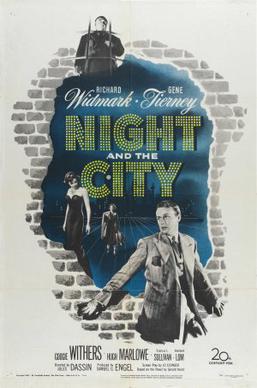
Jules Dassin's Night and the City (1950) is another delightfully bleak and dark urban film about the self-degradation of the social climber. Harry Fabian (Richard Widmark), an American club tout and conman in London, just wants "to be somebody." He's a hustler who goes from one get-rich-quick scheme after another, wearing suits one size too big (literally) and trying (usually unsuccessfully) to swagger his way though trouble. He's "an artist without an art," a phony out to make a name for himself by taking advantage of the real artists, practitioners, craftsmen, and tradesmen (honest or otherwise) with whom he is surrounded. For some reason, Mary, a nightclub singer played by the lovely Gene Tierney, is in love with him. His schemes to set himself up as a wrestling promoter blow up in his face, bringing ruin on pretty much every person he knows, and drawing him into the utmost nadir of moral abjection: betraying Mary. The last act is a frenetic all-night chase through a lurid urban underworld: he's the rabbit, and the greyhounds are in pursuit. Even his last-ditch effort to redeem himself in death fails miserably, as he's strangled by the Strangler and tossed like refuse into the Thames. Just my kind of film! The parallels with Nightcrawler are numerous, but the principal difference once again is that in Night and the City we have a thrilling descent into depravity – a narrative arc – rather than the static depiction given us by Nightcrawler.

However transgressive Hollywood types nowadays like to paint themselves, they're really too squeamish to depict true depravity. They can't have an unsympathetic protagonist without either making him out to be Robin Hood (and, thus, not unsympathetic) or else turning him into a farcical cipher. What makes Travis Bickle (Taxi Driver) so engrossing a subject is that you see his good points, and see also how isolation and alienation drive him into psychosis. He's a man who just doesn't know how to act, how to relate. You're also kept in suspense as to what his final actions will be, and the fact that he ends up a media hero instead of an assassin owes to pure chance. Louis Bloom, by contrast, has the flatness of allegory, much like Nicole Kidman's character in To Die For (1995), who's also driven by media aspirations. The comparison goes even further, for Lou subverts every person around him just as surely as Kidman's femme fatale. But To Die For is a black comedy, a farce, while Nightcrawler seems to be aiming at something else.

Sweet Smell of Success and Night and the City have protagonists who get what's coming to them. That's partly production codes, I know. But still, a film about human depravity is essentially moralistic (or else boring), and the viewer is left a bit deflated if the worm escapes without being crushed. Really it's not so much a moral requirement as a requirement of the story's logic. Even Nicole Kidman's character ends up under ice, with someone skating on her grave.

Hollywood has largely lost its ability to depict virtue, heroism, goodness. In my opinion this has more to do with unintelligent, uninspired writing and muddled characterization than lack of moral education. Unfortunately for me, it seems to have lost its ability to depict abject depravity as well.

Friday, November 7, 2014

Works & Days

In the midst of various mundane tasks, such as working toward tenure and preparing for a coming baby, I've had little opportunity to post lately, but, naturally, I've continued to write and to paint. If I didn't do these things I would swiftly find myself in the Slough of Despond. In the past I've tended to be a single-focus kind of person, and this lifestyle of getting up early, painting and/or writing, going to work (until nine p.m. a couple days out of the week), then coming home, spending time with the fam if possible, and staying up late to paint and/or write again, does not come natural to me. Somehow, though, I feel that if I were under less pressure and had more free time, I would get less done, not more.

In the midst of all of this I have found some time to read. I recently finished Gene Wolfe's Book of the Long Sun, and, surprisingly, was somewhat disappointed by it. I've read his Book of the New Sun avidly several times, and have written about it once or twice, but somehow Long Sun never really clicked with me.

For one thing, the plot moved forward at a glacial pace, reminding me of those anxiety dreams where you're about some task but nothing seems to get anywhere, and strange, irrelevant events happen for no reason at all, leading you further and further from your goal. It's written in an elliptical style – and this style is one of the things I love about Gene Wolfe – but I didn't feel like the parts really coalesced. The fourth and final volume just kind of falls apart, with long, long scenes where people ramble and ruminate and discuss and seem to forget what they were talking about, separated by scenes of action that are hinted at but not shown. The gaps get longer and longer, as though Mr. Wolfe were under contract to write four volumes but found the story stretching beyond these limits, as can easily happen.

Another thing that made it a difficult read was the constantly shifting viewpoint. Half the third volume is spent shifting to and from a party of people wandering around in dark tunnels without much happening in each scene. The book has a tremendous number of characters (there's a catalog of proper names) and I had a hard time keeping track of who was who, partly because I went a number of months between volumes two and three. The whole thing has a rather Dickensian feel, as opposed to the Melvillesque feel of New Sun. It reminded me a bit of David Copperfield or Bleak House or something like that.

The world of the Whorl is certainly an intriguing one to explore. That's what really sustained me through to the end, I think. It's a generation ship, but it's unclear how much the people inside it, who live in a Balkanized assortment of city-states, really understand or guess. The slow revelation of the Whorl's true nature is what makes the book an interesting read, but it closes without a clear resolution or elucidation, not even elliptical. New Sun closes with all lines converging upon an as-yet unrealized point; Long Sun just seems to end with a big splat. But then again, possibly I just need to read it again. It's quite possible that I'm simply missing the point.

The protagonist, Patera Silk, begins as a priest in the official pagan religion, dutifully obedient to the pantheon of AI gods that preside over the Whorl, but is enlightened and increasingly drawn to the Outsider, whose identity I'll let you guess. The details of life in his "manteion" are drawn from the life of the Catholic parish priest. Aside from the whole blood-sacrifice thing, he could be my own parish priest, who inhabits a tiny set of rooms at the back of the parish office with a temporary parochial vicar, and works with three sisters (our sibyls) who live in a house a block away and run a center that provides tutoring to at-risk students. Anyway, Silk is an interesting, charismatic character, who falls in love with and marries a shallow, unfaithful, somewhat cruel narcissist. Strange.

Mr. Wolfe's next series, The Book of the Short Sun, apparently continues the narrative to some extent, but sounds like it has a style more closely approaching that of New Sun, so I suspect I'll like it more. I've tried to find it in used bookstores, to no avail.

On the reading-books-out-loud front, I'm currently working through George MacDonald's The Princess and the Goblin with my kids. I always use my four-year-old daughter to gauge our books, because if she's interested then she'll soak the story up like a sponge and be able to repeat every minor detail weeks or months afterward, but if she finds it boring (which is to say, incomprehensible), then she just squirms around and makes trouble and can't recall anything afterward. Well, Princess is definitely a hit. My son is also into it. The "scary" chapters simply terrify them (naturally, I ham it up a bit), and the other night I had to spend time comforting my son as I tucked him in, because our chapter had ended with the hero, Curdie the miner boy, locked in a room with an arrow wound and a high fever. So you see, it's very real to them.

It has me thinking. I've mentioned that we read The Lion, the Witch, and the Wardrobe over the summer, and both my kids loved it. My daughter remembers all these crazy little details that we haven't talked about since. And she was the White Witch for Halloween. (Obviously she wasn't going to be someone boring like Lucy or Susan.) My son was Curdie, pick-ax and all. They chose their costumes for themselves, so clearly these books in particular have made an impression.

But Prince Caspian and Voyage of the Dawn Treader? Meh. I've made it no secret that I've never cared for Prince Caspian, but Voyage was definitely one of my favorite books when growing up. The reading level is higher than Wardrobe, one might argue, but I personally don't see a great difference in difficulty. And look at Princess, which is a Victorian novel and quite wordy. (Though I cut out the annoying meta passages that address the reader, of which there are few, thankfully.) So, why exactly are Wardrobe and Princess hits, while Caspian and Voyage are not?

I'll have to ponder that one. But this I can say. My kids love a straightforward, linear story that states the facts and events simply and plainly, without cute self-referential fripperies, and they love dialogue in which people mean what they say and say what they mean, and they love curious little details and descriptions that combine the familiar with the strange, like a fire of glowing roses. Oh, and they hate being patronized.

On a wholly unrelated point, my blog is about to reach its twenty thousandth visitor. To all you loyal readers, occasional visitors, random strangers, roving bots, Ukrainian referrer spam, and the rest, my humble thanks is owed.