Saturday, August 13, 2016

Keftu (Still) Indomitable!

Okay, ladies and gentlemen. The King of Nightspore's Crown is back and better than ever. In honor of the awesome new series name, let's peruse a few passages from...the King James Bible!
And Cain went out from the presence of the Lord, and dwelt in the land of Nod, on the east of Eden. And Cain knew his wife; and she conceived, and bare Enoch: and he builded a city, and called the name of the city, after the name of his son, Enoch. And unto Enoch was born Irad: and Irad begat Mehujael: and Mehujael begat Methusael: and Methusael begat Lamech. And Lamech took unto him two wives: the name of the one was Adah, and the name of the other Zillah. And Adah bare Jabal: he was the father of such as dwell in tents, and of such as have cattle. And his brother's name was Jubal: he was the father of all such as handle the harp and organ.
When I was about nine, I happened to see a hardcover Bible for sale in the mall. (This was back when you could buy books in malls.) I didn't have access to a Bible at the time, and this one caught my eye for some reason. I begged my mom to buy it for me. She did so, despite an initial reluctance out of fear that I would trash it or something. (I still have it, and it's still in perfect condition, so there.) (My parents were always suckers for buying me books, but they eventually discovered that I would buy them with my own allowance if necessary, so that source dried up.)

It was the King James Version. I set to work reading it at once. And man oh man, is there some weird shit in the Bible. I use the colorful metaphor advisedly, because scriptures are chock full of earthy images and bizarre carnal encounters, though the prudery of the translation hid certain, ah, matters, from my impressionable mind. I do remember asking my mother what "begat" and "slayeth" meant.
And it came to pass, when men began to multiply on the face of the earth, and daughters were born unto them, that the sons of God saw the daughters of men that they were fair; and they took them wives of all which they chose. There were nephilim in the earth in those days; and also after that, when the sons of God came in unto the daughters of men, and they bare children to them, the same became mighty men which were of old, men of renown.
I read Madeleine L'Engle's Many Waters at around the same time, and even dressed up as Japheth the son of Noah for Halloween. Yes, I was a weird kid. But ever since, I've been fascinated with the first eleven chapters of Genesis. My Ant–, er, Enoch stories reflect that. I don't know what it is about Norse / Teutonic / Medieval settings and fantasy – Tolkien is to blame, I guess – but me? I'm all about the Greek and the Semitic (cf. here and here). I'm especially interested in the ways in which the religions of the surrounding cultures bled into the Bronze Age traditions that went into what we call the Bible.
And the whole earth was of one language, and of one speech. And it came to pass, as they journeyed from the east, that they found a plain in the land of Shinar; and they dwelt there. And they said one to another, Go to, let us make brick, and burn them thoroughly. And they had brick for stone, and slime had they for mortar. And they said, Go to, let us build us a city and a tower, whose top may reach unto heaven; and let us make us a name, lest we be scattered abroad upon the face of the whole earth.
Anyways, these days I'm not reading my Bible so much as J. B. Bury's A History of Greece (1900). I've also been working on Lord Foul's Bane, but I have to say, it's been kind of a slog. And I read Bleak House this year, people. I can't fault the author, really. Epic fantasy has just gotten kind of boring to me. Even edgy epic fantasy.

Wait, don't I write epic fantasy? I don't know. To me it's different somehow. More along the lines of The Book of the New Sun than The Lord of the Rings. Anyway, I used to eat up epic fantasy, but these days it's tough going. Maybe reading Cars and Trucks and Things That Go too many times has shortened my attention span.

Friday, August 12, 2016

On Imaginary Real Estate

I have good news, and I have bad news. What, you want the bad news first? Here it is.

I have been informed that the term "Antellus," my name for the counter-earth at the cosmic antipodes, is in fact a registered trademark, which I stupidly used for the name of my novel series without doing a thorough search, despite my usual care about such things. It so happens that Antellus is already the name of someone else's planet, and has been since 1988, when I was in the third grade, not that it matters what grade I was in. I was granted permission to leave it on my already-published works, and I'm sincerely grateful for that, but it seemed best to go ahead and expunge it, because (a) the series is not complete, and (b) I get all nervous when people use words like "licensing fee" and "litigation."

So I have changed the series name to Enoch, after the principal setting of the stories. The name of the planet continues to be Antellus, because my muse wills it so, but I must please ask everyone to refrain from referring to it as such in the future. You can call it the counter-earth. You can call it the antichthon, which is the ancient Greek term for that hypothetical planet. You just can't call it Antellus.

Incidentally, no one within my novels calls their world Antellus, because to them it's just the earth, of course. The term actually only appears in the metadata for my two novels and in the front and back matter of one, and wasn't associated with the ISBN of either, so the issue is fixable. And I'm pretty sure that "Enoch" won't give me any problems, because it's the name of a city in the Bible, after all. You can't sue people for using names from the Bible. Right?

This change has three annoying side-effects, however. One is that The King of Nightspore's Crown will be unavailable for a day or two while the corrected files get approved. The second is that the links are all broken now. I've tried to correct everything on my sites, but there might be a bad link or two out there. The third annoying thing is that the kind patrons who purchased copies of my novel before the change now have an out-of-date series reference on the front cover. However, I would encourage them to think of their copies as collectors' items, and imagine the millions they'll bring in when their heirs auction them off in remote posterity.

In all seriousness, I'm more than a little frustrated by this, because it was a stupid, easily avoidable mistake, because my novel-writing endeavors are like a tiny flickering flame that the merest breath of air threatens to extinguish, and because, despite my limited powers, it deeply grieves me to be paid by willing patrons for anything less than the best I can deliver. So, sorry.

Now on to the good news. Drat, I've forgotten what it was. Well, in lieu of that, I hope you'll go check out the excellent greydogtales.com, where they like the kind of stuff I like, and where they gave me a nice shout-out the other day.

Thursday, August 4, 2016

"Salt and Sorcery" at BCS

It never rains but it pours, as we say in my hometown.* Three days after the hotly-anticipated release of my novel, The King of Nightspore's Crown, my latest short story, "Salt and Sorcery," is out at Beneath Ceaseless Skies. Go check it out!

The story is inspired by a few of my favorite stories by the likes of Catherine Moore, Fritz Leiber, and Michael Moorcock; Herman Melville's meditations on whiteness; the 2015 Yuggoth Pluto flyby; and, of course, salt. But that's not all! BCS Issue #205 also features the beautifully written "A Deeper Green" by newcomer Samantha Murray, and Turtle Caravan, a weird, lovely painting by Marek Hlavaty.

One of the things that's always drawn me to sword-and-sorcery is its proximity to science fiction on one side and to weird / cosmic horror on the other. Sometimes I think it's closer to either of these than to epic fantasy, which frankly tends to bore me these days. I remember reading once in some literary essay the suggestion that sword-and-sorcery stands close to sci-fi because its worldview is fundamentally technological (sword) and scientific (sorcery). And as for cosmic horror, we can take Conan's word for it:
"A devil from the Outer Dark," he grunted. "Oh, they're nothing uncommon. They lurk as thick as fleas outside the belt of light which surrounds this world. [...] Some find their way to earth, but when they do, they have to take on earthly form and flesh of some sort. A man like myself, with a sword, is a match for any amount of fangs and talons, infernal or terrestrial." ["The Vale of Lost Women"]
There you have it. The steppes of the Hyborian world border on outer space.

My story is so titled because it takes place in a salt pan. I read a bit about such formations for the writing of it. That's how my stories often originate: I get interested in some scientific topic, like the fruiting bodies of funguses or the mating habits of horseshoe crabs, and begin romancing about it.

So go check out "Salt and Sorcery" at Beneath Ceaseless Skies! And if you like that, my friend, check thou out my novels, Dragonfly and The King of Nightspore's Crown.

* Actually, we never say that in my hometown.

Monday, August 1, 2016

Keftu Indomitable: Nightspore Is Here!

It has been one year since Keftu, the last phylarch of Arras, established a wandering society of misfits in the underworld of Enoch, the rust-stained city of stone, mankind's omega. The end of all change is at hand, hastened by the machinations of the veiled warlock Zilla.

What can one outcast warrior do to halt the slow slide into tepid chaos? Keftu is about to find out. His quest will take him from the crumbling tenements of Enoch to the black jungles of Ir. He will form alliances the like of which he would never have dreamed.

In the end, he may lose his soul to gain...

THE KING OF NIGHTSPORE'S CROWN


The Second Volume in the Enoch Series

The King of Nightspore's Crown is the second in a series of sword-and-planet tales set in the counter-earth, a world of prehistoric beasts and ocean-girding cities, ancient ruins and space elevators, primordial daemons and antediluvian races.

Inspired by the first master fantasists – Edgar Rice Burroughs, Lord Dunsany, E. R. Eddison, H. Rider Haggard, William Hope Hodgson – and pulp writers like Robert E. Howard and Clark Ashton Smith, the Antellus series combines a contemplative outlook with a drive to action, a sense of mystery with a dash of violence.

A Visceral Epic Fantasy. A Dark Romance.

A throw-stick flashed past my eyes. The lantern exploded in a shower of glittering shards. Cyrus took off at a run. I followed close behind. Shrill voices hooted and screamed all around us. I slipped in the mud and came down hard on the flagstones. Cyrus, wholly intent on self-preservation, vanished into the murk. By the time I regained my feet, he was out of earshot.

I hesitated, listening. All was quiet save the steady drip of the trees. The chase had passed me by, leaving me alone in the darkness. Though certain that the creatures sought me and me alone as their prize, I feared what they might do if they caught up with Cyrus or gained the
Concubine. I continued forward cautiously, my face beaded with raindrops and sweat.

Without warning, the ground dropped away before me. I tumbled into a hollow. Swarms of huge black dobsonflies swirled up around me. Too late, I realized that I had taken a spurious side-path. I lay sprawled across the roots of a rotting scale-tree stump, its pithy, crannied mass overgrown with toadstools and swathed in spider silk.

I felt a rush of legs and a quick, pinching jab in the heel of my hand. Groaning with horror, I jerked back and scrambled away

Drums dinned in my ears, beginning lowly, mounting ever louder. My heart galloped in my chest. Curtains of coruscating colors descended over the dark forest, washing the scale-tree stems in waves. The agony of my soul found vent in one loud, long, and final scream of despair


Buy it at Amazon


Buy it at Amazon

The Words of Metal

I recently came across this interesting study at Degenerate State, a blog run by "an ex-physicist working as a data scientist".

The author reports on an informal analysis of word use in heavy metal lyrics as opposed to the "standard" American English represented by the Brown corpus, a collection of documents compiled by linguists in 1961. He defines a measure for the "metalness" of a word as the logarithm of the ratio of the frequencies of the word in the respective corpora. Basically, the more times a word appears in the metal corpus, and fewer times it appears in the Brown corpus, the greater its metalness will be. Each word has to appear at least five times in the respective corpora in order to be included in the study.

The most metal word is, apparently, burn, which has a metalness of 3.81; the least metal word is particularly, which has a metalness of -6.47. The top twenty most metal words are: burn, cries, veins, eternity, breathe, beast, gonna, demons, ashes, soul, sorrow, sword, goodbye, dreams, gods, pray, reign, tear, flames, and scream. The top twenty least metal words are: particularly, indicated, secretary, committee... Ugh, let's just stop there. This news story on the analysis puts it this way:
What you can infer from this is that the metal English is spoken from a timeless, elemental, and darkly ethereal space, while standard English is unremarkably deskbound. Perhaps this is why we hunger for metal in the first place.
Now, look at some of those metal words. Burn. Veins. Eternity. Beast. Demons. Ashes. Sword. Gods. Flames. Reads like a good old Robert E. Howard story. Which goes to show you what we already knew: metal loves sword-and-sorcery, weird horror, and even epic fantasy.

I'm not exactly what you'd call a metalhead. I'm not regular about listening to music of any sort, and rarely leave the mainstream. But I can say that I'd rather listen to certain brands of metal (the red part on the right of this cluster dendrogram, to be specific) than pretty much anything else, with Metallica's "Wherever I May Roam" at the dead center.

What I most like about Metallica is the way it sounds (duh), but I'm also drawn by the lyrics, which have a kind of dark, quasi-biblical, historical-mythological resonance, with occasional touches of H. P. Lovecraft and Stephen King. Their best songs inhabit this dark desert landscape in my mind, imbued with a certain atmosphere that I can't quite describe but have tried introduce here and there in my writing.

Since I'm about to release my novel The King of Nightspore's Crown, it occurred to me to see how metal it is. Turns out it's pretty metal. In my highly unscientific count, I find that burn (or close variants, which, I know, is not quite fair) appears 28 times; cries (and variants), 98; beast, 67; demon (or daemon, rather), 22; sword, 90; dream, 51; scream, 25, etc. Each of the top twenty words appears at least several times, with the exception of gonna, which I don't use when translating from the nephelic tongue, for a total of 430 occurrences. By contrast, only five of the bottom twenty words appear, with 13 occurrences in all, and several of these in tongue-in-cheek dialogue.

This graph plots the metalness of all 10,000 words used in the study against their word length, with the horizontal axis representing metalness and the vertical representing length. I note that my stories (which tend to feature lone warriors pitted against primeval beasts, ancient aliens, and elder evil) are situated in the bottom right-hand corner, while my work e-mails (which deal with academic advising, faculty governance, and program assessment) inhabit the upper left-hand corner. And, certainly, my writing does take place in a "timeless, elemental, and darkly ethereal space," while my work life, it must be confessed, is "unremarkably deskbound".

Talk about your double lives. Sure, some might deride S&S (and metal) as puerile escapism. But who's to say which of these two lives is the real one, eh? Maybe I just keep my staid day job so that I can escape from the "timeless, elemental, and darkly ethereal space" of my burning dreams of gods and demons.

Friday, July 29, 2016

Oodles of Doodles

I have an art show coming up in September and am working to make a few quick pieces to fill out the exhibit. I've gotten two done in one week, which must be some kind of record for me. (Lately, anyway; in my tumultuous youth I used to dash paintings off in an hour or so.)

My art shows generally attract a few of my math students, so I've been under some pains to make mathematical art, dangerous though this is, beauty and truth being distinct transcendentals, &c., &c. A while back a student sent me a YouTube video about topological doodles. Being both a doodler and a student of topology, I added one technique contained therein to my Long Meeting Repertoire. Begin with a squiggle, turn each crossing into a twist, and, Voila!, you have a surface with boundary. In the fullness of time, this led to the advent of...the Chicken Man:

Chicken Man, 5" x 7", watercolor and ink on hot-pressed paper.
Born from a drawing completed on my mother-in-law's kitchen table. Is he a chicken? A man? An indeterminate embryo? A once-punctured non-orientable surface of genus 10?

He is, at any rate, inspired by Paul Klee and the ideas expressed in his highly mathematical Pedagogical Sketchbook. I regard Klee as one of the great artistic geniuses of all time; that I might link the present discussion back to the main topic of my blog, perhaps it would be apposite to recall that time I received the following disapprobation from the famous sci-fi author and political commentator John C. Wright for my opinion:
You sound very reasonable, but then I looked up the works of Paul Klee, and they were so abominably ugly and deranged that I admit the gulf between us can never be crossed. Artistically, it is the same as trying to reason out the sound of one hand clapping: you are looking at something meant to hinder the ability to admire art, to blind the eye and benumb the brain. It is garbage, pure and simple, and even simple drawings by comic book artists or commercial artists doing magazine covers show far more skill, sanity, proportion, color, composition, and execution. [...]
Why do you vainly tell me to ignore the evidence of my eyes, which I trust, and believe the conclusions of your judgment, which even the limited experience of this exchange proves is execrable.
Had you pointed me to some painting that was merely odd or incomprehensible to me, my reaction would be different. I could continue to give you the benefit of the doubt. Instead you have pointed me to the most absurd, ghastly, and disproportion bits of ugly lunacy imaginable, pieces that make me physically sick to look at, and call them good work. [...]
I am an artist. I know what art is because I can do it. I also know when I am looking at something far better than I do because I lack the skill, and I can see the garbage you like and I know I could draw as well with my left foot after my foot was run over by a tractor and I was pumped so full of painkillers that the lower half of my brain was sloshing.
It is also obvious that no further comment is needed. Why do you think words can make me see beauty where there is nothing but filth?
I like to look that over every so often, as a message addressed to me personally by a famous person, and a perfect specimen of some art form of which the name escapes me. Good thing I'm so indefatigably ebullient, or it might have hurt my feelings. But, as my father-in-law says, opinions are like, well, you know. Everybody's got one.

My Long Meeting Doodle Repertoire is quite extensive, and consists solely of mathematical explorations. That way, when my colleagues look over and see me doodling during an important meeting, they'll just think I'm a brilliant mathematician working out some new theory. Actually, I have to draw so I can listen attentively and recall what I hear, a fact that my fifth grade math teacher didn't fully appreciate. These days my sketches consist mainly of Platonic solids and the like, as I've been developing a graduate course on regular polytopes. Here's a few sticky notes:


My aunt bought me these "Dr." sticky notes for graduation, incidentally; I don't buy them for myself.


Why, you ask, am I showing you doodled-upon sticky notes from my office? Perhaps, my friend, you are looking for one of those "sensible" blogs.


Anyway, inspired by such, I spent the first part of this week super-doodling a sketch of the rhombic triacontahedron:

Triacontahedron, 5" x 7", watercolor and ink on hot-pressed paper.
The triacontahedron is a zonohedron, which, well, I won't bore you with the details. It's formed from thirty golden rhombi and is the basis of that cool lampshade you see in coffee shops sometimes. The coloration is determined by five intersecting cubes contained in the solid. The layout shamelessly mimics Leonardo da Vinci's polyhedron illustrations for Luca Pacioli's Da Divina Proportione. Pacioli is one of my mathematical ancestors – I am "descended" from him, advisor to student, down through the centuries, along with about two hundred thousand other mathematicians – so this is something of an homage to him, as well as to H. S. M. Coxeter, from whose book Regular Polytopes I first learned of zonohedra.

My multicolored sketches were the wonder of my graduate algebraic topology class, so perhaps I'll continue to produce a few more watercolors along the same lines, for old times' sake.

Monday, July 25, 2016

On Reptoids from Alpha Draconis

In keeping with my time-honored tradition of writing a blog post whenever I encounter a network of ideas connected in any way, shape, or form with speculative fiction, but also in keeping with my equally time-honored tradition of not commenting on current affairs, I hereby commence a post about

THE REPTOIDS AMONG US


without explaining what, precisely, has motivated me to pursue this particular avenue of discovery.

I will tell you what set me upon the path, however.

One day at the office, whilst devouring the salami sandwich, granola bar, and green apple that constitute my lunch, I happened to watch a Mental Floss YouTube video about weird conspiracy theories. Among the factoids presented therein is the assertion that 12 million Americans believe that shape-shifting lizard people secretly hold the reins of world government. This is according to Public Policy Polling.

Now, if a survey company called me to ask whether I believe shape-shifting lizard people are in control of the government, I would respond with an enthusiastic YES, YES, I DO STRONGLY BELIEVE THAT. And surely I'm not alone in my love of trolling the strangers who call my house to ask stupid questions. So, perhaps the number is a little misleading. Still, there must be some truly devout lizard-people believers, right? A little googling (not for the faint of heart in this case) would seem to confirm that, yes, there are some believers out there.

The leading proponent is one David Icke, British ex-footballer and conspiracy theorist. He asserts that reptilians (or reptoids, as I prefer to call them) from Alpha Draconis have been selectively breeding the human race since its inception, creating the Babylonian Brotherhood, a hybrid race of Illuminati who now control the world. He suggests that the aliens first came to earth in search of monatomic gold, which enhances the capacity of their nervous systems ten thousandfold.

Hm. A race of superintelligent extraterrestrials who inhabited earth long before man's coming and now treat the human race as a pet project and secretly orchestrate events from behind the scenes? Remind you of anything? Here we have the connection with my blog's purported focus. It has been suggested that the Reptoid Hypothesis owes a large debt to the writings of H. P. Lovecraft, Robert E. Howard, and Clark Ashton Smith; they, in their turn, took much of their material from nineteenth-century theosophical writings on Atlantis and Lemuria.

The idea that disguised aliens secretly control everything of course puts me in mind of John Carpenter's They Live (1988). I love eighties sci-fi actioners, and They Live is one of the most enjoyable. The screenplay was written by Carpenter under the pseudonym Frank Armitage, an allusion to Dr. Henry Armitage of "The Dunwich Horror." Like most Carpenter assays, They Live has a B-movie feel, but it's also hilarious, sharply satirical, and eerily contemporary. It takes place in a not-so-distant future when the middle class is being squeezed out of existence, the underemployed live in shantytowns on vacant lots, racial discord and police brutality are on the rise, and a media-induced malaise seems to have overcome the human race. One day, a down-and-outer (played by pro wrestler Rowdy Roddy Piper) discovers a pair of cheap-looking sunglasses that let him see a whole new reality. Turns out the rich and powerful are all aliens or people who have sold out to the aliens. This leads to one of the greatest and cheesiest one-liners in action sci-fi history: "I have come here to chew bubblegum and kick ass...and I'm all out of bubblegum."

Now, it's one of my little pleasures in life to post extremely weird links and opaque commentary on Facebook to see if my aunts, cousins, in-laws, coworkers, and high school friends will think I've gone off my rocker. (I used to go in for politics, but eventually you learn what everybody is going to say, so why bother?) So I recently posted the above picture of George W. Bush, Tony Blair, and Queen Elizabeth II as reptoids. Imagine my surprise when, immediately afterward, the "people also posted" thing popped up with three stories about...Donald Trump.

Let me pause here to assure whomever might be reading this that I, for one, welcome our new reptilian overlords.

Now, what's interesting to me about They Live (which is awesome and you should watch soon if you haven't yet) is that it appeared shortly before David Icke began his career as New Age prophet. Was it an influence on his ideas? Icke is also supposed to have been influenced by 1940s non-fiction writer Mark Doreal, who took some of his ideas from Robert E. Howard. So apparently there's been a strange cross-fertilization between weird horror and cranky fringe conspiracy theories. Each influences the other; both grow together.

For all that, though, there's a distinct psychological line between the weird horror fan and the wild-eyed conspiracy theorist. For the former, there's a big element of play, of fun. The latter is in deadly earnest. I would even assert that the fan is the unlikeliest person to go down that rabbit hole. They're inoculated by their sense of humor.

But what does make someone start thinking that the celebrities and politicians they see on TV and in the news are all reptoids in disguise? That, I'm afraid, is a question above my pay grade, so I'll just conclude with a word from our sponsor:


ADDENDUM: D'oh! While writing this, I forgot to mention another ridiculous eighties movie making use of the same idea: the inimitable The Adventures of Buckaroo Banzai Across the 8th Dimension (1984), which pits humans and Black Lectroids against the evil Red Lectroids of Planet 10. Less pointed, much weirder, with an awesome cast. I'll have to start reviewing fantasy and sci-fi schlock from the eighties sometime soon.

Wednesday, July 20, 2016

Comic Book Adventures

So, I've been reading me some Batman comics. Surprised? I don't put them down in my "Books I've Read This Year" list because I have my dignity, you know? Anyway, it's been a very, very long time since I read an actual honest-to-goodness comic book. But I like Batman so much that it seemed high time to delve deeply into the actual, um, literature. Graphic literature.

So far I've focused on the iconic entries of the eighties and nineties. I think my favorite is Year One (1987) by Frank Miller, David Mazzucchelli, et al. I love the way it drops the Batman story into the gritty urban reality of a Scorsese film. It was obviously inspired by Taxi Driver at several points. It also reminds me of Serpico. The art is awesome: clear, dynamic, and distinctly noirish, with dark, muted colors and free-flowing hand lettering. I much prefer it to the polished, digitized look of more recent comics. And the part where Batman battles the police in a bombed building and calls bats to make his getaway is super cool.

I also think Frank Miller's The Dark Knight Returns (1986) is really great. It cracks me up, actually. With its over-the-top TV segments and epic brutality, it reminds me of Paul Verhoven's satirical sci-fi actioners, especially RoboCop (of which I'm rather fond). Its Batman is like a humongous, creeptastic Dirty Harry; the girl Robin looks about the size of his thigh. I know it's a polarizing comic. Personally I don't care much for the art. But as for the general plot, I think that Batman and Superman are big enough to take a little satire. Some people need to take a chill pill. It's got a storyline of almost mythic proportions, with tank battles, atom bomb detonations, apocalyptic showdowns, and Batman retreating to the underground with a creepy race of mutant followers at the end.

Another fave is The Long Halloween (1997) by Jeph Loeb, Tim Sale, et al. It's got more of a slow-burning mystery plot, using the origin story of Two-Face to describe the descent of Gotham from merely crime-ridden to downright maniacal. The story, though suffering a bit from serialization (and the apparent need to work just about every single villain into the plot), is supremely engrossing. And the expressionistic art, with its big pools of black, snaky pen lines, and dynamic linear perspective, is simply beautiful. Every page is a joy to behold.

One thing that gets on my nerves a little bit is its constant use of one-liners from the Godfather movies. Do it once or twice, and it's a sly allusion. More than that, and it gets cute. All the time, and I start thinking that maybe the writer hasn't done all that much homework on the Mob. Halloween also takes a lot from The Silence of the Lambs. In general, I've noticed that comics are much more open to lifting material from mainstream sources than, say, books or movies. Not that that's a bad thing, as William Blake says in my sidebar. But it has to be done artfully.

Still, The Long Halloween is a monumental piece of work, and the chief inspiration for what's probably the greatest superhero movie ever made: Christopher Nolan's The Dark Knight.

A more recent entry that I've enjoyed, though not nearly so much, is Hush (2003) by Jeph Loeb, Jim Lee, et al. The art is beautiful, though so polished that I find it a bit boring at times. It does have lots of heaving bosoms, rippling muscles, and gritted teeth, if you like that sort of thing. The story is OK, too; it just suffers from expanded universe syndrome.

You see, unlike practically every other fanboy in the galaxy right now, I prefer my superhero stories to be self-contained. I avoid Marvel movies for that reason. They're like sitcom crossover episodes, or The Jetsons Meet the Flintstones. Ugh. To me it makes the superhero concept too familiar. I like Batman to exist in his own dark little universe, where you never quite lose the surprise and wonder that there is such a person as Batman. Bring Superman into it, and superhero-dom starts to feel like an exclusive yet chummy clubhouse.

But I do very much like Superman on his own turf. I'll probably delve into some of his comics before long, though I'm more familiar with them from of old. For me, Batman represents the mythologizing of hardboiled fiction and film noir, the melding of gothic horror with urban drama. Superman, on the other hand, seems to more akin to John Carter, Tarzan, and the supermen of early sci-fi. Both are inspirations in my own writing.

Oh, last but not least, I also read The Killing Joke (1988) by Alan Moore, Brian Bolland, & Co. A little sadistic for me, but I like the way it explores the weird love-hate relationship between Batman and the Joker. Its "origin story" for the Joker, presented through flashbacks in a delightfully noirish, nightmarish style, is distinctly underwhelming, but then again the Joker himself undercuts its reliability at the end of the comic. And the ending about as artful as they come. I mention this one mainly because the animated film, starring the voice talent of Mark Hamill, is soon to be released. I watched Batman: The Animated Series every day after school when I was in junior high, and, to me, Mark Hamill is the Joker. (Never knew it was him at the time, though.)

So, what's next? Do I venture into the New 52? I don't know if I'm ready for that yet, especially with all the dithering about DC has been doing lately. There are still a few titles from the eighties and nineties that I have my eye on.

Tuesday, July 12, 2016

D.O.A.
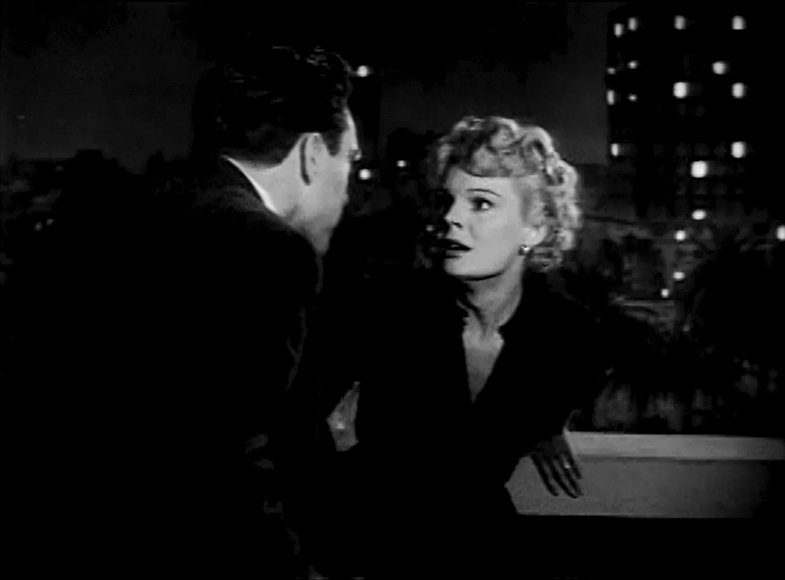
I can breathe and I can move, but I'm not alive because I took that poison, and nothing can save me.
I watch a lot of film noir. To some people, the term means trenchcoated detectives, laconic voiceovers, femmes fatales, and cigarette smoke. I think of it more as a directorial style, a style that uses harshly geometric, minimalistic (= dark) photography and unpityingly logical plots taking place beyond the boundaries of "normal" society to create an atmosphere of emotional detachment and alienation. Yes, chain-smoking dicks and dames figure largely in such films, but that's because the world they inhabit lends itself so readily to the style. Some of my favorite films noir don't involve detectives at all.

That includes D.O.A., a film that wasn't appreciated at the time of its release (1950) and isn't very well known today. It's in the public domain, and you can watch it at the Internet Archive, which no doubt has to do with its obscurity. Edmund O'Brien plays Frank Bigelow, an accountant and notary public who, months prior to the opening, notarized a seemingly innocuous transaction, a chance happening that sends him down a black rabbit-hole of madness and murder. Most films noir have a certain sense of predestination, but this one takes it a step further: it's narrated by a dead man.

Grim humor and dark irony punctuate Bigelow's nightmare urban odyssey. In confronting his nonsensical, undignified position (the human position), he seizes control of his destiny, loses all fear, and achieves a kind of justice, only to keel over in the film's final minutes. One of the last lines is the homicide captain's dispassionate "Call the morgue!"

D.O.A. has some corny elements toward the beginning, as many films noir do, but rapidly descends into darkness, madness, sweat, and grit. I appreciate it a little more every time I watch it. It also has an almost science-fictional feel, with a search for stolen iridium and a "luminous toxin" that glows in the dark. And it must have one of the best openings of any movie ever:
Bigelow: I want to report a murder.
Captain: Sit down. Where was this murder committed?
Bigelow: San Francisco, last night.
Captain: Who was murdered?
Bigelow: I was. 
Anyway, because this is my blog, and I can do whatever I like, here's some of my favorite stills:
 
The opening sequence. Bigelow marches through a dark police station.

"I want to report a murder."

Pamela Britten plays Paula, Bigelow's sweet but slightly clingy
secretary-girlfriend back home.

The madness begins: a San Francisco jive club.

"He's flipped. The music's drivin' him crazy." Meanwhile, the faceless
killer prepares the luminous toxin.

"You've got it, all right." A doctor confirms his diagnosis with a glowing
test tube. Bigelow has one day to live.

"I don't think you fully understand, Bigelow. You've been murdered."
Bigelow races down a crowded street. A neat sequence filmed without
permit, and without the bystanders' knowing what was happening.

Irony.

Now on the trail of his own killer, he journeys to Los Angeles, where he
encounters tart, unprofessional secretaries...

...and gun-toting models.

Soon he's getting shot at...

...and chasing phantom gunmen through abandoned warehouses.

Someone doesn't like him sticking his nose in.

But he's utterly fearless now. "He's not afraid," says Majak. "You can tell
from a man's eyes when he is afraid. Look at his eyes."

Chester, one of the creepiest henchmen I've seen. "That's the way I wanna
see you go, Bigelow...niiice and slooow."

But it's Chester who goes, in a drugstore shoot-out.

Beautiful on-site night photography.

The final interview with a not-so-grieving widow.

Surrounded by people but utterly alone.

Crawling on hands and knees to gain a few hours of life.

A few hours to go to the final confrontation at...

...the Bradbury Building, Los Angeles. Is this actually the exterior of the
Bradbury, though? I don't think so.

This, however, is clearly the interior. Recognize it? It's where the climax
of Blade Runner takes place. A lot of movies have been filmed there.

The faceless killer.

The final shot. "Better make it 'Dead on arrival.'"

Friday, July 8, 2016

The City in the Sea

The print edition of The King of Nightspore's Crown, the second book of my Antellus tetralogy, nears completion. I hope to have it out sometime in late July or early August. This works out perfectly, as my novelette "Salt and Sorcery" is due to appear at Beneath Ceaseless Skies in early August. Don't miss it!

But, to tide you over, here's some images. First we have the (tentative) front cover.

 
Then my personal favorite, the spine:

 
And the back cover:

 
In case you can't read it, here's the back pitch as it currently stands:
It has been one year since Keftu, the last phylarch of Arras, established an itinerant society of misfits in the bowels of Enoch, the rust-stained city of stone, mankind's omega. The end of all change is at hand, hastened by the machinations of the veiled warlock Zilla. What can one outcast warrior do to halt the slow slide into tepid chaos? Keftu is about to find out. His quest will take him from the crumbling tenements of Enoch to the black jungles of Ir. He will form alliances the like of which he would never have dreamed. In the end, he may lose his soul to gain...
THE KING OF NIGHTSPORE'S CROWN
Last but not least, here is the map, turned sideways, as you will have to turn it if you wish to consult it while reading the story:


However, I consider it sloppy writing to rely on extraneous objects like maps, and the attentive reader should be able to gather all relevant geographical details from the text. On the second or third reading, at least. Also, I'm always wanting to get into Rhûn and Harad when I read The Lord of the Rings, so it's possible that this map is not entirely adequate...

Rather than pontificate on the story's various influences and antecedents, as I am wont to do, I'll leave you with Edgar Allan Poe's "The City in the Sea," which provides a fitting epigraph.
THE CITY IN THE SEA 
Lo! Death has reared himself a throne 
In a strange city lying alone
Far down within the dim West,
Where the good and the bad and the worst and the best
Have gone to their eternal rest.
There shrines and palaces and towers
(Time-eaten towers that tremble not!)
Resemble nothing that is ours.
Around, by lifting winds forgot,
Resignedly beneath the sky
The melancholy waters lie. 
No rays from the holy heaven come down
On the long night-time of that town;
But light from out the lurid sea
Streams up the turrets silently—
Gleams up the pinnacles far and free—
Up domes—up spires—up kingly halls—
Up fanes—up Babylon-like walls—
Up shadowy long-forgotten bowers
Of sculptured ivy and stone flowers—
Up many and many a marvellous shrine
Whose wreathéd friezes intertwine
The viol, the violet, and the vine.
Resignedly beneath the sky
The melancholy waters lie.
So blend the turrets and shadows there
That all seem pendulous in air,
While from a proud tower in the town
Death looks gigantically down. 
There open fanes and gaping graves
Yawn level with the luminous waves;
But not the riches there that lie
In each idol's diamond eye—
Not the gaily-jewelled dead
Tempt the waters from their bed;
For no ripples curl, alas!
Along that wilderness of glass—
No swellings tell that winds may be
Upon some far-off happier sea—
No heavings hint that winds have been
On seas less hideously serene. 
But lo, a stir is in the air!
The wave—there is a movement there!
As if the towers had thrust aside,
In slightly sinking, the dull tide—
As if their tops had feebly given
A void within the filmy Heaven.
The waves have now a redder glow—
The hours are breathing faint and low—
And when, amid no earthly moans,
Down, down that town shall settle hence,
Hell, rising from a thousand thrones.
Shall do it reverence.
If you haven't yet, I hope you'll consider checking out Dragonfly, the first book in the series, which is available from Amazon.